About

The Role of Emotional Intelligence in Sales Success
Most sales professionals know emotional intelligence matters. What they don’t know is that having it isn’t enough. The role of emotional intelligence sales professionals play goes deeper than reading a room or staying calm under pressure. A 2026 body of research reveals something that changes the entire conversation: your confidence in your emotional abilities matters just as much as the abilities themselves. Without that match, even the most emotionally skilled rep on your team may be leaving serious revenue on the table. Here’s what that means for you and your team.
Table of Contents
- Key Takeaways
- The role of emotional intelligence in sales, defined
- What the research actually shows
- Building EI and confidence together
- EI in sales leadership
- My honest take on all of this
- How the right tools free you to sell with empathy
- FAQ
Key Takeaways
| Point | Details |
|---|---|
| EI alone isn’t enough | Confidence in your emotional skills must match your actual ability to drive real sales results. |
| Calibration drives performance | Salespeople with matched EI and confidence outperform their peers by up to 351% over overconfident reps. |
| Stress undermines EI gains | Even moderate workplace stress can significantly erode the performance benefits of emotional calibration. |
| Leaders set the emotional tone | Sales leaders with high EI reduce turnover, improve forecast accuracy, and produce steadier team results. |
| Practice builds both skills | Somatic regulation and deliberate reflection exercises can raise EI scores by over 10% in just four weeks. |
The role of emotional intelligence in sales, defined
Before you can build something, you need to know exactly what you’re building. Emotional intelligence, often shortened to EI, is the ability to recognize, understand, and manage emotions. Both your own and those of the people you’re selling to.
But there’s a second concept that most sales training ignores entirely: emotional self-efficacy. This is your confidence in those emotional abilities. It’s the difference between knowing how to defuse a tense negotiation and actually believing you can do it when the stakes are high.
When your EI ability and your EI confidence align, researchers call this emotional calibration. Here’s why this distinction matters for every sales conversation you have:
- High EI, low confidence: You have the skills but hesitate to use them. You read the client’s frustration accurately but freeze instead of responding with empathy.
- Low EI, high confidence: You’re overconfident in abilities you don’t actually have. You think you’re building rapport while the prospect is mentally checking out.
- Calibrated high EI: Your skills and your trust in those skills move together. You notice emotional cues, you respond in real time, and clients feel genuinely understood.
- Low EI, low confidence: Performance suffers, but at least the mismatch doesn’t actively damage client relationships the way overconfidence does.
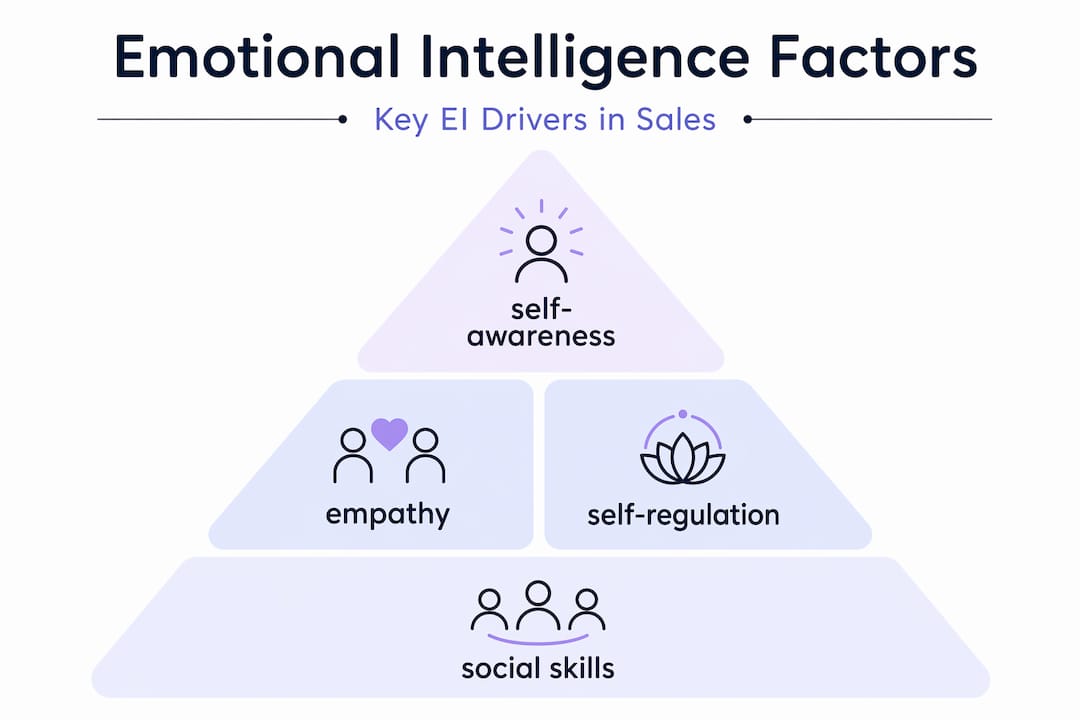
Four dimensions of EI, specifically self-awareness, self-regulation, empathy, and social skills, explain 43.6% of the variance in job performance across industries. That’s not a marginal edge. That’s a structural advantage. The goal isn’t just to develop these skills. It’s to develop them alongside the belief that you can deploy them precisely when it counts.
What the research actually shows
The numbers here are striking, and they should shift how you think about emotional intelligence training for salespeople.
Sales professionals with calibrated EI outperform underconfident peers by 37%, those with low EI and low confidence by 61%, and here’s the one that should stop you cold: they outperform overconfident reps by 351%. Not a typo. Three hundred and fifty-one percent. The worst performers in that study weren’t the ones who lacked emotional skill. They were the ones who thought they had more of it than they actually did.
The broader performance data backs this up. High EI sales professionals outperform peers by 58% in revenue and 50% in measured performance outcomes, with 25% better team morale in organizations that invest in EI development.

| EI Profile | Performance vs. Calibrated High EI |
|---|---|
| Calibrated high EI | Baseline (best outcomes) |
| Underconfident, high EI | 37% lower |
| Low EI, low confidence | 61% lower |
| Overconfident, low EI | 351% lower |
Stress is the factor most sales leaders underestimate. Elevated stress weakens the benefits of emotional calibration significantly. Even moderate pressure, a missed quarter, a contested deal, a hostile CRM review, can erode the performance gains that EI is supposed to produce. This means building EI skills in a training room isn’t enough. You need to practice them under conditions that mirror the actual pressure of the job.
“Sales leaders should focus less on lagging data and more on coaching the real people behind the numbers through emotional intelligence to drive future performance.” — Harry Spaight
There’s also a meaningful difference between experienced reps and newer ones. Tenured salespeople benefit most from refining their emotional calibration. They already have the foundational skills. What they need is to close the gap between what they can do and how much they trust themselves to do it. New hires, on the other hand, need the basics first. Throwing advanced EI coaching at someone who hasn’t built the underlying self-awareness yet creates confusion, not growth.
Building EI and confidence together
Knowing what emotional calibration is and actually developing it are two different problems. Most sales training programs build one without the other. They run empathy workshops that raise skill scores but don’t touch confidence. Or they run confidence-building sessions that inflate self-perception without growing the underlying ability. The result is a team full of people who are either hesitant or overconfident.
Here’s what actually works:
- The pause practice. The pause between stimulus and response is one of the most underrated tools in sales. Before you respond to a difficult objection or an emotionally charged client, you take a breath. Deliberately. Physically. That gap lets your prefrontal cortex catch up to your emotional brain, and it signals control to your prospect.
- Somatic regulation exercises. Somatic awareness practices increase self-awareness and self-management competencies, producing EI score improvements of over 10% in four weeks. This means body-based techniques like controlled breathing, grounding exercises, and physical stillness aren’t wellness extras. They’re performance tools.
- Resist the fix-it impulse. Many salespeople fail because their first instinct when a client raises a problem is to immediately solve it. Consultative selling requires staying in the emotion with your prospect first. Listen. Reflect. Let them feel heard before you pivot to solutions.
- Humility as a calibration tool. Let your EI ability run slightly ahead of your confidence, not the other way around. That slight gap keeps you curious, adaptive, and honest about blind spots instead of coasting on assumption.
- Journaling and after-call reviews. After high-stakes calls, take five minutes to note the emotional dynamics you observed, how you responded, and what you’d do differently. This reflection loop closes the calibration gap faster than any formal training alone.
Pro Tip: Build stress into your EI practice deliberately. Role-play emotionally charged scenarios under simulated time pressure. If your skills only hold up in calm conditions, they’re not ready for the real sales floor.
EI in sales leadership
Individual rep performance is one thing. But the role of emotional intelligence scales up when you look at sales leadership. Leaders shape the emotional environment their entire team operates in, and that environment either amplifies or undermines every EI skill those reps are trying to develop.
Sales leadership with high EI produces measurably better outcomes across the board: stronger coaching conversations, lower turnover among top performers, more accurate pipeline forecasts, and smoother collaboration across departments. The mechanism is worth understanding. When a leader responds to a missed target with genuine curiosity instead of pressure, reps give more accurate forecast data. They stop sandbagging. The emotional safety created by EI leadership produces better business intelligence, not just better morale.
Here’s a practical framework for evaluating EI leadership capability in your own organization:
- Coaching quality: Does the leader ask questions or deliver verdicts? Emotionally mature leaders explore before they prescribe.
- Conflict response: When two reps clash or a deal dies, does the leader escalate tension or absorb it? Emotional control under commercial pressure predicts whether a team sustains growth or fractures under it.
- Recognition patterns: Are wins acknowledged publicly and specifically, or only implied by the absence of criticism? Recognition behavior reveals how attuned a leader actually is to what motivates their team.
- Pipeline conversations: Does the leader read the person behind the number or just the number? Coaching the real people behind the data drives future performance in ways dashboards never will.
- Self-awareness signals: Does the leader acknowledge mistakes openly, or shift blame when pressure peaks? Self-awareness at the leadership level sets the permission structure for the entire team.
The importance of emotional intelligence for leaders extends beyond sales: 61% of employers now require leadership and social influence skills as core workforce competencies, and more than 50% require empathy and active listening. This is the market signaling that drive-only leadership has a shelf life.
Pro Tip: Run structured “emotional debrief” sessions after major deals, wins or losses alike. Ask your team what they felt, not just what happened. That one habit, done consistently, builds more EI culture than a year of training seminars.
My honest take on all of this
I’ve watched talented sales professionals fail not because they lacked skill, but because they didn’t trust themselves to use it when it mattered. The EI was there. The confidence wasn’t. And I’ve seen the opposite too, reps who radiated certainty but couldn’t read a client’s discomfort from three feet away.
What I’ve learned is that the pause is everything. Not as a technique. As a discipline. The willingness to sit in an uncomfortable moment without immediately trying to close or fix or impress is where the real trust gets built. Most salespeople have never trained that muscle at all.
Stress is the variable everyone underestimates. I’ve seen well-trained teams fall apart emotionally under a tough Q4. The skills were there in theory. The ability to access them under fire was not.
The leadership gap is real and it’s urgent. You cannot build an emotionally intelligent sales culture with a leader who mistakes pressure for motivation. The “soft” skills, and I’d argue they’re anything but soft, are the ones that take the longest to build and produce the most durable results. Start there, not after you hit your number.
— Jason
How the right tools free you to sell with empathy
Emotional intelligence only has room to work when your attention isn’t consumed by administrative noise. When your team is buried in manual data entry, chasing cold lists, or rebuilding prospect profiles from scratch, there’s no cognitive space left for the kind of attentive, responsive selling that EI requires.

That’s exactly where Plo comes in. Plo’s platform automates the routine prospecting and pipeline tasks that drain your team’s focus, so your agents spend more time in real conversations and less time in spreadsheets. The best prospecting tools in Plo’s suite are built for real estate agents, luxury brokers, and yacht brokers who want technology to carry the operational load while they bring the human connection. And when AI handles client prospecting intelligently, your reps show up to every conversation with context, not guesswork. That’s the foundation emotional intelligence needs to perform.
FAQ
What is emotional calibration in sales?
Emotional calibration is the alignment between your actual emotional intelligence ability and your confidence in those abilities. Research shows calibrated salespeople outperform overconfident peers by up to 351%.
Does emotional intelligence improve sales performance?
Yes. High EI sales professionals generate 58% more revenue and show 50% higher performance compared to lower EI peers, with compounding effects at the team level.
How does stress affect emotional intelligence in sales?
Elevated stress significantly weakens the benefits of emotional calibration. Skills that hold up in training often break down in high-pressure sales environments, which is why practicing EI under simulated pressure is critical.
What EI skills matter most for sales leaders?
Self-awareness, empathy, and emotional regulation are the core competencies. Leaders who apply these skills produce better coaching outcomes, lower turnover, and more accurate pipeline data than those who rely on drive and metrics alone.
How quickly can emotional intelligence be developed in salespeople?
Somatic regulation practices have been shown to increase EI scores by over 10% in just four weeks, with the sharpest gains in areas like consequential thinking and self-management.