

Most American real estate professionals are discovering that Artificial Intelligence is not about replacing agents but about amplifying their expertise. With over 85 percent of leading brokerages now adopting some form of AI, technology is rapidly changing daily operations. Understanding what Real Estate AI really means and clearing up common misconceptions will help American agents realize how these tools open the door to smarter, more accurate decision making.
Table of Contents
- Defining Real Estate AI And Dispelling Myths
- Major Types Of AI Tools For Agents
- How AI Integrates Into Real Estate Tasks
- Real-World Applications For Brokers And Teams
- Business Risks, Ethical Concerns, And Pitfalls
Key Takeaways
| Point | Details |
|---|---|
| AI Empowers Agents | Real Estate AI is a collaborative tool, enhancing human expertise rather than replacing it. This technology enables agents to make data-driven decisions quickly and accurately. |
| Diverse AI Tools | Modern agents have access to a variety of AI tools, enhancing lead generation, client communication, and property analysis to streamline operations. |
| Workflow Optimization | AI can automate complex tasks in real estate, such as document processing and predictive analytics, allowing agents to focus on client relationships. |
| Ethical Considerations | Professionals must address potential algorithmic bias and ensure transparency in AI systems to maintain trust and compliance in real estate operations. |
Defining Real Estate AI and Dispelling Myths
Real Estate Artificial Intelligence represents a transformative technological approach that goes far beyond simple data processing. Unlike traditional assumptions, AI in real estate is not about replacing human agents but empowering them with sophisticated analytical capabilities. Advanced property valuation techniques are now enabling agents to make more precise, data-driven decisions with unprecedented speed and accuracy.
The misconception that AI will eliminate human real estate professionals is fundamentally flawed. Modern AI systems are designed as collaborative tools that augment human expertise. For instance, self-supervised vision transformers can rapidly analyze property images and market trends, providing agents with deep insights that would take hours of manual research. These systems process complex data patterns, identifying potential investment opportunities, market shifts, and property valuation nuances that might escape human perception.
Key capabilities of Real Estate AI include advanced predictive analytics, automated lead generation, personalized client matching, and intelligent market trend analysis. Agents leveraging Real Estate AI Agent Growth strategies can significantly enhance their prospecting efficiency, reduce administrative overhead, and focus more time on building meaningful client relationships. The technology enables precise targeting, allowing professionals to identify high-potential leads with remarkable accuracy.
Pro Tip: Strategic AI Integration: Start by identifying one repetitive task in your workflow and implement an AI tool to automate it. This incremental approach helps you build confidence and demonstrate tangible productivity gains without overwhelming your existing processes.
Major Types of AI Tools for Agents
Real estate professionals now have access to a diverse array of AI-powered tools that dramatically transform client prospecting and engagement strategies. Comprehensive AI technologies have emerged to address multiple aspects of an agent’s workflow, ranging from lead generation to client communication and property analysis.
The most critical AI tools for modern real estate agents can be categorized into several key functionality groups. Predictive analytics tools help agents identify high-potential leads by analyzing market trends and client behavior patterns. Automated chatbots enable 24/7 client communication, providing instant responses and capturing potential client information. Intelligent property management systems offer advanced features like automated scheduling, document processing, and personalized client recommendations that streamline administrative tasks and enhance customer experience.
Advanced AI technologies also include image recognition tools for property analysis, virtual tour generators, and machine learning algorithms that can accurately predict property valuations. These tools not only save time but provide agents with sophisticated insights that were previously impossible to obtain quickly. By integrating Real Estate Agent Business Plan AI strategies, professionals can leverage these technologies to create more targeted, efficient marketing approaches and improve overall client engagement.
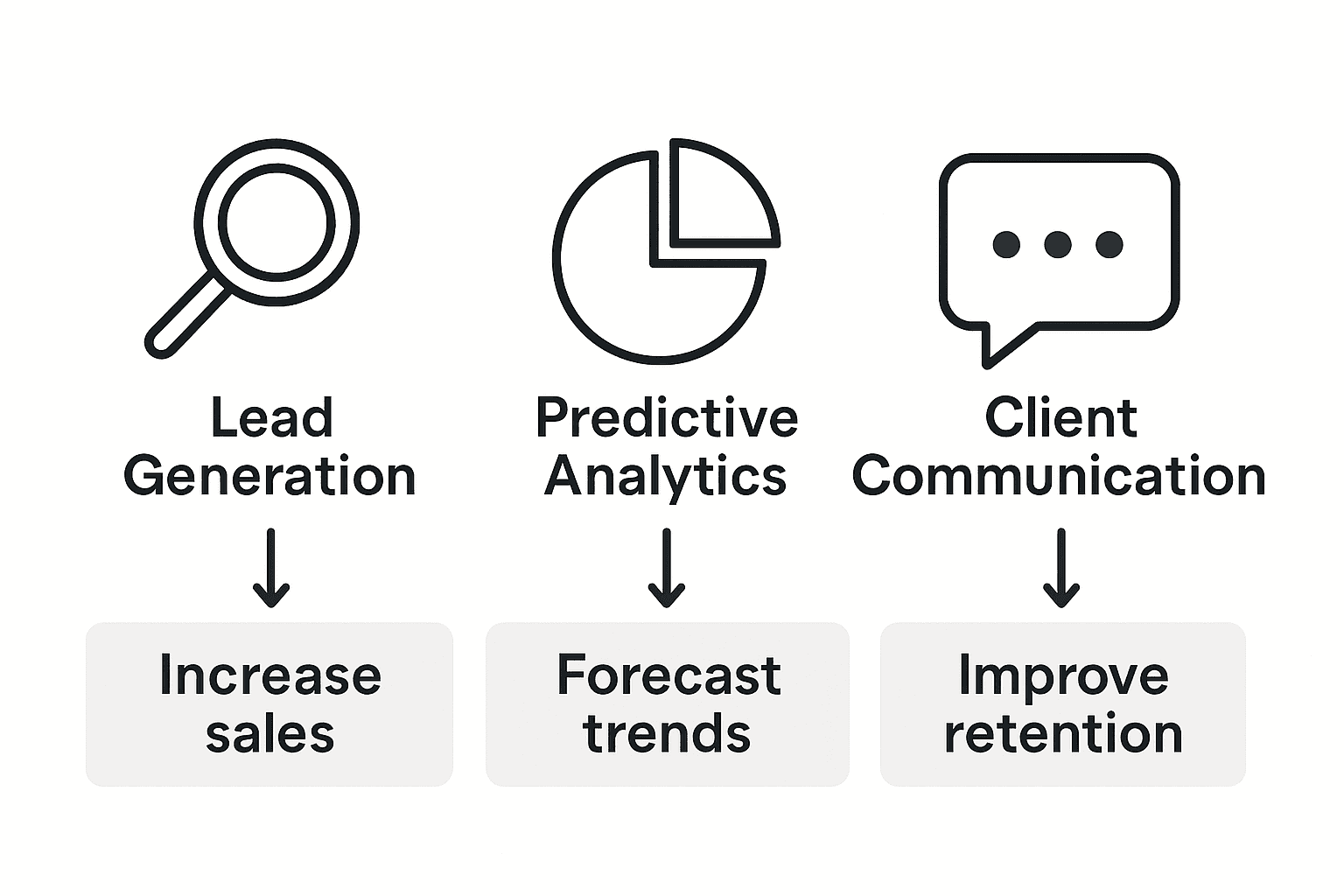
Here’s a summary of key AI tool types and their business impact:
| AI Tool Type | Main Function | Business Impact |
|---|---|---|
| Predictive Analytics | Forecasts trends and leads | Boosts lead quality, targets efforts |
| Automated Chatbots | Handles client communication | Captures leads 24/7, improves service |
| Property Management Systems | Schedules and processes docs | Cuts admin time, enhances accuracy |
| Image Recognition Tools | Analyzes property photos | Increases valuation accuracy |
Pro Tip: Technology Adoption Strategy: Start by selecting one AI tool that addresses your most time-consuming task and invest time in understanding its full capabilities. Gradual, strategic implementation will help you maximize technological benefits without overwhelming your existing workflow.
How AI Integrates Into Real Estate Tasks
Artificial Intelligence is revolutionizing real estate tasks by transforming complex workflows into streamlined, intelligent processes. Advanced AI frameworks enable agents to tackle intricate tasks with unprecedented precision and efficiency, fundamentally reshaping how professionals approach property valuation, client interactions, and market analysis.
In property valuation, AI demonstrates remarkable capabilities through cognitive reasoning and semantic data understanding. Self-supervised vision transformers can now analyze property images, extracting nuanced details about condition, architectural features, and potential market value. These systems process multiple data points simultaneously, comparing historical trends, neighborhood dynamics, and granular property characteristics to generate accurate valuation estimates that would take human analysts significant time and effort to compile.

Real estate professionals can leverage AI integration across multiple critical tasks. Intelligent systems now handle lead scoring, automatically prioritizing potential clients based on their digital behaviors and interaction patterns. Marketing becomes more targeted, with AI algorithms predicting client preferences and recommending personalized property selections. Document processing, traditionally a time-consuming administrative burden, is now automated through machine learning algorithms that can rapidly extract and categorize crucial information from contracts, inspection reports, and financial documents. Real Estate Marketing Strategies can be dramatically enhanced through these intelligent technologies, allowing agents to focus on high-value relationship-building activities.
Pro Tip: Workflow Optimization: Begin by mapping your current real estate workflow and identify three repetitive tasks that consume significant time. Research AI tools specifically designed to automate those exact processes, ensuring a strategic and focused approach to technological integration.
Real-World Applications for Brokers and Teams
Brokers and real estate teams are experiencing transformative shifts through strategic AI implementation, fundamentally changing how they approach client acquisition, engagement, and service delivery. Comprehensive AI tool applications are enabling professionals to streamline complex operational processes and create more personalized client experiences.
In team environments, AI technologies are revolutionizing collaboration and productivity. Intelligent CRM systems now automatically segment leads, prioritize client interactions, and generate predictive insights about potential sales opportunities. Advanced market analysis tools can rapidly process vast amounts of market data, helping brokers identify emerging trends, pricing strategies, and investment potential with unprecedented accuracy. These systems enable teams to make data-driven decisions faster and more confidently than traditional manual methods.
Real estate brokerages are discovering nuanced AI applications across multiple operational domains. Customer support AI can now handle initial client inquiries, schedule appointments, and provide preliminary property information, freeing up human agents to focus on high-value relationship-building activities. Real Estate Brokerage Comparisons reveal that teams adopting AI technologies are gaining significant competitive advantages, with improved lead conversion rates, more efficient workflow management, and enhanced client satisfaction. Machine learning algorithms are continuously refining their understanding of client preferences, enabling more targeted marketing and personalized property recommendations.
Pro Tip: Team Integration Strategy: Start by selecting one AI tool that addresses a specific team pain point, conduct a small pilot program, and meticulously track performance metrics to demonstrate tangible improvements before broader implementation.
Business Risks, Ethical Concerns, and Pitfalls
As artificial intelligence transforms real estate operations, professionals must navigate a complex landscape of potential risks and ethical challenges. Advanced algorithmic research reveals critical concerns about fairness, transparency, and potential systemic biases that could inadvertently impact property valuations and client interactions.
One of the most significant ethical challenges involves algorithmic bias and discrimination. AI systems can unintentionally perpetuate historical market inequities by relying on historical data that may reflect past discriminatory practices. Accuracy and explainability trade-offs highlight the critical need for transparent algorithms that can be audited and understood, preventing hidden discrimination in property valuation, lending decisions, and client recommendations. Real estate professionals must remain vigilant, implementing robust review processes that consistently evaluate AI systems for potential unintended consequences.
Business risks extend beyond ethical considerations into practical operational challenges. AI technologies can generate significant financial and reputational risks if not carefully implemented. Inaccurate predictive models might lead to misguided investment strategies, while overreliance on automated systems can result in missed nuanced market opportunities. Regulatory compliance becomes increasingly complex, as Real Estate Brokerage Comparisons demonstrate the intricate legal landscape surrounding AI-driven decision-making. Professionals must develop sophisticated governance frameworks that balance technological innovation with human oversight and professional judgment.
Compare risks and ethical concerns of AI adoption in real estate:
| Area | Main Concern | Potential Consequence |
|---|---|---|
| Algorithmic Bias | Unintended discrimination | Fair housing issues, lost trust |
| Transparency | Opaque decision-making processes | Harder to spot errors or bias |
| Compliance | Keeping up with regulations | Legal penalties and reputation harm |
| Overreliance | Ignoring human judgment | Missed nuanced market opportunities |
Pro Tip: Ethical AI Assessment: Develop a quarterly AI audit process that systematically evaluates your AI tools for potential biases, accuracy, and alignment with professional ethical standards, ensuring continuous improvement and responsible technology adoption.
Unlock the Full Potential of Real Estate AI to Revolutionize Your Client Prospecting
The article highlights critical challenges real estate agents face including time-consuming lead generation, complex property valuation, and the need for precise client matching. These pain points slow down success and drain energy from the core mission of building relationships and closing deals. Terms like predictive analytics, automated lead generation, and intelligent market trend analysis reveal how AI can empower agents with sharper insights and increased efficiency without replacing their unique expertise.
At ex.plo.re CRM, we amplify your real estate impact by seamlessly integrating AI-powered tools into your existing workflow. Our platform helps you transform cumbersome prospecting tasks into streamlined, data-driven strategies so you can focus on what matters most. Think of us as your partner in navigating the evolving AI landscape while enhancing your sales pitch and local client acquisition.
Discover how to implement proven Real Estate Agent Business Plan AI strategies that boost performance and use Real Estate AI Agent Growth tactics designed specifically for agents ready to scale confidently.
Ready to accelerate your client prospecting and become a power broker in your market?

Explore cutting-edge solutions that complement your workflow perfectly now at ex.plo.re CRM. Don’t wait for technology to change your industry. Let us help you lead it today.
Frequently Asked Questions
What is Real Estate AI and how does it work?
Real Estate AI refers to the use of artificial intelligence technologies specifically designed to assist real estate professionals in their operations. It works by analyzing complex data patterns, automating repetitive tasks, and providing insights that enhance decision-making.
How can AI improve client prospecting in real estate?
AI improves client prospecting by utilizing predictive analytics to identify high-potential leads, automating client communication through chatbots, and providing personalized recommendations based on client preferences. This helps agents focus on more meaningful interactions with their clients.
What are some key AI tools utilized by real estate agents?
Key AI tools for real estate agents include predictive analytics platforms, automated chatbots for client communication, intelligent property management systems, image recognition tools for property analysis, and virtual tour generators. Each tool addresses specific needs within the agent’s workflow.
What are the risks and ethical concerns associated with using AI in real estate?
Risks and ethical concerns include algorithmic bias, transparency issues in decision-making processes, and challenges with regulatory compliance. It is essential for real estate professionals to implement robust review processes to evaluate AI’s impact on fairness and accuracy.