

Real estate professionals who embrace AI-driven sales automation gain a decisive 12-18 month competitive advantage over slower-moving competitors. This window represents a critical opportunity to transform routine tasks into strategic client relationships. While many agents fear automation might replace the human element, the reality is far different. Smart automation frees you from administrative burden, letting you focus on what truly drives deals: building trust, understanding client needs, and closing sales. This guide reveals how to leverage automation strategically to win more clients, respond faster, and amplify your impact without sacrificing the personal touch that sets top performers apart.
Table of Contents
- Understanding Automation’s Impact On Real Estate Sales
- Competitive Advantage Of Adopting Sales Automation In Real Estate
- Balancing Automation With Human Touch To Avoid Common Pitfalls
- Practical Steps To Implement Sales Automation Effectively
- How Our Tools Simplify Real Estate Sales Automation
- Frequently Asked Questions
Key takeaways
| Point | Details |
|---|---|
| Time liberation | Automation eliminates up to 60% of routine tasks, freeing agents to focus on client relationships and deal closing. |
| Speed wins deals | Responding to leads within 5-10 minutes dramatically increases conversion rates compared to delayed manual follow-ups. |
| Balance is critical | Combining automated workflows with personalized human interaction prevents the robotic outreach that damages client trust. |
| Integration drives results | Connecting marketing automation with CRM platforms creates seamless workflows that boost efficiency and conversions. |
| Strategic advantage | Early adopters of AI-driven sales automation build significant competitive leads within 12-18 months. |
Understanding automation’s impact on real estate sales
Sales automation transforms how real estate professionals manage their daily workflows by handling repetitive tasks through technology. For agents, this means automated lead capture, email sequences, appointment scheduling, CRM updates, and follow-up reminders that previously consumed hours each day. The shift isn’t about replacing agents but amplifying their effectiveness.
Consider the numbers. Agents spend up to 60% of working hours on routine administrative tasks rather than revenue-generating activities. That’s more than half your week dedicated to data entry, scheduling, and manual follow-ups instead of showing properties, negotiating deals, and building client relationships. Automation reclaims this time, shifting your focus to high-value interactions that actually close transactions.
The components of effective sales automation include:
- Lead capture systems that instantly route inquiries to your CRM
- Intelligent email sequences triggered by specific client actions
- Automated appointment scheduling that syncs with your calendar
- Task reminders that ensure no follow-up falls through cracks
- Data enrichment tools that gather client intelligence automatically
As one industry expert noted, “The agent’s role is evolving from administrative coordinator to strategic advisor. Automation handles the logistics so professionals can focus on the nuanced human elements that technology cannot replicate.” This transformation becomes even more powerful as AI enters the picture, enabling predictive workflows that anticipate client needs before they’re explicitly stated.
Exploring real estate automation tools 2026 reveals how modern platforms integrate these capabilities seamlessly. The role of AI in real estate extends beyond simple task automation to intelligent pattern recognition that identifies which leads are most likely to convert, when clients are ready to make decisions, and what communication style resonates best with each prospect.
Competitive advantage of adopting sales automation in real estate
Firms implementing AI-driven sales gain a 12-18 month lead over competitors who delay adoption. This window represents a massive opportunity to capture market share, build superior client databases, and establish reputation as a tech-forward professional. The advantage compounds over time as your automated systems learn from each interaction, continuously improving their effectiveness.
Speed transforms everything in real estate sales. When a potential buyer submits an inquiry at 9 PM, automated systems can acknowledge receipt instantly, schedule a follow-up call for the next morning, and send relevant property information before the prospect even wakes up. Meanwhile, agents relying on manual processes might not see that inquiry until the following afternoon, by which time the lead has already connected with three competitors.

Personalization at scale becomes possible through automation. Rather than sending generic property alerts to your entire database, intelligent systems analyze individual behavior patterns, search history, and engagement metrics to deliver precisely targeted recommendations. This relevance builds trust and positions you as an attentive professional who understands specific needs.
| Aspect | Traditional Manual Sales | Automated Sales Approach |
|---|---|---|
| Lead response time | Hours to days | Minutes to seconds |
| Follow-up consistency | Sporadic, depends on memory | Systematic, never misses |
| Personalization capacity | Limited to top prospects | Scalable across entire database |
| Data insights | Manual tracking, incomplete | Comprehensive analytics, predictive |
| Agent time allocation | 60% admin, 40% client-facing | 20% admin, 80% client-facing |
Pro Tip: Focus your automation efforts on high-leverage activities like instant lead acknowledgment, appointment scheduling, and post-showing follow-ups rather than trying to automate client conversations themselves. Let technology handle logistics while you handle relationships.
AI-based systems drive better predictions and faster workflows by analyzing historical data to identify patterns invisible to human observation. These systems can predict which leads are most likely to convert, optimal times to contact specific prospects, and which properties match unstated preferences based on browsing behavior.
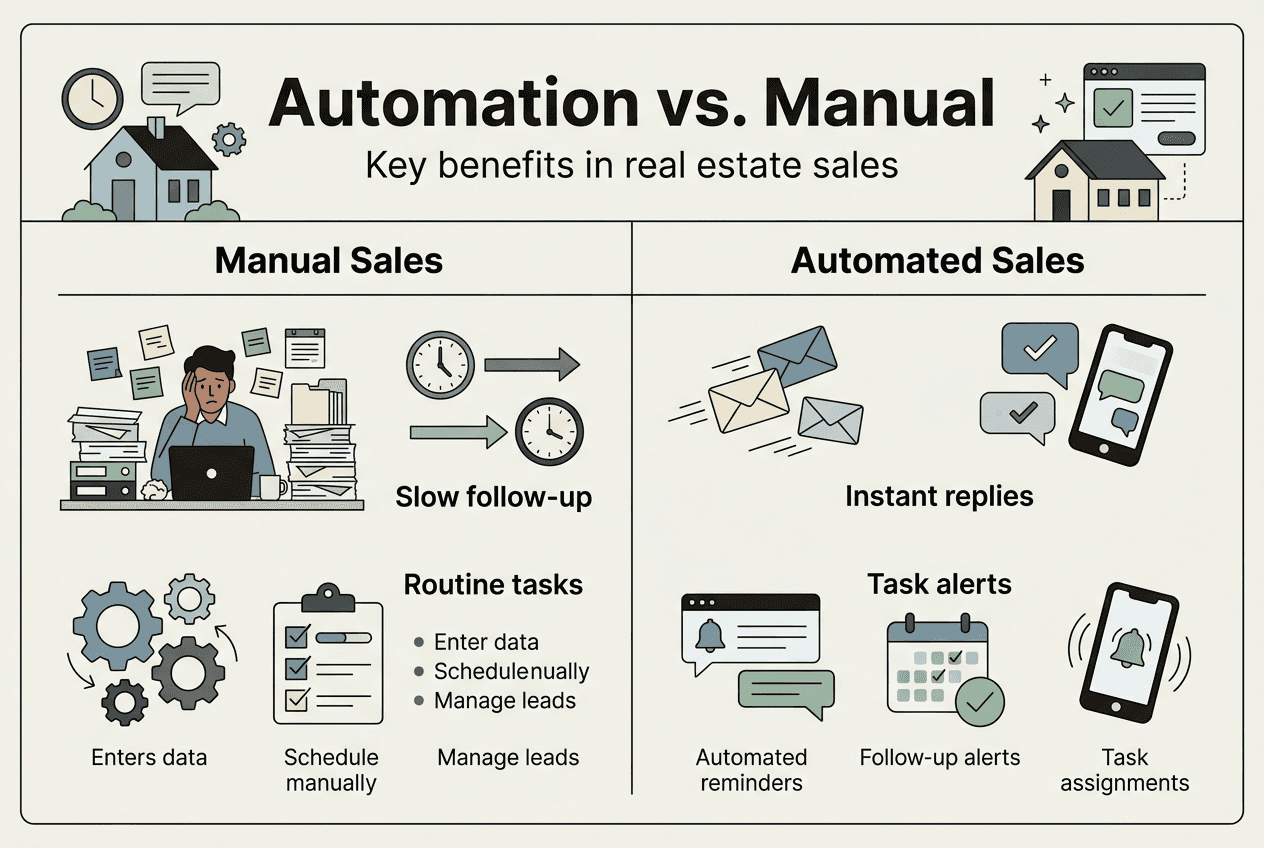
The real estate AI prospecting tools available today go far beyond simple email automation. They integrate property data, market trends, client behavior, and communication preferences to create intelligent workflows that adapt in real time. The real estate AI agent growth guide demonstrates how professionals are leveraging these capabilities to scale their businesses without proportionally increasing their workload.
Balancing automation with human touch to avoid common pitfalls
Robotic outreach destroys trust faster than any other sales mistake. Automated follow-up systems create leaking sales funnels when they prioritize volume over relevance, sending generic messages that feel impersonal and disconnected from actual client needs. Prospects can instantly recognize when they’re receiving canned responses, and this recognition damages your credibility.
The uncanny valley effect applies to sales communication just as it does to robotics. When automation attempts to perfectly mimic human interaction but falls slightly short, the result feels creepier and less trustworthy than obviously automated messages. Canned replies lack contextual awareness, failing to address the specific emotions, concerns, and circumstances that drive real estate decisions.
Real estate virtual assistants offer a middle path, combining automation’s efficiency with human empathy and judgment. These professionals use automated tools to manage workflows while applying personal insight to each client interaction. They can recognize when a prospect needs immediate personal attention versus when an automated response suffices.
Best practices for blending automation with genuine human interaction:
- Use automation to trigger personal follow-ups rather than replace them entirely
- Program systems to alert you when high-value leads take specific actions
- Personalize automated messages with specific property details and client preferences
- Reserve purely automated communication for administrative tasks like appointment confirmations
- Review automated message performance regularly and refine based on response rates
- Train your team to recognize when automation should hand off to human interaction
Pro Tip: Configure your automation to send you alerts when leads exhibit buying signals like viewing the same property multiple times or spending extended time on mortgage calculators. Use technology to identify opportunities, then apply personal attention to convert them.
The master follow-up workflow for brokers demonstrates how to structure automated sequences that feel personal and relevant. Understanding how to nurture real estate leads requires recognizing that automation amplifies your strategy but cannot replace the empathy and adaptability that close complex transactions.
Successful agents treat automation as an assistant that handles logistics while they focus on relationship building. The technology reminds you to follow up, prepares relevant information, and tracks engagement patterns. You provide the strategic thinking, emotional intelligence, and persuasive communication that turns prospects into clients.
Practical steps to implement sales automation effectively
Implementing automation requires strategic planning rather than simply purchasing software and hoping for results. Follow this systematic approach:
- Audit your current sales process to identify repetitive tasks consuming the most time
- Research automation platforms specifically designed for real estate professionals
- Start with one high-impact workflow like lead acknowledgment or appointment scheduling
- Configure personalization fields so automated messages include relevant property and client details
- Test your automation with a small segment before rolling out to your entire database
- Monitor performance metrics like response rates, conversion rates, and time saved
- Refine messaging and triggers based on actual results rather than assumptions
- Gradually expand automation to additional workflows as you master each component
- Train your team on when to let automation work and when to intervene personally
- Review and optimize your automation quarterly as your business and technology evolve
Integrating marketing automation with Propertybase and Salesforce leads to a 28% increase in conversions and response times under 10 minutes. These platforms connect your website, email marketing, CRM, and transaction management into unified workflows that eliminate manual data transfer and ensure nothing falls through cracks.
| Metric | Manual Sales Funnel | Automation-Enhanced Funnel |
|---|---|---|
| Average lead response time | 4-6 hours | 2-5 minutes |
| Follow-up consistency rate | 45-60% | 95-100% |
| Lead to appointment conversion | 8-12% | 18-25% |
| Agent hours per closed deal | 40-50 hours | 25-35 hours |
| Database engagement rate | 15-20% | 35-45% |
Speed matters enormously in lead conversion. Research consistently shows that responding within five to ten minutes dramatically increases the likelihood of connecting with prospects and moving them through your sales funnel. Automation makes this speed achievable even when you’re showing properties, in meetings, or off hours.
Measuring ROI requires tracking both time saved and revenue generated. Calculate hours reclaimed from administrative tasks and multiply by your hourly value. Compare conversion rates before and after implementing automation. Monitor how many additional clients you can serve without increasing your workload. These metrics justify your technology investment and guide optimization efforts.
The best real estate prospecting tools integrate seamlessly with your existing systems rather than creating additional complexity. Understanding sales funnel real estate conversions helps you identify exactly where automation delivers maximum impact in your specific business model.
Remember that automation amplifies your existing strategy. If your manual process is ineffective, automating it simply scales ineffectiveness faster. Perfect your messaging, value proposition, and client experience first, then use automation to deliver that excellence consistently across your entire database.
How our tools simplify real estate sales automation
Navigating the automation landscape can feel overwhelming with countless platforms promising to revolutionize your business. We’ve eliminated that complexity by integrating cutting-edge automation tools specifically designed for real estate professionals into a unified platform. Our system connects prospecting, client communication, property marketing, and transaction management into seamless workflows that require minimal technical expertise.

You’ll reduce time spent on manual tasks by up to 70% while simultaneously increasing client engagement through personalized, timely communication. Our platform learns from your interactions, continuously improving its effectiveness at identifying high-value prospects and optimal outreach timing. Explore our best real estate prospecting tools to see how technology amplifies your natural strengths, or dive deeper into prospecting in real estate strategies that combine automation with personal touch. Ready to experience how our talented team and technology can amplify your impact? Book a demo and let us show you exactly how automation transforms your sales process.
Frequently asked questions
What is the role of automation in modern real estate sales?
Automation handles repetitive administrative tasks like lead capture, follow-up scheduling, email sequences, and CRM updates, freeing agents to focus on client relationships and deal closing. It accelerates response times, ensures consistent follow-up, and enables personalization at scale that would be impossible manually.
How quickly should I respond to new leads using automation?
Automated systems should acknowledge new leads within minutes, ideally under five minutes, as this dramatically increases conversion rates compared to delayed responses. However, automated acknowledgment should trigger personal follow-up within hours, not replace human interaction entirely.
Can automation replace real estate agents?
No, automation amplifies agent effectiveness rather than replacing them. Technology excels at logistics, data management, and routine communication but cannot replicate the empathy, negotiation skills, local expertise, and relationship building that close complex real estate transactions.
What are the biggest mistakes agents make with sales automation?
The most damaging mistake is using generic, robotic messaging that lacks personalization and contextual awareness. Other common errors include automating too much of the client relationship, failing to monitor and optimize performance, and implementing automation without first perfecting the underlying sales strategy.
How do I measure ROI from sales automation investments?
Track time saved on administrative tasks, compare conversion rates before and after implementation, monitor how many additional clients you can serve without increasing workload, and calculate the revenue generated from faster response times and improved follow-up consistency. These metrics demonstrate both efficiency gains and revenue growth.