

Every successful deal starts with understanding what motivates high-value clients. As the demand for prestige properties and luxury yachts rises, agents face pressure to deliver results faster and more efficiently. Generative AI technologies are transforming client acquisition and sales strategy, bringing sharper data insights and more personalized interactions. This article explores how advanced AI tools empower professionals to stand out, streamline workflows, and build deeper relationships with discerning clientele worldwide.
Table of Contents
- AI’s Evolving Influence In Real Estate
- Key AI Technologies Driving The Market
- AI Applications In Client Acquisition
- Optimizing Sales And Marketing With AI
- Risks, Costs, And Legal Considerations
Key Takeaways
| Point | Details |
|---|---|
| AI Transforms Real Estate | Integrating AI technologies provides real estate professionals with enhanced predictive analytics, personalized client interactions, and automated valuation capabilities. |
| Strategic Implementation Required | Successful adoption of AI involves understanding technological capabilities, investing in training, and developing adaptive strategies. |
| Mitigating Risks is Crucial | Organizations must address data privacy, algorithmic bias, and compliance with evolving regulations while implementing AI. |
| Emphasis on Human Connection | While AI enhances efficiency, real estate professionals should balance technology with authentic client engagement to build trust. |
AI’s Evolving Influence in Real Estate
Artificial Intelligence is dramatically reshaping the real estate landscape, offering unprecedented opportunities for innovation and efficiency. Generative AI technologies are transforming how real estate professionals approach client interactions, property valuation, and market analysis.
The impact of AI on real estate extends far beyond simple automation. Real estate agents can now leverage sophisticated tools that provide deeper insights and more personalized experiences. Key areas of transformation include:
- Predictive Analytics: Forecasting market trends with unprecedented accuracy
- Customer Segmentation: Creating hyper-targeted marketing strategies
- Automated Valuation: Generating instant property price estimates
- Personalized Recommendations: Matching clients with ideal properties faster
Professional real estate agents who embrace AI technologies will gain significant competitive advantages. By integrating machine learning algorithms and data-driven insights, brokers can streamline their workflows, reduce manual tasks, and focus on high-value client interactions.
The strategic implementation of AI requires a nuanced approach. Successful adoption means understanding both technological capabilities and industry-specific challenges. Real estate professionals must invest in training, develop adaptive strategies, and remain open to continuous technological evolution.
Pro tip: Start small by integrating one AI tool into your workflow and gradually expand your technological capabilities to minimize disruption and maximize learning.
Key AI Technologies Driving the Market
Generative AI technologies are revolutionizing the real estate sector by offering unprecedented capabilities in data analysis, market prediction, and client engagement. These advanced technological solutions are transforming traditional approaches to property management, investment strategies, and customer interactions.
The key AI technologies reshaping real estate include:
- Predictive Analytics Engines: Advanced machine learning models that forecast market trends
- Automated Valuation Models (AVMs): AI-powered systems generating instant property value estimates
- Natural Language Processing (NLP): Intelligent communication and analysis tools
- Computer Vision Technologies: Advanced image recognition and property assessment systems
- Personalization Algorithms: Customized recommendation engines for property matching
Real estate professionals can leverage these technologies to gain significant competitive advantages. Machine learning algorithms enable brokers to process complex market data rapidly, identify emerging opportunities, and make more informed strategic decisions. By integrating sophisticated AI tools, agents can streamline workflows, reduce manual tasks, and provide more personalized client experiences.
Here is a comparison of key AI technologies and their primary benefits in real estate:
| Technology | Main Function | Business Impact |
|---|---|---|
| Predictive Analytics Engines | Market trend forecasting | Enables data-driven investment choices |
| Automated Valuation Models | Instant property value estimates | Streamlines pricing and appraisals |
| Natural Language Processing | Communication and data interpretation | Enhances client interactions |
| Computer Vision Technologies | Visual property assessments | Automates image-driven analysis |
| Personalization Algorithms | Customized property recommendations | Improves match accuracy for clients |
The integration of AI technologies requires a strategic approach. Successful implementation involves continuous learning, technology adaptation, and understanding the nuanced capabilities of different AI systems. Real estate organizations must invest in training, develop robust data infrastructure, and remain flexible in their technological adoption strategies.
Pro tip: Develop a gradual AI integration strategy by first identifying one specific area of your workflow where AI can provide immediate, measurable improvements.
AI Applications in Client Acquisition
AI-driven decision-making techniques are transforming the landscape of real estate client acquisition, offering unprecedented opportunities for targeted marketing and personalized engagement. These advanced technologies enable real estate professionals to identify, attract, and convert high-potential clients with remarkable precision and efficiency.
The most impactful AI applications in client acquisition include:
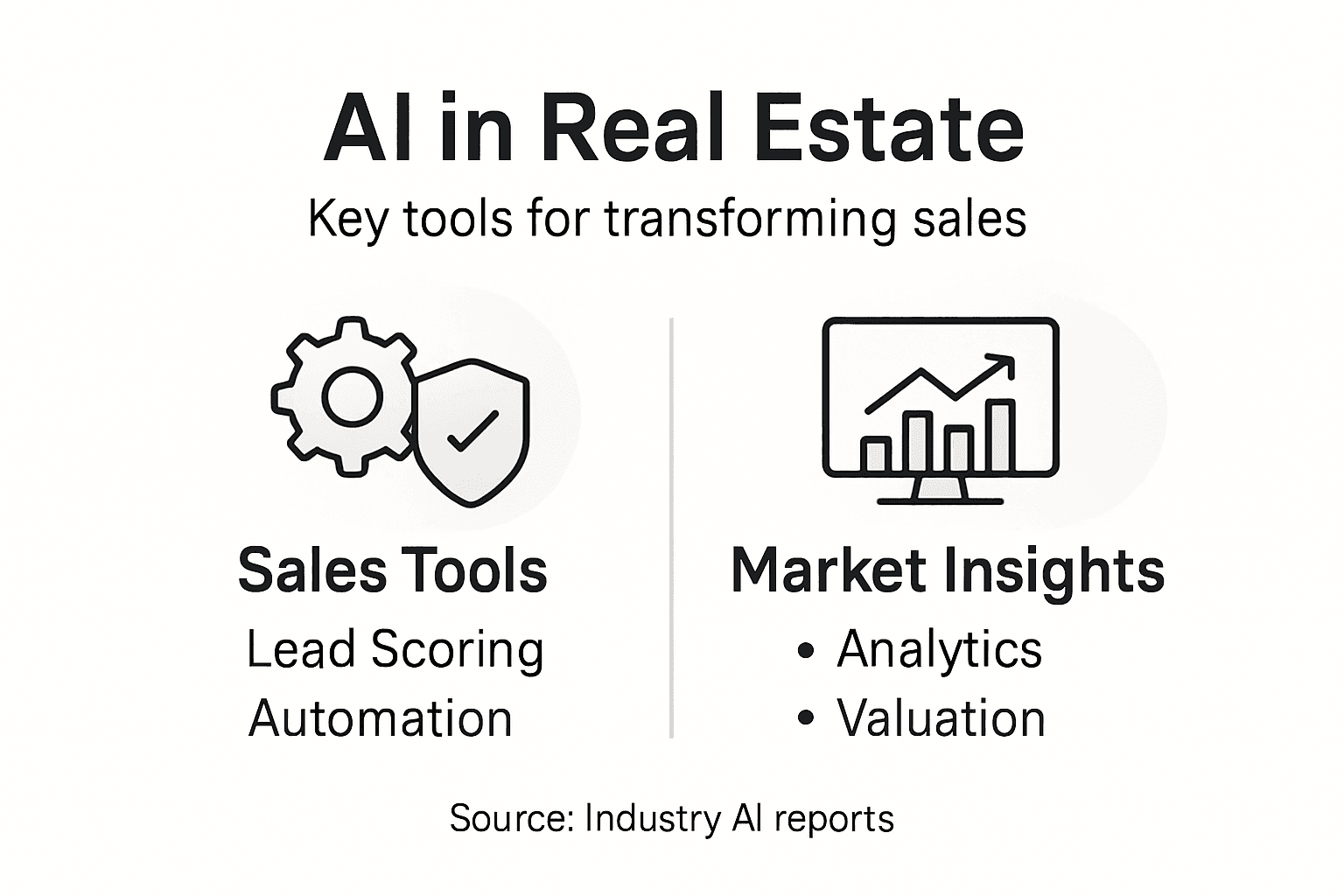
- Predictive Lead Scoring: Identifying and ranking potential clients based on complex behavioral patterns
- Personalized Communication Strategies: Tailoring outreach using advanced natural language processing
- Demographic Targeting: Analyzing micro-market segments with unprecedented accuracy
- Behavioral Prediction Models: Anticipating client needs before they emerge
- Automated Follow-up Systems: Maintaining consistent engagement through intelligent communication tools
Real estate agents can leverage intelligent recommendation systems to create more meaningful client interactions. These sophisticated algorithms analyze historical data, online behaviors, and market trends to generate highly targeted prospecting strategies. By understanding individual client preferences and potential investment patterns, agents can develop more nuanced and effective approaches to client acquisition.
Successful implementation requires a balanced approach that combines technological capabilities with human expertise. While AI provides powerful analytical tools, the most effective client acquisition strategies integrate machine insights with personal relationship-building skills. Real estate professionals must view AI as an enhancement tool, not a replacement for human connection and intuitive understanding.
Pro tip: Implement a hybrid approach by using AI-generated insights to prioritize and personalize client interactions, while maintaining authentic human touchpoints.
Optimizing Sales and Marketing with AI
AI-driven marketing strategies are revolutionizing real estate sales and marketing by transforming traditional approaches to customer engagement and market analysis. These advanced technologies enable real estate professionals to develop more targeted, efficient, and personalized marketing strategies that significantly improve conversion rates and client satisfaction.
Key AI-powered marketing optimization techniques include:
- Predictive Customer Segmentation: Identifying and targeting most promising client profiles
- Dynamic Content Personalization: Tailoring marketing messages to individual client preferences
- Intelligent Lead Scoring: Prioritizing and ranking potential client opportunities
- Automated Marketing Workflows: Streamlining communication and follow-up processes
- Real-Time Performance Analytics: Measuring and adjusting marketing strategies instantly
Real estate professionals can leverage advanced machine learning algorithms to create more sophisticated marketing approaches. These technologies analyze vast amounts of data to uncover hidden patterns, predict client behaviors, and generate insights that traditional marketing methods cannot detect. By understanding micro-market dynamics and individual client motivations, agents can craft highly targeted campaigns that resonate more effectively with potential buyers and sellers.

Successful AI integration in sales and marketing requires a strategic and balanced approach. While technological tools provide powerful insights, they must be combined with human intuition and relationship-building skills. Real estate agents should view AI as an enhancement tool that augments their expertise, not a replacement for personal connection and professional judgment.
Pro tip: Begin implementing AI marketing tools incrementally, starting with one specific area like lead scoring or content personalization, to minimize disruption and maximize learning.
Risks, Costs, and Legal Considerations
Comprehensive AI risk management has become crucial for real estate professionals navigating the complex technological landscape. As artificial intelligence transforms industry practices, understanding potential legal, ethical, and financial implications is paramount for responsible implementation and sustainable growth.
Key risks and considerations in AI adoption include:
- Data Privacy Vulnerabilities: Protecting client information and complying with regulatory standards
- Algorithmic Bias: Identifying and mitigating potential discrimination in AI decision-making
- Intellectual Property Challenges: Understanding ownership and usage rights of AI-generated content
- Cybersecurity Threats: Preventing unauthorized access and potential data breaches
- Compliance and Regulatory Complexity: Adapting to evolving legal frameworks surrounding AI technologies
Real estate organizations must develop robust governance frameworks that address potential technological and legal challenges. This involves creating comprehensive strategies that balance innovation with risk mitigation, including regular audits, transparent algorithmic processes, and continuous training for professionals on ethical AI usage.
The financial considerations of AI implementation extend beyond initial technology costs. Organizations must budget for ongoing training, system updates, potential legal consultations, and potential risk mitigation strategies. Investing in comprehensive risk assessment and management approaches will help real estate professionals leverage AI technologies while maintaining professional integrity and client trust.
Summary of major AI adoption risks and recommended mitigation strategies for real estate organizations:
| Risk Area | Example Challenge | Mitigation Strategy |
|---|---|---|
| Data Privacy | Client data breaches | Encrypt data, update compliance |
| Algorithmic Bias | Discriminatory recommendations | Regular audits, diverse datasets |
| Intellectual Property | Unclear ownership of AI outputs | Legal reviews, clear contracts |
| Cybersecurity | System hacking or intrusions | Ongoing security assessments |
| Regulatory Compliance | Changing AI-related laws | Continuous legal monitoring |
Pro tip: Conduct a thorough risk assessment and develop a phased AI implementation strategy that prioritizes data protection, ethical considerations, and regulatory compliance.
Unlock the Power of AI to Transform Your Real Estate Sales
The article highlights the challenges real estate professionals face in leveraging AI technologies like predictive analytics and personalized recommendations to boost sales and client acquisition. Many agents struggle with streamlining prospecting, automating follow-ups, and delivering targeted offers that truly resonate with clients. At ex.plo.re, we understand these pain points and offer cutting-edge tools designed specifically to amplify your sales pitch and local client outreach. Our platform integrates the latest AI-driven features to help you become a power broker who works smarter, not harder.
From intelligent lead scoring to automated workflows, our technology enhances your daily sales cycle while our expert team supports your mission every step of the way. Make data-driven decisions, eliminate tedious manual tasks, and create personalized client experiences that build trust and close deals faster.
Take control of your real estate career with proven solutions that align perfectly with the evolving AI landscape. Discover how we can help you master the sales transformation by visiting ex.plo.re CRM.

Ready to elevate your real estate sales using AI-powered tools and expert support Invest in your future today by exploring how ex.plo.re CRM can transform your prospecting and client engagement strategies. Don’t wait to become the power broker you were meant to be. Learn more now and start closing more deals tomorrow.
Frequently Asked Questions
How is AI transforming the real estate industry?
AI is transforming the real estate industry by providing advanced tools for predictive analytics, automated property valuations, personalized recommendations, and enhanced client engagement, allowing professionals to make data-driven decisions and streamline their workflows.
What are some key AI technologies used in real estate?
Key AI technologies in real estate include predictive analytics engines for market forecasting, automated valuation models for instant property pricing, natural language processing for improved communication, and computer vision technologies for visual assessments.
How can real estate agents leverage AI for client acquisition?
Real estate agents can leverage AI for client acquisition by using predictive lead scoring to identify potential clients, implementing personalized communication strategies based on client behaviors, and utilizing demographic targeting to analyze micro-market segments effectively.
What are the risks associated with AI adoption in real estate?
The risks associated with AI adoption include data privacy vulnerabilities, algorithmic bias, intellectual property challenges, cybersecurity threats, and compliance complexities. It is essential for organizations to develop robust governance frameworks to mitigate these risks effectively.
Recommended
- Real Estate AI Agent Growth: Complete Guide
- Real Estate AI: Transforming Client Prospecting Now
- Real Estate Agent Business Plan AI Explained
- Digital Marketing’s Impact on Real Estate Success
- ReliaBotAI™ | Instant Enquiry Handling for Estate Agencies
- ReliaBotAI™ | Instant Enquiry Handling for Estate Agencies
- Virtual Staging im Vorderen Odenwald | Hausverkauf mit KI-Visualisierung