

Most agents think outreach is about sending more emails. It isn’t. The agents closing more deals are not the ones blasting the loudest messages into inboxes. They’re the ones running coordinated, automated, multi-channel workflows that make every lead feel like a priority. Outreach tools unify calls, texts, emails, and automations for better follow-up, turning scattered touchpoints into a consistent, conversion-driving machine. If your current process still relies on manual reminders or spreadsheets, you’re leaving serious opportunity on the table.
Table of Contents
- How outreach tools changed real estate client acquisition
- Core functions: What outreach tools actually do for agents
- AI in outreach: Benefits, risks, and real-world agent control
- Choosing and validating the right tool for your business
- Why human touch and local testing still matter
- Upgrade your outreach with expert-vetted tools
- Frequently asked questions
Key Takeaways
| Point | Details |
|---|---|
| Unified communication channels | Modern outreach tools bring calls, texts, emails, and follow-ups into one platform to keep leads organized. |
| AI-driven personalization | AI enables faster, more tailored communication but still requires agent oversight for quality and compliance. |
| Validation over hype | Local testing and continuous optimization are essential to confirm tool effectiveness for your unique market. |
| Balanced automation | Automate routine touches, but blend with genuine agent interaction to build trust and rapport. |
How outreach tools changed real estate client acquisition
Real estate prospecting looked very different a decade ago. Agents relied on cold-calling lists, door-knocking routes, and hand-written follow-up notes. The system depended entirely on individual effort and memory. If you forgot to call back a lead, that lead moved on. If you were busy with a closing, your pipeline quietly dried up.
Modern outreach tools eliminated that fragility. Today, multi-channel execution across calls, emails, SMS, direct mail, and social outreach happens through a single platform, with every interaction logged automatically in your CRM. You no longer need to remember who you called last Tuesday. The system tracks it, flags the next step, and can even trigger the follow-up message for you.
This shift matters beyond convenience. Consistent, coordinated outreach directly affects conversion rates. When a lead receives a timely text after missing your call, followed by a personalized email the next morning, they experience a professional, attentive agent before they’ve even spoken with you. That first impression shapes everything.
Consider the difference in experience between two agents. Agent A calls once, leaves a voicemail, and waits. Agent B calls, sends a text within five minutes, follows up with a value-driven email that evening, and schedules a check-in for 48 hours later. Agent B’s sequence runs automatically. The lead notices the difference.
“The shift to coordinated digital outreach isn’t just a technology trend. It’s a fundamental change in how agents build sustainable pipelines. The agents who adapt early are the ones who will define the next generation of power brokers.” — Industry insight sourced from HousingWire CRM analysis
Exploring multichannel marketing strategies and understanding digital marketing in real estate reveals a clear pattern: consistency across channels beats intensity in any single channel.
| Outreach approach | Key strengths | Limitations |
|---|---|---|
| Cold-calling only | Direct, personal | High effort, low scale |
| Email-only campaigns | Scalable, trackable | Easily ignored, low response |
| Multi-channel CRM automation | Consistent, personalized at scale | Requires setup and review |
| AI-assisted outreach | Fast, adaptive, data-driven | Needs human oversight |
The table above shows clearly why agents who commit to multi-channel, CRM-integrated outreach outperform those locked into a single tactic.
Core functions: What outreach tools actually do for agents
Now that the big picture is clear, let’s get practical. The best outreach tools are not just contact databases. They are operational engines that power your daily workflow, reduce friction, and prevent leads from slipping through.

Unified daily communication through calls, texts, and emails, combined with automated follow-ups and full interaction history tracking, is the backbone of every high-performing agent’s system. Here’s what that looks like in practice:
Core outreach tool functions that matter most:
- Multi-channel execution: Initiate a call, send a text, and schedule an email all from the same contact record. Every action is logged with timestamps and outcomes.
- Automated sequences: Set up a seven-day follow-up sequence once. It runs for every new lead automatically, adjusting timing based on response behavior.
- Lead status tracking: Move leads through pipeline stages from “new inquiry” to “under contract” with notes, tags, and activity histories attached to each contact.
- Template libraries: Pre-built message templates for common scenarios like open house follow-up, listing inquiry responses, and price reduction announcements.
- Reminders and alerts: The system notifies you when a hot lead hasn’t been contacted in 48 hours or when a sequence has stalled.
The impact of these features compounds over time. An agent with 150 active leads cannot manually track every interaction across every channel. But a well-configured CRM can manage that volume without missing a beat, surfacing the right contact at the right moment.
For lead nurturing that drives faster sales, sequences need to adapt based on how a lead engages. If someone opens your email three times but hasn’t responded, that’s a buying signal. Your tool should flag it. Advanced platforms even allow conditional logic: if the lead clicks the listing link, send a showing invitation; if they don’t, send a market update instead.
Expanding your lead source strategies and understanding how to build powerful funnels for generating real estate leads becomes far more effective when every source feeds into one coordinated outreach system.
Pro Tip: Build sequences that automatically adapt based on lead behavior. A lead who opens three emails but never replies needs a different sequence than one who clicked once and went cold. Use conditional triggers in your CRM to serve each situation without manual intervention.
| Feature | What it does | Why it matters |
|---|---|---|
| Automated email sequences | Sends timed, templated emails | Keeps leads warm without manual effort |
| Two-way SMS | Allows lead replies in your CRM | Keeps conversations in one place |
| Call logging | Records call outcomes and notes | Tracks relationship history accurately |
| Pipeline dashboards | Shows lead stage and activity | Prioritizes daily action clearly |
AI in outreach: Benefits, risks, and real-world agent control
AI is now embedded in most leading outreach platforms. It writes message drafts, suggests send times, flags disengaged leads, and even proposes next-best actions based on deal stage. For busy agents, this capability is genuinely transformative when used correctly.
AI-powered outreach tools can personalize messaging and automate communication at scale, but human oversight is essential to prevent impersonal mass messaging that erodes trust and violates platform guidelines.
Here are the primary benefits agents report from AI-integrated outreach:
- Faster content creation: AI generates first drafts of follow-up emails, property description messages, and check-in texts in seconds. Agents edit and personalize rather than write from scratch.
- Smarter personalization: Platforms analyze past interactions to recommend personalized subject lines and message angles, increasing open and response rates.
- Consistency at volume: AI ensures every lead in your pipeline receives timely contact, even during your busiest closing weeks.
- Deal-stage awareness: Advanced tools recognize where a lead sits in the buying or selling cycle and suggest messaging aligned with that stage.
- Pattern recognition: AI surfaces leads showing renewed engagement, giving agents the signal to prioritize a personal call at exactly the right moment.
The risks are equally real. Over-automation creates distance. When every message sounds templated and generic, leads notice. Some platforms also have strict policies on automated messaging volume, and agents who ignore those guidelines risk account suspension or spam filtering that kills deliverability.
Understanding AI for real estate communication, exploring purpose-built AI prospecting tools, and grasping AI’s role in real estate sales all point to the same conclusion: AI amplifies agent capability. It does not replace agent judgment.
A critical statistic to internalize: Research consistently shows that response rates drop significantly when outreach messages feel mass-produced. Personalization, even minor name and property-specific customization, improves reply rates by measurable margins across email and SMS channels. The implication is clear. Use AI to move faster, but invest that saved time into personalizing the message, not into sending more generic ones.
Pro Tip: Review every automated campaign monthly. Look at open rates, reply rates, and opt-out rates together. If any sequence shows rising opt-outs, it’s a signal that your messages have drifted toward generic. Adjust the tone, timing, or trigger logic before it damages your deliverability reputation.
Choosing and validating the right tool for your business
Selecting the ideal outreach tool isn’t a one-size-fits-all process. Your market, your lead mix, and your daily workflow all shape what features matter most. A luxury agent in a low-inventory coastal market needs different automation logic than an investor-focused agent working high-volume leads in an expanding suburb.
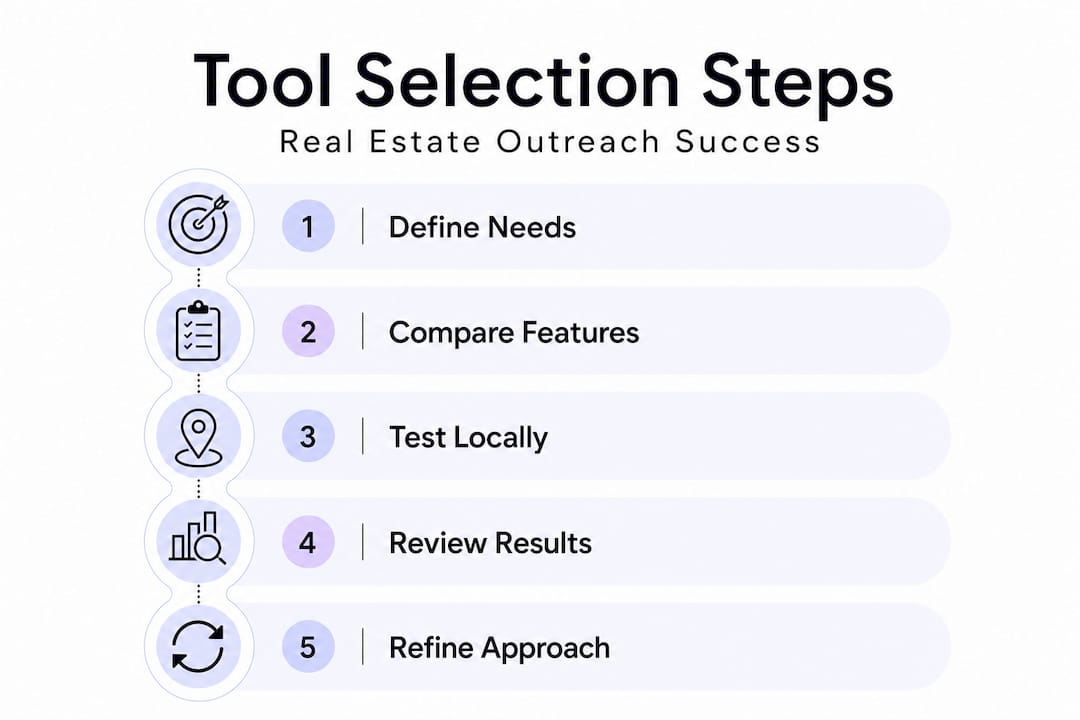
Vendor benchmarks are only directional. Agents must validate sequences and deliverability in their own market before committing to a tool at full scale.
Here’s how to approach tool selection with discipline:
- Start with your lead sources. If most of your leads come from online portals, SMS response time matters enormously. If referrals dominate, a tool with strong email personalization and call logging may be your priority.
- Map your follow-up gaps. Before testing any tool, document where leads currently fall through. Is it the first 48 hours? The 30-day follow-up? The tool should specifically address your weakest point.
- Run a 30-day controlled test. Take one lead segment and run two outreach sequences simultaneously. Different timing, different channels, different message angles. After 30 days, review which sequence generated more replies, appointments, and conversions.
- Track deliverability, not just activity. High send volume means nothing if emails land in spam. Monitor open rates weekly. A healthy email outreach program should maintain open rates above 25% for cold lists and well above 40% for warm lists.
- Evaluate integration depth. The best tool for your business is the one your CRM connects to seamlessly. Fragmented systems create manual work, which defeats the purpose of automation.
Reviewing detailed lead generation tool comparisons and applying proven real estate automation tips will sharpen your evaluation criteria before you commit to any platform.
Pro Tip: Set up A/B tests with different outreach sequences for one month. Review your CRM data every week, not just at the end of the test. Early signals in week one often reveal sequence problems that you can fix before they waste an entire month of lead activity.
Why human touch and local testing still matter
Most expert guides focus on which tool is best or which AI feature is most impressive. We want to push back on that framing. The tools are not the strategy. Your judgment is.
Every market has its own rhythm. What works in a hot urban condo market may completely miss in a slower rural single-family market. AI-generated message timing that’s calibrated for national averages may be perfectly misaligned with your buyers’ actual behavior patterns. No software vendor knows your market better than you do after six months of local testing.
AI should enhance, not replace human expertise in client interactions. That’s not just an ethical principle. It’s a practical one. Agents who lean too heavily on automation report something consistent: their pipeline grows but their close rate drops. Leads come in, sequences run, but somewhere in the automated flow, the relationship never solidifies. The agent was never really present.
The agents we see outperform their markets consistently share a different approach. They use automation to handle the routine so they can show up powerfully at the human moments. The first live conversation. The negotiation call. The moment a client needs honest guidance on a pricing decision. Those moments cannot be automated, and they’re where deals are actually won.
Implementing strong lead nurturing strategies alongside your automation layer builds the kind of pipeline that doesn’t just generate inquiries. It builds trust that converts. Local iteration, consistent testing, and a genuine commitment to showing up as a human being in key moments is what separates power brokers from agents who are simply busy.
Upgrade your outreach with expert-vetted tools
You now know what separates effective outreach from the noise. You understand how multi-channel automation, AI personalization, and rigorous local testing combine to create a prospecting system that actually converts. The next step is putting the right tools in place.
At ex.plo.re, we’ve done the work of identifying and curating the platforms that move the needle for real estate agents in competitive markets. Explore our roundup of top real estate outreach tools to find options that fit your workflow and budget. Compare your options in depth with our lead generation tools for realtors breakdown, or sharpen your approach with expert-backed real estate prospecting tips tailored to agents who want results, not just activity metrics. Our team is ready to help you build the outreach system your pipeline deserves.
Frequently asked questions
Do outreach tools replace the need for personal follow-up in real estate?
No. Outreach tools automate routine tasks, but AI should enhance rather than replace personal communication, especially at key decision moments in the client relationship.
What types of outreach channels are essential for real estate agents?
Essential channels include calls, texts, emails, social media, and direct mail. Multi-channel execution across all of these, unified inside a CRM, produces the most consistent and trackable results.
How can agents assess if an outreach tool actually improves their results?
Run local A/B tests and track lead responses and conversions inside your CRM over several weeks. Vendor benchmarks are directional at best; your own market data is the only reliable performance indicator.
What is the main risk of using AI-powered outreach in real estate?
The main risk is over-automation, which makes communications feel impersonal. Human oversight is necessary to ensure messages stay relevant, authentic, and compliant with platform guidelines.