

Manual prospecting drains time and money from real estate professionals who could be closing deals instead of chasing cold leads. Most agents spend over 15 hours weekly on repetitive tasks like data entry, follow-up emails, and lead sourcing. Automation transforms this reality by handling routine work while you focus on relationship-building and negotiations. This guide reveals how automating prospecting saves 13-16 hours per week, cuts costs by over 50%, and increases sales productivity by up to 29%, backed by data and practical implementation strategies.
Table of Contents
- Key takeaways
- How automation saves time and reduces costs in prospecting
- Boosting sales productivity and revenue with automated prospecting
- Avoiding pitfalls: balancing automation with relationship-building
- Implementing effective prospecting automation: best practices for real estate professionals
- Explore top prospecting tools to automate your real estate success
- Frequently asked questions about automating prospecting
Key Takeaways
| Point | Details |
|---|---|
| Weekly time savings | Automating prospecting saves 13 to 16 hours per week and frees time for client meetings and negotiations. |
| Lowered cost per meeting | Automated systems reduce the cost per qualified meeting from about 85 to 120 dollars to around 35 to 55 dollars. |
| Productivity gains | CRM driven automation yields roughly 29 percent higher sales, while marketing automation drives about 14.5 percent gains. |
| Hybrid approach | Balancing automation with personal outreach prevents robotic impressions and maximizes efficiency. |
How automation saves time and reduces costs in prospecting
Real estate agents waste enormous amounts of time on manual prospecting tasks that technology handles better and faster. Automation saves real estate agents 13-16 hours per week on repetitive activities like lead data entry, initial outreach sequences, and follow-up scheduling. Those recovered hours translate directly into more client meetings, property showings, and deal negotiations.
The financial impact extends beyond time savings. Manual prospecting costs $85-120 per qualified meeting when you factor in labor hours, database subscriptions, and opportunity costs. Automated systems reduce this to $35-55 per meeting by eliminating redundant work and improving targeting accuracy. The cost difference compounds quickly across dozens of monthly prospects.
| Task | Manual Time | Automated Time | Weekly Savings |
|---|---|---|---|
| Lead sourcing and research | 8 hours | 2 hours | 6 hours |
| Data entry and CRM updates | 5 hours | 1 hour | 4 hours |
| Follow-up emails and scheduling | 6 hours | 2 hours | 4 hours |
| Lead qualification screening | 4 hours | 1 hour | 3 hours |
Automation excels at tasks requiring consistency and speed. Lead capture forms instantly populate your CRM without manual typing. Email sequences trigger based on prospect behavior rather than your memory. Calendar integrations eliminate back-and-forth scheduling messages. These improvements free you to focus on high-value activities that truly require human judgment and relationship skills.
Pro Tip: Start by automating your most repetitive, time-consuming tasks first. Track time savings weekly to quantify ROI and identify which processes deliver the biggest efficiency gains. Most agents see the largest impact from automating lead data entry and initial follow-up sequences.
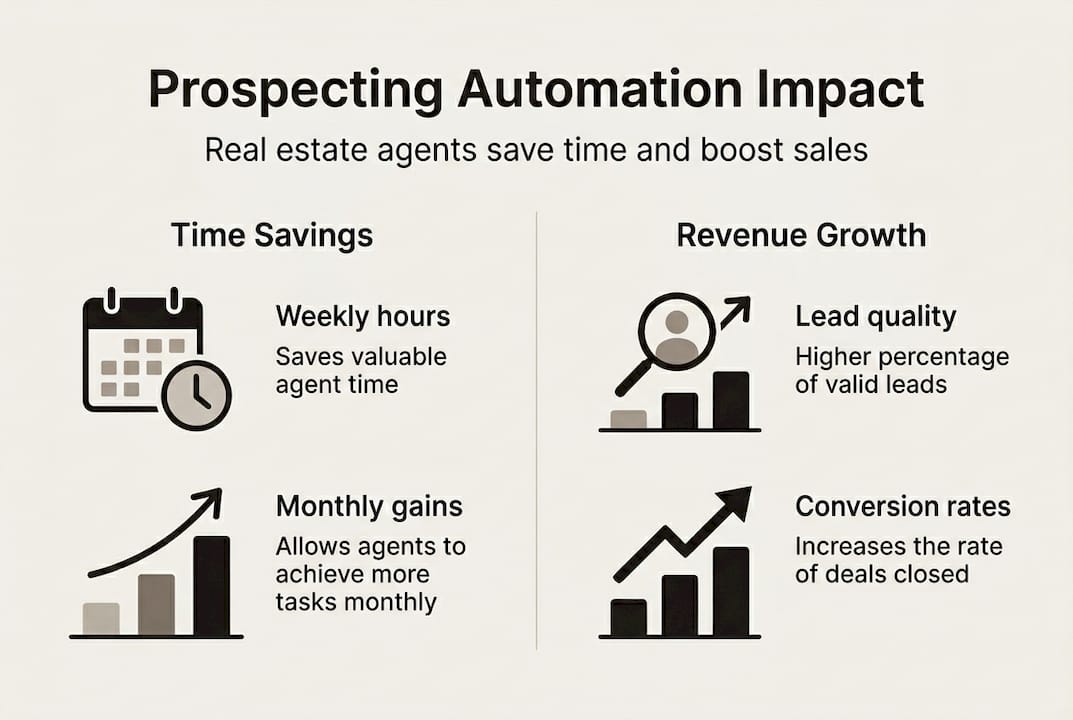
The compounding effect matters more than individual time savings. Recovering 15 hours weekly means 60 extra hours monthly for client-facing activities. That’s equivalent to hiring a part-time assistant without the overhead costs. Smart agents reinvest those hours into lead generation strategies that require personal expertise, creating a virtuous cycle of growth.
Boosting sales productivity and revenue with automated prospecting
Automation doesn’t just save time; it directly amplifies sales performance and revenue generation. Marketing automation yields 14.5% sales productivity increase while CRM users see 29% higher sales compared to agents relying on manual methods. These gains stem from faster response times, consistent follow-up, and better lead prioritization.
Automated lead management systems can increase revenue by 10% within six months of implementation. The improvement comes from reduced lead leakage, where prospects fall through cracks in manual systems. Automation ensures every lead receives timely attention and appropriate nurturing based on their stage in the buying journey. No more forgotten follow-ups or missed opportunities due to overwhelmed schedules.
- Better lead nurturing through personalized drip campaigns that adapt to prospect behavior
- Consistent follow-up that maintains engagement without manual tracking or reminders
- Personalized outreach at scale using dynamic fields and behavioral triggers
- Improved lead scoring that identifies hot prospects ready for personal contact
- Real-time alerts when prospects take high-intent actions like viewing listings multiple times
The productivity boost extends beyond individual efficiency. Teams using automation in real estate sales coordinate better because everyone accesses the same updated lead data and activity history. Managers gain visibility into pipeline health without constant status meetings. Agents spend less time on administrative coordination and more time actually selling.
Agents using marketing automation report 14.5% higher productivity while CRM adoption drives 29% sales increases. These gains compound over time as systems learn prospect patterns and optimize outreach timing automatically.
Revenue growth accelerates because automation enables you to work more leads simultaneously without quality degradation. Manual prospecting limits you to perhaps 20-30 active prospects you can effectively nurture. Automated systems let you manage 100+ leads with personalized touches, dramatically expanding your potential deal pipeline. The math is simple: more qualified prospects receiving timely attention equals more closed deals.

Role of CRM in real estate success becomes clearer when you see conversion rate improvements. Automated lead scoring identifies which prospects deserve immediate personal attention versus those needing more nurturing time. This prioritization prevents wasting hours on low-intent leads while hot prospects grow cold waiting for contact.
Avoiding pitfalls: balancing automation with relationship-building
Automation creates efficiency but introduces risks when implemented poorly. Over-automation feels robotic and canned replies kill trust according to agents who’ve experienced prospect pushback. Real estate transactions involve major financial and emotional decisions, so prospects quickly detect and reject impersonal, template-driven communication.
The uncanny valley effect hits hard in automated prospecting. Messages that almost sound human but miss subtle personalization cues trigger skepticism rather than engagement. Prospects recognize mass emails disguised as personal outreach, damaging your credibility before you get a chance to demonstrate genuine value. The solution isn’t abandoning automation but using it strategically for appropriate tasks.
False positives waste resources and frustrate both agents and prospects. Rules-based lead scoring systems often flag unqualified leads as hot prospects because they lack sophisticated behavioral analysis. You end up spending time on dead-end conversations while genuine opportunities receive delayed attention. Data integration quality directly impacts scoring accuracy, making clean CRM data essential for automation success.
- Canned messaging that ignores prospect-specific context and needs
- Ignoring buyer signals because automation follows predetermined sequences regardless of responses
- Over-reliance on rules-based scoring that misses nuanced buying intent indicators
- Neglecting to update automation workflows as market conditions and buyer preferences evolve
- Failing to monitor automation performance metrics and adjust based on actual results
Pro Tip: Use automation for initial outreach and routine follow-ups, but inject personal touches at key decision points. Review automated messages monthly and refresh language to prevent stale, obviously templated communication. Set triggers for personal intervention when prospects show high engagement.
The hybrid approach works best for prospecting in real estate because it combines technological efficiency with human relationship skills. Let automation handle scheduling, data entry, and initial qualification. Reserve your personal energy for consultative conversations, property tours, and negotiation discussions where your expertise creates real value prospects can’t get from technology alone.
Relationship-focused industries like real estate require authenticity that pure automation can’t deliver. Prospects want to know a real person understands their unique situation and will advocate for their interests. Use automation to create space for those meaningful interactions rather than replacing them entirely. The agents winning in 2026 master this balance instead of choosing one extreme.
Implementing effective prospecting automation: best practices for real estate professionals
Successful automation implementation follows a structured approach rather than random tool adoption. Start by assessing which prospecting tasks consume the most time and offer the clearest automation opportunities. Most agents find lead data entry, initial outreach, and follow-up scheduling deliver quick wins with minimal complexity.
- Assess your current prospecting workflow and identify repetitive, time-consuming tasks
- Choose automation tools that integrate with your existing CRM and communication platforms
- Train your team on proper tool usage and establish clear protocols for when automation hands off to personal outreach
- Monitor key metrics like response rates, meeting conversion, and time savings to measure ROI
- Iterate based on results, refining messaging, timing, and triggers to improve performance continuously
Tool selection matters more than most agents realize. The wrong platform creates more work through poor integrations, clunky interfaces, or missing features that force workarounds. Experts recommend hybrid automation-manual approach for real estate’s relationship focus, so prioritize tools offering flexibility and personalization capabilities alongside efficiency features.
| Tool Category | Key Features | Best For | Integration Priority |
|---|---|---|---|
| CRM with automation | Lead scoring, email sequences, task automation | Full pipeline management | Essential |
| Email marketing platforms | Drip campaigns, behavioral triggers, A/B testing | Nurturing cold leads | High |
| Scheduling tools | Calendar sync, automated booking, reminders | Meeting coordination | High |
| Lead capture systems | Form builders, landing pages, instant CRM sync | Website conversion | Medium |
| Social media automation | Post scheduling, engagement tracking, lead identification | Brand building | Medium |
Integrating automation into existing workflows without losing personal touch requires intentional design. Set up automation to handle initial contact and routine follow-ups, but trigger personal intervention when prospects show high engagement or ask specific questions. Review automated message performance monthly and refresh language to prevent stale, obviously templated communication.
Pro Tip: Implement continuous data quality checks to maintain accurate lead information and improve scoring reliability. Schedule weekly CRM audits to catch and correct duplicate entries, outdated contact details, and incomplete prospect profiles. Clean data dramatically reduces false positives and wasted outreach efforts.
Explore comprehensive guides on real estate automation tools to understand feature differences and pricing models before committing. Compare options using lead generation tools for realtors to find platforms matching your specific needs and budget constraints. The right tool stack amplifies your strengths rather than forcing you to adapt to rigid systems.
Measurement separates successful automation from wasted technology spending. Track metrics like email open rates, response rates, meeting booking percentages, and ultimately closed deal attribution. These numbers reveal which automated sequences work and which need refinement. Adjust messaging, timing, and targeting based on data rather than assumptions about what prospects want.
Explore top prospecting tools to automate your real estate success
Ready to transform your prospecting efficiency with proven automation solutions? We’ve curated comprehensive resources to help you identify and implement the best tools for your specific needs. Our expert team understands the challenges real estate professionals face when trying to scale client acquisition without sacrificing relationship quality.

Discover the best real estate prospecting tools 2026 has to offer, with detailed comparisons of features, pricing, and integration capabilities. Learn advanced strategies for prospecting in real estate client acquisition that blend automation efficiency with personal relationship-building. Explore cutting-edge real estate AI prospecting tools that use machine learning to identify high-intent prospects and optimize outreach timing. Let our talented team and technology amplify your impact and streamline your path from prospect to closed deal.
Frequently asked questions about automating prospecting
What tasks in real estate prospecting are easiest to automate?
Lead data entry, initial email outreach, follow-up scheduling, and social media posting offer the quickest automation wins. These repetitive tasks require consistency rather than creative judgment, making them perfect for technology to handle. Start with these foundational automations before tackling more complex processes.
How do I balance automation with personal outreach effectively?
Use automation for initial contact, routine follow-ups, and administrative tasks while reserving personal interaction for high-value conversations and relationship-building moments. Set triggers that alert you when prospects show strong engagement signals, prompting immediate personal follow-up. The key is letting technology create space for meaningful human interaction rather than replacing it entirely.
What is the ROI of investing in prospecting automation?
Most agents see 10-29% productivity increases and recover 13-16 hours weekly within three months of implementation. Cost per qualified meeting drops from $85-120 to $35-55, delivering clear financial returns. Calculate your current time spent on manual prospecting and multiply by your hourly value to estimate potential savings.
Can automation help with lead qualification accuracy?
Yes, when implemented with clean data and behavioral tracking. Modern lead scoring systems analyze engagement patterns, property viewing history, and communication responsiveness to identify genuinely interested prospects. However, you must maintain data quality and regularly update scoring criteria to avoid false positives that waste time on unqualified leads.
Are AI prospecting tools worth adopting now?
AI tools offer significant advantages in pattern recognition, optimal timing prediction, and personalization at scale. Early adopters gain competitive advantages in generating real estate leads for high-value clients. However, start with foundational automation before adding AI complexity to ensure your team can effectively leverage advanced capabilities.