

Turning potential buyers into loyal clients takes more than just charm in today’s global real estate market. As competition intensifies and client expectations shift, understanding the true power of a real estate sales funnel becomes essential. This article explores the strategic process behind guiding prospects from first encounter to final transaction, offering practical insights for real estate professionals seeking to maximize opportunities and build stronger, longer-lasting client relationships.
Table of Contents
- Defining A Real Estate Sales Funnel
- Key Stages In Real Estate Funnels
- Effective Types And Proven Strategies
- How Crm And Automation Tools Enhance Funnels
- Critical Mistakes And Risk Factors To Avoid
Key Takeaways
| Point | Details |
|---|---|
| Understanding the Sales Funnel | A real estate sales funnel guides potential clients from awareness to purchase, optimizing client management strategies and improving conversion rates. |
| Key Stages of the Funnel | The sales funnel consists of seven stages that require tailored strategies and communication to cater to clients’ unique needs and motivations. |
| Dynamic Strategies for Client Segments | Successful real estate agents customize their sales funnel approaches for specific client segments, enhancing engagement and conversion through targeted content. |
| Automation and CRM Benefits | Leveraging advanced CRM and automation tools improves efficiency and personalization in client interactions, allowing agents to focus on high-value communications. |
Defining a Real Estate Sales Funnel
A real estate sales funnel represents the strategic journey potential clients navigate from initial awareness to final property transaction. Unlike traditional sales approaches, this methodical process transforms cold leads into committed buyers through carefully orchestrated interactions and targeted communication.
The core components of an effective real estate sales funnel typically include:
- Awareness Stage: Attracting potential clients through targeted marketing
- Interest Stage: Engaging prospects with compelling property information
- Consideration Stage: Nurturing leads with personalized communication
- Decision Stage: Presenting tailored property options and closing strategies
- Retention Stage: Building long-term client relationships
Understanding the sales funnel is crucial because real estate market dynamics require strategic client management. By mapping each client’s unique journey, agents can optimize their approach, anticipate client needs, and dramatically improve conversion rates.

Successful real estate professionals recognize that a sales funnel is more than a linear progression. It’s a dynamic ecosystem where relationships, trust, and strategic communication converge to transform potential opportunities into successful transactions.
Pro tip: Create detailed client personas to personalize your sales funnel approach and increase engagement at every stage of the buyer’s journey.
Key Stages in Real Estate Funnels
The real estate sales funnel is a sophisticated process that transforms potential leads into committed property buyers through a strategic, multi-stage approach. Comprehensive sales funnel frameworks demonstrate that successful conversions rely on understanding and mastering each critical stage of client interaction.
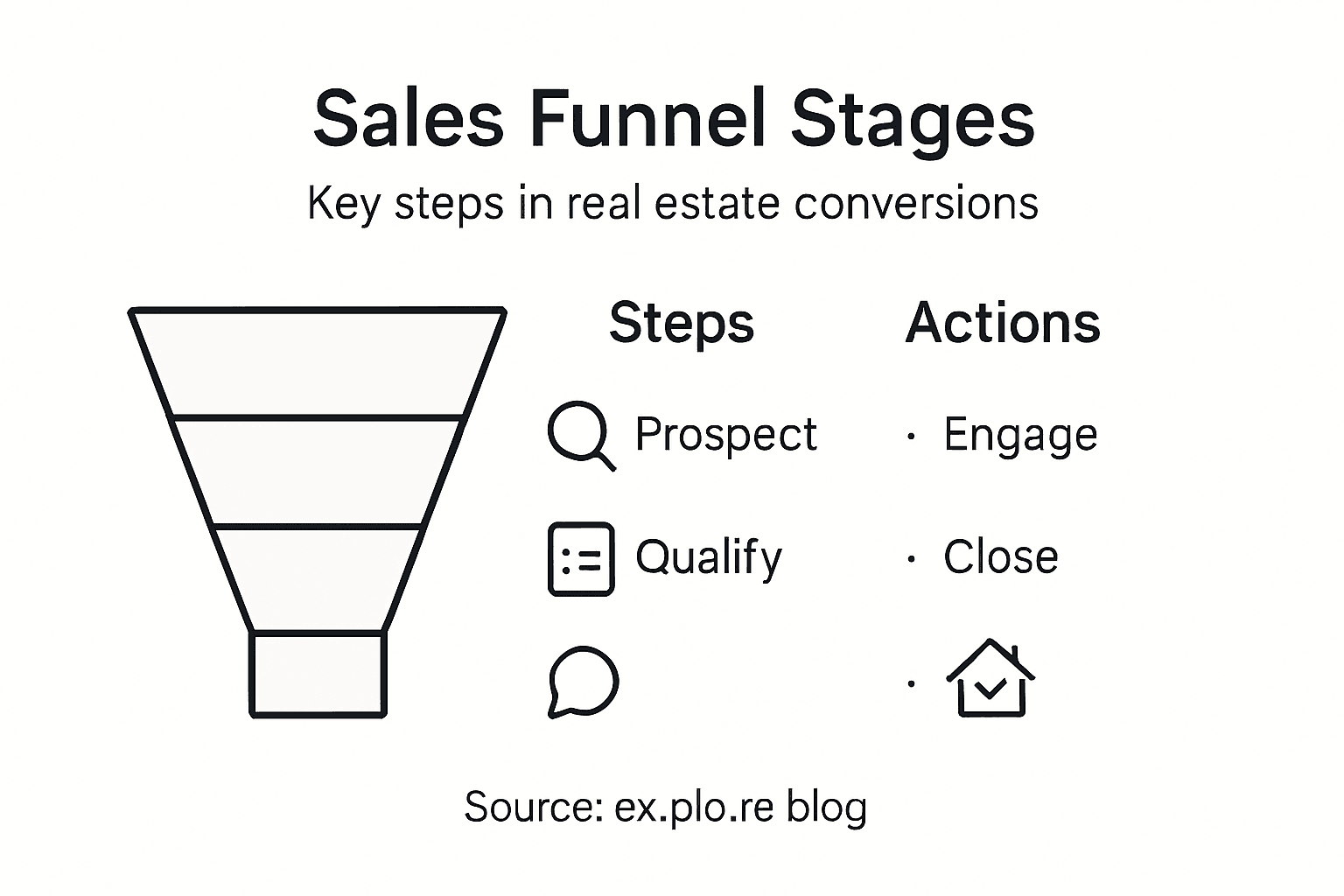
Traditional real estate sales funnels typically encompass seven key stages:
- Prospecting Stage: Identifying and attracting potential clients
- Pre-Approach Stage: Researching client backgrounds and preferences
- Approach Stage: Making initial contact and establishing rapport
- Presentation Stage: Showcasing property options and value propositions
- Objection Handling Stage: Addressing client concerns and reservations
- Closing Stage: Negotiating and finalizing property transactions
- Follow-Up/Retention Stage: Building long-term client relationships
Each stage requires specific strategies and communication techniques. Real estate agents must adapt their approach dynamically, understanding that clients move through these stages at different paces and with unique motivations. Successful professionals develop nuanced skills to guide clients seamlessly from initial curiosity to final purchase.
Pro tip: Develop a personalized tracking system to monitor client progress through each funnel stage and customize your engagement strategies accordingly.
Effective Types and Proven Strategies
Successful real estate professionals understand that sales funnel strategies must be dynamic and tailored to specific client segments. Advanced marketing techniques demonstrate the importance of customizing approaches for different real estate markets and buyer personas.
Key strategies for optimizing real estate sales funnels include:
- Content Marketing: Creating valuable, targeted property insights
- SEO Optimization: Improving online visibility and search rankings
- Social Media Engagement: Building brand presence and trust
- CRM Integration: Tracking and managing client interactions
- Personalized Communication: Segmenting audiences for precise targeting
- Retargeting Ads: Reconnecting with potential clients
- Performance Metrics: Continuously measuring and improving conversion rates
Different types of real estate sales funnels require unique approaches. First-time homebuyers need educational content and guidance, while property investors demand data-driven insights and quick, efficient communication channels. Successful agents adapt their strategies to match specific client motivations and expectations.
Here’s a summary of strategies and the client segments they best support:
| Strategy | Ideal Client Segment | Key Benefit |
|---|---|---|
| Content Marketing | First-time homebuyers | Builds trust through education |
| Data-Driven Insights | Property investors | Informs fast decision-making |
| Social Media Engagement | Younger buyers | Increases brand visibility |
| Personalized Communication | Upscale clients | Increases engagement |
By implementing a comprehensive, multi-channel approach, real estate professionals can transform potential leads into loyal clients and maximize their conversion potential.
Pro tip: Develop granular client personas and create specialized content tracks that speak directly to each segment’s unique needs and pain points.
How CRM and Automation Tools Enhance Funnels
Real estate professionals increasingly rely on advanced CRM technologies to transform their sales processes. Advanced CRM platforms centralize customer interactions and provide unprecedented insights into client behaviors and preferences.
Key automation capabilities that enhance real estate sales funnels include:
- Data Centralization: Consolidating client information in one platform
- Predictive Analytics: Identifying high-potential leads
- Automated Communication: Scheduling personalized follow-ups
- Performance Tracking: Monitoring conversion rates and engagement
- Lead Scoring: Prioritizing prospects based on potential value
- Workflow Automation: Reducing manual administrative tasks
- Personalized Messaging: Tailoring communication to individual client needs
The integration of artificial intelligence and automation transforms traditional sales approaches. By leveraging intelligent tools, real estate agents can create more responsive, efficient, and targeted sales strategies that adapt to each client’s unique journey.
Pro tip: Implement a robust CRM system that offers AI-driven insights and automates repetitive tasks to free up time for high-value client interactions.
Critical Mistakes and Risk Factors to Avoid
Real estate professionals must be vigilant about potential pitfalls that can undermine their sales funnel effectiveness. Common mistakes in automated sales processes can significantly reduce conversion rates and damage client relationships.
Key risk factors and critical mistakes to avoid include:
- Lack of Strategic Planning: Implementing automation without clear objectives
- Poor Audience Segmentation: Treating all leads with a one-size-fits-all approach
- Inadequate Personalization: Sending generic, impersonal communications
- Neglecting Performance Metrics: Failing to track and analyze funnel performance
- Weak Multi-Channel Integration: Disconnected communication across platforms
- Information Overload: Overwhelming prospects with excessive details
- Insufficient Human Interaction: Over-relying on automated systems
Successful real estate professionals understand that automation is a tool, not a complete solution. The most effective sales funnels balance technological efficiency with genuine human connection, ensuring that each lead receives personalized attention and meaningful engagement.
The following table highlights common automation risks and how to prevent them:
| Risk Factor | Potential Consequence | Mitigation Method |
|---|---|---|
| Poor Segmentation | Wasted marketing efforts | Refine lead categories |
| Information Overload | Loss of client interest | Simplify key messages |
| Insufficient Human Touch | Lower trust and engagement | Add personal interactions |
| Neglecting Metrics | Missed sales improvement | Regular funnel analysis |
Pro tip: Regularly audit your sales funnel, reviewing each stage for potential bottlenecks and implementing data-driven improvements to optimize client conversion.
Accelerate Your Real Estate Sales Funnel Success Today
Understanding the complexity of a real estate sales funnel is the first step toward turning leads into loyal clients. This article highlights critical challenges like ineffective segmentation, lack of personalization, and poor performance analysis that can stall your conversions. Real estate agents striving to navigate each funnel stage from prospecting to closing need tools that deliver actionable insights and automate repetitive tasks.
At ex.plo.re, we specialize in empowering agents to overcome these exact pain points with cutting-edge CRM and automation solutions. Our platform streamlines your prospecting and sales cycle, enabling personalized communication and intelligent lead scoring so you can focus on meaningful client engagement. Leverage our expert team and technology to boost your client conversions while avoiding common pitfalls outlined in Sales Funnel Real Estate: Boost Conversions Fast.

Take control of your sales funnel today and transform your lead management with our advanced CRM platform. Discover how personalized automation and client segmentation can ignite your local real estate success. Don’t let another opportunity slip away when you can start amplifying your impact now at ex.plo.re.
Frequently Asked Questions
What are the key stages of a real estate sales funnel?
The key stages of a real estate sales funnel typically include: Prospecting, Pre-Approach, Approach, Presentation, Objection Handling, Closing, and Follow-Up/Retention. Each stage requires tailored strategies to engage clients effectively.
How can content marketing boost my real estate sales funnel?
Content marketing can attract and educate potential clients, particularly first-time homebuyers, by providing valuable information about properties and the buying process, thus building trust and increasing engagement.
What mistakes should I avoid when using automation in my sales funnel?
Key mistakes include lack of strategic planning, poor audience segmentation, inadequate personalization, and neglecting performance metrics. These can lead to ineffective marketing efforts and lost conversions.
How can CRM systems enhance my real estate sales funnel?
CRM systems enhance real estate sales funnels by centralizing client data, providing predictive analytics, automating communications, and tracking performance metrics, which all help to prioritize leads and personalize client interactions.