

Busy American real estate agents know the frustration of juggling client details, property updates, and endless follow-ups. In a competitive market where quick response and personalized service are the difference between winning a listing or losing a lead, CRM systems organize customer data and automate your daily workflow for measurable results. This introduction breaks down the key concepts and tools that help you stay ahead locally, maximize every client relationship, and convert prospects into loyal clients using the most effective CRM features.
Table of Contents
- CRM Basics For Real Estate Professionals
- Main Types Of Real Estate CRM Systems
- Key CRM Features Agents Need
- How CRM Streamlines Local Client Acquisition
- Common CRM Challenges And Mistakes To Avoid
Key Takeaways
| Point | Details |
|---|---|
| Importance of CRM | A CRM system centralizes client information, automates tasks, and enhances relationship management, offering a competitive edge in real estate. |
| Choosing the Right CRM | Understand the three main types of CRM systems: All-in-one, marketing-focused, and pipeline management, to fit your business model. |
| Essential Features | Look for lead management, pipeline tracking, and automation features to effectively convert prospects into clients. |
| Avoid Common Mistakes | Ensure accurate data entry, prioritize follow-up tasks, and personalize messaging to improve client engagement and retention. |
CRM Basics for Real Estate Professionals
A Customer Relationship Management (CRM) system is your business operating system. It’s where you store client information, track interactions, manage properties, and automate the repetitive tasks that eat up your time. Think of it as a centralized hub that connects every relationship and transaction in your business—one place where your entire client history lives, accessible from anywhere. Rather than juggling spreadsheets, email inboxes, and scattered notes, you’re working with organized, real-time data that keeps everyone on the same page. This matters because North American real estate is competitive, and agents who can access client preferences, follow-up dates, and property history instantly gain a significant edge. CRM principles emphasize organizing customer data and automating processes that would otherwise consume hours each week.
When you implement a CRM, you’re essentially giving yourself the ability to scale your business without scaling your stress. The system tracks every client touchpoint—calls, emails, property viewings, negotiations—so nothing falls through the cracks. You can set up automated workflows that send follow-up messages at exactly the right time, create task reminders for follow-ups, and generate reports showing which prospects are most engaged. Rather than relying on memory or sticky notes, you’re working with data. This means a lead who expressed interest in luxury homes on the waterfront three months ago automatically resurfaces when a matching property hits the market. A CRM also helps you segment your client base, so you’re sending relevant information to the right people—young first-time buyers see starter homes; experienced investors see investment opportunities. The cloud-based access that most modern CRM platforms offer means you can pull up client details from an open house, a client meeting, or your car.
The practical foundation involves three key components. First, contact management: storing detailed information about buyers, sellers, and prospects with notes on their preferences, budget, timeline, and family situation. Second, property tracking: logging listings, status changes, and performance metrics so you know which properties are generating interest. Third, communication automation: scheduling emails, creating follow-up sequences, and setting task reminders so consistency happens automatically rather than by willpower. When you’re managing dozens of active clients and tracking hundreds of potential leads, these three systems prevent leads from slipping away and ensure you maintain regular contact with your sphere. Your CRM becomes the single source of truth that every member of your team can reference, eliminating the confusion that comes from multiple versions of client information.
Pro tip: Start by importing your existing contacts and focusing on one workflow (like lead follow-up sequences) before expanding to additional features—this prevents overwhelm and lets you see real results quickly.
Main Types of Real Estate CRM Systems
Not all CRM systems are created equal, and choosing the wrong one can waste time and money. Real estate professionals need to understand the three primary types of CRM systems to select the right fit for their business model. Each type serves different priorities, and your choice depends on whether you’re focused on managing transactions, generating leads, or building comprehensive client relationships across multiple channels.
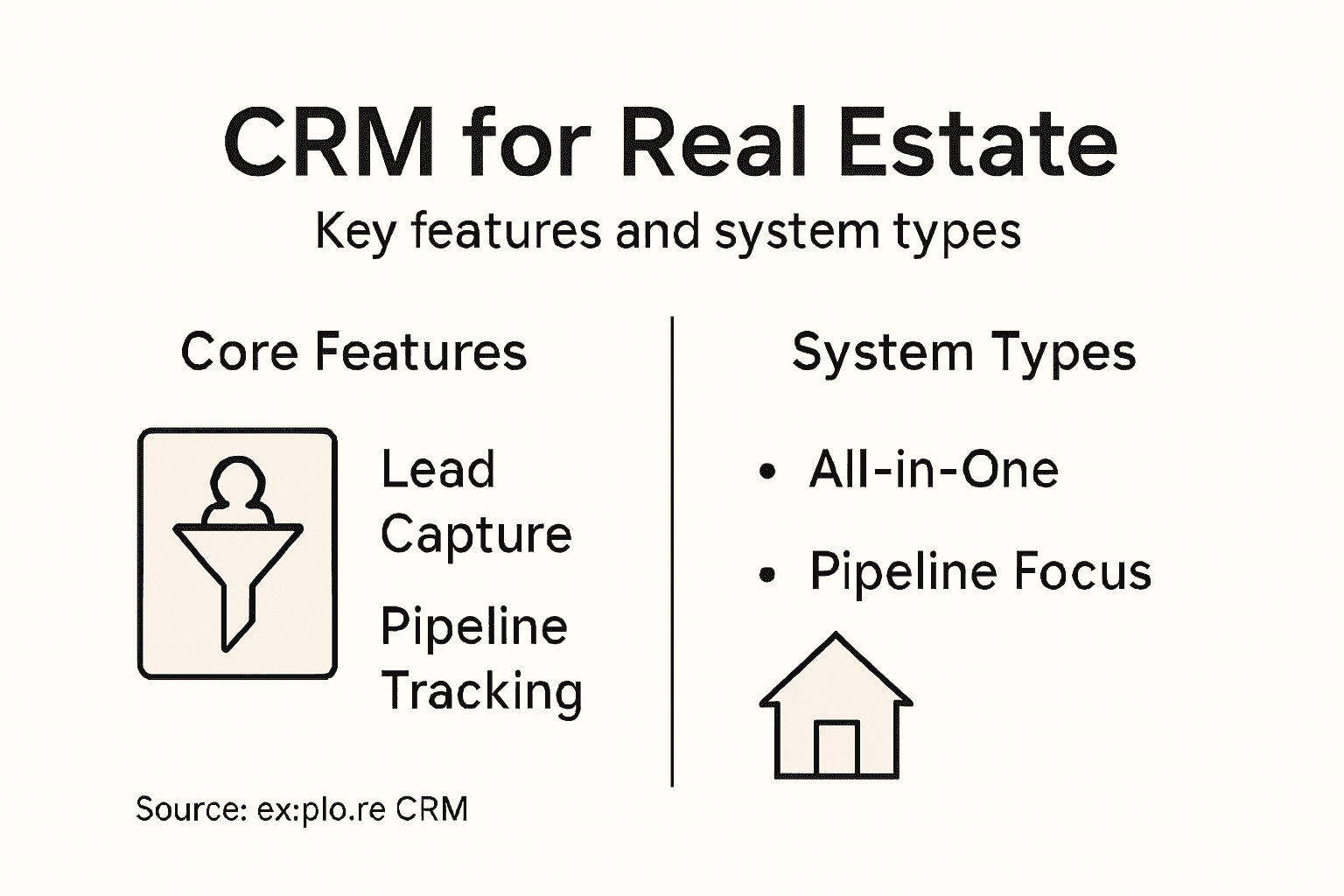
All-in-one platforms are the most comprehensive option, bundling contact management, property tracking, transaction management, and marketing automation into a single system. These platforms work well for agents and brokers who want everything in one place, reducing the need to juggle multiple software subscriptions. You get contact management for storing client information, document storage for contracts and disclosures, lead scoring to identify hot prospects, and integrated marketing tools for email campaigns. The advantage is seamless data flow—when a lead moves through your pipeline, all information updates automatically. The tradeoff is that all-in-one systems often come with a steeper learning curve and higher monthly costs, though they typically deliver better returns for agents managing substantial transaction volumes. Marketing-focused CRMs prioritize lead generation and client engagement, emphasizing email campaigns, social media integration, and automated nurture sequences. These systems excel at keeping prospects engaged through consistent communication and sophisticated lead tracking and segmentation features. If your primary goal is building a pipeline and converting prospects into clients, a marketing-focused CRM gives you the tools to do that efficiently without extra features you won’t use.
Pipeline management CRMs zero in on deal tracking and sales efficiency. These systems visualize where each transaction stands—from initial contact through closing—making it easy to spot bottlenecks and prioritize deals. Real estate teams with multiple agents benefit from pipeline management systems because management can track every transaction in real time, forecast revenue accurately, and identify which agents need support. The downside is limited marketing automation, so you’ll likely need a separate solution for lead nurturing if that’s important to your business. Your choice between these types depends on your business size, transaction volume, and what drives revenue for you. Solo agents with strong past client relationships may thrive with a marketing-focused CRM. Larger teams managing dozens of concurrent transactions need pipeline visibility that an all-in-one or pipeline-focused system provides. Ask yourself this: What’s the biggest bottleneck in your business right now? That answer points you toward the right CRM type.
Here’s a quick comparison of the three main real estate CRM types:
| CRM Type | Core Strength | Best For |
|---|---|---|
| All-in-one | Combines contact, transaction, and marketing tools | Teams managing many deals |
| Marketing-focused | Lead generation and client engagement | Solo agents growing pipeline |
| Pipeline management | Visual deal tracking and revenue forecasting | Large teams needing sales oversight |
Pro tip: Request demos from at least three CRM vendors representing different types, then test each system with your actual workflow for 2-3 days before committing—what works on paper often feels different when you’re actually using it.
Key CRM Features Agents Need
The difference between a CRM that transforms your business and one that collects dust comes down to having the right features. You need functionality that speaks directly to how real estate works, not generic sales software adapted from other industries. The core features worth investigating are lead management, pipeline tracking, automation, and property management integration. Without these, you’re essentially paying for a fancy contact database.
Lead management is non-negotiable. Your CRM must capture leads from multiple sources—website forms, phone calls, open house sign-ins, social media inquiries—and funnel them into a single system. Once captured, the system should score leads automatically, showing you which prospects are most likely to convert based on their behavior and engagement level. You need the ability to segment your leads by criteria like budget, location preferences, timeline, and property type, so your follow-up communications feel personal rather than generic. Efficient lead management and automated follow-ups ensure prospects stay engaged while you focus on high-priority clients. Without proper lead management, deals slip away because nobody follows up consistently, and your database becomes a graveyard of missed opportunities.
Pipeline tracking shows you exactly where each deal stands and prevents transactions from stalling in limbo. Your CRM should visualize every stage—initial contact, property showing, offer submitted, inspection, appraisal, closing—so you and your team know what needs attention today. Document management integrations are equally critical because real estate generates mountains of paperwork. Your system should store contracts, disclosures, inspection reports, and financial documents in one place, accessible instantly without hunting through email attachments or file folders. Task automation saves countless hours by triggering actions automatically. When a lead signs up, the CRM can automatically send a welcome email, create a follow-up task for two days later, and alert your team that a new prospect entered the system. Features like property listing integration and showing scheduling support the unique demands of managing multiple properties, coordinating appointments, and tracking commissions. AI assistants and predictive analytics are becoming standard, helping you identify which leads to prioritize and when to reach out for maximum impact.

The bottom line: evaluate every feature against this question: Does this save me time or make me money? If a feature doesn’t do either, skip it.
Below is a summary of essential CRM features and the business impact for real estate agents:
| Feature | What It Does | Business Impact |
|---|---|---|
| Lead Management | Captures, scores, and segments prospects | Increases conversion and reduces lost deals |
| Pipeline Tracking | Visualizes each stage of sales process | Prevents stalled transactions and boosts accuracy |
| Task Automation | Schedules follow-ups and reminders | Saves time and ensures consistency |
| Property Integration | Links listings and documents to contacts | Streamlines management and reduces errors |
Pro tip: During your CRM trial, focus on testing lead capture and follow-up automation with real leads—these two features alone will prove whether the system can actually improve your results or just add another tab to your browser.
How CRM Streamlines Local Client Acquisition
Local real estate success hinges on knowing your market intimately and staying top-of-mind with prospects in your area. A CRM transforms this from guesswork into a systematic process. Instead of hoping people remember you when they’re ready to buy or sell, your CRM ensures consistent, personalized contact that keeps you present throughout their decision-making journey. This matters because local markets are built on relationships and reputation. When a prospect is considering listing their home, they’re comparing agents. The agent who reaches out at the right moment with relevant information wins the listing. Your CRM makes that possible at scale.
The core mechanism is contact segmentation and targeted outreach. Your CRM organizes prospects by location, budget, property type interest, and timeline. When you capture a lead from a local open house, their information automatically goes into a segment with other prospects interested in that neighborhood. Your CRM can then trigger a personalized email sequence highlighting recent sales in that area, featuring new listings, or sharing market insights specific to that community. Automating lead follow-ups and personalizing drip campaigns dramatically increases engagement rates because prospects receive relevant information instead of generic mass emails. A buyer researching homes in the $500K to $600K range in a specific school district gets different content than an investor looking for rental properties. This relevance is what separates agents who dominate their local market from those who struggle for visibility.
Your CRM also captures behavior data that reveals buying intent. When a prospect visits your website multiple times, opens emails consistently, or clicks on listings in a particular area, your system flags them as hot. You can see which leads need immediate follow-up and which ones are still in early research mode. Real estate CRMs track client interactions and manage marketing campaigns based on buying patterns, helping you prioritize your time on prospects most likely to convert. Integration with advertising platforms means every dollar you spend on local Facebook ads, Google search campaigns, or direct mail feeds directly into your CRM, making it easy to track which marketing channels deliver actual clients. You stop wasting money on campaigns you can’t measure.
The result is faster client acquisition and higher conversion rates in your local market. Agents using CRM-driven strategies stay in constant, relevant contact with their prospect pool without constant manual effort. Your reputation grows locally because people remember you as the agent who knows the market and stays in touch.
Pro tip: Set up one location-based segment first (your primary neighborhood or market), create a 4-email welcome series for new prospects in that area, then measure results for 30 days before expanding to additional segments—this teaches you what resonates locally before rolling out broadly.
Common CRM Challenges and Mistakes to Avoid
Investing in a CRM is only half the battle. Many agents buy the software, set it up halfway, and then wonder why they’re not seeing results. The real issues emerge after implementation. You’ll encounter problems that aren’t about the technology itself but about how you’re using it. Understanding these pitfalls before they derail your business saves time, money, and frustration.
The most costly mistake is poor data entry discipline. When leads enter your CRM slowly or incompletely, your system becomes unreliable. A prospect calls interested in a waterfront property, and you jot down their name and number, planning to add details later. Three days pass. You forget to enter their property preferences and budget. When a perfect listing hits the market, your system can’t match it to them because the data was never complete. Delayed lead entry and outdated information directly cause lost opportunities. Set a non-negotiable rule: every lead gets entered fully within 24 hours. Incomplete data is nearly worthless data. Your CRM is only as good as the information inside it. A second critical error is creating tasks and follow-ups without prioritization. Agents who dump 47 tasks into their system each week find themselves paralyzed. Should you call the hot prospect or follow up on the listing that closed last month? Without clear prioritization, important items slip through. Your CRM should surface the three to five actions that matter most today. Everything else can wait. Create a daily review habit: spend five minutes each morning identifying which three tasks drive revenue today.
Generic messaging is another silent killer. Your CRM enables personalization, but many agents treat it as a broadcast tool. You send the same “new listings in your area” email to 200 people with zero customization. A first-time buyer with a $300K budget gets the same message as a seasoned investor looking for commercial properties. That’s not how CRM works. Customizing communications based on client preferences builds stronger relationships and dramatically improves response rates. Spend time segmenting your database and creating targeted messaging for each segment. A buyer segment gets content about financing and home inspection tips. An investor segment gets cash-on-cash return calculations and market analysis. The effort pays dividends in engagement and conversion.
Finally, many agents view their CRM as a solo tool rather than a team resource. If you’re the only person with access to client information, you create bottlenecks and risk losing relationships if you’re unavailable. Your team should have visibility into client history, preferences, and next steps. This prevents miscommunication and ensures every team member can serve clients professionally when you’re busy.
Pro tip: Audit your CRM data monthly by reviewing 20 random contacts and checking for completeness, accuracy, and whether follow-up dates are relevant—this catches problems before they cost you deals.
Boost Your Real Estate Success with the Right CRM Solution
The article highlights the crucial role of a well-implemented CRM system in overcoming common challenges such as inconsistent follow-ups, disorganized contact data, and missed client opportunities. Real estate professionals like you need a tailored platform that streamlines lead management, pipeline tracking, and automated communication to convert prospects into loyal clients. These pain points slow down growth and increase stress but can be transformed into opportunities with the right technology and expert support.
At ex.plo.re CRM we understand the demands of local client acquisition and sales cycle efficiency emphasized in the article. Our all-in-one platform is designed to help agents and brokers organize detailed client information, automate personalized follow-ups, and visualize every stage of the deal pipeline so you never miss a crucial step. Combining cutting edge tools with a dedicated team, we empower you to amplify your impact and become a true power broker.
Are you ready to turn data chaos into organized success and accelerate your sales growth today

Explore how our expert talent and technology can simplify your daily workflows and help you close more deals. Visit ex.plo.re CRM now for a personalized demo and start transforming your real estate business immediately.
Frequently Asked Questions
What is the role of a CRM in real estate?
A CRM serves as a centralized hub for real estate professionals, allowing them to store client information, track interactions, manage properties, and automate tasks, thus enhancing efficiency and client relationships.
How can a CRM help real estate agents improve client acquisition?
A CRM can streamline local client acquisition by enabling targeted outreach, organizing prospects based on their preferences, and automating follow-up communications, which keeps agents top-of-mind with potential clients.
What types of CRM systems are available for real estate professionals?
There are three main types of CRM systems for real estate: all-in-one platforms, marketing-focused CRMs, and pipeline management CRMs, each catering to different business needs and priorities.
What key features should a real estate CRM have?
A real estate CRM should include essential features such as lead management, pipeline tracking, automation, and property management integration to effectively support agents in their workflow.