

Most real estate agents send the same pitch to every prospect and wonder why their pipeline stalls. The gap between generic and personalized outreach is staggering. Response rates run 3 to 10 times higher with personalized pitches, jumping from a 1 to 5% reply rate on generic messages to 18 to 32% when you tailor your approach. Some agents using advanced personalization see a 142% boost in replies. If you are still relying on a one-size-fits-all script, you are leaving deals on the table every single day. This article breaks down why personalization works, what it actually looks like in practice, and how you can implement it starting now.
Table of Contents
- Why personalization matters in real estate sales
- Performance data: Generic vs personalized sales pitches
- What personalization really means: Going beyond the name
- Balancing depth: Effective but not intrusive
- Implementing personalization: Tactics and tools for agents
- Take your sales pitch personalization further
- Frequently asked questions
Key Takeaways
| Point | Details |
|---|---|
| Dramatic ROI gains | Personalized sales pitches deliver far higher response and revenue results than generic approaches. |
| Beyond surface details | Effective personalization involves behaviors, needs, and timing, not just names or simple demographics. |
| Balance is critical | Over-personalization can feel intrusive; focus on what is relevant and comfortable for clients. |
| Tech boosts scale | AI-powered CRM tools empower agents to personalize at scale without losing quality. |
| Action drives success | Applying advanced personalization strategies helps agents close more deals in competitive real estate markets. |
Why personalization matters in real estate sales
Real estate is not a commodity transaction. Buying or selling a home is one of the most emotionally charged decisions a person makes. Generic pitches signal that you see clients as numbers, not people. That disconnect kills trust before the conversation even starts.
Modern buyers expect more. 72% of B2B customers expect personalized experiences, and that expectation has crossed into residential real estate. Clients want property recommendations that reflect their lifestyle, budget, and timeline, not a mass email blast about listings that do not fit their needs.
The revenue impact is real too. Companies that excel at personalization generate 40% more revenue than those that do not. For agents, that translates directly into more signed contracts and higher commissions.
Here is what generic pitches cost you:
- Lost trust: Clients sense when they are getting a template. It signals low effort.
- Missed connection: You cannot address a client’s real objections if you do not know what they are.
- Slower pipeline: Generic outreach generates fewer callbacks, meaning longer sales cycles.
- Weaker referrals: Clients who feel seen refer others. Clients who feel processed do not.
Personalization is not a nice-to-have. It is the foundation of boosting closing rates in a competitive market. Agents who master it control the narrative and win more deals.
Performance data: Generic vs personalized sales pitches
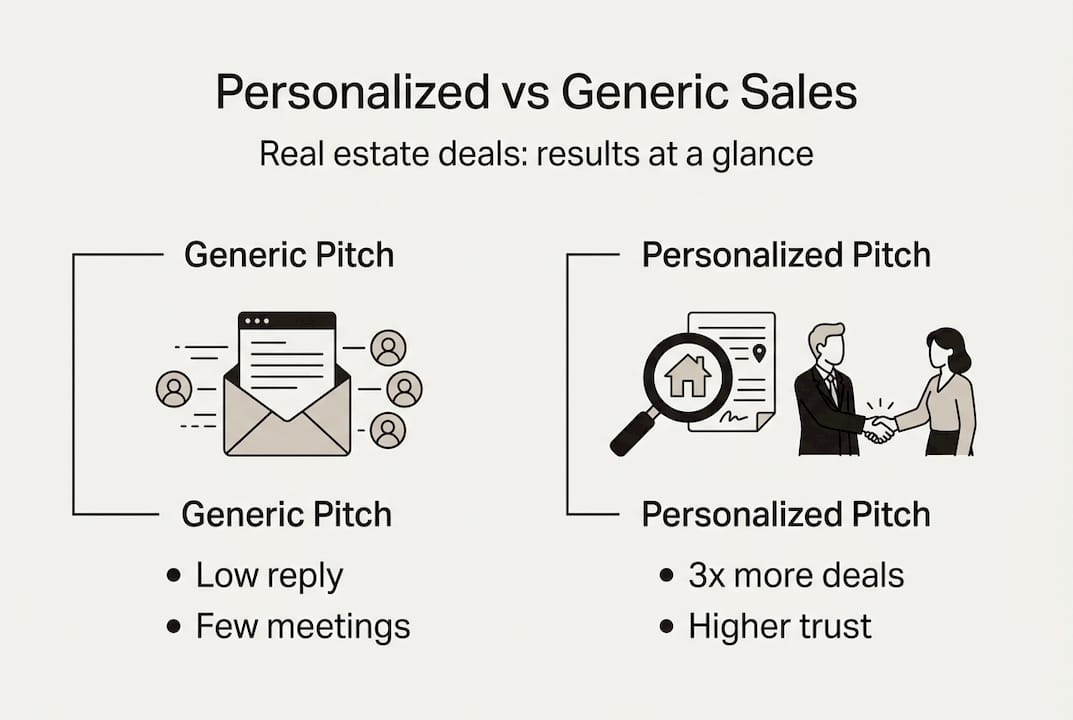
Let’s look at the numbers directly. The performance gap between generic and personalized outreach is not marginal. It is dramatic.
| Metric | Generic pitch | Personalized pitch |
|---|---|---|
| Response rate | 1 to 5% | 18 to 32% |
| Reply rate boost | Baseline | Up to 142% higher |
| Revenue lift | Baseline | 5 to 15% overall |
| Top performer revenue | Baseline | Up to 40% more |
| Marketers reporting sales increase | N/A | 96% |
Those numbers come from real data. Personalized outreach consistently outperforms generic messaging across every measurable metric. And the gap widens as personalization gets more sophisticated.
“Personalization drives a 5 to 15% revenue increase overall, with top performers seeing up to 40% more. A remarkable 96% of marketers report increased sales from personalized experiences.”
Think about what a 20% improvement in your response rate means for your pipeline. If you are sending 100 outreach messages a month and currently converting 3, a personalized approach could push that to 20 or more. That is not incremental improvement. That is a business transformation.
Top agents are already using real estate prospecting tools to gather the data they need to personalize at scale. The agents who ignore this shift will find themselves competing on price alone, which is a race to the bottom.

What personalization really means: Going beyond the name
Here is where most agents get it wrong. They think personalization means adding a first name to an email subject line. That is table stakes. Real personalization goes several layers deeper.
Effective personalization operates across three dimensions:
- Behavioral personalization: Track what properties a prospect has viewed, what neighborhoods they have searched, and how long they spent on specific listings. This tells you what they actually want, not just what they say they want.
- Demographic and situational personalization: Factor in life stage, family size, income signals, and timing triggers. A couple expecting a child has very different needs than a retiree downsizing.
- Trigger-based personalization: Watch for signals like a job change, a recent move to the area, or a lease expiration. These behavioral triggers are golden opportunities to reach out with a pitch that feels perfectly timed.
AI-powered CRM tools make this scalable. You do not have to manually track every signal. Platforms built for AI in prospecting can surface the right data at the right moment, so your pitch lands when the prospect is most receptive.
Pro Tip: Before your next client call, spend five minutes reviewing their recent search activity, social media updates, and any notes from past interactions. That five-minute investment can completely change the tone and outcome of the conversation.
You can also use AI for personalization to draft tailored follow-up messages, suggest relevant listings automatically, and flag when a prospect’s behavior signals buying intent. This is how top agents operate at scale without sacrificing quality.
Balancing depth: Effective but not intrusive
Personalization has a ceiling. Push past it and you stop feeling helpful and start feeling invasive. The line between impressive and uncomfortable is thinner than most agents realize.
The psychology here is straightforward. Clients want to feel understood, not surveilled. When your pitch references something too specific or private, it triggers discomfort rather than connection. Balancing personalization depth is as important as the personalization itself.
Here is how to stay on the right side of that line:
- Stick to relevant signals: Reference what the client has shared with you directly or what is publicly visible. Avoid referencing data they did not knowingly provide.
- Focus on needs, not facts: Instead of saying “I noticed you visited this listing 12 times,” say “Based on your interest in this neighborhood, I think you will love this new listing.”
- Watch for disengagement: If a client pulls back or goes quiet after a pitch, that is a signal you may have overstepped. Adjust your approach.
- Measure outcomes, not activity: Track engagement rates and conversion, not just how many personalized messages you sent. Real sales pitch tips always tie back to results.
Pro Tip: After each client interaction, note what felt natural and what felt forced. Over time, you will develop an instinct for the right level of personalization for different client personalities.
The goal is to make every client feel like your only client. That feeling drives loyalty, referrals, and repeat business. It also directly impacts boosting conversions throughout your entire sales funnel.
Implementing personalization: Tactics and tools for agents
Knowing the theory is one thing. Building it into your daily workflow is another. Here is a practical roadmap to get started.
Step-by-step implementation:
- Audit your current pitch: Write down your standard pitch. Identify every generic statement. Replace each one with a question or placeholder that forces you to customize before sending.
- Build a client profile template: Create a simple form you fill out before every prospect call. Include fields for lifestyle preferences, timeline, budget signals, and any personal details they have shared.
- Set up CRM tracking: Use a CRM in real estate to log every interaction, track property views, and set reminders for follow-ups tied to specific triggers.
- Segment your list: Group prospects by life stage, property type interest, and urgency. Send different messages to each segment rather than one blast to all.
- Test and iterate: Run A/B tests on your outreach. Compare a generic version against a personalized one and track response rates over 30 days.
Tool comparison for personalization at scale:
| Tool type | Best for | Personalization capability |
|---|---|---|
| AI-powered CRM (HubSpot, Salesforce) | Scaling outreach | High: behavioral tracking, auto-segmentation |
| Email platforms with advanced personalization | Drip campaigns | Medium: dynamic fields, conditional content |
| ex.plo.re prospecting suite | Real estate specific | High: local data, listing alerts, lead scoring |
AI scales via CRM platforms like HubSpot and Salesforce, giving you behavioral data, automated segmentation, and personalized follow-up sequences without manual effort. Pair that with effective real estate marketing strategies and you have a system that works while you focus on closing.
Real agents using these systems report shorter sales cycles, higher client satisfaction scores, and more referrals. The investment in setup pays back fast.
Take your sales pitch personalization further
You now have the framework. The next step is putting the right tools behind it. ex.plo.re is built specifically for agents who want to move faster, pitch smarter, and close more deals without burning out.
Our platform gives you access to prospecting tools for real estate that surface the right leads at the right time, paired with automation in sales that keeps your pipeline moving without constant manual effort. From AI-driven lead scoring to personalized outreach sequences, we amplify the work you are already doing. Explore our lead generation tools and see how top agents are turning personalization into a repeatable, scalable system that wins more listings every month.
Frequently asked questions
How does personalization improve sales pitch effectiveness for real estate agents?
Personalized pitches achieve response rates 3 to 10 times higher than generic ones, driving more callbacks, more showings, and ultimately more signed contracts.
What are examples of deep personalization in a real estate sales pitch?
Deep personalization means referencing a client’s specific search history, life stage triggers, and neighborhood preferences, going well beyond just using their name. Behavioral data and triggers like job changes or lease expirations are powerful signals to act on.
What tools help automate personalization for agents?
AI-driven CRM platforms like HubSpot and Salesforce let agents scale personalization across hundreds of prospects without losing the quality or context that makes each pitch feel tailored.
How can I avoid being intrusive when personalizing my pitch?
Focus on needs and interests the client has openly shared, and avoid referencing overly specific data. Balancing personalization depth keeps your pitch feeling helpful rather than invasive.
Do personalized sales pitches always outperform generic ones?
Most data shows a clear advantage, with 96% of marketers reporting increased sales from personalized experiences, though some clients prefer direct communication. Test and measure what resonates in your specific market.