

Gut instinct built careers in real estate. But instinct alone won’t scale your business in 2026. Agents who lean on data analytics are outpacing their competition in measurable ways: SmartZip predicts sellers with 70% accuracy, and CRM analytics routinely surface bottlenecks that cost agents deals every month. This guide breaks down how data analytics actually works in practice, which strategies move the needle for client acquisition and sales, and where agents go wrong. Whether you’re a solo agent or running a luxury brokerage, the shift from intuition to evidence is the single most powerful move you can make right now.
Table of Contents
- The evolution of data analytics in real estate
- Core data analytics strategies for client acquisition
- Optimizing sales strategies with advanced analytics
- Common data pitfalls and how to avoid them
- Benchmarks, ROI, and the future of data-driven real estate
- Why top agents blend analytics with expertise, not just automation
- Supercharge your real estate success with the right tools
- Frequently asked questions
Key Takeaways
| Point | Details |
|---|---|
| Data analytics boosts results | Agents who embrace analytics see more listings, lower costs, and faster sales than those who rely on intuition. |
| Strategic use wins | The top performers use analytics for insight and decisions—not just automation—to outperform peers. |
| Human context is essential | Combining local expertise with data-driven tools creates an unbeatable edge in any market. |
| Avoid data pitfalls | Regular audits, multi-source validation, and human review are key to reliable, actionable analytics. |
The evolution of data analytics in real estate
Real estate used to run on relationships. You knew the neighborhood, you knew the families, and your Rolodex was your most valuable asset. That model still matters, but it’s no longer enough on its own. Over the past decade, the industry has undergone a fundamental shift toward evidence-driven strategy, and the agents who recognized it early are now operating at a different level.
The first wave was CRM adoption. Agents moved their contacts out of spreadsheets and into platforms that could track touchpoints, automate follow-ups, and flag warm leads. Then came MLS data integration, eSignature tools, and eventually AI-powered platforms that could analyze thousands of data points simultaneously. Each milestone raised the floor for what “good” looks like in prospecting and sales.
Social media accelerated everything. According to a NAR technology survey, social media is now the top lead source for agents at 39%, and 33% of agents report a moderate positive impact from AI tools. These aren’t fringe numbers. They reflect a profession that is actively rewiring how it finds and converts clients.
Here’s what the modern data-driven toolkit looks like:
- CRM platforms that score and segment leads automatically
- Predictive analytics tools that flag likely sellers before they list
- Social listening software that tracks engagement signals across channels
- AI-powered real estate AI adoption platforms that surface pattern-based insights from market data
- MLS-integrated dashboards that visualize inventory trends and buyer demand in real time
The agents who treat these tools as core infrastructure, not optional add-ons, are the ones controlling the narrative in their markets.
Core data analytics strategies for client acquisition
Understanding the progression of technology, let’s explore exactly how top agents and brokers apply these tools in client acquisition. The goal isn’t to collect data. It’s to act on it faster and smarter than anyone else in your market.
Lead scoring is where most agents start. RFM models (Recency, Frequency, Monetary value) rank your existing contacts by how recently they engaged, how often they interact, and what their transaction history looks like. Propensity models go further, using behavioral signals like website visits, email opens, and search activity to predict who’s likely to move next.
Lead enrichment layers demographic, social, and behavioral data onto your existing contacts. The results speak for themselves: enriched lead data delivers a 35% boost in listings and 50% more sales-ready leads at 33% lower cost. That’s not a marginal gain. That’s a structural advantage.
Here’s a quick comparison of core acquisition strategies:
| Strategy | Primary benefit | Best use case |
|---|---|---|
| Lead scoring (RFM) | Prioritizes hottest contacts | Large existing databases |
| Propensity modeling | Predicts future intent | Cold and warm outreach |
| Lead enrichment | Adds context to contacts | Improving conversion rates |
| Time-series forecasting | Spots ready-to-move clients | Seasonal market planning |
For a practical rollout, follow this sequence:
- Audit your CRM for data completeness and accuracy
- Implement a lead scoring model using your platform’s native tools
- Enrich your top 20% of leads with third-party data
- Set up automated alerts for high-intent behavioral signals
- Review lead generation strategies to align your outreach cadence with your scoring output
Pro Tip: Don’t score all leads equally. Segment by life stage (first-time buyer, upsizer, downsizer) and run separate scoring models for each. The signals that predict a downsizer’s readiness look very different from a first-time buyer’s.
Pair your scoring with AI prospecting tools that automate outreach sequencing, and you’ll spend less time chasing and more time closing.
Optimizing sales strategies with advanced analytics
Once you’ve mastered the art of acquisition, analytics can also radically enhance your sales process. This is where the real leverage lives, because shortening your sales cycle by even a few days per deal compounds dramatically over a full year.
Automated valuation models (AVMs) give you a data-backed starting point for pricing conversations. They pull comparable sales, market trends, and property characteristics to generate pricing ranges that are harder for sellers to argue with. Pair AVMs with your local expertise and you walk into every listing presentation with authority.

Portfolio optimization means matching your active listings to the buyers in your pipeline most likely to convert. Analytics platforms can rank buyer-listing fit by criteria like price range, location preference, and behavioral signals, so you’re not blasting every listing to your entire list.
CRM funnel analytics reveal exactly where deals stall. Days-on-market analysis, stage-by-stage conversion tracking, and choke-point discovery show you which part of your process is leaking revenue. Analytics identify bottlenecks and improve conversion, with XGBoost machine learning models reducing pricing error by 68% compared to traditional regression.
“The agents winning in 2026 aren’t working harder. They’re using analytics to work on the right deals, at the right time, with the right message.”
Here’s how leading ML techniques stack up for sales optimization:
| Technique | Application | Key advantage |
|---|---|---|
| XGBoost | Pricing and valuation | 68% lower error vs. regression |
| Time-series forecasting | Market timing | Predicts demand cycles |
| Spatial analysis | Location-based targeting | Identifies micro-market trends |
Pro Tip: Use your CRM’s stage-conversion data to find your single biggest drop-off point. Fix that one stage before optimizing anything else. Most agents have one bottleneck that accounts for 60% of their lost deals.
For deeper guidance on keeping deals moving, explore how to nurture real estate leads and review sales funnel optimization frameworks built specifically for agents. ML techniques for sales boosts are also worth studying for the underlying methodology.
Common data pitfalls and how to avoid them
But every powerful tool comes with risks. Here’s what can undermine your gains and how to stay ahead.
The most dangerous mistake isn’t ignoring data. It’s trusting bad data. Fragmented data sources lead to unreliable predictions, and large language models still struggle with spatial and temporal reasoning specific to local real estate markets. If your inputs are flawed, your outputs will be too, no matter how sophisticated your platform.
Common pitfalls to watch for:
- Single-source bias: Relying on one data feed (like MLS only) creates blind spots. Cross-reference with public records, social signals, and third-party enrichment.
- Public record lags: County records can be 30 to 90 days behind. Decisions made on stale data lead to missed opportunities.
- Explainability gaps: If you can’t explain why your model flagged a lead, you can’t confidently act on it or defend your pricing strategy to a client.
- Over-automation: Letting tools run without human review strips out the local context and emotional intelligence that close deals.
The fix is a hybrid approach. Use analytics to surface insights and prioritize your time, but keep a human in the loop for interpretation and client-facing decisions. Regular data audits, at minimum quarterly, catch errors before they compound. Governance policies, like defining which data sources are authoritative and how often they’re refreshed, protect your decision-making quality.
Pro Tip: Assign one team member or yourself to own data quality. A monthly 30-minute audit of your CRM for duplicate records, missing fields, and outdated contacts pays dividends across every campaign you run.
For a grounded view of AI’s role in real estate and where human expertise remains irreplaceable, the research on AI and human expertise is worth your time.
Benchmarks, ROI, and the future of data-driven real estate
Even with pitfalls, the real-world payoffs and future potential of data analytics are hard to ignore. Let’s talk numbers.
Agents using enriched data and predictive tools consistently report 35% more listings, 50% more sales-ready leads, and 40% faster conversions compared to peers relying on traditional methods. These aren’t aspirational figures. They’re benchmarks from agents who committed to analytics as a core strategy, not a side experiment.
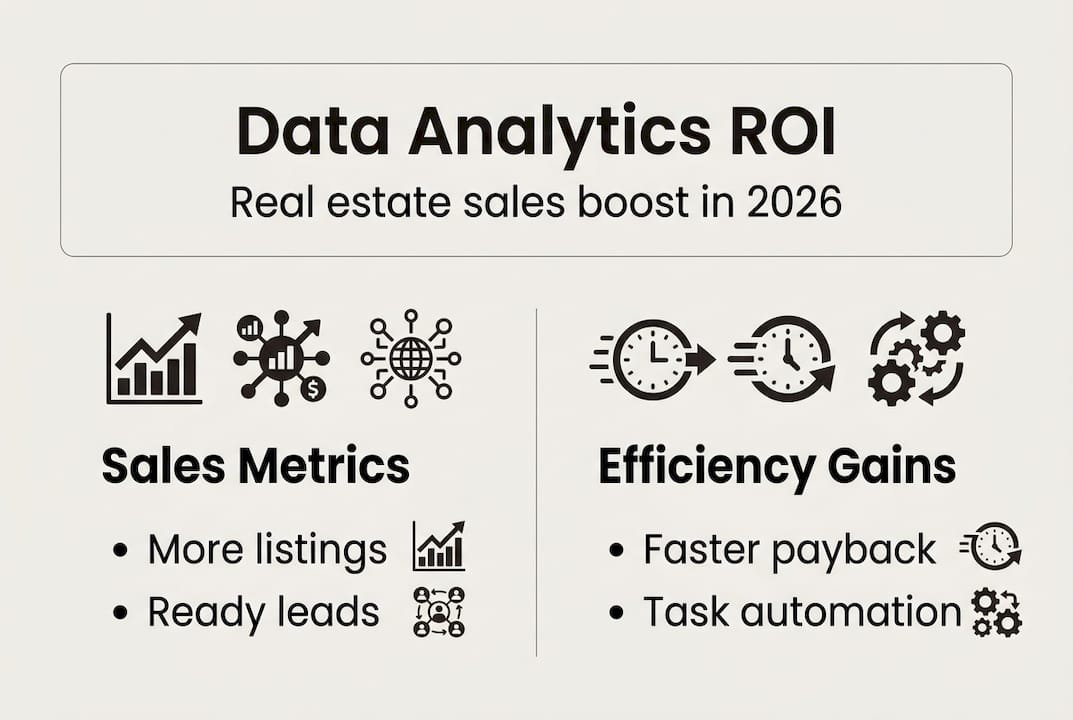
ROI timelines are faster than most agents expect. Payback on AI tools in lead generation and sales typically lands within 3 to 8 months when analytics drive strategy rather than just automate tasks. The distinction matters. Automation without strategy is just faster noise. Analytics-driven strategy is a compounding advantage.
The macro picture reinforces urgency. AI automates 37% of real estate tasks and delivers an estimated $34 billion in operational efficiencies across the industry. The agents who capture that efficiency are the ones using analytics for strategic decisions, not just scheduling emails.
Key takeaways for 2026 and beyond:
| Metric | Benchmark result |
|---|---|
| Listings increase | +35% with lead enrichment |
| Sales-ready leads | +50% at 33% lower cost |
| Conversion speed | Up to 40% faster |
| ROI timeline | 3 to 8 months |
| Task automation | 37% of real estate tasks |
- Start with one analytics tool and master it before adding more
- Measure your baseline conversion rates before implementing changes
- Review your ROI at the 90-day mark and adjust your strategy
- Use generate high-value real estate leads frameworks to align your analytics output with outreach
- Stay current with AI-driven real estate insights as the technology evolves
Why top agents blend analytics with expertise, not just automation
Here’s the perspective that most analytics articles won’t give you: data is not a replacement for judgment. It’s a multiplier of it.
The agents who are truly winning right now aren’t the ones with the most sophisticated tech stack. They’re the ones who use analytics to sharpen their instincts, not replace them. Strategic use for insights over automation is what separates top performers from agents who automate their way into mediocrity.
Local expertise is not a soft skill. It’s a competitive moat. A model can tell you that a neighborhood’s median days on market dropped 12% last quarter. It cannot tell you that the new coffee shop on the corner is what’s driving buyer interest, or that the school rezoning announcement will shift demand in six months. That context lives in your head, not in any dataset.
Emotional intelligence closes deals. Analytics gets you to the table. The agents who understand this distinction are building defensible practices that AI cannot replicate. They use AI role in sales transformation to handle the volume work, freeing themselves to focus on relationships, negotiation, and the human moments that convert prospects into loyal clients.
Position yourself now. The divide between agents who use analytics strategically and those who don’t is widening every quarter. The opportunity to land on the right side of that divide is still open, but the window is narrowing.
Supercharge your real estate success with the right tools
You now have the framework. The next step is putting it into action with tools built specifically for agents and brokers who are serious about growth.

At ex.plo.re, we’ve built a platform that streamlines prospecting, lead conversion, and sales cycle management for real estate professionals at every level. From solo agents to luxury brokerages, our technology and expert team amplify the work you’re already doing. Explore the best real estate prospecting tools and compare the top lead generation tools for realtors to find the right fit for your market. Turn your analytics insight into real pipeline, real clients, and real revenue.
Frequently asked questions
What is the most impactful data analytics tool for real estate agents?
Predictive lead scoring, which uses AI to rank and prioritize prospects, is typically the highest-ROI tool available. Lead scoring tools predict seller intent with up to 70% accuracy, making them a powerful starting point for any agent.
How soon can agents see ROI from data analytics investments?
Most agents see tangible results within 3 to 8 months of focused, strategic usage. Payback for analytics tools is typically under 8 months when the platform is used for strategy, not just automation.
What are the top risks with relying on real estate data analytics?
The biggest risks are bad data, single-source bias, lagging public records, and over-automation without local expertise. Fragmented data leads to unreliable predictions, which is why regular audits and a human-in-the-loop approach are essential.
Can data analytics replace real estate agents?
No. Analytics augments and divides agents by how they use technology, but it does not replace them. AI does not replace agents; it separates those who use it strategically from those who don’t.