

Every luxury real estate agent knows that guiding high-net-worth clients requires far more than a simple property tour. In a world where client expectations are high and transactions are complex, mastering each step of the sales cycle becomes a vital advantage. This overview brings clarity to the stages and strategies that set top producers apart, highlighting how exceptional relationship building and specialized market knowledge are the foundation for lasting client success.
Table of Contents
- What the Real Estate Sales Cycle Involves
- Stages of the Luxury Sales Cycle
- Key Tactics for Lead Conversion and Nurture
- Technology and Data in Sales Optimization
- Common Pitfalls and How to Avoid Them
Key Takeaways
| Point | Details |
|---|---|
| Understanding the Sales Cycle | Real estate professionals must navigate a non-linear sales cycle that includes lead generation, consultation, and closing stages, requiring strong interpersonal skills and adaptability. |
| Luxury Sales Strategies | In luxury real estate, brokers need to focus on trust building and personalized service, tailoring every step to meet high-net-worth clients’ unique expectations. |
| Effective Lead Conversion | Successful lead conversion hinges on personalized engagement, comprehensive segmentation, and the use of data-driven strategies that foster meaningful client relationships. |
| Technology Utilization | Embracing advanced technology and analytics is crucial for optimizing sales processes, enhancing client engagement, and forecasting market trends. |
What the Real Estate Sales Cycle Involves
The real estate sales cycle represents a strategic journey from initial client contact to successful property transaction. Unlike traditional sales processes, real estate demands nuanced relationship building and market expertise. Real estate professionals help clients navigate complex property transactions, requiring sophisticated interpersonal and analytical skills.
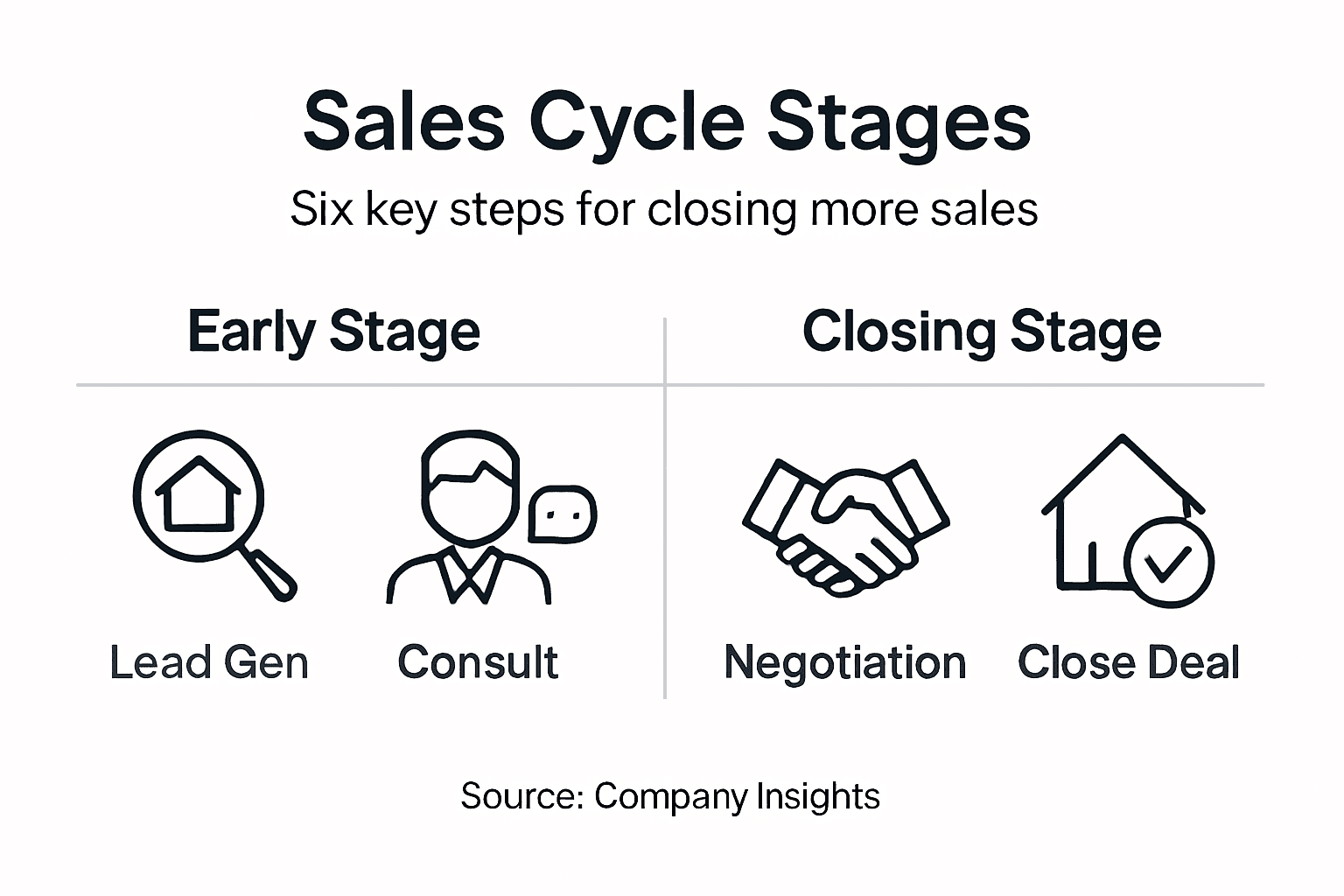
The sales cycle typically encompasses several critical stages that transform potential leads into satisfied property owners:
- Lead Generation: Identifying prospective buyers or sellers through networking, referrals, and targeted marketing
- Initial Consultation: Understanding client needs, preferences, and financial capabilities
- Property Research: Matching client requirements with available market inventory
- Property Showings: Demonstrating potential properties and highlighting unique value propositions
- Negotiation: Crafting competitive offers and navigating complex transaction details
- Closing: Finalizing legal and financial documentation for property transfer
Successful real estate agents recognize that each stage requires distinct skills and strategic approaches. The cycle is not linear but an interconnected process demanding adaptability, market knowledge, and strong communication abilities.
Professionals must master the art of reading client signals, understanding market dynamics, and anticipating potential challenges. This requires continuous learning about local market trends, emerging technologies, and evolving client expectations.
Real estate sales success depends on transforming transactions into trusted relationships.
Pro tip: Develop a systematic approach to tracking your sales cycle stages and consistently follow up with potential clients to maximize conversion opportunities.
Stages of the Luxury Sales Cycle
Luxury real estate sales demand a sophisticated, nuanced approach that transcends traditional transactional processes. Luxury market transactions require specialized engagement strategies that prioritize personalized client experiences and exceptional service delivery.
The luxury sales cycle encompasses several critical stages designed to meet the expectations of high-net-worth clients:
- Client Qualification: Identifying and vetting affluent prospects with specific lifestyle and investment preferences
- Trust Building: Establishing credibility through deep market knowledge and professional reputation
- Needs Assessment: Conducting comprehensive consultations to understand unique client requirements
- Exclusive Property Curation: Selecting and presenting properties that precisely match client expectations
- Strategic Negotiation: Crafting tailored proposals that reflect sophisticated client motivations
- White-Glove Closing: Managing complex transactions with meticulous attention to client comfort and confidentiality
Successful luxury brokers understand that each stage requires exceptional interpersonal skills, market intelligence, and a commitment to discretion. The process is less about selling a property and more about curating an entire lifestyle experience for discerning clients.

Understanding the nuanced dynamics of high-end real estate markets means recognizing that emotional intelligence and personalized service are as crucial as financial expertise. Top-tier agents leverage deep market insights, advanced analytics, and robust professional networks to deliver unparalleled client experiences.
Here’s a summary of the unique skills required for standard and luxury real estate sales cycles:
| Skill Category | Standard Real Estate | Luxury Real Estate |
|---|---|---|
| Client Communication | Clear, responsive | Discreet, high-touch |
| Market Knowledge | Local trends focus | Deep, global perspective |
| Relationship Building | Trust and rapport | Lifestyle curation |
| Negotiation Approach | Competitive offers | Tailored, strategic proposals |
| Technology Utilization | CRM basics, analytics | Advanced platforms, automation |
| Confidentiality | Moderate | Critical priority |
Luxury real estate sales are fundamentally about transforming transactions into extraordinary journeys.
Pro tip: Develop a comprehensive client profile database that tracks preferences, communication styles, and lifestyle indicators to create truly personalized property recommendations.
Key Tactics for Lead Conversion and Nurture
Successful real estate lead conversion requires a strategic, multi-dimensional approach that transforms potential clients into committed buyers. Effective lead generation involves sophisticated discovery techniques that prioritize understanding client motivations and creating personalized engagement pathways.
Key tactics for nurturing and converting real estate leads include:
- Comprehensive Lead Segmentation: Categorizing prospects based on investment potential, property preferences, and buyer readiness
- Personalized Communication Strategies: Developing targeted messaging that resonates with specific client segments
- Multi-Channel Engagement: Utilizing digital platforms, social media, email, and direct communication to maintain consistent contact
- Data-Driven Lead Scoring: Implementing analytical models to prioritize and track lead potential
- Relationship Building: Creating trust through consistent, value-added interactions
- Tailored Content Marketing: Developing educational resources that address specific client pain points and interests
Top real estate professionals understand that lead conversion is not about aggressive selling but about establishing meaningful professional relationships. The process requires a delicate balance of market knowledge, emotional intelligence, and strategic communication.
Advanced agents leverage technology and data analytics to create highly personalized lead nurturing experiences. By understanding client preferences, investment goals, and communication styles, they can craft targeted approaches that significantly increase conversion rates and long-term client loyalty.
Lead conversion is an art of listening, understanding, and strategically positioning value.
Pro tip: Develop a systematic lead tracking system that monitors interaction history, preferences, and engagement levels to create increasingly personalized communication strategies.
Technology and Data in Sales Optimization
Modern real estate sales demand sophisticated technological integration that transforms traditional approaches into data-driven strategies. Digitalization enhances customer engagement and sales efficiency by providing unprecedented insights into client behaviors and market dynamics.
Key technological strategies for sales optimization include:
- Advanced Analytics Platforms: Aggregating and interpreting complex client data
- Artificial Intelligence Lead Scoring: Predicting client conversion potential with machine learning algorithms
- Automated Communication Systems: Delivering personalized, timely interactions
- Customer Relationship Management (CRM) Integration: Centralizing client information and interaction histories
- Predictive Market Modeling: Using data to forecast property trends and client needs
- Multi-Channel Communication Tracking: Monitoring engagement across digital platforms
Successful real estate professionals understand that technological intelligence transforms raw data into actionable strategic insights. The most effective agents leverage cutting-edge tools that provide comprehensive client understanding, moving beyond traditional sales approaches.
Data standardization plays a critical role in technological sales optimization. By creating uniform data formats and seamless information exchanges, real estate professionals can make more informed decisions, reduce processing times, and create more targeted client experiences.
Technology transforms data into meaningful client connections.
Pro tip: Invest in integrated technology platforms that provide comprehensive data visualization and real-time analytics to stay ahead of market trends and client preferences.
Here’s a reference table illustrating how key technologies impact real estate sales optimization:
| Technology | Business Impact | Typical Application |
|---|---|---|
| Advanced Analytics | Improved client insights | Identifying buying patterns |
| AI Lead Scoring | Enhanced conversion rates | Prioritizing high-potential leads |
| Automated Communication | Increased engagement speed | Timely follow-up and reminders |
| CRM Integration | Streamlined workflow | Managing client profiles |
| Predictive Market Modeling | Better forecasting | Anticipating property trends |
Common Pitfalls and How to Avoid Them
Real estate sales success hinges on recognizing and strategically navigating potential obstacles that can derail professional performance. Agent performance suffers from insufficient training and experience which dramatically impacts client outcomes and career sustainability.
Critical pitfalls in real estate sales include:
- Inadequate Lead Qualification: Pursuing unqualified prospects and wasting valuable time
- Poor Communication Management: Inconsistent or ineffective client interactions
- Lack of Continuous Professional Development: Failing to update skills and market knowledge
- Ineffective Sales Resource Allocation: Misaligning efforts with high-potential opportunities
- Neglecting Early-Stage Customer Discovery: Skipping crucial relationship-building steps
- Technology Resistance: Avoiding digital tools and data-driven strategies
Successful real estate professionals understand that strategic self-awareness is crucial in avoiding common career-limiting mistakes. The most resilient agents continuously evaluate their performance, seek mentorship, and remain adaptable to changing market dynamics.
Addressing these pitfalls requires a proactive approach to professional growth. This means investing in ongoing training, embracing technological innovations, developing robust communication skills, and maintaining a growth-oriented mindset that prioritizes client needs and professional excellence.
Avoiding pitfalls is not about perfection, but consistent improvement.
Pro tip: Conduct quarterly self-assessments of your sales strategies, tracking key performance indicators and identifying specific areas for targeted professional development.
Elevate Your Real Estate Sales Cycle with Proven Tools and Talent
Navigating the complex stages of the real estate sales cycle demands clarity, precision, and adaptability. Whether you are struggling with lead qualification, personalized client communication, or converting luxury prospects, understanding these challenges is the first step to winning more clients. Our platform at ex.plo.re is designed to empower real estate agents and luxury brokers with the exact tools and expert support needed to master every phase from lead generation to closing.
Gain confidence by:
- Streamlining your sales process with advanced CRM features
- Enhancing client engagement using data-driven lead nurturing
- Automating your follow-ups for timely, personalized communication

Don’t let common pitfalls stall your success. Visit ex.plo.re CRM today and transform your sales cycle into a power broker’s journey. Start amplifying your local client base and delivering a more strategic, efficient, and relationship-driven real estate experience right now.
Frequently Asked Questions
What are the stages of the real estate sales cycle?
The real estate sales cycle typically includes the following stages: lead generation, initial consultation, property research, property showings, negotiation, and closing. Each stage is essential for effectively guiding clients through a successful property transaction.
How can technology improve the real estate sales process?
Technology enhances the real estate sales process by providing tools like advanced analytics platforms, AI lead scoring, automated communication systems, and CRM integration. These tools help real estate professionals gain insights into client behavior, streamline workflows, and create personalized engagement strategies.
What are key tactics for converting leads in real estate?
Key tactics for converting leads include comprehensive lead segmentation, personalized communication strategies, multi-channel engagement, data-driven lead scoring, relationship building, and tailored content marketing to address specific client interests and needs.
What common pitfalls should real estate professionals avoid?
Common pitfalls include inadequate lead qualification, poor communication management, lack of continuous professional development, ineffective resource allocation, neglecting early-stage customer discovery, and technology resistance. Addressing these areas proactively can lead to better client outcomes and career sustainability.