About

What Is Retargeting? A Digital Marketer’s Guide
Retargeting is a digital advertising tactic that re-engages website visitors who showed interest in your product or service but left without converting, by delivering tailored ads to them across other platforms and websites. Using tracking pixels and cookies, retargeting follows warm audiences across Google Display Network, Meta, LinkedIn, and beyond, bringing them back into your funnel. Platforms like Google Ads and Meta Ads Manager make this technically accessible to any marketer with a live website. The result is a second chance to close deals with people who already know you, and that familiarity is worth more than most marketers realize.
What is retargeting and how does it work technically?
Retargeting works by placing a small piece of code, called a retargeting pixel, on your website. When a visitor lands on your site, that pixel fires and drops a cookie in their browser. That cookie is the signal that tells ad platforms to start showing your ads to that specific person as they browse other websites, scroll through social media, or watch YouTube videos.
The workflow behind a retargeting campaign follows four clear steps:
- Install the pixel. You place a tracking tag from Google Ads, Meta Ads Manager, or another ad platform on your website. This tag begins building your custom audience immediately.
- Segment your audience by behavior. Not every visitor deserves the same ad. Someone who viewed a product page is at a different stage than someone who abandoned a cart. Segmenting by behavior is where most campaigns either win or waste budget.
- Personalize your creatives and offers. A cart abandoner should see the exact product they left behind, possibly with a time-sensitive discount. A blog reader should see an ad that moves them one step deeper into your funnel, not a hard sell.
- Deliver ads across chosen channels. Google Display Network reaches users across millions of websites. Meta reaches them on Facebook and Instagram. LinkedIn works for B2B audiences. Choose channels based on where your audience actually spends time.
Pro Tip: Set up separate pixel events for each key action on your site: page views, product views, add-to-cart, and purchase. Granular event data gives you the segmentation power to run campaigns that feel personal rather than generic.
The technical precision of this process is what separates retargeting from standard display advertising. You are not buying impressions from strangers. You are buying attention from people who already raised their hand.

What is the difference between retargeting and remarketing?
These two terms get used interchangeably, but they describe different tactics. Retargeting is a subset of remarketing, focused specifically on paid ad channels and typically relying on third-party cookie data or pixel-based tracking. Remarketing is the broader strategy, which includes owned channels like email, SMS, and push notifications using first-party data you already hold.
Here is how they compare directly:
| Factor | Retargeting | Remarketing |
|---|---|---|
| Primary channel | Paid ads (display, social, search) | Email, SMS, owned media |
| Data source | Third-party cookies, pixels | First-party CRM and subscriber data |
| Audience type | Anonymous site visitors | Known contacts with identifiers |
| Campaign goal | Re-engage and convert warm traffic | Re-engage lapsed customers or leads |
| Platform examples | Google Ads, Meta Ads Manager | Mailchimp, Klaviyo, HubSpot |
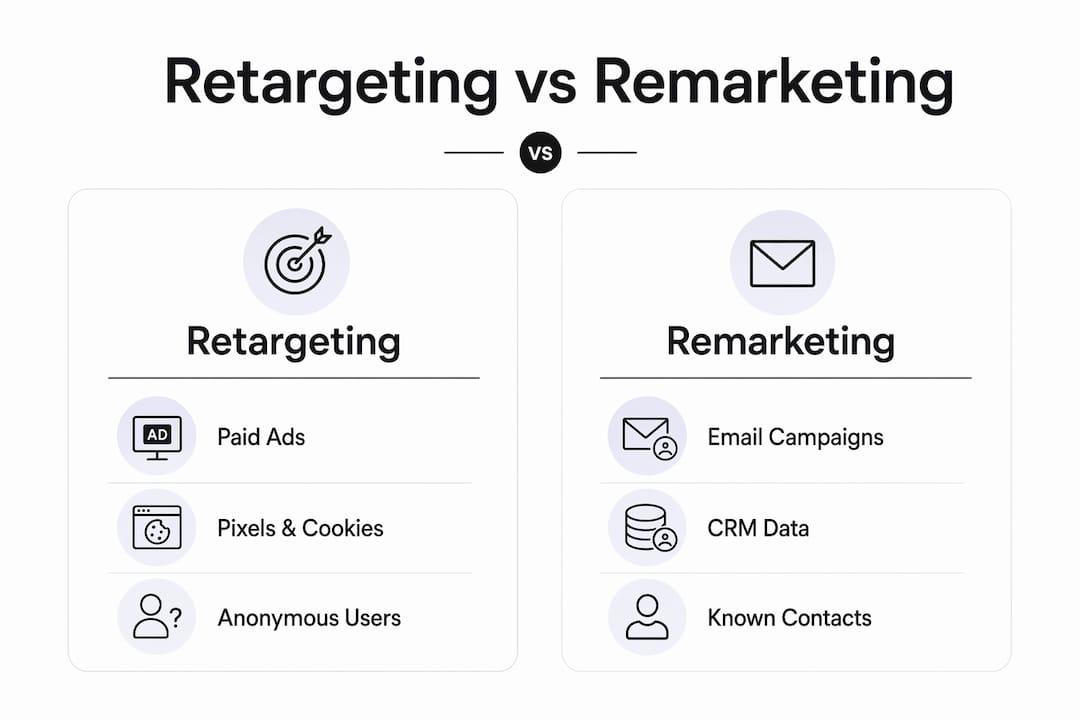
The distinction matters because the two tactics complement each other rather than compete. A visitor who abandons a cart might see a retargeted display ad on a news site and then receive a follow-up email the next morning. That combination, paid retargeting plus owned channel remarketing, is far more effective than either tactic alone.
Key points to keep in mind:
- Retargeting requires an existing flow of site visitors to build audiences from. Without traffic, there is no audience to retarget.
- Remarketing requires a contact list with identifiers like email addresses or phone numbers.
- Both tactics aim to move people closer to conversion by leveraging prior brand familiarity.
- Used together, they cover the full spectrum of re-engagement across paid and owned channels.
What are the benefits of retargeting for your business?
The core advantage of retargeting is that it focuses your ad spend on people who already demonstrated intent. Retargeted users convert at significantly higher rates compared to cold audiences because they already know your brand and have shown behavioral signals of interest. That higher intent translates directly into better return on ad spend.
Here is where the real strategic value shows up:
- Higher conversion rates. Warm audiences convert at a fraction of the cost of cold prospecting. A real estate agent retargeting people who viewed a listing page will always outperform one running generic awareness ads to a zip code.
- Efficient ad spend. You stop paying to reach people who have never heard of you and focus budget on those most likely to act.
- Brand recall across devices. Modern buyers research on mobile, compare on desktop, and decide on tablet. Multichannel retargeting campaigns maintain your presence across that fragmented journey.
- Personalization at scale. Dynamic retargeting ads automatically populate with the specific product or listing a user viewed, making every impression feel relevant without manual creative work for each user.
- Shortened sales cycles. Repeated, relevant exposure accelerates decision-making. A prospect who sees your ad five times over two weeks moves through the funnel faster than one who saw you once.
For real estate professionals specifically, retargeting is one of the highest-leverage tactics available. Someone who visited your listing page for a $2.4 million property in Aspen is not a casual browser. Showing them that property again on Instagram or Google Display keeps you top of mind during a decision process that might take weeks or months. You can explore how this fits into a broader real estate marketing strategy to see the full picture.
How are privacy changes reshaping retargeting strategies?
Third-party cookies are disappearing. Safari and Firefox already block them by default, and the broader digital advertising industry is restructuring around privacy-first approaches. IAB Tech Lab guidance now emphasizes ID-less solutions and compliance with GDPR, CCPA, and similar regulations, which means the pixel-and-cookie model that powered retargeting for a decade is no longer the only option.
The shift is toward first-party data. This means collecting email addresses, phone numbers, and behavioral data directly from your own audience through forms, CRM systems, and logged-in experiences. Platforms like Meta allow you to upload customer lists and build lookalike audiences from them, bypassing the need for third-party cookies entirely. Google’s Enhanced Conversions and Customer Match features serve the same purpose.
Marketers who design campaigns with signal loss in mind will outperform those still relying on legacy cookie-based tracking. This means building larger first-party data assets now, before signal loss accelerates further.
Pro Tip: Audit your current retargeting setup today. Identify what percentage of your audience data comes from third-party cookies versus first-party sources. If the answer is mostly third-party, start building your email capture and CRM infrastructure before your audience pools shrink.
Privacy compliance is not just a legal requirement. It is a competitive advantage. Brands that build trusted, consent-based data relationships with their audiences will have retargeting capabilities that competitors without those relationships simply cannot replicate. For data-driven marketers in real estate, understanding why data matters is the foundation of every effective campaign.
What are best practices for effective retargeting campaigns?
Retargeting campaigns fail for one of three reasons: poor segmentation, creative fatigue, or misaligned offers. All three are preventable with the right setup.
Follow these steps to build campaigns that actually perform:
- Segment with precision. Cart abandoners, product viewers, blog readers, and past purchasers all require different messages. Grouping them into one audience and running one ad is the fastest way to waste budget.
- Match creatives to funnel stage. A top-of-funnel blog reader needs educational content or a lead magnet. A bottom-of-funnel cart abandoner needs urgency, social proof, or a specific offer.
- Set frequency caps. Showing the same ad to the same person 20 times in a week creates resentment, not conversions. Cap frequency at 3 to 5 impressions per week per user as a starting point, then adjust based on performance data.
- Use exclusion audiences. Always exclude recent purchasers from conversion-focused campaigns. Showing a “buy now” ad to someone who bought yesterday is a waste of spend and a poor client experience.
- Test ad formats by platform. Carousel ads work well on Meta for showing multiple listings or products. Responsive display ads cover Google’s network efficiently. Short video clips on Instagram Reels and YouTube pre-roll can outperform static images for high-consideration purchases.
Beyond the setup, ongoing optimization separates good campaigns from great ones:
- Review audience overlap between segments to avoid showing conflicting messages to the same user.
- Refresh creatives every 3 to 4 weeks to combat ad fatigue.
- Monitor view-through conversions alongside click-through conversions to capture the full impact of your retargeting spend.
- Align your retargeting campaigns with your broader lead generation strategy so every touchpoint moves prospects forward rather than repeating the same message indefinitely.
Effective retargeting hinges on matching segments to tailored creatives and pacing. When those three elements align, retargeting becomes one of the most predictable conversion tools in your marketing mix.
Key takeaways
Retargeting converts warm audiences at higher rates than cold prospecting because it targets people who already demonstrated intent, making it the most budget-efficient re-engagement tactic available to digital marketers.
| Point | Details |
|---|---|
| Core mechanism | Pixels track visitor behavior and trigger personalized ads across Google, Meta, and other platforms. |
| Retargeting vs. remarketing | Retargeting uses paid ads and pixel data; remarketing uses owned channels and first-party CRM data. |
| Primary benefit | Higher conversion rates and lower cost per acquisition compared to cold audience advertising. |
| Privacy shift | Third-party cookie deprecation demands a move to first-party data and ID-less retargeting solutions. |
| Best practice | Segment audiences by behavior and match creatives to funnel stage to maximize every dollar spent. |
Why most retargeting campaigns underperform (and what to do about it)
I have reviewed dozens of retargeting setups across real estate, luxury goods, and professional services, and the pattern is almost always the same. Marketers install the pixel, create one audience of “all website visitors,” write one ad, and call it a retargeting strategy. Then they wonder why the results are mediocre.
Retargeting is not an ad-firing mechanism. It is an audience-building discipline. The pixel is just the starting point. The real work is in understanding what each visitor’s behavior signals about their intent and then responding with something that actually matches where they are in their decision process. A person who spent four minutes reading about your luxury listing in Malibu is not the same as someone who bounced after two seconds. Treating them identically is a missed opportunity.
The privacy changes happening right now are not a threat to retargeting. They are a filter. Marketers who built their strategies on borrowed cookie data are scrambling. Marketers who invested in first-party data, CRM infrastructure, and consent-based audience building are finding that their retargeting capabilities are actually getting stronger relative to competitors. The ID-less environment rewards those who own their audience relationships.
My honest advice: stop thinking about retargeting as a tactic you turn on and forget. Treat it as a living system that requires regular segmentation reviews, creative refreshes, and alignment with your broader client acquisition goals. When you do that, it becomes one of the most reliable tools in your entire marketing operation.
— Jason
Take your retargeting further with Plo
Retargeting works best when it connects to a system that captures, organizes, and activates your audience data at every stage of the sales cycle. Plo gives real estate agents, luxury brokers, and yacht brokers the tools to do exactly that, from prospecting and CRM to campaign execution that amplifies the work you are already doing.

If you are ready to move beyond generic ads and build a retargeting operation that actually converts warm leads into closed deals, start with the right foundation. Explore Plo’s top prospecting tools built for serious brokers, or go deeper with our guide to client acquisition through prospecting to see how retargeting fits into a complete growth system.
FAQ
What is retargeting in simple terms?
Retargeting is a paid advertising method that shows your ads to people who previously visited your website or app but did not convert. It uses tracking pixels to identify those visitors and deliver relevant ads to them on other platforms like Google and Meta.
How does a retargeting pixel work?
A retargeting pixel is a small code snippet placed on your website that fires when a visitor arrives and drops a cookie in their browser. That cookie signals ad platforms to show your ads to that visitor as they browse other sites and apps.
What is the difference between retargeting and remarketing?
Retargeting focuses on paid ad channels using pixel and cookie data to reach anonymous site visitors. Remarketing uses owned channels like email and SMS with first-party data from your CRM to re-engage known contacts.
Is retargeting still effective with privacy changes?
Yes, but the approach is shifting. Marketers designing for signal loss and building first-party data assets through CRM and email capture are maintaining strong retargeting performance despite third-party cookie restrictions.
How often should retargeting ads be shown to the same person?
A frequency cap of 3 to 5 impressions per week per user is a practical starting point. Exceeding that threshold risks ad fatigue and can create a negative brand association rather than driving conversions.