About

What Is a Buyer’s Broker? Why It Matters in 2026
Representing high-net-worth buyers in markets like the French Riviera or Miami hinges on more than just market access. Luxury clients expect more than property tours and draft contracts—they seek true advocacy backed by expertise and discretion. Understanding the crucial advantages of a buyer’s broker lets you deliver exceptional, tailored service that elevates your global reputation and unlocks new opportunities for demanding clients.
Table of Contents
- Defining a Buyer’s Broker in Real Estate
- Different Types of Buyer Representation
- How Buyer’s Brokers Work With Clients
- Legal Duties, Agreements, and Compensation
- Risks, Costs, and What to Avoid
Key Takeaways
| Point | Details |
|---|---|
| Buyer’s Broker Definition | A buyer’s broker exclusively represents property purchasers, providing dedicated advocacy throughout the acquisition process. |
| Types of Buyer Representation | Options include exclusive buyer agency, dual agency, and designated agency, each with its own implications for client representation and conflict management. |
| Legal Duties | Buyer’s brokers have fiduciary obligations including loyalty, confidentiality, and disclosure, ensuring the buyer’s best interests are prioritized. |
| Risks and Mitigation | Buyers should be aware of potential conflicts, especially with dual agency, and seek clear written agreements and fee transparency to avoid hidden costs. |
Defining a Buyer’s Broker in Real Estate
A buyer’s broker is a specialized real estate professional who exclusively represents the interests of property purchasers during real estate transactions. Unlike traditional agents who might work for sellers, these professionals dedicate their entire service model to protecting and advancing the buyer’s strategic objectives.
In the real estate landscape, buyer brokers legally represent the purchasing party’s interests, ensuring comprehensive advocacy throughout the property acquisition process. Their core responsibilities include identifying suitable properties, negotiating pricing, conducting thorough property evaluations, and guiding clients through complex transaction procedures. Real estate brokers operate with higher legal qualifications and greater professional authority compared to standard agents, enabling them to provide more sophisticated advisory services.
The buyer’s broker relationship is typically formalized through a written agency agreement, which establishes clear expectations, compensation structures, and fiduciary duties. These professionals are legally obligated to maintain confidentiality, disclose material information, and act in the buyer’s best financial and strategic interests. Their expertise becomes particularly valuable in complex markets where negotiation skills, local market knowledge, and transactional insights can significantly impact purchasing outcomes.
Pro tip: Always request a detailed buyer representation agreement that clearly outlines the broker’s specific responsibilities, commission structure, and termination clauses before engaging their services.
Different Types of Buyer Representation
Buyer representation in real estate encompasses several nuanced models, each with distinct characteristics and legal implications. The primary types of buyer representation range from exclusive buyer agency to more complex collaborative arrangements that can significantly impact transaction dynamics.
Exclusive Buyer Agency represents the most direct representation model, where brokers work exclusively for buyers without any conflicting seller-side interests. In this arrangement, the broker’s fiduciary responsibility is entirely dedicated to the buyer’s strategic objectives, ensuring uncompromised advocacy throughout the property acquisition process.
Alternative representation models include dual agency, where a single brokerage represents both buyer and seller, and designated agency, where different agents within the same brokerage represent opposing parties. These models require heightened transparency and carefully structured agreements to manage potential conflicts of interest. Buyer agents typically differentiate themselves by providing specialized market insights, negotiation expertise, and comprehensive transaction support tailored specifically to purchaser needs.
The landscape of buyer representation continues to evolve, with modern brokerages offering increasingly sophisticated service models that prioritize client-centric approaches. Sophisticated buyers increasingly seek representation that provides not just transactional support, but strategic guidance through complex real estate markets.
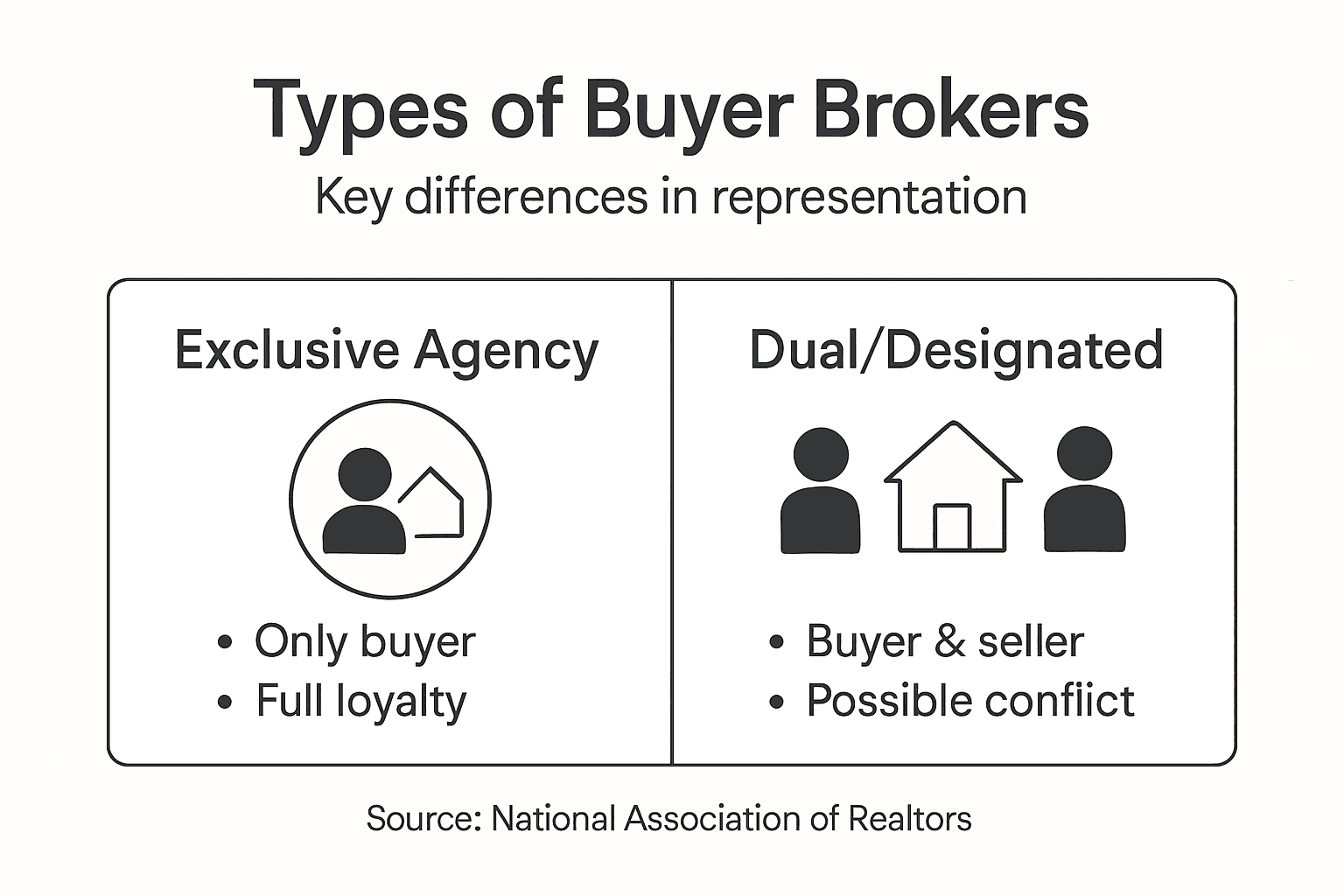
Here’s a comparison of the main buyer representation models in real estate:
| Representation Model | Who Is Represented | Potential Conflicts | Distinct Advantage |
|---|---|---|---|
| Exclusive Buyer Agency | Only the buyer | Minimal conflict risk | Full buyer advocacy |
| Dual Agency | Buyer and seller by same brokerage | Conflicts likely | Faster transaction coordination |
| Designated Agency | Separate agents in same brokerage for each party | Moderate risk, managed by firm | Brokerage expertise on both sides |
Pro tip: Request a detailed written representation agreement that explicitly outlines the broker’s specific responsibilities, potential conflict management protocols, and precise compensation structure before entering any professional relationship.
How Buyer’s Brokers Work With Clients
Buyer’s brokers engage with clients through a comprehensive, strategic approach that transforms the property acquisition process from a transactional interaction to a personalized advisory relationship. Buyer brokers exclusively represent client interests, providing end-to-end guidance that extends far beyond traditional real estate services.

The client engagement typically begins with an in-depth consultation where the broker assesses the buyer’s specific requirements, financial capabilities, and long-term real estate objectives. During this initial phase, brokers develop a tailored strategy that includes detailed market analysis, property identification criteria, and a nuanced understanding of the client’s unique preferences. This personalized approach allows brokers to narrow down potential properties with remarkable precision, saving clients significant time and reducing potential misalignments between buyer expectations and property characteristics.
Subsequent stages of client interaction involve comprehensive support across multiple dimensions. Brokers provide sophisticated market insights, conduct thorough property evaluations, negotiate pricing and terms, manage complex documentation, and navigate intricate legal and financial landscapes. Their expertise becomes particularly critical during due diligence, where they help clients uncover potential property issues, assess investment risks, and make informed decisions. Advanced brokers also leverage technological tools and extensive professional networks to provide clients with real-time market intelligence and competitive advantages.
Pro tip: Request a comprehensive initial consultation that includes a detailed discussion of your specific property goals, financial constraints, and preferred communication methods to establish a strong foundation for your broker relationship.
Legal Duties, Agreements, and Compensation
Buyer’s brokers operate within a complex legal framework that establishes clear professional responsibilities and ethical standards. Buyer agency agreements define fiduciary obligations that protect client interests through comprehensive legal protections, creating a structured approach to real estate representation.
These legal agreements typically outline three critical dimensions of broker representation: loyalty, confidentiality, and disclosure. Loyalty requires the broker to prioritize the buyer’s interests above all other considerations, including their own potential financial gains. Confidentiality mandates that sensitive client information remains protected, preventing unauthorized sharing of personal financial details, property preferences, or negotiation strategies. Disclosure obligations compel brokers to provide complete, transparent information about property conditions, market dynamics, and potential risks that might impact the buyer’s decision-making process.
Compensation structures in buyer brokerage are equally nuanced, often involving commission models that can be paid by either the buyer or seller, depending on negotiated terms. Traditional arrangements frequently involve the seller paying a commission split between listing and buyer’s brokers, though direct buyer-paid models are becoming increasingly common. Modern brokers are developing more flexible compensation approaches, including flat-fee structures, hourly rates, and performance-based compensation that align more closely with client outcomes and satisfaction levels.
Below is a summary of legal duties and compensation approaches for buyer’s brokers:
| Legal Duty | What It Means | Impact for Buyers |
|---|---|---|
| Loyalty | Broker prioritizes buyer’s interests | Improved negotiation leverage |
| Confidentiality | Client’s details are protected | Privacy and informational advantage |
| Disclosure | Broker shares all known material facts | Informed and safer decisions |
| Compensation Methods | Commissions, flat fees, hourly rates | Flexible payment options, higher transparency |
Pro tip: Request a detailed written breakdown of the broker’s compensation structure and potential fee arrangements during your initial consultation to ensure complete transparency and avoid future misunderstandings.
Risks, Costs, and What to Avoid
Navigating the buyer’s brokerage landscape requires careful understanding of potential pitfalls and strategic decision-making. Buyers must vigilantly assess potential conflicts that could compromise their transaction objectives and financial interests.
Several critical risks demand proactive management in real estate transactions. Dual agency represents one of the most significant potential conflicts, where a single broker represents both buyer and seller simultaneously. This arrangement can create inherent tensions, potentially diluting the broker’s ability to provide unbiased advocacy. Hidden costs pose another substantial risk, including undisclosed fees, commission structures, and additional transactional expenses that may not be immediately apparent. Sophisticated buyers should request comprehensive fee breakdowns and written documentation detailing all potential financial obligations before entering any brokerage relationship.
To mitigate risks effectively, buyers must develop a strategic approach to broker selection and engagement. Key warning signs include brokers who demonstrate reluctance to provide clear written agreements, fail to disclose potential conflicts of interest, or appear more focused on closing a transaction than understanding the client’s specific needs. Successful navigation requires thorough due diligence, including verifying professional credentials, checking references, and maintaining transparent communication throughout the property acquisition process. Advanced buyers should prioritize brokers who demonstrate a commitment to fiduciary responsibilities and maintain a track record of client-centric representation.
Pro tip: Request a comprehensive written disclosure document that explicitly outlines all potential conflicts of interest, fee structures, and representation terms before signing any brokerage agreement.
Empower Your Buyer Brokerage Success with Cutting-Edge Tools
Understanding the critical role of a buyer’s broker in real estate means recognizing the challenges brokers face in providing exclusive advocacy, managing conflicts of interest, and delivering personalized client strategies. If you want to stand out as a trusted advisor who expertly navigates loyalty, confidentiality, and disclosure obligations, you need a streamlined solution that enhances your client relationships and sharpens your sales pitch.

Boost your impact with ex.plo.re CRM, a platform designed to amplify the efforts of real estate professionals committed to buyer representation. Access expert talent and powerful technology to get more local clients, refine your offerings, and confidently manage complex negotiations. Don’t wait to transform your brokerage approach — explore how our tools can make you the power broker your clients deserve.
Start your journey to better client advocacy and smoother transactions today at ex.plo.re CRM and lead the way in buyer brokerage excellence.
Frequently Asked Questions
What is a buyer’s broker in real estate?
A buyer’s broker is a real estate professional who exclusively represents the interests of property purchasers, ensuring comprehensive advocacy throughout the property acquisition process.
Why should I hire a buyer’s broker?
Hiring a buyer’s broker provides specialized market insights, negotiation expertise, and personalized support, helping you navigate complex transactions and making more informed decisions.
What types of buyer representation are available?
There are several types of buyer representation, including exclusive buyer agency, dual agency, and designated agency. Each model has distinct characteristics and implications for potential conflicts of interest.
What legal duties do buyer’s brokers have to their clients?
Buyer’s brokers have legal obligations including loyalty, confidentiality, and full disclosure, which protect the client’s interests and promote transparency throughout the transaction.