
YouTube works best for real estate agents as a hyperlocal awareness and remarketing layer, not a lone lead-gen channel. Start with one 15 to 30 second neighborhood ad, put $10 to $20 a day behind it, and target a radius you can actually service. Give it 60 to 90 days to build a remarketing pool before judging results, because the real payoff shows up downstream, not on day one.
TL;DR:
- Use YouTube as a local awareness tool with a small daily budget and wait 60 to 90 days to see downstream remarketing results.
- Focus on skippable in-stream ads to maximize value, layering other formats like bumper or discovery ads as your campaign matures.
- Capture attention in the first five seconds by mentioning a local detail, stating a clear value, or creating urgency without a hard sell.
- Build a hyperlocal radius targeting layer with in-market and search intent signals, excluding known clients and limiting ad frequency to avoid fatigue.
- Consistently test and refine script content, landing pages, and retargeting sequences, with platforms like Plo simplifying campaign management for busy agents.
Table of Contents
- Why YouTube Fits the Real Estate Buyer and Seller Journey
- Which YouTube Ad Formats to Run First
- Creative That Wins the First 5 Seconds
- Targeting and Audience Setup for Hyperlocal Reach
- Budget, Test Windows, and the Metrics That Matter
- Turning Views Into Listing Conversations
- Production Workflow: Batching, Editing, and Repurposing
- Perspective: What a Hyperlocal Test Actually Looks Like
- How Plo Can Run the Whole Funnel for You
- Official Resources Worth Bookmarking
- Sources
- FAQ
Why YouTube Fits the Real Estate Buyer and Seller Journey
Buyers research for weeks before they ever call an agent, and YouTube sits right in the middle of that research window. It’s a search engine and a living-room screen at the same time, which is a combination no other ad platform quite matches. Someone scrolling listings on Zillow at 9 p.m. might see your face on the same TV screen twenty minutes later during a show, and that repetition builds name recognition the way a bus bench ad never could.
Paid YouTube also does something organic posting can’t: it puts your video in front of people who have never heard of you and never subscribed to your channel. Organic uploads reach whoever already follows you or stumbles onto the video; ads reach a defined radius of homeowners and buyers whether they know your name or not. Agents who treat organic and paid as the same activity are leaving half the reach on the table. The NAR guidance on video lead generation points out that video is one of the strongest-performing media types available to agents, and recommends repurposing longer YouTube content into shorter social clips rather than treating each platform as a separate production job.
YouTube isn’t meant to replace your other paid channels. It’s meant to feed them.
- Facebook and Instagram catch people mid-scroll with low-friction offers like home valuations or open house reminders.
- Search ads catch people who already know they’re looking, right when they type “homes for sale in [neighborhood].”
- YouTube builds the face and name recognition that makes both of those other channels convert better, because the person clicking your Facebook ad already half-recognizes you.
If you’re already running search-intent campaigns for real estate or testing Facebook ads for your listings, YouTube is the layer that makes both of those work harder. It’s not competing with them for budget. It’s warming the audience before they ever see them.
Which YouTube Ad Formats to Run First
Google Ads runs every YouTube ad campaign, and the Google Ads platform gives you four practical format choices. You don’t need all four on day one. Pick based on whether your immediate goal is brand recognition or a faster response signal.
Skippable in-stream ads are the format to start with for almost every local agent. Viewers can skip after five seconds, but you only pay when someone watches past 30 seconds or clicks something, which means a skip costs you nothing. The Adbetter analysis of YouTube ad types for real estate notes that this format tends to deliver the best value for local advertisers precisely because of that pricing structure. You’re only paying for genuine attention, not impressions.
In-feed video discovery ads show up next to search results and related videos, and they work well when you want intent-driven traffic rather than pure brand exposure. Someone searching “best neighborhoods near [city]” who sees your thumbnail is already further down the funnel than someone watching a cooking video who gets interrupted by your ad.
Other formats worth knowing, roughly in order of when to add them:
- Bumper ads (6 seconds, non-skippable) reinforce name recognition once your main ad is already proving out, but they carry almost no room for a message beyond your name and face.
- Non-skippable in-stream ads guarantee full-message delivery but tend to cost more per view and can frustrate viewers if overused. Save these for retargeting warm audiences, not cold prospecting.
- Shorts placements and companion banners are worth testing once your core ad is working, mostly as low-cost extensions rather than primary vehicles.
Start with skippable in-stream. Everything else is an addition once you know your creative holds attention.
Creative That Wins the First 5 Seconds
The first five seconds decide whether your ad gets skipped, and most real estate ads lose right there because they open with a logo animation or a “Hi, I’m [name] with [brokerage]” intro nobody asked for. A viewer deciding whether to skip doesn’t care who you work for yet. They care whether you’re about to say something relevant to them.
Three hook templates consistently outperform generic intros:
- The hyperlocal mention. Name the street, the school district, or the specific subdivision in the first sentence. “If you live near Maple Ridge Elementary, listen for ten seconds” stops a local scroll faster than any brokerage slogan.
- The direct value statement. Skip the pleasantries and say the thing outright: “Homes in this zip code sold for 4% over asking last month.” No warm-up, no name drop.
- The urgent time window. “There are three homes left under $450,000 in this area right now.” Urgency without a hard sell tends to hold attention through the skip point.
Once the hook lands, the rest of the script follows a simple three-line formula: hook, then a brief local proof point or market fact, then one single call to action. Don’t stack two asks. Pick either a lead magnet (“Get the full market report, link below”) or an event RSVP (“Open house Saturday, tap to save your spot”) and stop there.
Production rules matter more than production budget. Shoot on your phone. Record both vertical and horizontal versions in the same session so you’re not scrambling later to fit different placements. Authenticity beats polish here almost every time, and the practitioner workflows behind tools like BIGVU’s teleprompter approach to hyperlocal YouTube ads lean on exactly this: short scripts, minimal setup, high repetition.
Pro Tip: Write your hook line last. Draft the market fact and the call to action first, then go back and write the shortest, sharpest opening sentence that sets up what you already wrote. Working backward keeps the hook tight instead of turning into a rambling intro.
Avoid opening with your brokerage name, a long personal bio, or stock phrases like “your trusted local expert.” None of that earns the next five seconds. A specific street name does.
Targeting and Audience Setup for Hyperlocal Reach
Sizing your digital farm is the first decision, and it’s easy to get wrong in either direction. Too wide, and your budget spreads across people who will never buy in your service area. Too narrow, and Google’s algorithm won’t have enough impressions to optimize against. A workable starting point for most single agents is a radius covering the neighborhoods you’d genuinely want another listing in, roughly the same footprint you’d choose for a mailed farming campaign.
From there, layer three targeting signals instead of relying on geography alone:
- In-market audiences flag people Google already believes are actively shopping for real estate based on recent search and browsing behavior.
- Custom intent and keyword targeting lets you reach people who’ve searched terms like “homes for sale [neighborhood]” or “sell my house fast [city],” which signals much stronger intent than geography alone.
- Topic and placement filters keep your ad off content that isn’t relevant, like unrelated local news channels that happen to fall inside your zip codes.
The layering itself matters as much as any single audience. Geography narrows the field, in-market behavior confirms buying intent, and keyword targeting sharpens it further. Running all three at once, rather than geography alone, is usually what separates a campaign that burns budget on lookers from one that reaches people close to acting.
Two setup details save money that agents often skip. First, build an exclusion list. If you already have past clients or current sellers in your CRM, exclude them from cold prospecting campaigns so you’re not paying to advertise to people who already know you. Second, set a frequency cap, generally somewhere in the range of two to four impressions per week per viewer. Without a cap, the algorithm will happily show your ad to the same forty people fifteen times each, and ad fatigue sets in fast in a market small enough to farm hyperlocally.
Budget, Test Windows, and the Metrics That Matter
Start at $10 to $20 a day. That’s enough for Google’s algorithm to gather signal without burning through a month’s marketing budget on one untested script. Once a specific ad shows a strong watch rate and a healthy click rate over two to three weeks, scale in increments, doubling spend rather than jumping straight to a large daily number that outpaces your creative’s proven performance.
Timeline expectations matter as much as budget. Expect to spend the first 30 days simply building your remarketing pool, which is the audience of people who watched enough of your video to be worth retargeting later. Practitioners generally treat the 60 to 90 day mark as the point where inquiry volume starts to show a measurable lift, according to the YouTube Ads for Real Estate Agents guide from Krista Mashore, which frames YouTube as an upstream awareness touch that compounds once retargeting kicks in rather than a same-day lead machine.
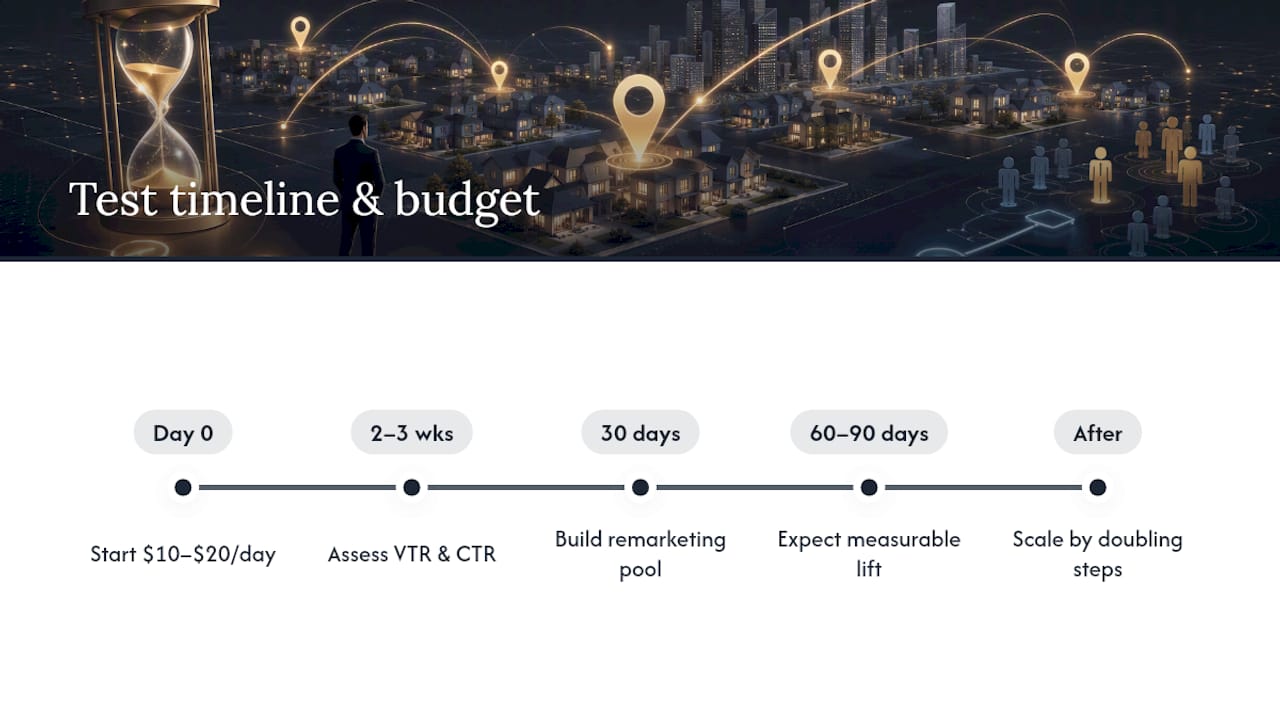
The four metrics worth watching weekly:
Five-second retention tells you whether your hook is working before anyone even reaches your view-through rate. View-through rate (VTR) shows what percentage of people who started your ad watched a meaningful chunk of it. Click-through rate (CTR) tells you whether the ad’s message is compelling enough to act on immediately. Landing-page conversion closes the loop by showing whether the people who clicked actually did something once they arrived.
When VTR is strong but CTR is weak, the hook is working but the call to action isn’t landing, so change the offer before you touch the targeting. When both are weak, the creative itself isn’t earning attention, and no amount of audience refinement will fix a script problem. Iterate creative first. Change targeting second.
Turning Views Into Listing Conversations
A view is not a lead. The gap between the two gets closed with a retargeting sequence that treats different levels of engagement differently, rather than serving the same ad to everyone who’s ever seen your channel.
A workable cadence looks like this:
- Someone who watches just 5 seconds gets served a short proof point next, like a quick client testimonial clip or a recent sale in their neighborhood.
- Someone who watches a full 30 seconds gets shown your lead magnet directly, since they’ve already demonstrated real interest.
- Someone who clicks through gets sent to a landing page built specifically to capture an email or phone number, not a generic homepage.
The lead magnet itself needs to match whatever the ad promised. A neighborhood market report works well when the ad talked about local pricing trends. An off-market listings list fits an ad aimed at buyers frustrated with a tight inventory. A no-obligation valuation request pairs naturally with an ad targeting potential sellers. Message-match between the ad and the landing page is one of the more consistent factors separating campaigns that convert from campaigns that just accumulate views, according to the same Krista Mashore guide on YouTube ads for agents.
Track the whole chain with UTM tags on every landing page link and CRM events tied to each stage, so you can see exactly which ad, which audience, and which lead magnet produced an actual conversation, not just a click. If you’re building this out, a retargeting sequence built for real estate can shortcut a lot of the setup work. And once someone opts in, don’t let YouTube carry the whole relationship alone. Layer in an email drip and a local outreach touch, because nurturing sequences close a meaningful share of the gap between “opted in” and “booked an appointment.”
Production Workflow: Batching, Editing, and Repurposing
The agents who keep YouTube ads running longer than a month are almost always the ones who batch production instead of filming one video at a time whenever inspiration strikes.
- Script writing session. Draft five to ten short scripts in one sitting, following the hook, proof, call-to-action formula from earlier. Writing scripts in a batch keeps the format consistent and saves you from starting from a blank page every time.
- Teleprompter recording session. Load your scripts into a teleprompter app, BIGVU-style tools work well for this, and record everything in one block. Capture both vertical and horizontal framing in the same take whenever your setup allows it, so you’re not reshooting later for different placements.
- Repurposing pass. Take your longer-form footage and cut it into Shorts, trimmed ad clips for new tests, and standalone testimonial clips reserved specifically for the retargeting sequence.
Your gear checklist can stay short: a phone with a decent front camera, a $20 clip-on microphone, and either a window for natural light or a cheap ring light. Before uploading anything, run a quick quality check for audio clarity, a steady frame, and a caption pass, since a large share of viewers watch with sound off during the first few seconds.
Rotate creatives on a schedule rather than waiting for performance to visibly drop. A new script every two to three weeks keeps frequency caps meaningful and prevents the same faces from wearing out an audience that’s still small enough to notice repetition.
Pro Tip: Batch three months of scripts in one afternoon by writing five variations of the same three hook types instead of trying to invent a brand-new concept every single time. Small changes in the local detail keep it fresh without requiring new creative thinking every time.
Perspective: What a Hyperlocal Test Actually Looks Like
Picture an agent running a single $15 a day ad naming one subdivision, paired with a market-fact hook about recent sale prices. Nothing happened for three weeks. Then the retargeted testimonial clip started reaching people who’d watched the first ad, and two listing conversations followed within days of each other. That’s the pattern more often than an ad that converts on day three.
Three lessons carry across almost every version of this story. Patience matters more than most agents expect, because the payoff lives in the retargeting layer, not the first impression. Message-match between the hook and the landing page decides whether a click becomes a lead. Follow-up discipline, meaning a real CRM sequence behind the ad, does more work than any single creative tweak.
Keep the script simple, keep testing, and resist the urge to make version two more polished than version one just because it’s still under the wire on view-through rate.
— Jason
How Plo Can Run the Whole Funnel for You
Running a hyperlocal YouTube campaign well takes consistent scripting, retargeting setup, and CRM tracking, which is exactly the workload that eats into an agent’s actual selling time. Plo is built for agents who want the awareness-plus-remarketing engine running without becoming a part-time video editor to get it there.
Plo’s platform pairs AI ad creation with managed campaign execution, so your hyperlocal scripts, landing pages, and retargeting sequences get built and monitored without you touching Google Ads settings every week. If you’re a solo agent testing your first $15 a day ad, DIY makes sense while you learn the format. Once you’re managing multiple listings or a small team and want guaranteed lead flow instead of a side project, a managed partner closes that gap faster than trial and error will. Plo offers plans that include packages for managing campaign management, creative production, and reporting off your plate. Check current pricing and plan details to see which tier fits your current listing volume.
Official Resources Worth Bookmarking
Set up and manage campaigns directly through Google Ads, the official console for all YouTube ad formats, billing, and targeting controls. For lead-generation context specific to agents, the NAR video marketing guidance is worth a bookmark too.
Sources
- 8 invaluable lead-generation ideas for agents and brokers | NAR
- Google Ads
- YouTube Ads for Real Estate Agents: The 2026 Guide | Krista Mashore
- Getting Results with YouTube Ads for Real Estate | Adbetter
FAQ
Are Google Ads Worth It for Realtors?
Yes, when paired with a clear landing page and a retargeting sequence, since Google Ads (which powers all YouTube ad campaigns) rewards message-match between the ad and what happens after the click. Agents who run ads without a follow-up system tend to see weak results regardless of platform.
How Do I Run Ads for Real Estate Agents on YouTube?
Start with a skippable in-stream ad targeting a specific neighborhood radius, budget $10 to $20 a day, and build the script around a five-second hyperlocal hook. Layer in retargeting once you’ve built enough views to form a remarketing pool, generally over the first 60 to 90 days.
How Much Do YouTube or Google Ads Cost for Realtors?
Starter budgets of $10 to $20 a day are common for testing a new script, with skippable in-stream ads charging only when a viewer watches past 30 seconds or clicks, according to Adbetter’s breakdown of YouTube ad pricing. Agents who want the setup, creative, and reporting managed for them can compare packages like Plo’s Marketing suite, listed at $445 per month, on the pricing page.
Who Are the Top YouTube Realtors to Learn From?
There’s no official ranking, but the agents getting cited most often for hyperlocal YouTube strategy tend to be practitioners who publish their own playbooks rather than national franchises. Studying a documented approach, like the one detailed in the Krista Mashore guide to YouTube ads for agents, is more useful than chasing a specific name.