

Add a short, high-impact negative keyword list today: block agent, buyer, rental, job, and free-tool searches, then check your Search terms report every week. Negative keywords in real estate campaigns rely on telling Google which searches to skip, so your budget stops chasing “realtor jobs near me” and starts reaching people who actually want to sell their house fast. Get the match types wrong, though, and you’ll block the exact seller leads you’re paying to find.
TL;DR:
- Using precise negative keywords can cut wasted clicks by 20 to 40 percent, significantly lowering cost per acquisition in real estate campaigns.
- Effective negative keyword lists should include no more than 80 targeted terms, organized by intent, and regularly updated based on search term reports.
- Different negative match types serve specific functions: exact for pinpoint queries, phrase for common word sequences, broad for unreliably irrelevant combinations, and each requires careful testing.
- Overblocking search terms by using broad negatives can cause a sudden decrease in impressions and conversions, so changes should be tracked with a detailed log.
- A systematic 90-day audit process helps maintain optimal negative keyword performance and prevent budget leaks, especially during market or seasonal shifts.
Table of Contents
- What Negative Keywords Are (and How They Differ From Regular Keywords)
- Why Negative Keywords Matter for Real Estate Investors
- High-Impact Negative Keyword Categories for Real Estate Ads
- Negative Match Types: Broad, Phrase, and Exact Explained
- How to Find Negative Keywords Hiding in Your Account
- How Often Should You Update Your Negative Keyword List?
- Common Negative Keyword Mistakes That Hurt Real Estate Campaigns
- The 90-Day Negative Keyword Audit Every Investor Should Run
- Why Surgical Negative Keyword Work Beats Chasing Bigger Bids
- How Plo Handles Negative Keyword Audits for Real Estate Advertisers
- Sources
- FAQ
What Negative Keywords Are (and How They Differ From Regular Keywords)
A positive keyword tells Google Ads which searches to chase. A negative keyword tells it which searches to ignore. A search query is the actual phrase someone typed into Google, the raw material both keyword types react to.
Here’s the part that trips up a lot of investors: negative keywords are literal. Google Ads documentation confirms they don’t match synonyms, plurals, or close variants the way regular keywords sometimes do. Add “realtor” as a negative and you’ve blocked “realtor,” but not automatically “realtors” or “real estate agent.” You have to add each variant yourself.
That literalism cuts both ways. It gives you precise control, but it also means a sloppy negative list leaves gaps a mile wide.
Picture a seller-lead campaign built around “sell my house fast.” Without exclusions, that ad also fires on:
- “sell my house fast realtor commission”
- “how to become a real estate agent fast”
- “sell my house fast for free estimate”
None of those searchers want a cash offer. They want a job listing, a commission calculator, or a free valuation tool. Negative keywords are how you draw the line between them and your actual buyer, before they ever click and cost you money.
Why Negative Keywords Matter for Real Estate Investors
Every click from an agent, a jobseeker, or a curious homeowner researching Zillow comps burns budget that should have gone toward a genuine seller lead. That’s the entire economic case for negatives: they reallocate spend, not just reduce it.
Practitioner data backs this up. Case examples compiled by Investor Nitro show active negative-keyword programs cutting wasted clicks by 20 to 40 percent, with meaningful drops in cost per acquisition once the lists mature. That’s not a rounding error.
Motivated-seller campaigns feel this the hardest. Probate, inherited-property, and pre-foreclosure ad groups sit on top of some of the messiest search behavior in real estate; understanding when a property owner fails to disclose issues on a real estate contract can help clarify some common legal concerns that drive these search patterns. “Probate” alone pulls in law students, paralegal jobseekers, and people researching a relative’s estate for reasons that have nothing to do with selling. Preserve the seller intent in those campaigns and you preserve your entire lead pipeline, since the whole strategy depends on reaching people at a very specific moment of decision.
Understanding which lead types you’re actually targeting helps you decide which search intents deserve protection and which ones deserve the axe.
High-Impact Negative Keyword Categories for Real Estate Ads
Most investors don’t need a 500-line negative list. They need the right 50 to 80 terms, organized by intent, adjusted for their specific offer. Here’s a starter framework built around the categories that drain budget fastest.
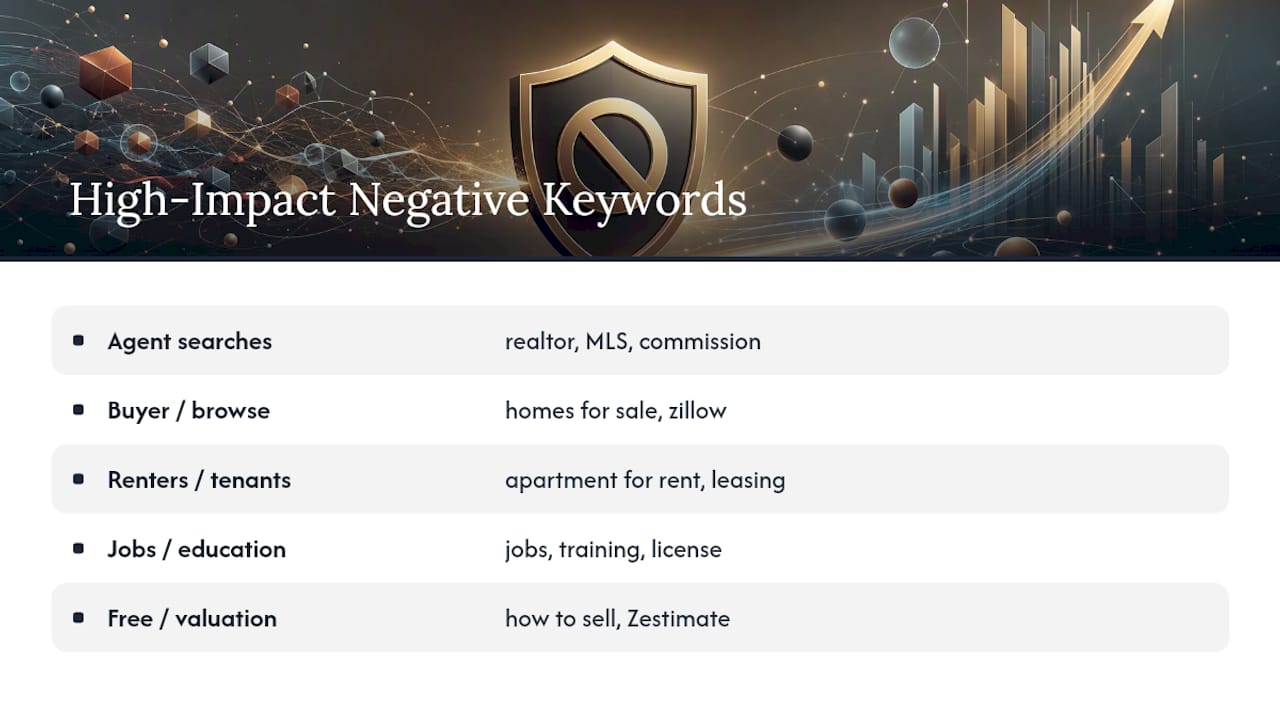
Agent and professional searches. Anyone using industry jargon isn’t your seller. Block: realtor, listing agent, MLS, commission, brokerage, real estate license, become an agent.
Buyer and browse phrases. These searchers want to purchase, not sell. Block: homes for sale, buy a house, house hunting, zillow, redfin, realtor.com, open house.
Renters and tenants. Wrong side of the transaction entirely. Block: apartment for rent, rental listings, leasing office, tenant rights, rent to own.
Jobs and education. Surprisingly heavy traffic drain in real estate accounts. Block: real estate jobs, careers, training course, certification, exam prep, license course.
Financing searches, if you don’t originate loans yourself. Block: mortgage rates, refinance, home loan, FHA loan, down payment assistance.
Free, research, and valuation queries. These indicate someone gathering information, not someone ready to sell today. Block: free, how to sell, what is my house worth, zestimate, home value estimator, DIY.
Competitor and third-party brand terms, applied carefully at the account level. If a competing cash-buyer brand’s name keeps showing up in your search terms and draining clicks without converting, a shared negative list can trim that leak. REIRank’s negative keyword list is a solid starting point for cash-buyer campaigns, though every list needs tuning to your specific offer before you trust it wholesale.
One caveat worth repeating: a term that’s toxic in one campaign can be gold in another. “Zillow” might be a wasted click in your seller-lead campaign, but if you also run buyer-side listings, it’s a qualifying signal, not a threat.
Negative Match Types: Broad, Phrase, and Exact Explained
Google Ads gives you three negative match types, and each one behaves differently enough that picking the wrong one can quietly wreck a campaign.
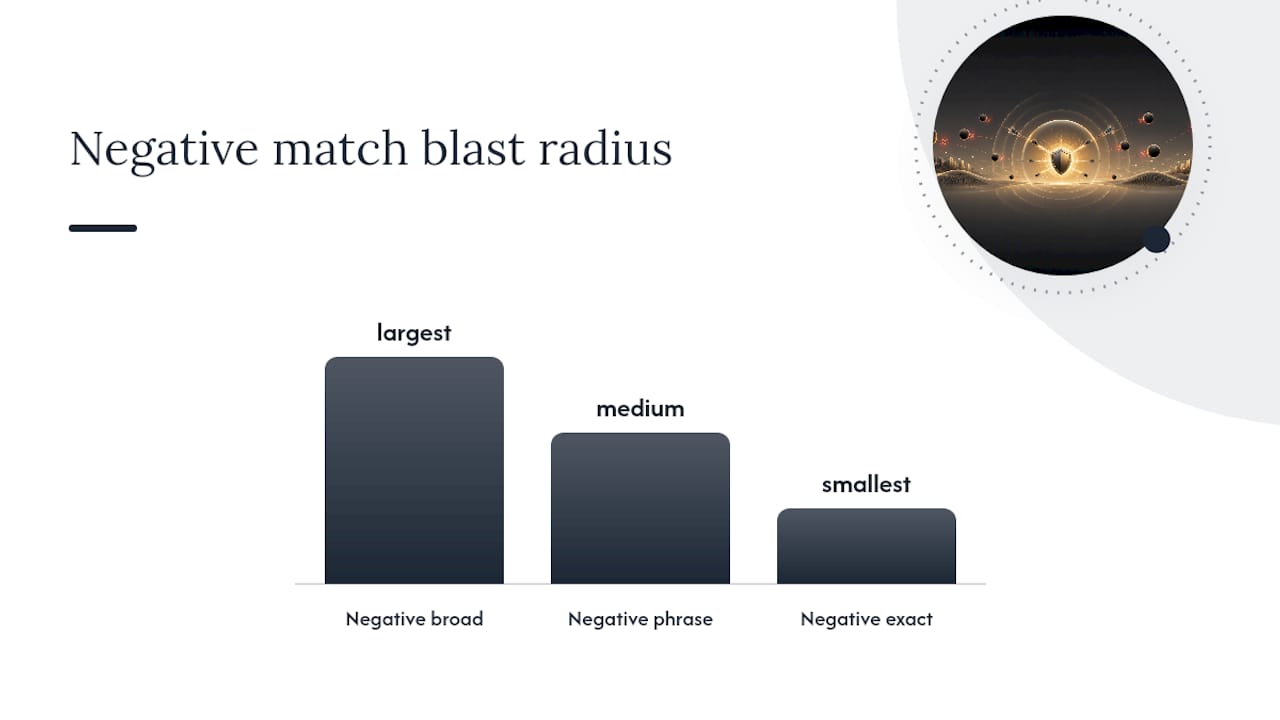
Negative broad match blocks a search when all the words in your negative appear anywhere in the query, regardless of order. Add “real estate agent” as a negative broad and you’ll block “agent for real estate,” “best real estate agent near me,” and dozens of other combinations. Use this only when you’re certain the combination of words is always unwanted, no matter how it’s arranged.
Negative phrase match blocks the exact word sequence, even with other words before or after it. “Sell my house” as a negative phrase blocks “sell my house fast free” and “please sell my house,” but not “house I want to sell.” Phrase negatives are the workhorse for most multi-word exclusions because they’re specific enough to avoid collateral damage but flexible enough to catch variations.
Negative exact match is the narrowest tool in the drawer. Google’s own documentation confirms it blocks only the precise search term, with no extra words tolerated. Use exact negatives when you’ve spotted one specific irrelevant query in your Search terms report and want to kill it without touching anything else.
- Start with exact match for anything you’re not 100% sure about.
- Move to phrase match once you’ve confirmed a pattern across multiple queries.
- Reserve broad match negatives for word combinations you’re confident are always irrelevant.
- Avoid single-word broad negatives almost entirely. Blocking a common word like “free” or “cheap” at broad match can eliminate searches you never even reviewed.
Practical guidance from LeadUp frames this well: negative match types control the “blast radius” of an exclusion. Start narrow, widen only with repeated evidence, and you’ll rarely blow a hole in a working campaign.
Pro Tip: Before you add any negative broad match term, search it yourself in Google Ads’ keyword planner or your own Search terms report first. If you can’t predict every combination it might catch, don’t use broad. Downgrade to phrase and sleep easier.
How to Find Negative Keywords Hiding in Your Account
Most of the negative keywords you need are already sitting in your account, disguised as wasted clicks. Finding them is a matter of running the right report and reading it correctly.
-
Export your Search terms report. Inside Google Ads, filter by cost and sort by zero conversions. Any query that’s burned real dollars without producing a lead, a call, or a form fill is a candidate for exclusion. The Search terms report is the single best evidence source in your account, better than any generic list, because it reflects your actual traffic.
-
Tag every irrelevant query by intent. Set up columns for buyer, agent, renter, job seeker, and researcher. A query like “how to sell house without realtor commission” might look seller-adjacent, but tag it “researcher” if it never converts, since intent labels help you spot patterns across a full month instead of reacting to one-off queries.
-
Decide placement and document why. Some negatives belong at the ad group level because they only hurt one campaign. Others belong in a shared negative list applied account-wide. Write down your reasoning next to each addition. Six months from now, you’ll thank yourself for remembering why “estimate” got blocked.
Spreadsheet regex filters speed up the tagging step considerably, and industry starter lists give you a baseline to compare against your own account data. Programs like the 90-day Google Ads systemization approach build this audit rhythm directly into a broader lead-generation framework.
How Often Should You Update Your Negative Keyword List?
Negative keyword maintenance isn’t a one-time setup task. Search behavior shifts with the market, seasonal cycles, and even news events, so a list that worked in January can leak budget by June.
A workable cadence looks like this:
- Weekly: A five-minute scan of new search terms for anything glaringly irrelevant. Catch the obvious noise before it accumulates cost.
- Monthly: A deeper audit comparing conversion rate and cost per acquisition before and after your last round of negative additions.
- Quarterly: A wholesale review of your entire negative list, checking for outdated exclusions and terms that may have shifted in relevance.
Watch four metrics after any negative keyword change: click-through rate, conversion rate, cost per acquisition, and impression share. Give the data at least one to two weeks and a reasonable volume of impressions before judging impact. A handful of clicks tells you nothing; a few hundred does.
Practitioner benchmarks compiled by Investor Nitro show that accounts with disciplined negative-keyword maintenance see steadier CPA improvements over time than accounts that set a list once and forget it. Test changes in small batches, keep a backup of your previous list, and roll back immediately if conversions drop without a clear explanation. Benchmark data on real estate Google Ads costs can help you judge whether a CPA shift is normal fluctuation or an actual red flag.
Common Negative Keyword Mistakes That Hurt Real Estate Campaigns
Overblocking is the most common failure mode, and it’s sneaky because it often looks like success at first. Impressions drop, CTR ticks up, and everything seems cleaner. Then conversions stall out, because you accidentally excluded a search pattern that included real seller intent buried inside it.
Watch for these warning signs:
- A sharp, sudden drop in impressions right after a negative list update.
- Click-through rate rising while total conversions fall.
- A previously reliable campaign suddenly going quiet with no seasonal explanation.
When you spot one of these, trace it back. Pull the negative keywords added most recently and check each one against your current Search terms report; a broad match negative is almost always the culprit. Google’s own guidance warns that overusing negatives can meaningfully limit reach, and negatives never catch misspellings or close variants automatically, so removing a bad exclusion won’t retroactively recover the traffic you missed while it was live.
Pro Tip: Keep a running change log with the date, the exact term, the match type, and your reasoning. When performance dips, that log turns a frustrating guessing game into a five-minute diagnosis.
The 90-Day Negative Keyword Audit Every Investor Should Run
A structured 90-day cycle turns negative keyword management from a reactive chore into a system.
- Days 1 to 15: Establish baseline metrics. Pull CTR, conversion rate, and CPA for the trailing 60 days before touching anything.
- Days 15 to 45: Run the full Search terms audit, tag every query by intent, and apply your first round of exact and phrase negatives.
- Days 45 to 75: Test narrower campaign-specific exclusions against the account-wide shared list, watching for any conversion dip.
- Days 75 to 90: Scale what’s working, document the final list, and set your ongoing weekly and monthly review rhythm.
A starter template that works across most seller-lead campaigns: block agent and MLS terms at phrase match, buyer and rental terms at phrase match, and job/education terms at broad match once confirmed clean. Layer in exact-match negatives as your Search terms report surfaces new noise. This is the same rhythm behind the 90-day lead systemization framework many investors used to stabilize their cost per lead.
Why Surgical Negative Keyword Work Beats Chasing Bigger Bids
The instinct in a struggling campaign is almost always to raise bids or widen targeting. That’s backward. In every account audit worth its salt, the first move should be subtraction, not addition. You don’t fix a leaky bucket by pouring in more water.
The single biggest judgment call in negative keyword work is knowing when a term is genuinely dead weight versus when it’s a modifier that only looks bad in isolation. “Free” seems like an obvious negative until you realize your seller campaign is losing “free consultation” searches, which convert at a higher rate than most of your paid traffic. That’s why exact and phrase match belong in front of broad match almost every time: conservative testing costs you a little speed, but it protects you from torching a working campaign over one bad assumption.
If your account has hit a plateau where every lever feels tapped out, that’s usually the moment a deeper audit pays for itself several times over.
— Jason
How Plo Handles Negative Keyword Audits for Real Estate Advertisers
Plo is the alternative to hiring a generalist agency for real estate Google Ads: instead of a junior account manager guessing at exclusions once a quarter, you get a managed audit built specifically around motivated-seller campaigns, with weekly Search terms review baked into the process instead of billed as an extra.

A quick audit from Plo starts with your existing Search terms data, builds a categorized negative list tuned to your actual campaigns (not a generic template), and sets up the same 90-day systemization rhythm outlined above, at real timelines rather than vague promises. For agents and investors who want the work handled end to end, the Marketing suite runs $445 per month, while the Leads Guaranteed plan at $5,899 per month pairs managed ad optimization with a lead-volume guarantee for teams that need predictable pipeline, not just cleaner spend.
If you’d rather talk through your account first, book a demo and bring your last 30 days of Search terms data. Plo’s team will show you exactly where the waste is hiding before you commit to anything.
Sources
- About negative keywords – Google Ads Help
- Stop Wasting Ad Budget: The Real Estate Investor’s Negative Keyword Playbook | Investor Nitro
- Google Ads Negative Match Types Explained | LeadUp Blog
FAQ
What are examples of negative keywords in real estate ads?
Common examples include “realtor,” “MLS,” “for rent,” “jobs,” “free,” and “zestimate.” Each one filters out a specific unwanted intent, whether that’s an agent search, a rental query, or a job seeker, so your budget stays focused on genuine seller leads.
What is the 3-3-3 rule in real estate?
The 3-3-3 rule refers to a home-buying financial guideline: aim for a down payment of at least 3%, keep monthly housing costs under 3% of your income (or a comparable ratio), and have three months of expenses saved. It’s a buyer-side budgeting rule, unrelated to Google Ads targeting, but it’s worth knowing since buyer-focused searches using this framing are usually candidates for exclusion in a seller-lead campaign.
What are trigger words in real estate?
Trigger words are phrases in a listing or ad copy that specialists suggest can raise fair housing concerns, such as language implying preference based on protected characteristics. They’re a copywriting and compliance issue, separate from negative keywords, which control search targeting rather than ad text.
What are the 5 P’s in real estate?
Definitions of the “5 P’s” vary by source and aren’t standardized the way negative keyword match types are. Rather than force a definition that shifts depending on who’s writing it, treat any version you encounter as a general framework, not a fixed industry standard.
How much does managed negative keyword optimization cost?
Pricing depends on the scope of the campaign work involved. Plo’s Marketing suite starts at $445 per month for managed campaign optimization, while full lead-generation partnerships are priced separately on the pricing page.