
Plan on roughly $2.50 to $3.25 per click and $75 to $140 per lead, with wide swings based on your market and whether you’re chasing buyers or sellers. A solo agent needs about $900 to $1,000 a month just to generate enough clicks for Google’s algorithm to learn what’s working. Give any new campaign 60 to 90 days before judging the cost-per-lead number, because the first month is almost always your most expensive one.
TL;DR:
- Budgets below $900 per month rarely generate enough data for Google’s algorithm to optimize effectively, delaying stabilization beyond three months.
- Seller leads tend to cost significantly more per click and per lead than buyer leads due to higher commission potential and increased market competition.
- Targeting hyperlocal, long-tail keywords and matching ad copy directly to landing pages can reduce CPL by 20 to 40 percent through improved Quality Score and relevance.
- Seasonality and local competition heavily influence CPCs, with metro areas often paying 30 to 60 percent more than national averages, requiring strategic bidding and targeting adjustments.
- Automated bidding strategies should be adopted after accumulating roughly 30 conversions to maximize cost-efficiency and lead quality over manual bid management.
Table of Contents
- How Much Does Google Ads Cost for Real Estate Agents?
- What Drives Real Estate Google Ads Costs?
- How Much Should You Budget for Real Estate PPC?
- How Do You Lower Cost-Per-Lead in Real Estate Ads?
- What Should Your Google Ads Setup Look Like?
- How Plo Puts These Tactics to Work
- DIY or Managed: When Hiring a Specialist Actually Pays Off
- Get Predictable Lead Flow Without Managing the Account Yourself
- Sources
- FAQ
How Much Does Google Ads Cost for Real Estate Agents?
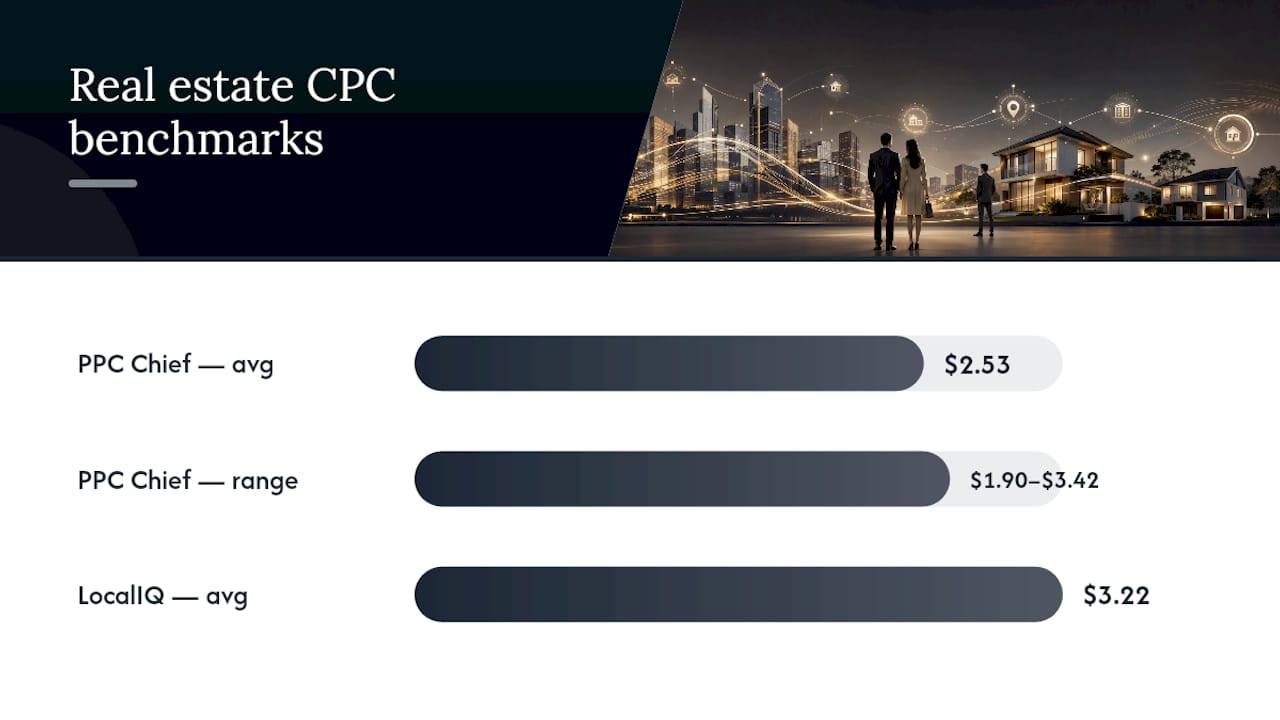
Industry benchmarks put the average real estate cost-per-click between $2.53 and $3.22, depending on which report you trust and when you pull the data. PPC Chief’s benchmark pegs the average CPC at $2.53, with a realistic range of $1.90 to $3.42 depending on your metro and keyword set. LocalIQ’s real estate benchmarks run slightly hotter, at an average of $3.22.
Cost-per-lead tells the more useful story, since clicks alone don’t pay your commission. PPC Chief puts average CPL at $100.48, with a typical spread of $75 to $136. LocalIQ’s figure lands close by, at $102.51. The gap between those two numbers isn’t a contradiction. It’s a reminder that “average” hides a lot of variance between a starter suburb campaign and a luxury condo push in a major metro.
Here’s what those numbers actually mean once you convert them into a monthly plan:
| Monthly budget | Estimated clicks (using an average CPC near $3) | Estimated leads (using an average CPL around $100) |
|---|---|---|
| Approximately $1,000 | Several hundred clicks | About ten leads |
| Approximately $2,500 | Around eight hundred clicks | About twenty-five leads |
| Approximately $5,000 | Over one thousand clicks | Approximately fifty leads |
These figures serve as general guidance rather than guarantees. Actual performance will depend on variables including landing page effectiveness, keyword targeting, and speed of lead follow-up. Still, these estimates provide a reasonable basis for planning, avoiding pure guesswork.
Lead type changes the equation more than almost any other variable. A few patterns worth knowing before you set targets:
- Seller leads cost more per click and per lead than buyer leads, often by a wide margin, because sellers represent a bigger, faster commission and every agent in the metro wants that same click, as explained in Realtor Commission vs Cash Offer in Miami: What You Really Keep.
- Buyer leads run cheaper but convert slower, since buyers browse for weeks or months before they’re ready to talk to anyone.
- Rental leads sit at the bottom of the cost scale, useful for building a database and referral pipeline but rarely worth heavy spend on their own.
If your current cost-per-lead looks nothing like these ranges, that’s not automatically a red flag. It just means you need to dig into which levers are pushing your number up or down, which is exactly what the next section covers.
What Drives Real Estate Google Ads Costs?
Every dollar you spend on real estate PPC costs gets shaped by an auction, and the auction rewards relevance more than it rewards budget size. Google’s Quality Score system weighs expected click-through rate, ad relevance, and landing page experience, and a low score can push your effective CPC up dramatically even when your bid stays flat.
A few forces are largely outside your control:
- Local competition. A metro with fifteen agents bidding on “homes for sale in [neighborhood]” will always cost more than a rural county with two.
- Seasonality. Spring listing season and back-to-school relocation windows both push CPCs up as more agents compete for the same buyer intent.
- Keyword intent. “Sell my house fast [city]” costs more than “homes for sale [city]” because the searcher is closer to a transaction.
Other forces sit entirely in your hands. Match type discipline is one of the biggest. Broad match without a strong negative keyword list will burn budget on searches like “how to become a real estate agent” or “real estate school,” neither of which is a lead. Building a negative keyword list in week one, not month three, saves real money.
Geography adds one more wrinkle. Major metro CPCs can run 30 to 60 percent above national averages, based on PPC Chief’s benchmark data. Targeting hyperlocal, long-tail phrases like “3 bedroom homes in [specific neighborhood]” instead of “homes for sale [city]” often pulls your CPL down while keeping the same buying intent.
Google’s housing policy also reshapes what you can do with targeting. Campaigns falling under the Special Ad Category for housing lose access to certain demographic and location-radius targeting options that other industries use freely. That restriction typically nudges CPL upward slightly, since you can’t narrow your audience as tightly as a general consumer advertiser can.
Pro Tip: Before you touch your bids, fix your landing page. A page built specifically for “sell my house in [neighborhood]” that matches the ad copy word-for-word will beat a generic homepage on Quality Score every time, and that alone can shave 20 to 40 percent off your effective cost, according to WordStream’s real estate guide.
How Much Should You Budget for Real Estate PPC?
Your real estate ad budget should match your goal, not your comfort level. A budget too small to generate conversions doesn’t just underperform, it actively works against you, because Google’s automated bidding needs conversion data to optimize and a thin trickle of leads never gives it enough signal.
- Under $900/month: testing purgatory. Below this line, you’re often just feeding Google’s learning phase without ever exiting it. Practitioner estimates from Sprout Sage suggest budgets under roughly $500 rarely produce enough conversion volume for the algorithm to optimize reliably.
- $900 to $2,000/month: solo agent steady state. This is the realistic floor for a single agent who wants consistent lead flow rather than sporadic clicks. LeadSites recommends a testing-phase allocation of $800 to $1,500 for the Google Ads portion of a broader $1,500 to $2,500 marketing budget.
- $2,000 to $5,000/month: small team territory. At this level you can run separate buyer and seller campaigns, test premium seller keywords without starving your buyer funnel, and layer in remarketing.
- $5,000+/month: brokerage scale. This range supports multiple campaign types running simultaneously, dedicated landing pages per listing type, and enough lead volume to justify a full-time or agency-managed optimization cycle.
Once you’ve picked a tier, split it across campaign types rather than dumping everything into one Search campaign:
- Search campaigns should get the largest share, since they capture the highest-intent traffic.
- Remarketing deserves 10 to 20 percent of spend, since it re-engages visitors who didn’t convert the first time and typically costs far less per click.
- Local/Maps campaigns matter most for agents relying on neighborhood foot traffic and open house visibility.
- Lead form ads work well as a lower-cost supplement, particularly on mobile, where a native form beats sending traffic to a slower external landing page.
If you’re weighing a managed service against running this yourself, compare the agency fee to what you’d actually save in wasted spend from mismanaged match types and missing negative keywords. A managed system built for real estate agents often earns back its fee just from tighter targeting alone.
How Do You Lower Cost-Per-Lead in Real Estate Ads?
Cutting real estate advertising expenses without cutting lead quality comes down to a short list of high-leverage moves, tackled in the right order.
Start with the landing page, not the bid. A dedicated page for each campaign, built around one property type or one neighborhood, with a mobile-first lead form above the fold, consistently outperforms a generic “contact us” homepage. WordStream’s data shows well-aligned landing pages can cut costs by 20 to 40 percent through the Quality Score mechanism alone.
Keyword hygiene comes next. Long-tail phrase and exact match keywords give you more control over who sees your ad than broad match ever will, and a growing negative keyword list keeps irrelevant searches from draining budget. Review your search terms report weekly for the first month, then monthly after that.
Ad copy and extensions matter more than most agents assume:
- Sitelink extensions pointing to specific listing categories raise click-through rate, which feeds directly back into Quality Score.
- Callout extensions highlighting credentials or guarantees give your ad more real estate on the results page without extra cost.
- Lead form assets let a prospect submit contact info without leaving Google, which tends to lift conversion rate on mobile traffic specifically.
Bidding strategy should evolve as your data grows. Start manual or Enhanced CPC while you’re still collecting conversions, then graduate to Maximize Conversions or Target CPA once you’ve logged enough conversion history for the algorithm to work with. Most practitioners treat 30 conversions as the rough threshold where automated bidding starts making smarter decisions than a human adjusting bids by hand.
Remarketing sequences do quiet, compounding work. A visitor who browsed listings but didn’t submit a form isn’t a lost lead, they’re a warm audience for a follow-up ad at a fraction of your cold-traffic cost. A structured retargeting sequence can lower your blended CPL meaningfully by converting people who already know your name.
Pro Tip: Connect your ad platform to your CRM before you connect it to anything else. Without that link, you’re optimizing for form fills, not closings, and those are two very different numbers. Tracking the right conversion events is what turns a cost report into a real ROI report.
What Should Your Google Ads Setup Look Like?
Campaign structure decisions made in week one tend to determine your cost trajectory for months, so it’s worth getting the launch checklist right before you spend a dollar.
Search campaigns should be your foundation, since they capture people actively typing buyer or seller intent phrases. Performance Max can extend reach across Google’s network once you have enough conversion data to feed it, but launching straight into Performance Max without that history often wastes early budget on low-intent placements. Local campaigns and Google Maps placements matter specifically for agents whose leads come from neighborhood visibility rather than broad search. Lead form campaigns work as a low-friction supplement, especially for mobile users who won’t fill out a multi-field form on a slow-loading page.
Bidding should follow a clear progression: manual or Enhanced CPC first, then a shift to automated strategies once you’ve cleared enough conversions for reliable optimization.
Real estate campaigns under Google’s housing Special Ad Category lose access to age, gender, parental status, and zip-code radius targeting, which changes how tightly you can define an audience compared to a standard consumer campaign.
Before launch, confirm each of these:
- Conversion tracking is installed and firing correctly on form submissions and phone calls.
- Your CRM is connected so leads route automatically instead of sitting in an inbox.
- A starter negative keyword list is in place, covering job-seeker terms, DIY terms, and competitor brand names.
- Ad copy and landing pages are matched one-to-one by campaign, not shared across multiple ad groups.
How Plo Puts These Tactics to Work
None of this works in theory alone. Plo built its Stable Leads in 90 Days system around the exact benchmarks and timelines covered above, because agents kept hitting the same wall: campaigns that looked fine on paper but never stabilized past month one.
The approach leans on a few consistent moves:
- Housing Special Ad Category compliance built into every campaign from day one, so accounts never get flagged or paused mid-launch.
- Retargeting sequences layered in early, since warm-audience remarketing consistently pulls blended CPL down faster than cold-traffic optimization alone.
- CRM-integrated conversion tracking, so lead cost gets measured against actual appointments and closings, not just form fills.
If you want to see how these pieces fit together for your specific market and budget tier, the lead generation resources for agents and luxury brokers walk through what a first 90 days typically looks like before you commit any spend.
DIY or Managed: When Hiring a Specialist Actually Pays Off
Running your own campaigns makes sense when you have the time to check search terms weekly and the patience to sit through a slow first month. It stops making sense the moment your calendar can’t absorb that maintenance, or your CPL refuses to stabilize past the 90-day mark despite reasonable spend.
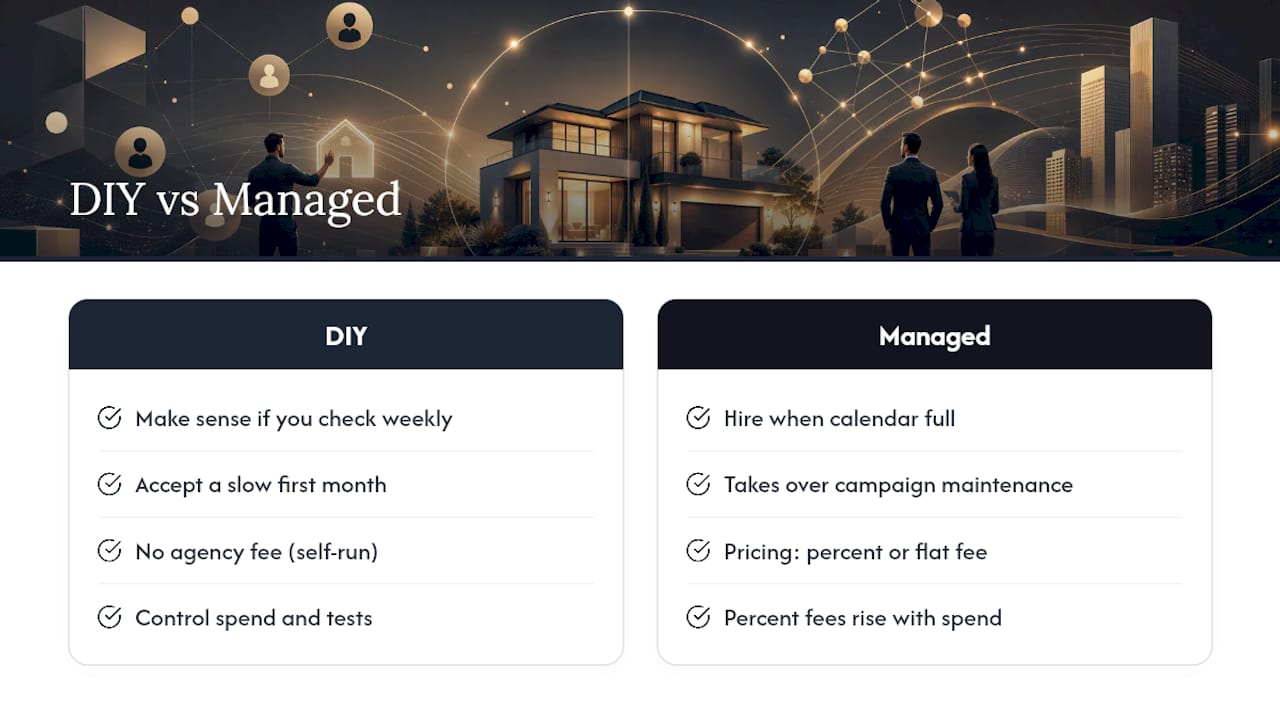
Pricing models split roughly two ways: a percentage of ad spend, or a flat monthly retainer. Percentage-based fees create a strange incentive, since the agency earns more as you spend more, regardless of lead quality. A flat fee aligns better with your actual goal, which is leads, not spend volume.
The clearest signal I’ve seen for when to hand this off: an agent tests a modest budget for a couple of months, sees the lead volume that’s possible, then hits a ceiling they can’t push past alone. That’s not a failure of the channel. It’s just the point where specialized attention starts outperforming trial and error.
— Jason
Get Predictable Lead Flow Without Managing the Account Yourself
You can choose alternatives to traditional agencies for real estate Google Ads that offer systems built around housing-compliant campaigns, CRM-integrated tracking, and lead guarantees.

The Leads Guaranteed plan costs several thousand dollars per month, and the Performance Partner plan begins at a similar starting price for agents seeking a scaled, ongoing partnership rather than a fixed package. Both plans include onboarding, campaign setup aligned to the housing Special Ad Category, and the same 60 to 90 day stabilization window covered earlier in this article, reflecting typical timelines for Google’s bidding systems to learn.
If you’d rather add lead volume without building or managing a campaign at all, the lead purchasing service fills that gap directly. Explore the full pricing breakdown to see which tier fits your current lead volume and where you’d want to grow next.
Sources
- Real estate Google Ads CPC: PPC Chief benchmark (2026)
- Google Ads for Real Estate: The Ultimate Step-by-Step Guide — WordStream
- Real Estate Advertising Benchmarks — LocalIQ
- Real Estate Advertising Budget Guide for 2026 — LeadSites
- Google Ads help: campaign types and planning
FAQ
Are Google Ads Worth It for Realtors?
Yes, for agents willing to fund a real campaign rather than a token test. High-intent searches like “homes for sale [city]” bring in people actively looking, and a well-structured campaign at $900 or more a month typically produces measurable leads within 60 to 90 days.
Is $500 a Month Enough for Google Ads?
Usually not. At that spend level, most real estate accounts struggle to collect enough conversions for Google’s bidding algorithm to optimize, which often traps the account in an extended, expensive learning phase.
Is $10 a Day Enough for Google Ads?
$10 a day works out to roughly $300 a month, which sits well below the $900 to $1,000 threshold that gives a real estate campaign meaningful optimization data. It can work for extremely narrow, low-competition local searches, but it rarely produces steady lead flow in most markets.
Is $20 a Day Good for Google Ads?
$20 a day is about $600 a month, still below the recommended solo-agent floor but closer to viable in lower-competition markets. It’s a reasonable starting point for testing keyword performance before committing to a full $900+ monthly budget.
How Long Until My Cost-Per-Lead Stabilizes?
Plan on 60 to 90 days. That window gives Google’s bidding systems enough conversion volume, often cited around 30 conversions, to shift from manual or Enhanced CPC bidding to more reliable automated strategies.