

Sales forecasting is defined as the process of estimating a company’s future sales revenue over a specific period using historical data, current pipeline status, and market trends. IBM states it enables leaders to make informed decisions on budgeting, hiring, and production. For real estate agents, yacht brokers, and luxury sales professionals, a reliable forecast is not a luxury. It is the operating system behind every smart business decision you make.
Most sales leaders treat forecasting as a reporting exercise. The ones who win treat it as a decision tool. When you know what revenue is realistically coming in over the next 30, 60, or 90 days, you can hire ahead of demand, protect margins, and prioritize the right deals. Fairview emphasizes that a forecast expressed as a revenue range with confidence levels reflects reality far better than a single number. That shift in thinking alone separates reactive teams from proactive ones.
What is sales forecasting and which methods work best?
Salesforce outlines three primary sales forecasting methods, and the right choice depends on your data maturity and how well your pipeline stages reflect real closing behavior.
Time-based forecasting
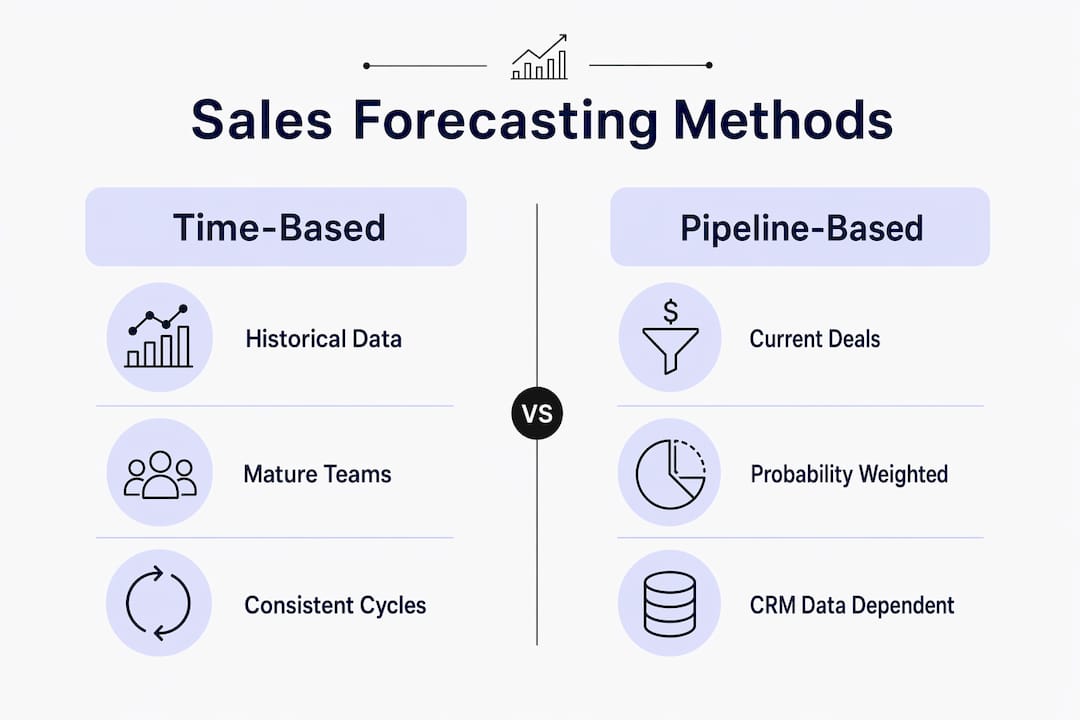
Time-based forecasting uses historical sales data to project future revenue. If your brokerage closed $2.4 million in listings every october for the past three years, that pattern becomes a baseline. This method works well for businesses with consistent, repeatable sales cycles. It breaks down fast when market conditions shift or your team composition changes significantly.
Pipeline-based forecasting
Pipeline-based forecasting looks at your current deals and assigns a probability of closing to each one. There are two common versions. Lead-driven forecasting estimates revenue based on the number and quality of leads entering your pipeline. Stage-based forecasting calculates expected revenue by multiplying each deal’s value by the probability assigned to its current stage.

Rework details the weighted pipeline calculation as deal amount multiplied by stage probability, summed across all active deals. A $500,000 listing at a 60% close probability contributes $300,000 to your weighted forecast. That math, applied across your full pipeline, gives you a grounded revenue estimate rather than wishful thinking.
Pro Tip: Match your forecasting method to your data quality. If your CRM history is thin, start with a simple pipeline-based method. Add time-based modeling once you have 12 or more months of clean historical data.
| Method | Best for | Limitation |
|---|---|---|
| Time-based | Mature teams with consistent cycles | Breaks down in volatile markets |
| Lead-driven | High-volume, early-stage pipelines | Depends on lead quality scoring |
| Stage-based weighted | Structured sales processes with defined stages | Requires accurate stage probabilities |
Why is sales forecasting important for your business?
IBM highlights that sales forecasts guide target setting and deal prioritization for sales teams. That is the operational core of why forecasting matters. Without a forecast, you are allocating resources based on gut feel rather than data.
The benefits of sales forecasting reach across every department in your business:
- Budgeting: Know how much revenue to expect before committing to expenses.
- Hiring: Identify when to bring on support staff before you are already overwhelmed.
- Inventory and production: Align supply with expected demand rather than reacting after the fact.
- Deal prioritization: Focus your team’s energy on deals most likely to close this quarter.
- Sales coaching: Spot which reps are consistently over or under their forecast, and address it early.
- Risk reduction: Identify revenue gaps weeks in advance so you can act, not scramble.
The importance of sales forecasting becomes clearest when a forecast is wrong. A team that misses its number by 40% did not just miss revenue. It likely overhired, over-spent on marketing, or under-resourced a key market. Accurate demand forecasting gives leadership the confidence to make bold moves because the data supports them.
What factors affect forecast accuracy?
Forecast accuracy depends more on process discipline than on model sophistication. IBM notes that AI-powered forecasting is only effective with clean, complete data inputs. The most advanced forecasting tool in the world cannot fix a CRM full of stale deals and missing close dates.
Artefact Ventures argues that forecast accuracy issues most often stem from flawed pipeline taxonomy rather than the forecasting model itself. When stage names are vague or inconsistent, the probabilities attached to them are meaningless. A deal labeled “proposal sent” means something very different at one brokerage than another.
The most common accuracy killers:
- Reps updating pipeline only before forecast meetings, not in real time.
- Stage definitions based on rep activity rather than buyer behavior.
- Optimistic deal values that never get revised as negotiations progress.
- No historical conversion data to calibrate stage probabilities.
- Leadership pressure that causes reps to inflate forecasts to meet targets.
Pro Tip: Run a pipeline audit every quarter. Pull every deal that has been in the same stage for more than 30 days and challenge your team to either advance it or remove it. A clean pipeline is a credible forecast.
Improving accuracy is not about buying better software. It starts with CRM data discipline and stage definitions tied to real buyer milestones. When your stages reflect what buyers actually do, your probabilities become reliable, and your forecast becomes a tool you can act on.
How do businesses implement sales forecasting step by step?
Building a forecasting process from scratch takes discipline, but the steps are straightforward. Salesforce advises calibrating stage probabilities empirically for best results, meaning you derive them from your own historical conversion data, not industry benchmarks.
- Collect and clean your data. Pull 12 or more months of closed deals from your CRM. Identify your average deal size, close rate by stage, and sales cycle length.
- Define your pipeline stages. Each stage must reflect a specific buyer action, not a rep activity. “Contract sent” is a buyer milestone. “Following up” is not.
- Assign empirical probabilities. Calculate what percentage of deals historically close from each stage. Use those numbers, not assumptions.
- Choose your forecasting method. Match the method to your data quality and business model. Start simple and add complexity as your data matures.
- Set a review cadence. IBM explains that operational reliability comes from repeatable timing and forecast locking. Weekly forecast reviews with your team create accountability and surface problems early.
- Involve leadership. Forecast expectations set at the top shape how reps report. Leaders who treat the forecast as a coaching tool get more honest numbers than those who use it as a performance scorecard.
Technology accelerates every step. CRM platforms, AI-driven pipeline tools, and sales automation software reduce manual data entry and flag deals that have gone stale. But the process must come before the technology. Tools amplify what you already do well. They do not fix broken habits.
Pro Tip: Never confuse your forecast with your sales target. Fairview notes that teams must distinguish the forecast as a probabilistic estimate and the target as a commitment. Conflating the two causes reps to game the forecast to match the target, which destroys its value entirely.
Key Takeaways
Accurate sales forecasting depends on clean CRM data, defined pipeline stages tied to buyer behavior, and a disciplined review cadence that separates the forecast from the sales target.
| Point | Details |
|---|---|
| Define forecasting clearly | Sales forecasting estimates future revenue using pipeline data, historical trends, and market context. |
| Match method to maturity | Choose time-based or stage-based methods based on your data quality and sales process structure. |
| Fix pipeline taxonomy first | Vague stage definitions cause more forecast errors than any model or tool ever will. |
| Separate forecast from target | Treating the forecast as a commitment causes reps to inflate numbers and destroys accuracy. |
| Discipline beats complexity | Weekly review cadence and CRM hygiene outperform any advanced forecasting model built on dirty data. |
The uncomfortable truth about sales forecasts
Most sales leaders I work with have a forecasting problem they do not realize is actually a culture problem. The forecast is only as honest as the environment that produces it. When reps know their manager will use the forecast to judge their performance, they stop reporting what they believe and start reporting what they think leadership wants to hear. That is not a data problem. That is a trust problem.
The teams I have seen get forecasting right share one trait: leadership treats the forecast as a diagnostic tool, not a report card. When a rep says a deal is at 40% and it closes at 20%, the right response is curiosity, not criticism. What did we miss? What does that tell us about our stage definitions? That mindset creates the psychological safety that makes honest forecasting possible.
The other mistake I see constantly is over-engineering the model before fixing the inputs. Teams spend weeks building weighted pipeline calculators in spreadsheets while their CRM has deals with no close dates, no contact activity, and stage names that nobody uses consistently. Clean the data first. The model is the easy part.
Forecasting is also not a quarterly exercise. The brokerages and sales teams that use it most effectively run a weekly forecast review, even a short one. Fifteen minutes every monday to look at what moved, what stalled, and what needs attention. That cadence builds muscle memory. It makes forecasting part of how the team operates, not a report they dread at the end of the quarter.
— Jason
Your pipeline is your forecast: build it right with Plo
A forecast is only as good as the pipeline feeding it. If your prospecting is inconsistent, your pipeline will be thin, and your forecast will be unreliable no matter which method you use.
Plo gives real estate agents, yacht brokers, and luxury sales professionals the tools to build a pipeline worth forecasting. From prospecting tools that keep your top of funnel full to pipeline optimization resources that sharpen your stage discipline, Plo amplifies the work you are already doing. Better inputs mean better forecasts. Better forecasts mean better decisions. That is the cycle that separates power brokers from the rest.
FAQ
What is sales forecasting in simple terms?
Sales forecasting is the process of estimating how much revenue your business will generate over a future period. It uses historical data, current pipeline deals, and market conditions to produce that estimate.
What are the main sales forecasting methods?
The three primary methods are time-based forecasting, lead-driven forecasting, and stage-based weighted forecasting. Salesforce recommends choosing based on your data maturity and how well your pipeline stages reflect real buyer behavior.
How does forecast accuracy improve?
Accuracy improves when pipeline stages are defined by buyer milestones, stage probabilities are calibrated from historical data, and teams maintain CRM discipline between forecast meetings, not just before them.
What is the difference between a forecast and a sales target?
A forecast is a probabilistic estimate of expected revenue based on current pipeline data. A target is a performance commitment. Fairview notes that conflating the two causes reps to inflate forecasts, which undermines their reliability.
What is demand forecasting vs. sales forecasting?
Demand forecasting estimates how much of a product or service the market will want. Sales forecasting estimates how much of that demand your specific team will capture and convert into revenue.