

Every luxury agent knows that success in 2025 depends on clarity, not just ambition. The market is facing shifting interest rates, policy curves, and fragmented regional outlooks that make a single approach impossible. Investors are showing cautious optimism as deal activity rises, but selective strategies now beat broad expansion. This article highlights where real estate and infrastructure intersect and reveals why mastering these regional nuances can give you the upper hand in a competitive world.
Table of Contents
- Defining 2025 Real Estate Trends Globally
- Types Of Luxury Properties And Market Segments
- Emerging Buyer Demographics And Global Wealth Transfer
- Technology, Sustainability, And Wellness In High-End Real Estate
- Financial Implications, Risks, And Opportunities For Agents
Key Takeaways
| Point | Details |
|---|---|
| 2025 Market Dynamics | The real estate market in 2025 shows regional fragmentation with varying recovery rates, requiring tailored strategies for each market. |
| Investor Caution | Despite increased deal activity, investors remain selective, emphasizing diversification and creative financing in response to rising interest rates. |
| Emerging Buyer Trends | Younger buyers prioritize technology, sustainability, and experiential value, reshaping property demands and necessitating revised marketing approaches. |
| Financial Strategy Evolution | Agents should adapt to rising costs and market volatility by developing specialized knowledge and alternative revenue streams beyond traditional commissions. |
Defining 2025 Real Estate Trends Globally
The global real estate market in 2025 stands at a critical inflection point. You’re navigating an environment shaped by complex geopolitical and economic forces that demand clarity and strategy.
What’s Actually Happening Right Now
The market isn’t moving in one direction. Instead, you’re seeing diverging regional dynamics where some markets recover while others face headwinds. This fragmentation means your approach in Miami differs fundamentally from strategy in London or Singapore.
Investor sentiment shows cautious optimism despite uncertainties. Deal activity is increasing, but investors remain selective about where capital flows. Your clients are repositioning portfolios to capture emerging opportunities rather than betting on broad market expansion.
The Three Key Dynamics Shaping 2025
-
Rising interest rates impact financing: Buyer purchasing power fluctuates based on regional rate policies. Higher rates in some markets compress margins and demand creative deal structures.
-
Geopolitical risks create portfolio shifts: Investors diversify holdings across stable markets. This reshuffles where capital concentrates and which properties command premium attention.
-
Regulatory environments vary dramatically: What works in one jurisdiction fails in another. Compliance complexity has become a pricing factor itself.
Your competitive edge depends on understanding regional nuances, not applying one global playbook to every market.
The Infrastructure-Real Estate Intersection
This is where your opportunities concentrate. Data centers and new energy infrastructure represent the highest-conviction sector bets. These assets solve real problems—digital expansion needs and energy transition demands.
Luxury properties connected to these trends command different valuations. A waterfront estate near emerging tech corridors values differently than one in declining regions. Understanding this intersection separates power brokers from commodity agents.
The Inflation Challenge
Inflation persists across regions, though intensity varies. Your pricing strategies must account for cost volatility. Material prices, labor expenses, and operational overhead don’t move uniformly across markets.
Pro tip: Use regional economic data and interest rate forecasts to set realistic client expectations about timeline and pricing—don’t rely on 2024 projections when 2025 fundamentals are shifting beneath your feet.
Here’s how key 2025 real estate trends impact agents and investors:
| Dynamic | Effect on Agents | Effect on Investors |
|---|---|---|
| Rising Interest Rates | Reduced purchasing power, creative deal structures needed | Compressed yields, focus on diversification |
| Geopolitical Risks | Need to advise on market safety, cross-border expertise | Portfolio shifts to stable regions |
| Regulatory Variance | Complex compliance, higher advisory value | Increased due diligence and risk assessment |
Types of Luxury Properties and Market Segments
Luxury properties aren’t one monolithic category. Your clients operate across distinct segments, each with unique buyer profiles, pricing dynamics, and competitive pressures. Understanding these segments directly impacts your ability to position properties and close deals.
Residential Luxury: The Foundation
Residential luxury dominates your portfolio volume. These are high-net-worth primary residences, second homes, and investment properties in premier locations. Think Manhattan penthouses, Beverly Hills estates, or Miami waterfront compounds.
Buyers in this segment prioritize location prestige, architectural significance, and lifestyle amenities. A $5 million home in a secondary market moves differently than a $3 million property on the right street in Manhattan.
Commercial and Investment Properties
Ultra-high-net-worth individuals acquire trophy office buildings, boutique hotels, and premium retail spaces. These purchases blend lifestyle goals with portfolio diversification. Your role expands beyond describing square footage to analyzing cap rates and revenue streams.

Investment-grade luxury requires deeper financial analysis. Your clients demand exit strategies and market positioning reports before committing capital.
Waterfront and Resort Properties
Beachfront villas, lakefront estates, and ski resort properties command premium pricing based on seasonal demand. Yacht brokers understand this segment intimately—waterfront luxury transcends real estate into lifestyle curation.
These properties often attract international buyers seeking vacation retreats with rental income potential. Currency fluctuations and foreign investment regulations significantly impact this segment.
Unique and Alternative Segments
- Vineyard estates: Wine country properties with production capability and hospitality potential
- Island properties: Exclusive developments with limited supply and high exclusivity premiums
- Historic estates: Architecturally significant properties requiring specialized knowledge and preservation expertise
- Smart homes: Technology-integrated luxury appealing to younger high-net-worth buyers
The luxury market isn’t just about price—it’s about understanding what defines luxury real estate in each specific segment and matching buyer expectations accordingly.
Market Segmentation by Geography
Prime markets differ dramatically. London, Dubai, and Hong Kong ultra-luxury segments operate on entirely different dynamics. Your pricing strategy in Singapore can’t translate to Miami Beach without regional adjustment.
Geographic segmentation also determines buyer psychology. International buyers in Monaco prioritize privacy and stability differently than domestic buyers in New York.
The Niche Advantage
Generalist agents struggle across multiple segments. Specialists dominate by building deep expertise in one category. Your competitive edge comes from becoming the recognized expert in your chosen luxury segment.
Pro tip: Pick one luxury segment and develop mastery in it—understand its buyer psychology, seasonal patterns, pricing benchmarks, and competitive positioning better than anyone else in your market.
Emerging Buyer Demographics and Global Wealth Transfer
The wealth transfer happening right now is unprecedented. Over the next decade, trillions of dollars flow from Baby Boomers to Millennials and Gen X. Your client base is fundamentally shifting, and so are their priorities.
Who’s Actually Buying Now
Traditional luxury buyers—older, conservative, location-obsessed—are being replaced by younger, globally-minded purchasers. Gen X and Millennial ultra-high-net-worth individuals think differently about property, value, and lifestyle.
Younger buyers prioritize sustainability, technology integration, and experiential value over pure prestige. A smart home with minimal environmental impact appeals to them far more than a historical mansion requiring constant restoration.
The Wealth Transfer Wave
Estimates suggest $30-84 trillion will transfer in coming decades. This creates two buyer cohorts: inheritors seeking their first trophy property and seasoned entrepreneurs building new fortunes in tech, finance, and renewable energy.
Inheritors often lack real estate experience. They need education and strategic positioning. Entrepreneurs want rapid acquisition for portfolio diversification and lifestyle impact.
International and Non-Traditional Buyers
Chinese, Middle Eastern, and Southeast Asian wealth increasingly targets Western markets. These buyers have different investment criteria and timeline expectations than domestic purchasers.
They view luxury real estate as capital preservation and diversification, not primary residences. Your pitch must address currency risk, regulatory stability, and exit strategies.
Demographic Preferences Reshaping the Market
- Tech-forward amenities: Home automation, fiber infrastructure, and workspace integration matter more than ever
- Wellness integration: Gyms, spas, air purification, and water systems drive buyer decisions
- Sustainability credentials: Carbon footprint and energy efficiency influence ultra-luxury pricing
- Community access: Proximity to dining, culture, and networks trumps isolation for younger buyers
- Flexibility: Remote work capability means location rules are breaking down
Understanding emerging buyer habits and preferences directly impacts how you position properties and close deals with this new generation.
Women as Primary Decision-Makers
Women now control significant wealth independently. Single female buyers, female business leaders, and women making joint decisions represent a growing segment often overlooked by traditional marketing approaches.
These buyers demand different communication styles and property features. Your pitch needs authentic representation and relevant amenity prioritization.
The Timing Advantage
This transition creates opportunity gaps. Brokers who understand new buyer psychology win deals. Those clinging to outdated approaches lose market share.
Pro tip: Build detailed buyer personas for the three emerging segments—tech entrepreneurs, wealth inheritors, and international investors—and tailor your property positioning and communication style specifically to each group’s decision-making priorities.
The table below summarizes new buyer personas and their property priorities:
| Buyer Segment | Main Priorities | Sought Property Features |
|---|---|---|
| Tech Entrepreneur | Technology, sustainability, flexibility | Smart systems, eco-certifications |
| Wealth Inheritor | Guidance, legacy value, prestige | Trophy assets, educational support |
| International Investor | Capital safety, diversification | Prime locations, regulatory stability |
Technology, Sustainability, and Wellness in High-End Real Estate
These three factors now determine luxury pricing and buyer appeal. Properties lacking smart infrastructure, sustainability credentials, or wellness features are increasingly harder to sell. Your clients expect all three—and they’re willing to pay premium prices for them.
The Wellness Revolution in Luxury
Wellness isn’t a buzzword anymore. It’s a market demand reshaping how luxury properties are designed and marketed. Neuro-architecture and biophilic design enhance mental health, productivity, and physical well-being in properties.
Buyers now expect circadian lighting systems that regulate sleep patterns, indoor greenery integration, and sensory environments optimized for relaxation. These aren’t luxury upgrades—they’re baseline expectations.
Smart Home Technology as Market Standard
Automation has moved beyond novelty. Ultra-high-net-worth buyers demand integrated systems controlling climate, lighting, security, and entertainment through single interfaces. Energy management through smart systems also reduces operational costs dramatically.
Properties without fiber infrastructure and home automation capabilities lose competitive positioning. Your marketing pitch must highlight technological sophistication as a core value driver.
Sustainability: From Trend to Requirement
ESG principles now shape luxury development. Buyers increasingly demand properties aligned with climate resilience and environmental consciousness. Net-zero energy systems and vertical green infrastructure are becoming standard features, not premium add-ons.
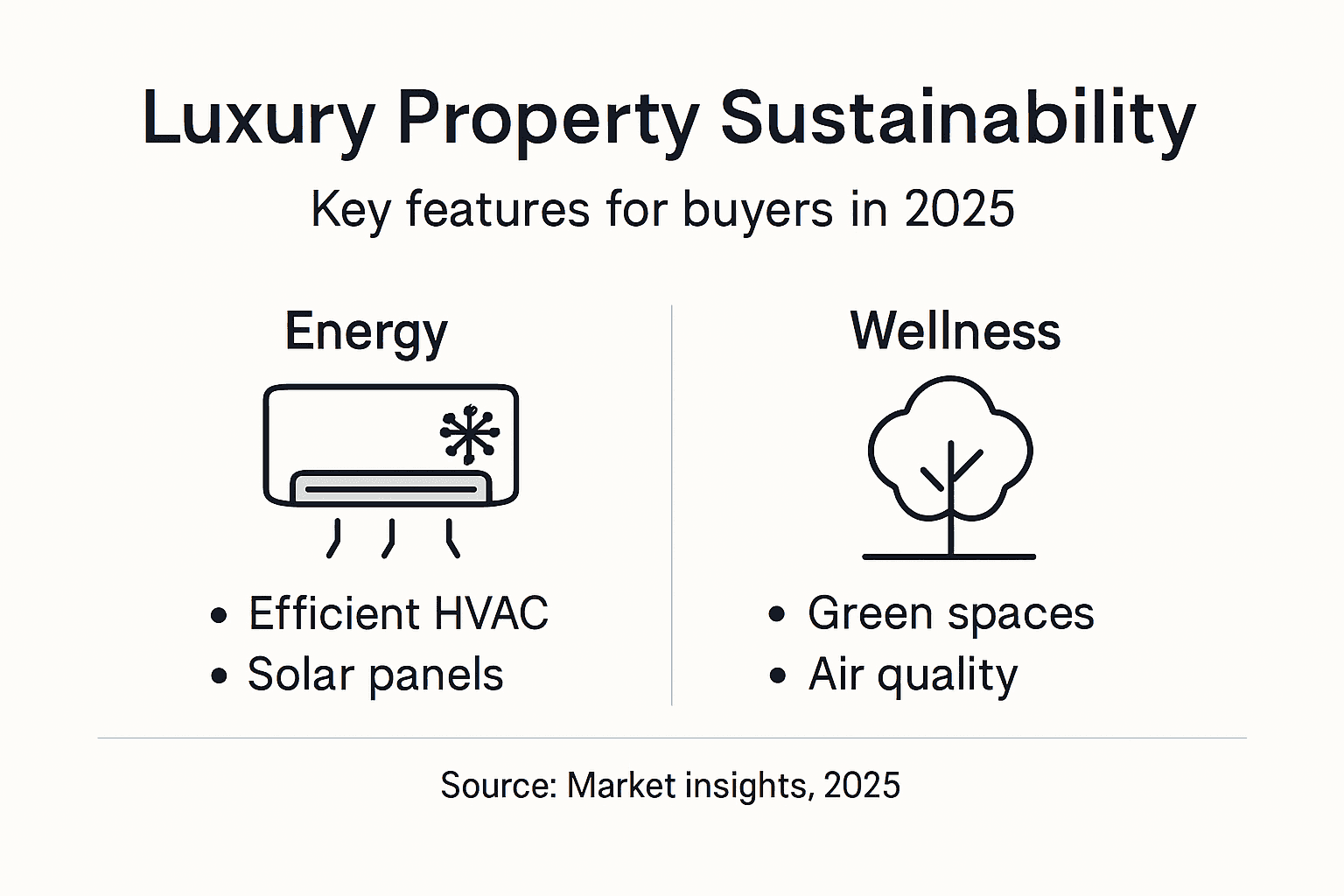
Carbon footprint disclosure influences buyer decisions. Properties with energy-efficient materials and urban biodiversity elements command higher valuations and attract international investors focused on long-term value retention.
The Convergence Strategy
Top-performing luxury agents position properties at the intersection of all three factors. Don’t market them separately.
- Smart wellness systems: Automated air purification linked to occupant health monitoring
- Sustainable technology: Solar systems powering home automation with battery storage
- Integrated living: Biophilic design enhanced by smart lighting and climate control
- Data efficiency: Systems tracking energy use and wellness metrics for occupant optimization
Properties that successfully integrate technology, wellness, and sustainability command 15-25% price premiums over comparable properties lacking these elements.
Marketing These Features Effectively
Your sales pitch changes. Stop describing amenities as features. Instead, connect them to buyer outcomes: better sleep, reduced stress, lower utility costs, environmental impact reduction, and investment value appreciation.
International buyers particularly value climate resilience and sustainability credentials. These directly impact long-term property value and resale potential.
Pro tip: Create detailed sustainability and wellness fact sheets for each property highlighting specific systems, certifications, and measurable benefits—buyers want proof these features deliver promised outcomes, not just marketing promises.
Financial Implications, Risks, and Opportunities for Agents
Your commission structure, deal flow, and profit margins are all shifting in 2025. Understanding the financial landscape separates thriving agents from those barely surviving. The risks are real, but so are the opportunities—if you position yourself correctly.
The Cost of Doing Business Has Changed
Inflation isn’t theoretical anymore. Your operational expenses are climbing: marketing costs, technology subscriptions, compliance requirements, and staffing. Rising financing costs also impact your clients’ purchasing power, which directly affects your deal volume and average commission size.
Rising Interest Rates Impact Your Commissions
Higher borrowing costs compress buyer purchasing power. A client who could afford a $10 million property at 3% interest rates now stretches to $7.5 million at 7% rates. Your commission pool shrinks proportionally.
However, strategic portfolio repositioning creates new opportunities. Investors reshuffling assets need expert guidance, and you can command higher fees for specialized advisory services beyond traditional commissions.
The Risk Side: Volatility and Delays
Market uncertainty creates unpredictability. Development projects face delays. Regulatory changes impact deal timelines. Your cash flow becomes less predictable, requiring stronger financial reserves.
Geopolitical risks affect specific markets differently. A London luxury property faces different headwinds than Miami. Diversifying your client base across markets reduces exposure to localized shocks.
Your Opportunity Zones
- Niche sector expertise: Logistics, data centers, and residential in emerging corridors command premium advisory fees
- Off-market transaction specialization: Off-market listings generate higher margins and attract exclusive clientele willing to pay premium commissions
- International buyer facilitation: Cross-border transactions require expertise clients will pay significantly more to access
- Technology-enhanced operations: Agents using advanced tools close deals faster, increasing deal volume despite compressed individual commissions
Your profitability in 2025 depends less on individual commission percentages and more on deal velocity, client quality, and specialized expertise.
Building Revenue Resilience
Stop relying solely on percentage-based commissions. Develop ancillary revenue streams: consulting fees for buyer advisory services, technology licensing, market analysis subscriptions, and transaction coordination services.
Specialization commands higher fees. A generalist agent competes on commission percentage. A specialist in waterfront luxury or international acquisitions charges flat fees or hourly rates clients gladly pay.
Managing Financial Risk Personally
Income volatility is real. Build a cash reserve covering 6-12 months of expenses. Negotiate better commission splits with brokerages by demonstrating deal volume and client quality. Consider strategic partnerships with other agents to pool resources and share risk.
Pro tip: Build a detailed financial model showing your break-even point, profit margins by deal type, and revenue scenarios under different market conditions—use this to identify which client segments and property types deliver the highest profitability and plan your prospecting accordingly.
Empower Your Luxury Real Estate Success in 2025
Navigating the complex global shifts in luxury real estate requires more than traditional strategies. With rising interest rates, evolving buyer demographics, and the urgent demand for technology, sustainability, and wellness integration, you need cutting-edge tools and expert support to stay ahead. The challenges of portfolio diversification, regulatory variance, and emerging buyer priorities demand precision and agility.
At ex.plo.re CRM, we understand these specific pain points and provide tailored solutions that streamline your prospecting and sales processes while amplifying your expertise. Whether you need to master niche market segments, build impactful buyer personas, or elevate your pitch with data-backed insights on wellness and sustainability, our technology and team empower you to be the authoritative power broker your clients demand.

Don’t let market volatility and shifting buyer expectations slow you down. Take control of your 2025 real estate journey now. Visit ex.plo.re CRM to explore how our advanced tools and expert talent can help you capture exclusive listings, close deals faster, and elevate your luxury offerings with confidence.
Frequently Asked Questions
What are the key factors affecting luxury real estate trends in 2025?
Rising interest rates, geopolitical risks, and varying regulatory environments are shaping the luxury real estate market. These factors influence buyer purchasing power, investment strategies, and overall market dynamics.
How are emerging buyer demographics changing the luxury real estate landscape?
Younger buyers, particularly Millennials and Gen Z, prioritize sustainability, technology integration, and community access over traditional luxury markers. This demographic shift requires agents to adapt their marketing and property positioning strategies.
What role does technology play in the luxury real estate market of 2025?
Technology is a cornerstone of luxury properties, with buyers expecting smart home features that enhance convenience and efficiency. Automation and energy management systems are increasingly viewed as essential rather than optional.
How can luxury agents effectively market wellness features in properties?
Agents should highlight wellness features by connecting them to tangible benefits like improved health and lower stress. Detailed fact sheets showcasing specific health and sustainability benefits will appeal to today’s discerning buyers.