

The highest-earning agents in any market rarely have the most listings. What they have is something far more powerful: a position in their clients’ minds that feels irreplaceable. While most agents compete on volume, the ones pulling in premium clients compete on identity. Market positioning is the strategic lever that separates a power broker from a commodity agent. This article breaks down exactly what market positioning means, how top luxury brokers use it to win high-net-worth clients, and the practical steps you can take right now to sharpen your own position and attract more of the clients you actually want.
Table of Contents
- Understanding market positioning in real estate
- Key components of market positioning for agents and brokers
- How luxury brokers tailor their market positioning
- Practical steps to strengthen your market positioning
- Why most agents misunderstand market positioning (and how to fix it)
- Take your positioning further with the right tools
- Frequently asked questions
Key Takeaways
| Point | Details |
|---|---|
| Define your position | Understand how you want to be perceived by your ideal clients and what sets you apart from competitors. |
| Leverage audience insights | Use market feedback, segment analysis, and persona data to tailor your value proposition and outreach. |
| Emphasize exclusivity for luxury | For luxury brokers, highlight privacy, network, and tailored service rather than generic luxury claims. |
| Apply practical tools | Use perceptual maps, surveys, and tech to measure and refine your market positioning over time. |
| Consistency drives results | Keep your messaging and value clear across channels to earn and keep premium clients’ trust. |
Understanding market positioning in real estate
Let’s get precise about what we mean. Market positioning is “the strategic process of establishing a unique image and identity for a brand, product, or service in the minds of target consumers relative to competitors.” That word relative is critical. Your position only means something in contrast to what else is available in the market.
Many agents confuse positioning with branding or marketing. Here’s a simple way to separate them:
- Brand is your overall identity: your logo, colors, tone, and visual language.
- Marketing is how you communicate and distribute that identity.
- Positioning is the specific place you occupy in a client’s mind when they think about buying or selling a particular type of property.
Think of it this way. Two agents can both call themselves “luxury specialists.” But one has positioned herself as the go-to expert for historic waterfront estates in a specific coastal county. The other is a generalist who occasionally sells high-end homes. When a buyer with a $4M budget for a historic waterfront property starts asking around, only one name comes up. That’s positioning at work.
“Successful agents dominate niches through hyperlocal expertise and differentiation” rather than broad visibility campaigns.
A common myth is that the biggest ad spender wins. In reality, the agent who owns a specific niche wins. Buyers and sellers don’t choose agents based on who they see most often. They choose based on perceived expertise and fit. If your real estate marketing strategies aren’t anchored to a clear position, you’re spending money to blend in. And if you’re serious about the luxury segment, your branding ideas for luxury agents need to reflect a sharply defined identity, not just premium aesthetics. A solid guide to positioning can help you map this out systematically.
Key components of market positioning for agents and brokers
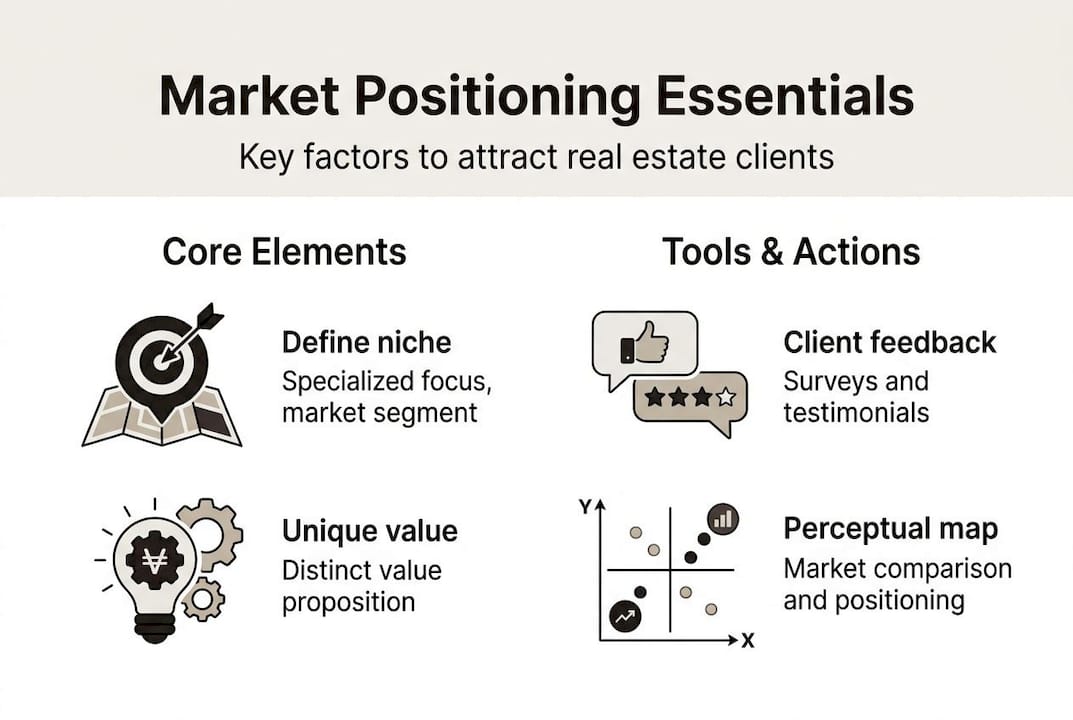
With a clear definition in place, the next step is to understand the core mechanics and methods that set top agents and brokers apart. Core mechanics include segmentation, target selection, perceptual mapping, a unique value proposition (UVP), and consistent messaging.
Here are the six essential steps to build a strong market position:
- Competitive analysis — Identify who else serves your target clients and how they position themselves.
- Audience identification — Define your ideal client profile with specificity: demographics, property preferences, decision drivers.
- UVP development — Craft a Unique Value Proposition that states clearly why your ideal client should choose you over every alternative.
- Brand identity alignment — Make sure your visual and verbal identity reinforces your position, not contradicts it.
- Messaging consistency — Every touchpoint, from email signatures to listing presentations, should reflect the same core position.
- Tracking and feedback loops — Use surveys, client interviews, and KPIs to measure whether your position is landing.
Tools like perceptual mapping (a visual chart that plots where you and competitors sit on key attributes) help you see gaps and opportunities clearly. Content marketing for real estate growth and AI in real estate sales are two powerful accelerators once your position is defined. Explore Shopify’s market positioning guide for a broader framework you can adapt to your practice.

Pro Tip: Start asking new clients how they describe you to friends. If their words don’t match your intended position, you have a gap worth closing immediately.
| Common positioning errors | Best practices |
|---|---|
| Targeting everyone in your metro | Focusing on a specific neighborhood or property type |
| Copying competitor messaging | Building a UVP around your unique story and results |
| Inconsistent tone across channels | Unified messaging from social to CRM to presentations |
| Ignoring client feedback | Running quarterly surveys to validate your position |
| Measuring only leads, not perception | Tracking brand awareness and referral language |
How luxury brokers tailor their market positioning
While core mechanics work across real estate, the luxury segment requires even more precision. High-net-worth individuals (HNWIs) evaluate brokers through a completely different lens than typical buyers or sellers.
Broad claims like “luxury service” or “premium results” are invisible to this audience. They’ve heard it all. What actually moves them is specificity and proof. Luxury brokers succeed by emphasizing exclusivity and privacy over broad luxury claims, using data and personas for HNWI targeting.
Here’s what HNWIs actually care about when selecting a broker:
- Privacy and discretion — They want to know their transaction won’t become public gossip.
- Exclusive access — Off-market listings, private networks, and relationships that aren’t available to every agent.
- Tailored communication — Not mass email blasts. Personal, timely, relevant outreach.
- Demonstrated expertise — Track record in their specific property type, not just high price points in general.
| Broad luxury claim | Exclusive positioning |
|---|---|
| “I specialize in luxury homes” | “I represent private estate sales above $5M in [specific area]” |
| “White-glove service for every client” | “Discreet off-market transactions for family offices and executives” |
| “Top producer in my market” | “Sold 9 of the last 12 oceanfront estates in [specific community]” |
Hyper-personalized messaging is the standard in this segment, not a differentiator. Your luxury agent marketing strategy must reflect this, and your local SEO for luxury agents should target the exact search terms your ideal clients use when they start looking. Use perceptual mapping to visualize where you sit relative to competitors on the attributes HNWIs value most.
Pro Tip: Build detailed client personas for your top three ideal client types. Use those personas to personalize every outreach, from the subject line of an email to the format of your listing presentation.
Practical steps to strengthen your market positioning
Now, let’s put these concepts into action with concrete steps to boost your own market position and track your results.
Here are five actions you can take right now:
- Segment your market — Identify two or three micro-niches where you have existing credibility or a natural advantage.
- Audit your current position — Ask five recent clients to describe what makes you different. Compare their words to your intended UVP.
- Differentiate with specificity — Replace vague claims with precise proof points: transaction counts, specific neighborhoods, client types served.
- Sharpen your messaging — Update your website bio, social profiles, and listing presentations to reflect your refined position consistently.
- Monitor and adjust — Set a quarterly calendar reminder to review your positioning against new competitors and shifting client needs.
Beyond these steps, there are practical tools that accelerate the process:
- Use AI tools to generate content that reinforces your niche authority and builds credibility over time.
- Update your web presence with location-specific and property-specific language that signals expertise to both clients and search engines.
- Target micro-niches with dedicated landing pages, case studies, and testimonials that speak directly to that segment.
Agents enhance positioning by dominating niches with hyperlocal expertise, AI content for authority, and perceptual tools. Your AI agent growth guide and AI for client prospecting are two resources worth bookmarking now. And for a broader framework on tracking your progress, revisit the SurveyMonkey market positioning resource.
Pro Tip: Revisit your UVP every quarter. Markets shift, competitors evolve, and client priorities change. A UVP that was sharp 18 months ago may now sound like everyone else in your market.
Why most agents misunderstand market positioning (and how to fix it)
Here’s the uncomfortable truth: most agents treat positioning as a marketing problem when it’s actually a clarity problem. They think louder means better. More ads, more listings, more social posts. But volume without a clear position just creates noise.
The agents who become truly irreplaceable don’t try to win every client. They focus on owning a small, specific segment so completely that their name becomes synonymous with it. When someone thinks “historic bungalows in [neighborhood],” there’s one agent who comes to mind. That’s not luck. That’s intentional positioning built over time.
Mimicry is the other trap. When you copy how competitors present themselves, you train clients to see you as interchangeable. The fix isn’t a new logo. It’s a sharper answer to the question: why you, specifically, for this client’s specific need?
Applying brand-approved AI in real estate can expose positioning gaps fast by analyzing how your content, reviews, and outreach compare to competitors. Prioritize client resonance over raw reach. A smaller audience that deeply connects with your position will always outperform a large audience that barely notices you.
Take your positioning further with the right tools
Your market position is only as strong as the systems you use to reinforce it every day. The right technology makes it easier to identify your best prospects, deliver personalized outreach at scale, and track whether your positioning is actually driving results.
Explore the best real estate prospecting tools to find solutions built specifically for agents and brokers who want to work smarter. If you’re in the luxury segment, the luxury broker marketing tools comparison gives you a side-by-side look at what’s available. Ready to see how ex.plo.re can amplify your positioning strategy? Book a demo and let our team show you exactly how to put these tools to work for your market.
Frequently asked questions
What is market positioning for a real estate agent?
Market positioning for real estate means creating a distinct, memorable spot in clients’ minds by highlighting what makes you different or better than other agents in your specific market.
How can market positioning help agents win more clients?
Strong positioning makes your value clear and attracts your ideal clients. Agents succeed by owning a unique market position rather than competing on volume or ad spend alone.
What are some examples of great market positioning niches?
Examples include luxury high-rise condos, historic home specialists, golf community experts, equestrian estate brokers, and off-market estate transactions for family offices.
How do you know if your market positioning is working?
Use surveys, client interviews, and deal data to see if your ideal clients choose you for your specific expertise. Tracking positioning effectiveness via surveys and KPIs gives you measurable signals to act on.
What’s the difference between branding and market positioning?
Branding is your overall identity; positioning is how clients perceive you relative to direct competitors when they have a specific need to fill.