

A lead is an unqualified contact who has shown some interest in your product or service, while a prospect is a lead who has been vetted and confirmed as a genuine fit for what you sell. That distinction sounds simple, but the difference between leads and prospects is one of the most operationally significant lines in any sales process. Blur it, and your team wastes hours chasing contacts who will never buy. Draw it clearly, and your pipeline becomes a precision instrument. Frameworks like BANT (Budget, Authority, Need, Timeline), tools like HubSpot and Zendesk, and roles like Business Development Representatives (BDRs) all exist to enforce this line with discipline.
What qualifies a lead to become a prospect?
Leads are top-of-funnel contacts who are aware of your company but have not yet been evaluated for purchase potential. They might have downloaded a guide, attended a webinar, or filled out a contact form. That action signals interest, not readiness. The qualification process is what separates the two groups.
Qualification typically involves assessing three dimensions: fit, intent, and engagement. Fit means the contact matches your ideal customer profile, whether by geography, budget range, property type in real estate, or company size in B2B. Intent means they have shown signals of wanting to move forward, not just browse. Engagement means they are responding to outreach and participating in the conversation.

BDRs or Sales Development Representatives (SDRs) own this assessment in most sales organizations. Their job is to take raw leads from marketing and run them through a qualification filter before passing them to a closing rep. Qualification duties typically fall to BDRs who assess and convert leads to prospects, making this role a critical operational checkpoint in the funnel.
The most widely used qualification framework is BANT, developed by IBM. A lead becomes a prospect when you can confirm:
- Budget: The contact has financial resources to purchase
- Authority: The person you are speaking with can make or influence the buying decision
- Need: There is a genuine, identified problem your solution addresses
- Timeline: The contact intends to act within a defined window
HubSpot maps this distinction to the MQL vs SQL divide. Marketing Qualified Leads (MQLs) show engagement but not purchase readiness. Sales Qualified Leads (SQLs) demonstrate confirmed buying intent and meet BANT-style criteria. In practical terms, MQLs are leads and SQLs are prospects.
Pro Tip: Never let a lead sit in “MQL” status for more than five business days without a qualification attempt. Response timing matters enormously: a 1-hour follow-up converts at 53%, while waiting 24 hours drops that rate to 17%.
How do leads, prospects, and opportunities differ?
Understanding sales leads, prospects, and opportunities as three distinct stages gives you a clear map of your pipeline. Each stage carries different ownership, different actions, and different expectations.
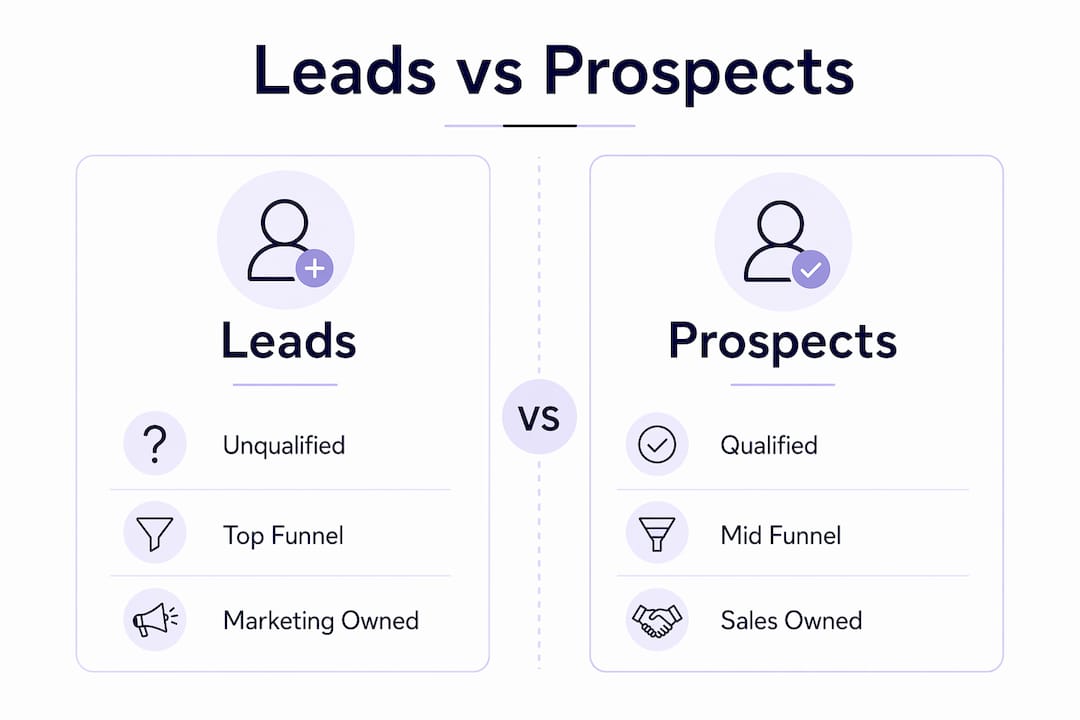
A lead sits at the top of the funnel. Marketing or an SDR team owns it. The primary action is nurturing and qualification outreach. A prospect sits in the middle of the funnel. Prospects are qualified contacts who respond well to nurturing and are likely buyers. The sales team owns them, and the actions shift to demos, discovery calls, and proposals. A sales opportunity is a qualified prospect with a confirmed budget, authority, need, and timeline. An opportunity represents a confirmed deal in the pipeline with a high probability of closing.
Here is how the three stages compare across key dimensions:
| Dimension | Lead | Prospect | Opportunity |
|---|---|---|---|
| Funnel stage | Top of funnel | Mid-funnel | Bottom of funnel |
| Qualification status | Unqualified | Qualified for fit and intent | Fully qualified, deal confirmed |
| CRM status | MQL or unassigned | SQL | Active deal / opportunity stage |
| Team ownership | Marketing or SDR | Sales rep | Account executive or closer |
| Primary sales action | Nurture and qualify | Demo, discovery, proposal | Negotiate and close |
| Likelihood to buy | Unknown | Moderate to high | High |
Leads are handled primarily by marketing or SDR teams with nurturing and qualification outreach, while prospects are handed over to sales for demos, proposals, and closing activities. That handoff is not just a label change in your CRM. It is a transfer of ownership, accountability, and sales strategy. Treating it casually is where most pipeline problems begin.
One common mistake is confusing CRM lifecycle stages with lead status fields. Confusing CRM lifecycle stages and statuses can undermine funnel visibility entirely. Lifecycle stage tracks where a contact is in their overall relationship with your company. Lead status tracks where they are in the current sales cycle. Both matter, and conflating them produces unreliable funnel metrics.
Best practices for qualifying leads and managing prospects
The BANT framework works well for most sales cycles, but high-value deals in luxury real estate, yacht brokerage, or enterprise B2B require a more rigorous approach. MEDDIC and its expanded version MEDDPICC add layers that BANT misses.
MEDDIC stands for Metrics, Economic Buyer, Decision Criteria, Decision Process, Identify Pain, and Champion. MEDDPICC adds Paper Process and Competition. These frameworks force your team to answer harder questions: Who controls the budget? What does the decision process look like internally? Who is your internal advocate? For a luxury broker closing a $4 million property, knowing the answer to each of those questions before investing 20 hours in a relationship is not optional.
Here are the best practices that separate high-performing sales teams from the rest:
- Document your qualification gate in writing. Defining qualification criteria with frameworks like BANT reduces subjective errors and improves tracking. Write down exactly what makes a contact a prospect in your business, and get both sales and marketing to sign off on it.
- Use behavioral signals alongside firmographic data. A contact who has visited your pricing page three times, opened four emails, and requested a callback is showing stronger intent than one who simply downloaded a brochure. Score both types of signals in your CRM.
- Set a qualification SLA. Define how quickly a new lead must be contacted and how many attempts qualify as a genuine effort before the lead is recycled or disqualified.
- Track conversion rates at each stage. Measure lead-to-prospect conversion and prospect-to-opportunity conversion separately. If your lead-to-prospect rate is high but your prospect-to-opportunity rate is low, your qualification criteria are too loose.
- Align your CRM stages to your qualification language. If your team calls something a prospect but your CRM labels it an MQL, you will have reporting confusion within weeks.
Pro Tip: For real estate agents and luxury brokers, add a sixth BANT criterion: Property Match. Confirming that a prospect’s requirements align with what you can actually deliver saves everyone time and protects your reputation as a qualifying buyers specialist.
How distinguishing leads from prospects improves conversion rates
Proper qualification focuses your sales energy where it produces results. When your team treats every lead like a prospect, they burn time on contacts who are not ready, not funded, or not the right fit. That is not just inefficient. It is demoralizing, and it inflates your pipeline with noise that obscures real opportunities.
Clear definitions of MQLs vs SQLs help marketing and sales align, reducing wasted effort on poor-quality leads and improving pipeline velocity. In practical terms, this means your closers spend their hours on prospects who have already been screened, not on cold contacts who need six more months of nurturing.
The metrics that improve when you draw this line clearly include:
- Conversion rate: Prospects convert at a higher rate than raw leads because they have already been screened for fit and intent
- Sales velocity: Deals move faster when reps are not restarting discovery conversations that SDRs should have completed
- Pipeline accuracy: Forecasts become more reliable when every deal in the pipeline has met a documented qualification standard
- Rep morale: Salespeople who work qualified prospects close more deals and stay longer
For real estate agents, the practical application is direct. A contact who attended an open house is a lead. A contact who has confirmed their budget, pre-approval status, desired neighborhood, and timeline to move is a prospect. Treating both the same way means either under-serving the prospect or over-investing in the lead. Plo’s approach to the real estate sales funnel is built around this exact distinction, giving agents a structured path from first contact to signed contract.
Nurturing strategies also differ by stage. Leads need educational content, trust-building touchpoints, and patience. Prospects need direct engagement: property tours, comparative market analyses, and personalized proposals. Mixing these up is one of the most common and costly mistakes in real estate sales.
Key takeaways
The difference between leads and prospects is a qualification threshold: leads are unscreened contacts showing interest, while prospects are confirmed fits who are ready for direct sales engagement.
| Point | Details |
|---|---|
| Lead definition | A lead is an unqualified contact at the top of the funnel who has shown interest but not been vetted. |
| Prospect definition | A prospect is a qualified lead confirmed for fit, intent, and readiness to engage with sales. |
| Qualification frameworks | BANT and MEDDIC provide structured criteria to upgrade leads to prospects with consistency. |
| Team ownership shifts | Leads belong to marketing or SDRs; prospects transfer to sales reps for direct engagement. |
| Conversion impact | Qualifying leads before passing them to sales improves conversion rates, pipeline accuracy, and rep performance. |
Why the line between leads and prospects is the most underrated decision in sales
I have worked with enough sales teams to know that the lead vs prospect debate almost always reveals a deeper organizational problem. When I ask a team to define what makes someone a prospect, I usually get five different answers from five different people. That is not a terminology problem. That is a revenue problem hiding in plain sight.
The teams that perform consistently are the ones who have written down their qualification criteria, reviewed them with both sales and marketing, and built them into their CRM as hard stage gates. Not soft labels. Not optional fields. Hard gates that require a rep to confirm specific criteria before a contact advances. It feels bureaucratic until you see the pipeline clarity it creates.
The other thing I have learned: misclassifying contacts does not just waste time. It erodes trust between sales and marketing. Marketing thinks sales is ignoring good leads. Sales thinks marketing is sending junk. Both are partially right, and the root cause is almost always an undefined qualification standard. Writing that standard down, even imperfectly, fixes more than any new tool or lead generation strategy ever will.
Buyer behavior is also shifting. In luxury real estate and high-value brokerage, prospects are doing more research before they ever contact you. By the time someone reaches out, they may already be 70% through their decision process. That means your qualification conversation needs to be sharper and faster than it was five years ago. The agents who adapt their prospecting approach to this reality are the ones building durable pipelines.
— Jason
Take your lead qualification further with Plo
Managing the gap between leads and prospects manually is where most agents lose deals. Plo gives real estate agents, luxury brokers, and yacht brokers the tools to qualify faster, track smarter, and close with confidence.
Whether you are building your first qualification process or tightening an existing one, the right tools make the difference between a pipeline full of noise and one full of genuine opportunities. Explore Plo’s top prospecting tools for 2026 to see how agents are cutting qualification time and converting more leads into signed clients. You can also compare the best lead generation tools for realtors to find the right fit for your market and workflow.
FAQ
What is the core difference between leads and prospects?
A lead is an unqualified contact who has shown interest but not been evaluated for fit. A prospect is a lead who has been vetted against criteria like budget, authority, need, and timeline and confirmed as a genuine potential buyer.
What is BANT and how does it qualify leads?
BANT stands for Budget, Authority, Need, and Timeline. It is a qualification framework used to assess whether a lead meets the minimum criteria to become a prospect and receive direct sales attention.
What is the difference between an MQL and an SQL?
A Marketing Qualified Lead (MQL) has shown engagement but not purchase readiness. A Sales Qualified Lead (SQL) has been independently vetted by sales and demonstrates confirmed buying intent, making it the equivalent of a prospect in most sales processes.
How does lead qualification improve sales conversion rates?
Qualifying leads before passing them to sales ensures reps spend time on contacts who are ready to buy. This improves conversion rates, shortens sales cycles, and produces more accurate pipeline forecasts.
When does a prospect become a sales opportunity?
A prospect becomes a sales opportunity when budget, authority, need, and timeline are all confirmed and the deal has a defined path to close. At that point, the contact moves from mid-funnel qualification to active deal management.