

Most sales professionals assume interest means readiness. It doesn’t. What is qualifying buyers, really? It’s the disciplined process of separating people who want to buy from people who can buy. Get that wrong, and you’ll spend months chasing prospects who were never going to close. Sellers routinely receive around 30 inquiries per opportunity, yet only one or two of those conversations are worth pursuing. That ratio should terrify any professional who wings their qualification process. This guide gives you the frameworks, criteria, and screening questions to stop wasting time and start closing.
Table of Contents
- Key Takeaways
- What qualifies a buyer across different industries
- Core qualification frameworks every sales pro should know
- Practical steps to qualify buyers early and decisively
- Industry-specific nuances: real estate vs. business sales
- My honest take on why qualification still gets ignored
- How Plo helps you qualify and close faster
- FAQ
Key Takeaways
| Point | Details |
|---|---|
| Interest is not qualification | A buyer showing curiosity does not mean they have the funds, authority, or timeline to close. |
| Proof of funds is the minimum bar | Written pre-qualification letters and financial statements are the baseline documents every serious buyer must provide. |
| Qualification frameworks prevent deal failure | BANT, MEDDIC, and GPCT give you a structured lens to assess buyers at every stage, not just the first call. |
| Real estate and business sales differ | Qualification criteria shift significantly depending on the deal type, from mortgage pre-approval to operational experience. |
| Qualification is an ongoing process | A buyer who qualifies in month one can disqualify in month three. Recheck at every major stage gate. |
What qualifies a buyer across different industries
The answer changes depending on what you are selling. Qualifying buyers in real estate looks different from qualifying buyers in a B2B software deal or a business acquisition. What stays constant is the core idea: you are verifying that the buyer has the financial means, the authority to decide, and a genuine reason to buy now.
Here is how buyer qualification criteria break down across major contexts:
-
Financial readiness. In real estate, this means a mortgage pre-approval letter from a lender, not a pre-qualification estimate based on self-reported income. Pre-approval letters are valid for 30 to 90 days and specify actual loan terms. In business acquisitions, it means recent bank or brokerage statements, typically within 90 days, or a written lender pre-qualification letter. Verbal claims about talking to a lender provide no decision-grade information and should never be accepted.
-
Strategic and operational fit. In business sales, you are not just checking whether the buyer can afford the purchase. You are asking whether they can run the company after they own it. Buyers with P&L responsibility and direct experience managing teams and making hiring decisions carry far more credibility than buyers with passive investment backgrounds.
-
Legal and compliance definitions. In investment law, “qualified purchaser” is a specific legal designation with asset minimums, not a casual label. This distinction matters for compliance exemptions and investment fund access. Conflating informal qualification with legal qualification in securities contexts creates real liability.
-
Decision-making authority. A buyer who needs four levels of sign-off before committing is not truly qualified, regardless of their financial profile. True qualification means confirming the person in front of you can say yes without going back to a committee every time.
Core qualification frameworks every sales pro should know
Frameworks exist because humans are optimistic. Left to their own judgment, most salespeople will convince themselves that a warm lead is a hot one. Structured methods force you to ask the uncomfortable questions early.
-
BANT (Budget, Authority, Need, Timing). This is the classic entry point for most sales teams. Does the buyer have a budget allocated? Are they the final decision-maker? Do they have a real problem your product or service solves? And can they move within a timeframe that makes sense for both parties? BANT is fast and effective for straightforward deals, but it has limits.
-
MEDDIC (Metrics, Economic Buyer, Decision Criteria, Decision Process, Identify Pain, Champion). For complex B2B deals with multiple stakeholders, MEDDIC is far more thorough. The framework forces you to identify the economic buyer and the internal champion who will advocate for you when you are not in the room. Without both, complex deals routinely stall at the final gate. MEDDIC also asks you to quantify the buyer’s pain in measurable terms, which makes your proposal far harder to dismiss.
-
GPCT (Goals, Plans, Challenges, Timeline). This framework is better suited for consultative selling relationships. Instead of asking about budget first, you start with the buyer’s goals and the plans they already have to achieve them. Challenges become your entry point, and timeline creates shared urgency. GPCT generates deeper conversations and stronger trust early in the relationship.
-
SPICED (Situation, Pain, Impact, Critical Event, Decision). A newer framework gaining traction in revenue-focused teams. The “Critical Event” component is particularly useful because it forces you to identify the external deadline or event that gives the buyer a real reason to act now, not someday.
The qualification process is ongoing, not a one-call checkbox. A buyer who passes BANT in week one can fail it in week six if their budget gets cut or a key decision-maker leaves. Requalify at every major milestone.
Pro Tip: Set formal requalification checkpoints at proposal submission, contract review, and final approval stages. Deals that skip these gates have a much higher rate of late-stage collapse.
Practical steps to qualify buyers early and decisively
Knowing the frameworks is one thing. Applying them in the first 20 minutes of a buyer conversation is another skill entirely. Here is where the rubber meets the road.

Start with documentation before you start any meaningful disclosure. For business sales, require signed NDAs and verified financial statements before sharing sensitive business information. Of every 30 to 40 inquiries, typically only 7 to 10 will meet this documentation bar. That number should guide your expectations from day one.
| Qualification Stage | What to Verify | Red Flags |
|---|---|---|
| Initial inquiry | Contact information, stated budget range, timeline | Vague answers, no specific budget |
| Pre-qualification | Proof of funds, NDA signed, lender letter | Verbal-only claims, reluctance to document |
| Deep qualification | Decision authority, operational experience, strategic fit | Committee dependency, no clear business rationale |
| Ongoing validation | Budget still active, timeline intact, champion engaged | Silence, shifting timelines, stakeholder turnover |
Key screening questions that consistently reveal buyer readiness:
- “Have you worked with a lender yet? Can you share the pre-approval or pre-qualification letter?”
- “What specifically attracted you to this property or business over others you’ve seen?”
- “What does your decision-making process look like, and who else needs to be involved before you commit?”
- “What is driving your timeline? Is there a specific date or event that makes this urgent for you?”
Pro Tip: Watch for commitment signals beyond words. A buyer who schedules follow-ups without prompting, brings their attorney to early meetings, and asks about integration specifics is showing you behavioral qualification, not just verbal interest.
Beyond financial documents, watch for advisor involvement. Buyers who engage legal and financial advisors early in the process signal genuine intent. Buyers who resist NDA requirements or advisor conversations are telling you something important about their readiness.
Explore lead nurturing strategies that keep qualified buyers engaged through longer sales cycles without losing momentum.
Industry-specific nuances: real estate vs. business sales
The buyer qualification process looks meaningfully different depending on your industry. Understanding these distinctions will prevent you from applying a business-acquisition lens to a real estate deal and losing a perfectly good client.
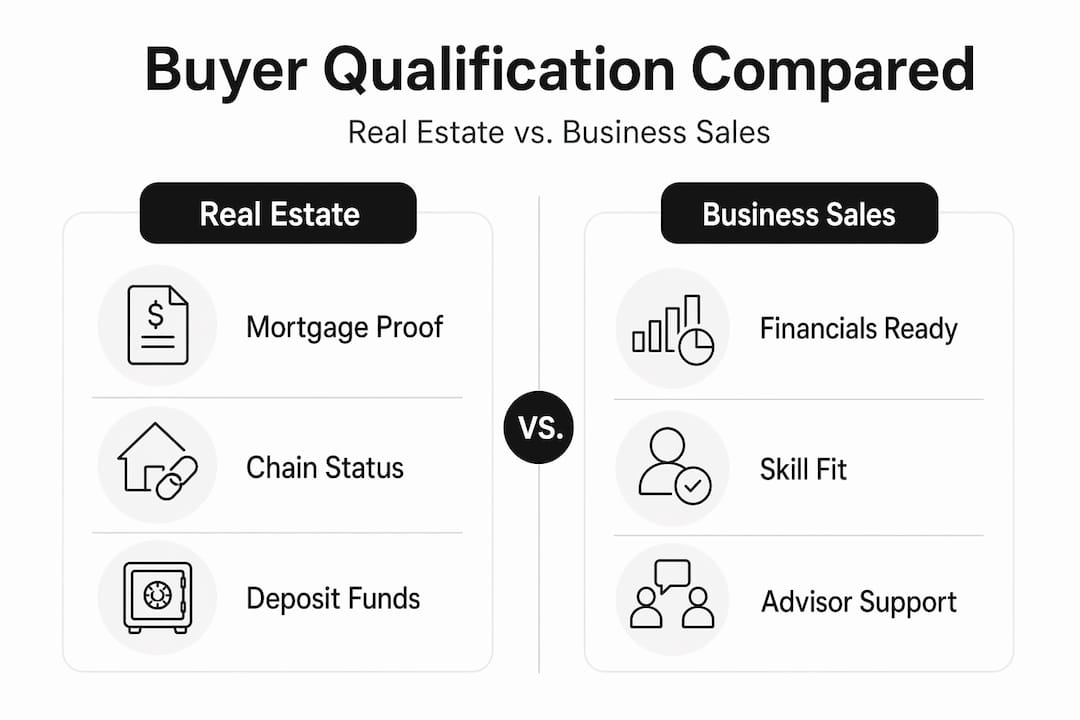
| Criteria | Real Estate | Business Sales |
|---|---|---|
| Financial proof | Mortgage pre-approval, deposit confirmation | Bank statements, lender pre-qualification letter |
| Operational readiness | Chain status, selling position confirmed | Management experience, P&L responsibility |
| Confidentiality | Less sensitive, but financial privacy matters | NDA required before any business disclosure |
| Decision timeline | Driven by listing competition and chain | Driven by seller readiness and due diligence |
| Qualification depth | Financial position and property chain | Strategic fit, operational capability, cultural alignment |
In real estate, a qualified buyer’s chain status matters as much as their mortgage pre-approval. A buyer with excellent credit who still needs to sell their current home first is a different risk profile than a chain-free cash buyer. Treating them identically will cost you months of work on deals that cannot close at the pace you need.
In business sales, financial readiness is just the admission ticket. The real qualification work is assessing whether the buyer has the operational experience to run the acquired company effectively. A buyer who has never managed staff or held P&L responsibility is a high-risk acquirer, regardless of their net worth. Sellers who skip this step often find themselves facing re-trades, deal delays, or post-close disputes rooted in buyer unpreparedness.
For agents working the luxury segment, exploring lead generation for luxury brokers offers frameworks tuned specifically to high-value buyer screening where the stakes of poor qualification are magnified.
My honest take on why qualification still gets ignored
I’ve watched experienced agents and seasoned business brokers skip proper qualification because they did not want to “scare off” a prospect. I understand the impulse. But in my experience, the buyers who exit when you ask for proof of funds were never going to close anyway. The real cost of skipping qualification is not losing a bad buyer early. It’s losing three to six months of your time, thousands in legal fees, and the opportunity cost of every qualified buyer you did not pursue because your pipeline looked full.
What I’ve learned is that rigorous qualification actually improves your relationship with serious buyers. It signals that you are a professional who runs a serious process. Buyers with real intent respect that. They want to know you are not going to waste their time either. Qualification is mutual. As Corum Group notes, the best qualification conversations flow both ways, with the buyer assessing whether the opportunity fits their vision and the seller assessing whether the buyer can execute.
The frameworks matter, but the mindset matters more. Stop treating qualification as an obstacle and start treating it as a filter that protects your most finite resource: your time. Every hour you spend with an unqualified buyer is an hour you did not spend with someone who could actually close.
— Jason
How Plo helps you qualify and close faster
If you’ve built your qualification process on frameworks but your pipeline still moves slowly, the missing piece is usually technology. Plo was built for real estate agents, luxury brokers, and yacht brokers who need to move fast without letting serious buyers fall through the cracks.

With Plo’s prospecting tools, you get a system that identifies and screens leads before they hit your calendar, so you spend more time with buyers who have already cleared the first qualification bar. Our top prospecting tools help you track proof of funds, follow-up signals, and pipeline stage in one place. Stop guessing who is serious. Let the data tell you. See how Plo’s platform fits the way you already work at ex.plo.re, and start your next quarter with a pipeline full of buyers worth your time.
FAQ
What is qualifying buyers in simple terms?
Qualifying buyers is the process of verifying that a prospective buyer has the financial means, decision-making authority, and genuine intent to complete a purchase within a realistic timeframe. It filters out unserious inquiries before they consume your time and resources.
What documents are needed to qualify a buyer?
For real estate, a mortgage pre-approval letter and confirmation of deposit funds are the baseline. For business sales, buyers typically need to provide recent bank or brokerage statements and a signed NDA before receiving sensitive business information.
How do BANT and MEDDIC differ in the buyer qualification process?
BANT covers Budget, Authority, Need, and Timing and works well for straightforward deals. MEDDIC is designed for complex B2B sales and adds layers like identifying the economic buyer and an internal champion, making it more reliable for multi-stakeholder decisions.
Why does the importance of qualifying buyers extend beyond the first call?
Because deal conditions change. A buyer’s budget can be cut, a key stakeholder can leave, or a technical requirement can emerge that disqualifies the deal entirely. Requalifying at every major milestone prevents late-stage surprises from collapsing deals you thought were certain.
How does qualifying buyers differ in real estate vs. business sales?
In real estate, the focus is on financial position and chain status. In business sales, qualification also includes assessing the buyer’s operational experience and strategic vision, since the buyer must be capable of running the business effectively after the transaction closes.