
Overview: A value proposition is a single, customer-facing statement that answers one question: why should this buyer choose you over every alternative to get the outcome they want? Not a tagline. Not a mission statement. A functional tool that drives positioning, closes deals, and aligns your team around what actually matters to buyers.

According to Investopedia, a value proposition is the clear answer to the buyer’s question of why to choose this product for this outcome instead of alternatives. Harvard Business School Online frames it as both an internal alignment tool and an external sales message. Salesforce calls the customer-facing version a Customer Value Proposition (CVP) and describes it as a concise, buyer-focused message that summarizes why someone should choose you.
Every strong value proposition contains four elements:
- Target customer: The specific person or business you are solving a problem for
- Primary outcome: The concrete result they get from working with you
- Removed tradeoff: What they no longer have to sacrifice to get that result
- Proof: A falsifiable claim, number, or named result that makes the promise credible
Stratridge recommends delivering this in three operational forms: a full structured statement for internal alignment, an 8–12 word one-liner for sales conversations, and a set of falsifiable proof points for marketing copy.
Table of Contents
- What is a value proposition, exactly?
- Why your value proposition determines whether you win or lose
- What goes inside an effective value proposition?
- Which frameworks actually help you build one?
- How to create a value proposition in 6 steps
- How do you know if your value proposition is working?
- Copy-ready templates and real-world examples
- Common mistakes that kill an otherwise good proposition
- Applying this to real estate: a worked example
- Key Takeaways
- The assumption that almost cost everything
- Plo helps you build and test your proposition faster
- Recommended reading and further resources
What is a value proposition, exactly?
The term was coined by McKinsey consultants Michael Lanning and Edward Michaels in 1988, according to Wikipedia, and it has since become one of the most used and most misunderstood concepts in marketing.
Here is where most people get confused. A value proposition is not:
- A tagline (“Just Do It,” “Think Different”) — taglines build brand recall, not buyer decisions
- A mission statement (“We exist to empower communities”) — that is internal purpose, not buyer value
- A unique selling proposition (USP) — a USP names one differentiating feature; a value proposition describes the full outcome the buyer receives
A positioning statement is the closest cousin. It defines where you sit in the market relative to competitors. A value proposition goes further: it speaks directly to the buyer’s desired outcome and names what they give up to get it.
You will encounter three common forms in practice:
- Brand-level value proposition: Why your company, not a competitor, for any buyer in your market
- Product-level value proposition: Why this specific product, for this specific use case
- Sales one-liner (CVP): An 8–12 word statement a rep delivers in the first 30 seconds of a call
A real estate agent, for example, needs all three. The brand-level prop explains why buyers and sellers choose their firm. The product-level prop explains why a seller should list with them specifically. The sales one-liner is what comes out of their mouth at an open house.

Why your value proposition determines whether you win or lose
Salesforce research found that 86% of business buyers are more likely to purchase from companies that demonstrate they understand the buyer’s goals, yet 59% say most salespeople never take the time to do this. That gap is where deals are won and lost.
A sharp value proposition closes that gap before the first conversation even starts. It does five things that generic marketing copy cannot:
- Wins customers faster by answering the buyer’s “why you” question before they ask it
- Speeds buying decisions by removing ambiguity about what outcome they are purchasing
- Aligns internal teams so sales, marketing, and product all describe the offering the same way
- Prioritizes product development by anchoring the roadmap to the outcomes buyers actually pay for
- Sharpens sales pitches so reps lead with buyer outcomes instead of feature lists
Strategyzer points out that many product ideas fail because companies build things nobody wants. A well-formed value proposition forces customer-focused evidence gathering before you invest in building or marketing anything.
What goes inside an effective value proposition?
Think of a value proposition as having six load-bearing components. Remove any one of them and the whole structure weakens.
- Target customer (ICP): Who, specifically, is this for? “Homeowners” is too broad. “First-time sellers in suburban markets who have never navigated a listing process” is specific enough to write copy around.
- Job-to-be-done / problem: What is the buyer trying to accomplish, or what frustration are they trying to escape? This is the functional job, not the emotional one.
- Primary outcome: The concrete result the buyer gets. Revenue, time saved, a sold home, a closed deal. One outcome, not five.
- Removed tradeoff: What the buyer no longer has to sacrifice. This is the most underused element in most propositions. Stratridge calls it the most persuasive mechanism in the entire statement because buyers expect to give something up. Naming what they won’t lose (time, money, complexity) pre-empts hesitation.
- Mechanism: Why does your solution produce this outcome? The brief, credible reason it works.
- Proof: A falsifiable claim. Named customers, specific numbers, or demonstrable results. “Clients love us” is not proof. “Sold in 23 days on average, 11 days faster than the county median” is.
What does good proof look like? A metric with a comparison point. A named client outcome. A before/after case. The test is simple: could a skeptic check this claim? If yes, it is proof. If no, it is a marketing claim.
Pro Tip: Pick one primary outcome and defend it with proof. Canva’s value proposition guidance notes that trying to address every customer pain dilutes credibility. One sharp promise beats five vague ones every time.
Which frameworks actually help you build one?
Two frameworks dominate practitioner work, and they answer different questions.
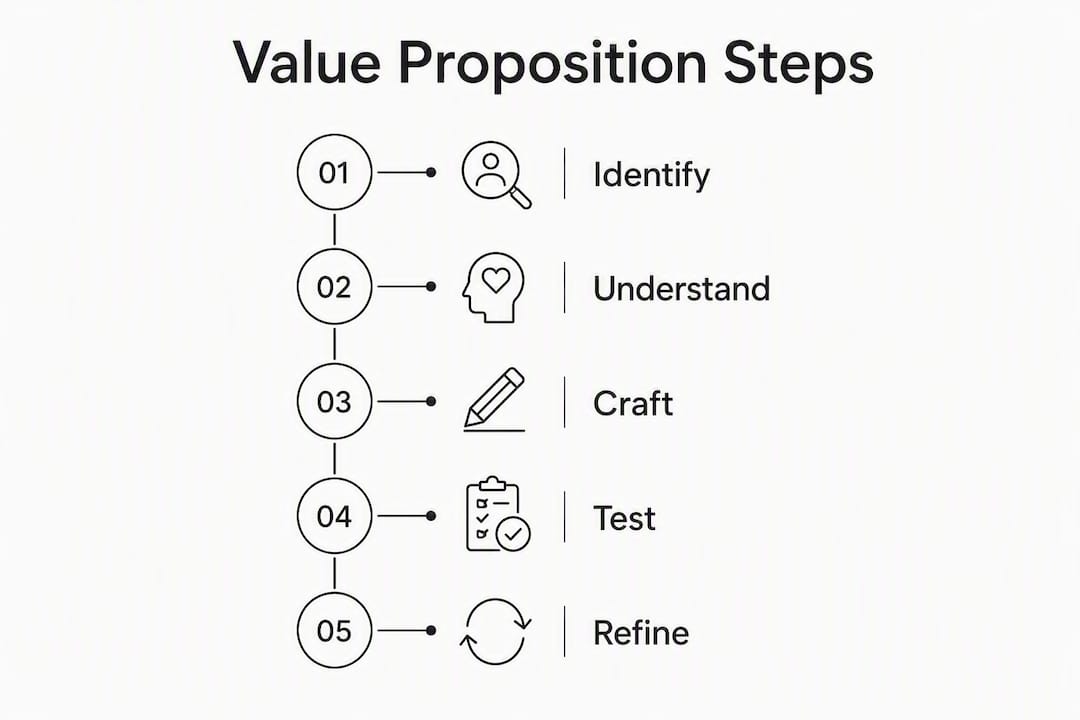
The Value Proposition Canvas (Strategyzer)
The Value Proposition Canvas maps customer jobs, pains, and gains on one side against your product’s features, pain relievers, and gain creators on the other. The diagnostic question it answers: Where does our offering actually fit what customers are trying to do? Use it when you are starting from scratch or when you suspect your current messaging is misaligned with buyer reality. Run it as a workshop with your sales team, not just your marketing team, because reps hear objections that marketers never see.
Jobs-to-be-Done (JTBD)
JTBD, developed by Clayton Christensen, asks: What job is the customer hiring this product to do? It shifts the frame from demographics to motivation. A seller is not “a 45-year-old homeowner.” They are someone trying to move their family to a better school district without losing money on a rushed sale. That framing produces sharper copy than any persona template.
Customer Value Proposition (CVP)
Salesforce uses the term CVP to describe the concise, customer-facing version of the full proposition. Where the Canvas is a diagnostic tool and JTBD is a research lens, the CVP is the output: the short statement that goes on a landing page, in an email subject line, or into a sales opener.
When to use each:
- Canvas: Early-stage positioning work, product launches, or when conversion rates drop unexpectedly
- JTBD: Customer interview design, messaging rewrites, and competitive repositioning
- CVP format: Any customer-facing channel where you have 10 seconds to earn attention
Concrete next steps: run one Canvas workshop with your sales team, collect five customer interviews using JTBD questions (“What were you trying to accomplish when you hired us?”), and draft your CVP from the language customers actually use.
How to create a value proposition in 6 steps
Salesforce describes a step-based process for building a CVP. Here is a reproducible six-step workflow you can run in a single week.
-
Define your ICP. Name the specific customer you are writing for. Job title, situation, and the one problem they are actively trying to solve. If you serve multiple segments, write a separate proposition for each. A buyer persona built from real customer data is the right starting point, not a demographic guess.
-
Run buyer interviews. Talk to five to eight of your best customers. Ask: “What were you trying to accomplish when you hired us? What would you have had to give up without us? How would you describe what we do to a colleague?” Record the exact words they use. This language is your raw material.
-
Extract outcome language. Pull the phrases customers repeat. The words they use to describe the outcome they got are almost always sharper than anything your team invents internally. Treat every internal draft as a hypothesis until customer language confirms or replaces it.
-
Map the removed tradeoff. Ask: what did buyers previously have to sacrifice to get this outcome? Long timelines, high fees, complexity, uncertainty? Name the specific tradeoff your solution eliminates. This single element separates a forgettable proposition from one that stops a buyer mid-scroll.
-
Draft the structured statement. Use this frame: “We help [ICP] achieve [outcome] without [tradeoff], because [mechanism].” Example: “We help first-time home sellers close in under 30 days without dropping their asking price, because our pre-listing preparation process eliminates the delays that kill most deals.” This is your internal alignment document. Every team member should be able to recite the core logic.
-
Write the one-liner and proof points. Compress the structured statement into an 8–12 word sales one-liner. Strip the mechanism and tradeoff down to their sharpest form. Then write three falsifiable proof points that defend the claim. The one-liner goes on your homepage headline, your sales opener, and your ad copy. The proof points go in the body copy, the sales deck, and the follow-up email.
Testing checklist before you publish:
- Can a new team member recite the one-liner after reading it once?
- Does the structured statement use words your customers actually said?
- Are all three proof points falsifiable (a skeptic could check them)?
- Does the proposition name one primary outcome, not three?
Shopify’s value proposition guide reinforces that a proposition should be treated as an evolving hypothesis, not finished copy. Draft it, publish it, and plan to revise it.
How do you know if your value proposition is working?
Testing is where most teams stop short. They write a proposition, put it on the homepage, and call it done. The ones who win treat it as a live experiment.
| Metric | What it signals | How to measure it |
|---|---|---|
| Headline click-through rate | Whether the one-liner earns attention | A/B test two headline variants on a landing page or paid ad |
| Demo or inquiry rate | Whether the proposition creates enough desire to act | Track form submissions or call bookings per visitor |
| Close rate | Whether the proposition survives the sales conversation | Compare close rates before and after a messaging change |
| Objection frequency | Whether the removed tradeoff is landing | Track which objections reps hear most in the first call |
| Retention / renewal rate | Whether the proposition matches the delivered experience | Measure churn in the days after onboarding |
For qualitative validation, five consistent customer interviews are the minimum signal. If five buyers describe the outcome the same way, unprompted, you have found language worth keeping. If they describe it five different ways, your proposition is not yet sharp enough.
A/B testing protocol: run headline variants for a minimum of two weeks or until you reach statistical significance. Test one variable at a time (headline vs. subhead, outcome language vs. tradeoff language). Never test design and copy simultaneously or you won’t know which change drove the result.
When to reject a claim: if a proof point cannot be verified by a third party, cut it. If the conversion lift from a new headline is flat after three weeks, the outcome language is wrong, not the design.
Pro Tip: Ask customers during interviews: “What would you have had to give up if you hadn’t hired us?” Their answer is almost always the removed tradeoff you should be leading with, and it is almost never what your team assumed.
Copy-ready templates and real-world examples
The structured statement, the one-liner, and the proof points each serve a different channel. Here is how they map.
Structured statement (internal alignment and sales decks):
“We help [ICP] achieve [outcome] without [tradeoff], because [mechanism].”
One-liner examples (homepage headline, ad copy, sales opener):
- “Sell faster. Keep your price. No listing surprises.”
- “More qualified leads. Less time chasing the wrong ones.”
- “Close in 30 days or we renegotiate our fee.”
- “Your listing, sold at full price, in under four weeks.”
Proof point examples (body copy, email, sales follow-up):
- “Our sellers close an average of 11 days faster than the county median.”
- “94% of our listings sell at or above asking price in the first 30 days.”
- “We’ve managed over $200M in residential transactions in this market.”
Channel guidance:
- Homepage headline: Lead with the primary outcome. One sentence, 8–12 words. No jargon.
- Paid ad: Lead with the removed tradeoff. “Sell without dropping your price” outperforms “Expert real estate services” every time.
- Sales opener: State the outcome and the mechanism in one breath. “We help sellers close in under 30 days because we handle the prep work most agents skip.”
- Email subject line: Use the removed tradeoff as a question. “Still waiting on a full-price offer?”
Real-estate-specific variants:
- For listing agents: “We help motivated sellers close at full asking price in under 30 days, without the stress of repeated price reductions, because our pre-listing process eliminates the friction that stalls most deals.”
- For buyer’s agents: “We help first-time buyers secure their home in a competitive market without overpaying, because we identify off-market opportunities before they hit the MLS.”
Shorten either of those to a one-liner by keeping the outcome and the tradeoff, dropping the mechanism: “Full asking price. Under 30 days. No price cuts.” That is your headline. The mechanism lives in the body copy where you have room to prove it. For more on qualifying the right leads to match your proposition, Plo’s guide walks through the full workflow.
Common mistakes that kill an otherwise good proposition
Most value propositions fail for the same five reasons. Here is the mistake, why it happens, and the fix.
| Mistake | Why it happens | Fix |
|---|---|---|
| Too broad (“We help everyone”) | Fear of excluding potential customers | Name one ICP; write separate props for other segments |
| Feature language instead of outcomes | Teams write from the inside out | Replace “our AI-powered CRM” with “you close more deals with less follow-up” |
| No customer validation | Proposition written in a conference room | Run five buyer interviews before finalizing any claim |
| Overpromising without proof | Desire to sound impressive | Every claim needs a falsifiable proof point; cut what you can’t defend |
| Tagline mistaken for a proposition | Confusion between brand voice and buyer value | A tagline builds recall; a proposition answers “why choose you for this outcome” |
The feature-language mistake is the most common and the most damaging. Buyers do not buy features. They buy outcomes. “Our platform has 47 integrations” means nothing to a seller who just wants to know if their home will sell quickly. “Your listing goes live on 47 platforms in 24 hours” is the same fact, framed as an outcome.
Applying this to real estate: a worked example
Here is how a listing-focused agent would build and test a value proposition using this workflow.
ICP: Homeowners in suburban markets who need to sell within 60 days and are worried about price reductions.
Outcome: Sell at or above asking price within 30 days.
Removed tradeoff: No repeated price cuts, no months of uncertainty, no last-minute deal collapses.
Mechanism: A pre-listing preparation process that addresses the top three buyer objections before the home hits the market.
Proof points:
- Average days on market: 23 (vs. county median of 41)
- Percentage of listings sold at or above asking: 94%
- Number of transactions closed in this zip code in the last 24 months: 34
Structured statement: “We help motivated sellers in [market] close at or above asking price in under 30 days, without repeated price reductions, because our pre-listing process eliminates the objections that stall most deals.”
One-liner: “Sell at your price. Close in 30 days. No surprises.”
4-step test plan for agents:
- Step 1 — Local landing page A/B test: Run two headline variants for three weeks. Variant A: outcome-led (“Sell at full price in 30 days”). Variant B: feature-led (“Expert listing services in [market]”). Track inquiry rate.
- Step 2 — Open-house pitch test: Use the one-liner as your opener with 10 consecutive prospects. Track how many ask a follow-up question vs. disengage. A strong proposition earns a follow-up question.
- Step 3 — Email campaign: Send the structured statement as the body of a prospecting email to 50 past contacts. Measure reply rate and meeting bookings.
- Step 4 — Follow-up conversion tracking: Track close rate and days-on-market for listings where you used the new proposition in the initial consultation vs. your historical average.
Realistic signals to watch: a 15–20% improvement in inquiry rate from the landing page test is a meaningful signal. A reply rate above 8% on the prospecting email suggests the outcome language is resonating. If neither moves, the removed tradeoff language needs revision.
Pro Tip: At every walkthrough and open house, ask sellers: “What’s the one thing that would make this process feel like a success?” Write down their exact words. That language is your next proposition draft. The seller motivation guide from Plo covers how to capture and use this in your pitch.
Key Takeaways
A value proposition works when it names one outcome, removes one tradeoff, and backs both claims with falsifiable proof, all delivered in three forms: a structured statement, an 8–12 word one-liner, and a proof point set.
| Point | Details |
|---|---|
| One outcome, one tradeoff | Focus on a single primary outcome and explicitly name what buyers no longer have to sacrifice. |
| Three required forms | Every proposition needs a structured statement, an 8–12 word one-liner, and falsifiable proof points. |
| Customer language wins | Internal drafts are hypotheses; validate with five or more buyer interviews before publishing. |
| Test before you finalize | A/B test headline variants for at least two weeks and track inquiry rate, close rate, and objection frequency. |
| Plo accelerates the process | Plo’s prospecting and sales automation tools help agents build, test, and scale their value proposition messaging across channels. |
The assumption that almost cost everything
Here is something that does not show up in most guides on this topic: the biggest enemy of a strong value proposition is confidence. Not arrogance, exactly. Just the quiet certainty that you already know what your buyers value most.
Every team I have seen build a proposition in a conference room, without a single customer interview, produces the same result. They write about their process, their technology, their years of experience. All of it true. None of it what the buyer actually cares about. Then they wonder why the homepage converts at 1.2% and the sales pitch gets polite nods but no signatures.
The fix is almost embarrassingly simple: ask five customers what they were trying to accomplish when they hired you, and then listen without steering the answer. The language they use will be more specific, more emotional, and more persuasive than anything your team writes. One agent I know discovered that her clients did not care about her market expertise at all. What they cared about was not having to explain their situation twice. That became her entire proposition. Her inquiry rate changed within two weeks of updating her homepage headline.
The three-form output (structured statement, one-liner, proof points) is not a creative exercise. It is a usability test. If a new team member cannot recite the one-liner after reading it once, the proposition is not sharp enough yet. If the proof points cannot survive a skeptic’s question, they are not proof. Iterate until both pass.
Pro Tip: In your next customer conversation, ask: “What would you have told a friend to expect before hiring someone like me?” The answer almost always contains the removed tradeoff in the buyer’s own words, which is the hardest element to write from the inside.
Plo helps you build and test your proposition faster
Most agents know what they want to say. The gap is in the testing, the distribution, and the follow-through. Plo was built specifically for real estate agents, yacht brokers, and luxury sales professionals who want to control their narrative and convert more of the right clients, without rebuilding their entire marketing operation from scratch.
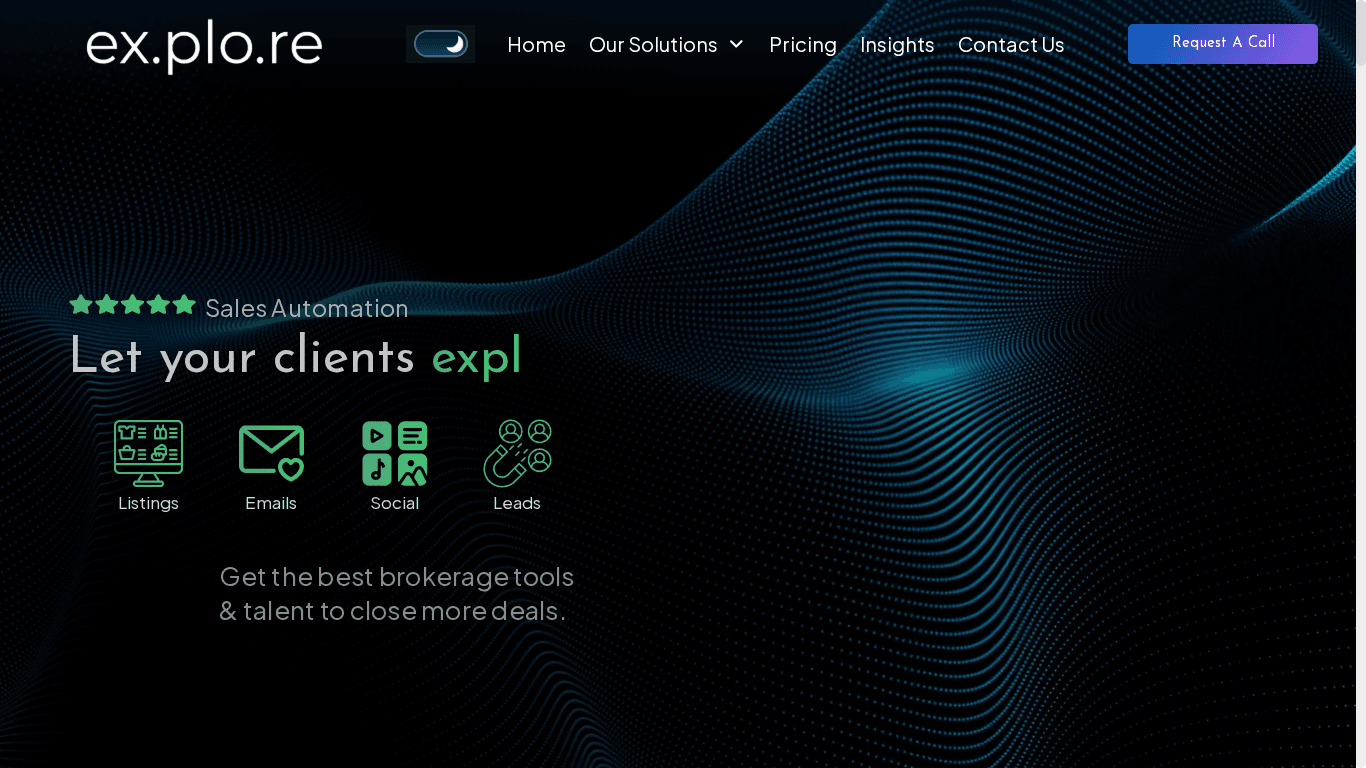
Plo’s platform combines AI-powered ad creation, landing-page management, CRM automation, and email campaign tools so you can run a live proposition test in days, not months. You draft your one-liner, Plo deploys it across your local ad campaigns and landing pages, and the reporting dashboard shows you exactly which message is driving inquiries. No agency retainer. No waiting six weeks for a creative brief. Your proposition, live and measurable, with the prospecting tools to back it up.
If you are ready to stop guessing which message resonates and start seeing real conversion data, register for Plo and put your value proposition to work this week.
Recommended reading and further resources
These sources go deeper on specific aspects of value proposition development.
- Strategyzer — Value Proposition Canvas: The canonical framework for mapping customer jobs, pains, and gains to your offering. Start here for diagnostic work.
- Harvard Business School Online — Creating a Value Proposition: Practical HBS guidance on structuring a CVP for both internal alignment and external messaging.
- Shopify — Value Proposition Guide: Accessible step-by-step guide with examples; strong on iteration and A/B testing advice.
- Salesforce — 6 Steps to Writing a Compelling CVP: Salesforce’s own framework for building a customer value proposition, with sales-focused language and buyer behavior data.
- Investopedia — Value Proposition Definition: Clean, authoritative definition and overview of how value propositions function in business strategy.
- Stratridge — How to Craft a Value Proposition: Practitioner-level step-by-step guide covering structured statements, removed tradeoffs, and proof points.
- Wikipedia — Value Proposition: Historical context, including the original McKinsey coinage, and a broad overview of how the concept has evolved.
- Plo — Market Positioning Guide for Real Estate: Plo’s own guide to positioning and differentiation for agents who want to stand out in a local market.