

Brand positioning is defined as the strategic process of establishing a distinct, memorable place for your brand in the minds of your ideal customers, directly shaping how they perceive your value, your price, and your relevance. Every revenue decision your business makes, from pricing to sales cycle length to marketing spend, flows downstream from how clearly and powerfully you are positioned. Research from Nielsen confirms that a 1-point gain in brand awareness drives a 1% increase in sales, which means positioning is not a branding exercise. It is a growth lever. Whether you are running a luxury brokerage, scaling a startup, or managing a regional sales team, the importance of brand positioning shows up in your close rates before it ever shows up in your quarterly report.
Why brand positioning matters for competitive advantage
The benefits of effective brand strategy are measurable, not theoretical. Well-positioned brands command pricing 20 to 40% above market averages, a premium that compounds over time as brand authority builds. That pricing power is not accidental. It comes from buyers who understand exactly what you stand for and why you are the right choice, without needing to be convinced through discounting or extended negotiation.
Brand positioning also compresses your sales cycle. When your narrative is clear, buyers arrive pre-sold on your category frame. They are not evaluating you against every competitor on a feature checklist. They are confirming what they already believe. This is why positioning consultant April Dunford describes positioning as the context that lets customers understand your value. Without that context, your product gets treated as a commodity and competes on price alone.
The emotional dimension matters just as much as the functional one. Harvard Business Review data shows that 64% of consumers who have a relationship with a brand cite shared values as the reason. That statistic reframes positioning entirely. You are not just communicating features. You are signaling identity, belief, and belonging to the people most likely to become loyal, high-value clients.

| Benefit | Business impact |
|---|---|
| Pricing power | 20 to 40% premium above market average |
| Sales cycle compression | Buyers arrive pre-qualified and pre-convinced |
| Brand awareness lift | 1-point gain drives 1% increase in sales |
| Customer loyalty | 64% of brand relationships built on shared values |
| Marketing efficiency | Clearer positioning reduces wasted ad spend |
How brand and product positioning work together for growth
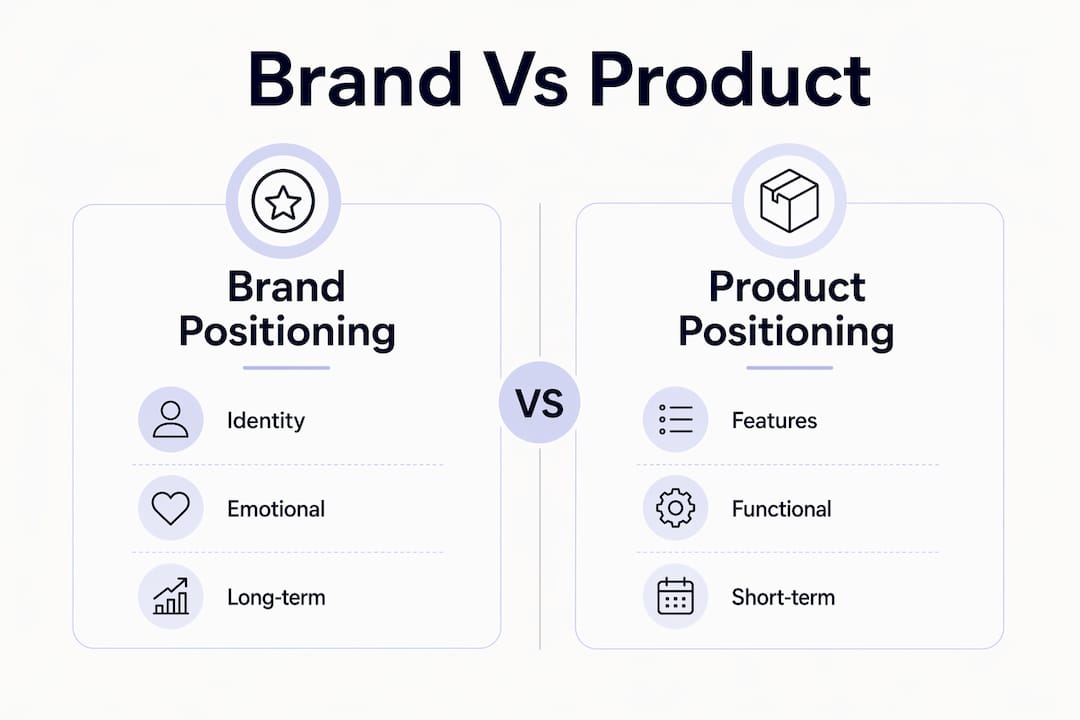
Brand positioning and product positioning are not the same thing, and confusing them costs businesses real money. Brand positioning defines how the market perceives your company, your values, and your promise. Product positioning defines the functional value your specific offering delivers to a specific buyer in a specific context. Both must exist. Neither is sufficient alone.
When the two are misaligned, the commercial damage is significant. Companies with misaligned brand and product positioning experience 35 to 40% longer sales cycles and 20 to 30% lower win rates against positioned competitors. Think about what that means operationally. Your sales team is working harder, closing less, and discounting more, not because the product is weak but because the story around it is fractured.
The convergence model, which integrates brand narrative, category framing, and product story into a single architecture, creates a flywheel effect. Companies that successfully converge product and brand positioning grow 2 to 3 times faster than their category average. Salesforce and HubSpot are the clearest enterprise examples. Both built category-defining brand narratives (“CRM for customer success” and “inbound marketing”) and then aligned every product story, every sales conversation, and every piece of content to that frame. The result was not just brand recognition. It was category ownership.
For real estate professionals and luxury brokers, this convergence looks like aligning your personal brand narrative (“the agent who specializes in waterfront properties for relocating executives”) with your specific service story (“here is exactly how I find off-market listings before they hit Zillow”). When those two stories match, buyers do not hesitate. They act. Understanding how branding drives real estate sales in 2026 means recognizing that convergence as a non-negotiable.
What happens when brand positioning is weak or unclear
Weak positioning is a business risk, not a marketing inconvenience. Positioning serves as a business-wide operating system affecting every team, from sales and product to customer success and paid media. When it is vague, every department pays a hidden tax. Sales reps over-explain. Ad campaigns underperform. Prospects ask “but what makes you different?” on every call.
The most dangerous aspect of positioning decay is how late most businesses detect it. Revenue can temporarily mask long-term brand damage. Brand decay appears first in memory, price acceptance, and search demand, well before it shows up in your revenue line. By the time your close rate drops visibly, the positioning problem has been compounding for months. This is why monitoring leading indicators matters more than watching quarterly revenue alone.
“Positioning decay is often misdiagnosed as a pricing problem or a sales execution problem. By the time it shows up in revenue, you have already lost significant ground in the minds of your buyers.”
Strong positioning does the opposite. Effective positioning reduces buyer cognitive effort, making your brand easier to choose and easier to justify at your price point. In AI-driven search environments where buyers increasingly get pre-filtered answers from tools like ChatGPT and Perplexity, brands with clear, consistent, authoritative positioning are the ones that get cited and recommended. Vague brands get skipped.
Pro Tip: Track three leading indicators of positioning health monthly: unaided brand recall in your target segment, price acceptance rate (how often prospects accept your quoted price without negotiating), and organic search demand for your brand name. These three metrics will tell you your positioning is slipping six to twelve months before your revenue does.
Practical steps to strengthen your brand positioning
The first move is to get specific and stay specific. Effective positioning is inherently polarizing, attracting best-fit clients while actively repelling poor-fit ones. That polarization improves operational efficiency. You spend less time on bad-fit prospects and more time closing the right ones. Trying to appeal to everyone is the fastest path to meaning nothing to anyone.
Here is a practical framework for building and maintaining strong positioning:
- Define your category frame. Decide what game you are playing and name it clearly. “Luxury waterfront specialist” is a category frame. “Real estate agent” is not.
- Align your proof points. Every claim in your brand narrative needs a corresponding product or service story that confirms it. Narrative without proof is just advertising.
- Build leadership visibility. Brand authority earned through consistent communication gives buyers confidence beyond visibility alone. Publish, speak, and show up where your best clients are paying attention.
- Measure positioning strength quarterly. Use brand recall surveys, price acceptance rates, and search volume for your brand name as your core metrics.
- Integrate positioning with sales enablement. Your sales team should be able to articulate your position in one sentence. If they cannot, the positioning is not clear enough yet.
Avoid the most common mistake: treating positioning as a logo refresh or a campaign. Positioning is not a creative project. It is a strategic decision about where you compete and why you win. It requires maintenance, not just launch. For real estate professionals, understanding how brand positioning builds client trust is the foundation of every client acquisition strategy worth building.
Pro Tip: When updating your positioning, test it with your three best existing clients before rolling it out. Ask them: “Does this describe why you chose us?” If they say yes immediately, you have it right. If they pause, you need to sharpen it.
Key takeaways
Brand positioning is a business-wide operating system that drives pricing power, sales efficiency, and long-term growth when brand and product narratives are fully aligned.
| Point | Details |
|---|---|
| Positioning drives pricing power | Well-positioned brands command 20 to 40% above market average pricing. |
| Alignment accelerates growth | Converged brand and product positioning delivers 2 to 3x faster category growth. |
| Misalignment has measurable costs | Misaligned positioning creates 35 to 40% longer sales cycles and lower win rates. |
| Decay appears before revenue drops | Monitor brand recall and price acceptance as early warning indicators. |
| Polarization improves efficiency | Clear positioning attracts best-fit clients and reduces wasted sales effort. |
Brand positioning as a business operating system, not a marketing tactic
I have worked with enough brokers and entrepreneurs to know that positioning conversations almost always start in the wrong room. Someone schedules a brand refresh meeting with their designer, picks new colors, updates the website header, and calls it done. Six months later, they are still discounting to close deals and wondering why their pipeline feels sluggish.
The real issue is that positioning was never treated as a business decision. It was treated as a visual one. The brands I have seen grow fastest, whether luxury real estate teams or boutique brokerages, all share one trait: their leadership team can articulate their position in a single sentence, and every person in the organization says roughly the same thing when asked what makes them different.
What I find most underappreciated is the connection between positioning and buyer trust in AI-compressed decision environments. When a prospect searches for a luxury waterfront agent and ChatGPT or Perplexity surfaces a recommendation, the brands with clear, consistent, well-documented positioning are the ones that appear. Vague positioning does not just hurt your sales pitch. It makes you invisible in the channels where buyers are increasingly making their first decisions.
Positioning is not something you set once and revisit every three years. It is a living asset that requires quarterly attention, honest measurement, and the willingness to say no to clients and opportunities that do not fit your frame. The brokers who treat it that way are the ones who control their narrative instead of reacting to the market.
— Jason
Take your positioning further with the right prospecting tools
Strong brand positioning tells the market who you are. The right tools make sure the right people find you and stay in your pipeline. Plo builds technology specifically for real estate agents, luxury brokers, and yacht brokers who want to amplify the work they are already doing, not add complexity to it.
If you are serious about turning your positioning into a client acquisition machine, start with the tools that top producers actually use. Plo’s curated list of top prospecting tools for 2026 gives you the exact stack to match your brand’s authority with the outreach volume and precision to back it up. You have built the position. Now go get the clients.
FAQ
What is brand positioning in simple terms?
Brand positioning is the process of defining how your brand is uniquely perceived in the minds of your ideal customers relative to competitors. It determines what you stand for, who you serve, and why buyers should choose you over every alternative.
How does brand positioning impact sales?
A 1-point gain in brand awareness drives a 1% increase in sales, and well-positioned brands close faster with less discounting because buyers arrive pre-qualified. Misaligned positioning, by contrast, extends sales cycles by 35 to 40% and reduces win rates significantly.
Why is brand identity crucial for pricing power?
Well-positioned brands command pricing 20 to 40% above market averages because buyers perceive clear, differentiated value and do not need to negotiate it down. Without strong brand identity, price becomes the only differentiator.
How do you know if your brand positioning is weakening?
Brand decay shows up first in declining brand recall, reduced price acceptance, and falling organic search demand for your brand name, often months before revenue is affected. Tracking these leading indicators quarterly gives you time to course-correct before the damage compounds.
What is the difference between brand positioning and product positioning?
Brand positioning defines your company’s overall market perception and values, while product positioning defines the specific functional value your offering delivers to a defined buyer. Both must be aligned. Companies that converge the two grow 2 to 3 times faster than their category average.