

Overview: A repeatable referral generation workflow for luxury real estate converts your best clients into a predictable local pipeline. The core sequence: identify your top 20% champions, trigger the ask at peak goodwill, make sharing frictionless, capture and qualify every lead, respond within 48 hours, and write every outcome back to your CRM. Plo’s platform at ex.plo.re is built to automate and track each of these steps so referrals become a measurable acquisition channel, not a lucky accident.
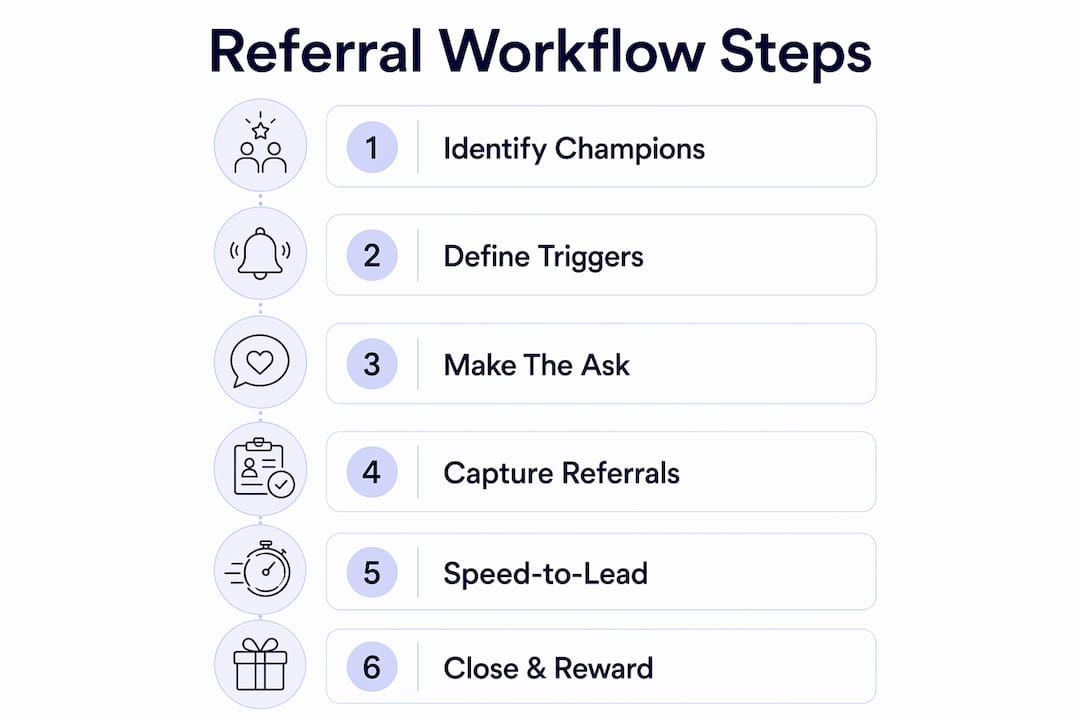
Your six-step checklist:
- Identify champions (top 20% by satisfaction and network)
- Trigger ask at closing, five-star review, or contract renewal
- Deliver a low-friction, forwardable message
- Capture and qualify with CRM fields on intake
- Acknowledge within 24 hours, contact lead within 48
- Close the loop with referrer within one week and log the reward
Table of Contents
- Why referrals are the highest-value channel for luxury brokers
- The 6-step referral workflow: your luxury broker playbook
- Ready-to-use templates and automation playbooks
- How to wire referrals into your CRM as a conversion channel
- Designing win-win incentives that hold up legally
- KPIs, reporting cadence, and how to iterate
- What causes referral programs to fail
- How to gather feedback and improve the workflow
- Legal and tax considerations for referral incentives
- Key Takeaways
- The workflow that actually holds up in the field
- Plo powers the referral workflow so you don’t have to build it yourself
- Useful sources and internal guides for implementation
Why referrals are the highest-value channel for luxury brokers
Warm introductions carry a trust premium that no paid ad can replicate. In luxury real estate, where a single transaction can represent millions of dollars and months of relationship-building, a referred prospect arrives pre-sold on your credibility. Referral conversion rates run significantly higher than the cold baseline, and time-to-close is materially shorter because the trust gap is already bridged by the referrer.
The economics compound quickly. A referred client who closes a $4M listing and then refers two more buyers is not just one deal; they are a node in your local network. Treating referrals as a managed acquisition channel rather than a passive byproduct of good service is what separates brokers who grow predictably from those who feast and famine.
The 6-step referral workflow: your luxury broker playbook
Step 1: Identify your champions
Focus on your top 20% of clients, scored by satisfaction, network relevance, and prior referral behavior. Score each contact on criteria such as NPS or review sentiment, industry/social overlap with your target buyer profile, and recency of positive interaction, with top scorers classified as champions. Everyone else gets a lighter-touch nurture sequence.
Step 2: Define peak-goodwill triggers
Timing the ask at the moment of highest satisfaction is the single biggest lever in the workflow. Set CRM automation triggers for closing day, a five-star review posted, a contract renewal, or a champion opening three consecutive emails. Asking after the peak goodwill moment substantially reduces conversion lift.
Step 3: Make the ask frictionless
Do the research for your client before you ask. Identify 3–5 specific people in their network who fit your buyer profile, then hand them a pre-written, forwardable message. The ask becomes one click, not a creative writing exercise. Text first (higher open rates), then email as a follow-up.
Step 4: Capture and qualify incoming referrals
Every inbound referral gets logged immediately: referred_by, referral channel, date, and a three-question qualifier (timeline, budget range, property type). Route high-fit leads directly to the listing agent; lower-fit leads enter a nurture sequence. No lead falls through because someone forgot to tag it.

Step 5: Speed-to-lead
A documented workflow with response SLAs improves client experience and conversion. Acknowledge the referral within 24 hours; make first contact with the lead within 48. Calendar routing should be automatic: a warm intro triggers a calendar invite, not a to-do item.
Step 6: Close the loop and reward
Update the referrer within one week, whether the lead converted or not. Customers who hear the outcome refer substantially more in subsequent periods. Log the reward status in CRM and trigger delivery automatically on deal close.
Ownership and cadence table:
| Trigger | Owner | Action | Timing |
|---|---|---|---|
| Closing day | Agent | Send forwardable ask | Immediate |
| Five-star review | Operations | CRM tag + SMS ask | Within 5 days |
| No response to ask | Assistant | Email follow-up | Day 30 |
| Referral received | Agent | Qualify + route | Within 24 hours |
| Deal closed | Operations | Reward delivery + loop-close | Within 7 days |
| Quarterly review | Agent | Champion list refresh | Day 90 |
Ready-to-use templates and automation playbooks
Playbook A — Personal concierge ask (post-closing, high-touch):
Send via text on closing day. Follow up by email on day 5 if no reply.
Playbook B — Scaled SMS ask (text-first automation):
Classify replies: “yes” routes to calendar booking; “not now” tags for a 90-day re-ask; no reply triggers one email follow-up at day 7.
Playbook C — Partner/network outreach (CPAs, attorneys, interior designers):
Send after an event or shared client interaction. Follow up at 30 days with a market update as a value-add.
Automation timeline: Trigger fires on closing day → SMS sends within 2 hours → reply classification within 24 hours → calendar routing or nurture tag → email follow-up at day 5 → loop-close update at day 7. Properly tuned referral automation can generate 3–5 booked clients per month from a consistent workflow.
How to wire referrals into your CRM as a conversion channel
Integrating referral events into your CRM turns word-of-mouth into a reportable acquisition channel with its own pipeline metrics. Add these fields to every contact and deal record:
| Field Name | Type | Purpose | Recommended Values |
|---|---|---|---|
referred_by |
Lookup (Contact ID) | Links lead to referrer | Contact record ID |
referral_date |
Date | Tracks timing and cadence | ISO date |
referral_channel |
Picklist | Source attribution | SMS, Email, Event, In-Person |
referral_status |
Picklist | Pipeline stage | Received, Qualified, Active, Closed |
referrer_value_score |
Number (1–5) | Champion scoring | 1 = low, 5 = high |
referral_reward_status |
Picklist | Incentive tracking | Pending, Delivered, N/A |
original_client_id |
Lookup | LTV chain tracking | Contact record ID |
Integration checklist: Set a webhook on deal-close to trigger reward delivery. Build a calendar routing rule that fires when referral_status moves to “Qualified.” Tag offline referrals (events, in-person) with referral_channel = Event and link them to the digital record within 24 hours. For CRM best practices specific to real estate, the data model above maps directly to standard agent workflows.
Dashboard widgets to build: referrals by source (bar chart), time-to-contact by channel (line), referral-to-client conversion rate (KPI card), and revenue attributed by referrer (ranked list).
Designing win-win incentives that hold up legally
Incentives must reward both the referrer and the referred prospect to sustain advocacy. One-sided rewards feel transactional and erode the authenticity that makes a referral valuable in the first place.
For luxury clients, experiential rewards outperform cash. Options that work: exclusive quarterly market briefings, curated client events (wine tastings, gallery openings), commission-offset services like staging or photography credits, or a charitable donation in the referrer’s name. For the referred prospect, a concierge closing gift or a complimentary market analysis creates immediate goodwill.
On compliance: in U.S. real estate, referral fees paid to unlicensed individuals are prohibited under RESPA and most state licensing laws. Always structure incentives as gifts or experiential rewards rather than percentage-based fees, and confirm the specific rules with your broker or legal counsel before launching.
Pro Tip: Tie incentive delivery to closed revenue in your CRM. When referral_status moves to “Closed,” trigger automatic gift fulfillment. This keeps incentives earned, visible, and never forgotten.
KPIs, reporting cadence, and how to iterate
| Metric | Definition | Target |
|---|---|---|
| Referral ask rate | % of champions asked per quarter | — |
| Referral share rate | % of asks that produce an intro | 20% |
| Referral-to-opportunity % | % of intros that qualify | — |
| Referral-to-client % | % of opportunities that close | significantly higher than cold baseline |
| Time-to-contact | Hours from intro to first agent contact | Under 48 hours |
| Revenue per referred client | Average deal value, referral cohort | Track vs. non-referral |
| Referrer LTV | Total revenue from referrer + their network | Segment by champion score |
Reporting cadence: Daily alert for new warm intros. Weekly pipeline review of open referral opportunities. Monthly dashboard review of share rate and conversion. Quarterly champion list refresh and A/B test read-out.
A/B test plan: Test message copy (concierge tone vs. direct ask) against share rate. Run for 60–90 days with a minimum of 30 asks per variant. If the concierge variant lifts share rate by more than 5 percentage points, roll it out as the default and test the next variable: incentive type.
What causes referral programs to fail
Most programs die quietly, not dramatically. The failure modes are predictable:
- Asking too late: Goodwill fades fast. An ask sent two weeks after closing converts at a fraction of the rate of a same-day ask.
- One-sided incentives: Rewarding only the referrer without offering value to the referred prospect makes the program feel like a sales tactic, not a service.
- Slow follow-up: A warm intro that waits 72 hours for a response is a cold intro. Set the 48-hour SLA and enforce it.
- No CRM write-back: If referrals aren’t logged, they can’t be measured, segmented, or rewarded consistently.
- Asking everyone: Broad asks dilute your champion relationships and produce low-quality intros. Stick to your scored top 20%.
- Generic messaging: A template that doesn’t reference the client’s specific property or experience reads as automated and gets ignored.
One-hour audit: Pull your last 20 referral asks from CRM. Check ask timing (days after trigger), response rate, time-to-contact, and whether the loop was closed. The metric with the worst gap is your first fix.
How to gather feedback and improve the workflow
Feedback from referrers and referred clients is the fastest way to find friction in your process. After each referral cycle, send a two-question survey to referrers: “How easy was it to make the introduction?” and “What would have made it easier?” For referred clients, ask at the first meeting: “How did [referrer’s name] describe working with me?” The answer tells you what your champions are actually saying about you, which is often different from your intended message.
Aggregate responses quarterly. If referrers consistently say the forwardable message felt too long, shorten it. If referred clients arrive with mismatched expectations, rewrite the intro context. Feed every insight back into your templates and champion scoring criteria.
Legal and tax considerations for referral incentives
Beyond RESPA compliance, referral gifts have tax implications worth knowing. The IRS requires that gifts to clients totaling more than $25 per person per year be treated as a business expense, and gifts to non-clients (referred prospects) may be taxable income to the recipient if they exceed IRS thresholds. For referral fees paid to licensed agents in other states, a formal referral fee agreement is required, and the fee is typically 25% of the receiving agent’s commission, though this varies by agreement.
Document every incentive delivered in your CRM with a date, value, and recipient. This record protects you in an audit and makes year-end reporting straightforward. When in doubt, run your incentive structure past your broker and a CPA before the program launches.
Key Takeaways
A repeatable referral generation workflow requires identifying your top 20% champions, asking at peak goodwill, automating low-friction outreach, and writing every result back to your CRM so referrals become a measurable, scalable acquisition channel.
| Point | Details |
|---|---|
| Champion focus | Score clients 1–5 and concentrate asks on your top 20% for higher conversion and less wasted outreach. |
| Goodwill timing | Trigger the ask on closing day or within 5 days of a five-star review; a late ask loses most of its conversion lift. |
| Frictionless ask | Provide a pre-written, forwardable message so the referrer’s only job is pressing send. |
| Speed-to-lead SLA | Acknowledge within 24 hours and make first contact with the referred lead within 48 hours. |
| CRM write-back | Log every referral event with referred_by, referral_status, and referral_reward_status to make the channel reportable. |
| Plo as your platform | Plo’s ex.plo.re automates CRM triggers, outreach templates, and reward delivery so the workflow runs without manual follow-up. |
The workflow that actually holds up in the field
The conventional wisdom on referral programs is that you need a formal incentive structure before you launch. In practice, the incentive is almost never the bottleneck. What kills most programs is the ask itself: it comes too late, it’s too vague, and it puts the cognitive work on the client. The brokers who generate consistent referral volume aren’t running elaborate reward schemes. They’re asking the right people at the right moment with a message the client can forward in ten seconds.
The 90-day expectation is realistic: in the first month, you’ll identify your champions and set up your CRM fields. In month two, you’ll send your first round of asks and measure share rate. By month three, you’ll have enough data to run your first A/B test on message copy. A realistic early result is three to five booked clients per month from a consistent referral workflow, based on automation examples in the industry.
Plo powers the referral workflow so you don’t have to build it yourself
Brokers who close more than four deals a month rarely have time to manually track champion scores, fire SMS sequences, and log reward statuses. That’s exactly the gap Plo fills. Plo’s platform at ex.plo.re wires your CRM fields, automates outreach timing, and manages the full referral loop from ask to reward delivery, without you building a single workflow from scratch.
If you’re closing fewer than two deals a month, the DIY playbook in this article is enough to start. If you’re at four or more, the time cost of managing the workflow manually exceeds the cost of a managed solution. Plo’s onboarding sprint gets your referral automation live in days, not weeks. See how prospecting tools for real estate stack up, or go straight to the local client acquisition workflow to see how Plo fits your pipeline.
Useful sources and internal guides for implementation
- Referral marketing examples for real estate agents — Real-world tactics and creative incentives that have worked for U.S. agents; useful for adapting the templates in this article to your market.
- How to build local referrals that actually stick — Practical playbooks for turning in-person networking and local events into digital referral records; directly supports the offline-to-CRM linkage covered above.
- How to grow client referrals: a sales pro’s guide — Longer-form guide on scaling referral volume and measuring long-term ROI; good reading once your first 90-day cycle is complete.
- Customer referral engine (Boomerang.ai) — The source behind the loop-close SLA and the conversion benchmarks cited in this article; worth reading for the full B2B referral engine methodology.
- Referral generation system (Rework) — The research backing the top-20% champion rule and goodwill timing guidance; a concise framework for professional services teams.