

Growing client referrals is the process of systematically generating new leads by turning satisfied clients into active advocates through well-timed asks, specific requests, and a repeatable referral infrastructure. Word-of-mouth marketing is the industry term for this discipline, and it sits at the core of every high-performing sales operation. The agents and brokers who build referral systems, rather than waiting for organic introductions, consistently outpace those who rely on advertising alone. This guide covers the exact mechanics: timing, specificity, tracking, and reciprocal partnerships that compound your referral volume over time.
How to grow client referrals with the right infrastructure
The single biggest reason referral programs fail is the absence of a system. Good intentions do not produce referrals. A reliable process of asking, tracking, thanking, and following up produces 3–5x more referrals than an ad hoc approach. That multiplier is the difference between a referral trickle and a referral pipeline.
Your infrastructure needs three components: a tracking sheet or CRM tag, a follow-up sequence, and a referral intake field at every client touchpoint. A tracking sheet records the recommender, the prospect, the source type, and the closing outcome. Without that data, you cannot measure what is working or where referrals are leaking out of your funnel.
CRM tagging goes one step further. Tag every inbound lead with its referral source at intake, then set automated alerts for post-sale milestones. Those alerts become your prompts to ask. A referral journal, even a simple spreadsheet, lets you spot patterns: which clients refer most often, which source types close fastest, and which months produce the most introductions.
| Infrastructure tool | Primary function |
|---|---|
| CRM referral tag | Tracks source at intake and links prospects to referrers |
| Referral tracking sheet | Records recommender, prospect, source type, and close data |
| Automated milestone alert | Triggers referral ask at peak satisfaction moments |
| Referral intake field | Captures source data at first client contact |
| Follow-up sequence | Ensures no referral lead goes cold after introduction |
Pro Tip: Set your CRM to flag every client who leaves a five-star review or sends a positive email. Those are your highest-probability referral sources, and the flag gives you a reason to reach out within 24 hours.
How do you identify the right moment to ask for a referral?
The right moment is called a value moment: the point when a client feels the full weight of what you delivered. Project completions, accepted offers, closed deals, and positive milestone check-ins all qualify. Timing referral requests within 48 hours of a value moment dramatically increases conversion compared to asks made days or weeks later.

The psychology is straightforward. Satisfaction peaks at the moment of delivery, then fades. A referral ask made at peak satisfaction feels natural, even generous. The same ask made two weeks later feels like a sales call. Waiting more than 48 hours after a high-value milestone cools the opportunity and makes the ask feel transactional rather than relational.
Here is how to build value moment triggers into your workflow:
- Closed deal or signed contract: Set a calendar reminder for 24 hours post-signing to send a personal note and referral ask.
- Positive feedback email: Flag the email in your CRM and respond with gratitude plus a specific referral request within the same business day.
- 30-day check-in call: Use the call to confirm satisfaction first, then ask if anyone in their network could benefit from the same result.
- Milestone anniversary: A one-year follow-up on a real estate purchase or yacht delivery is a natural, low-pressure moment to reconnect and ask.
- Public praise or social mention: When a client tags you or leaves a review, respond publicly and follow up privately with a referral ask.
Pro Tip: Before asking, confirm the client is genuinely happy. Ask one direct question: “Is there anything we could have done better?” If the answer reveals unresolved friction, address it first. Asking for a referral from a quietly dissatisfied client damages the relationship and produces zero leads.
What makes a referral request actually work?
Specificity in referral asks bridges the gap between polite agreement and an actual introduction. Generic requests fail because they put the cognitive burden on the client. When you say “let me know if anyone comes to mind,” the client nods and forgets. When you say “I’m looking for homeowners in Coral Gables with a property valued above $2 million who are considering a sale in the next 12 months,” the client immediately pictures two or three people.
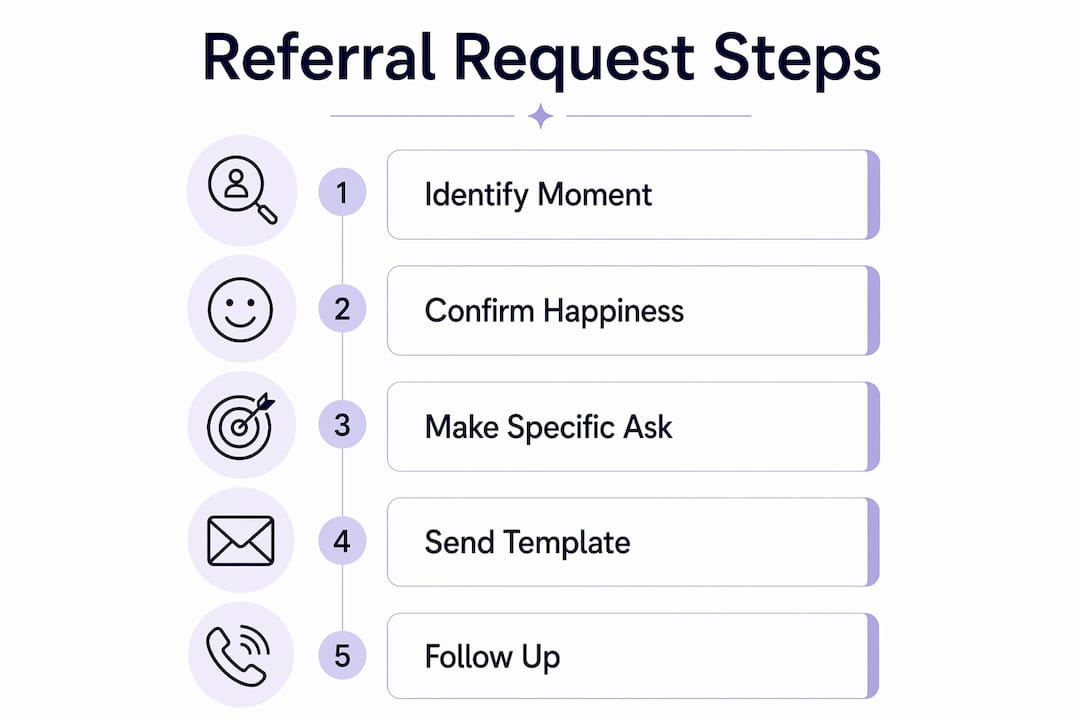
Specificity alone is not enough. Clients are busy, and even willing advocates stall when the referral process requires effort. Providing referral collateral like ready-to-send emails or LinkedIn blurbs removes friction and increases follow-through. You are not asking the client to write a recommendation. You are handing them one and asking them to press send.
An effective referral request has five elements:
- A specific client profile. Name the geography, price point, property type, or life stage you serve best.
- A clear outcome statement. Tell the client what result their contact will get, not just what service you provide.
- A ready-made introduction template. Write the email or message for them. Keep it under 100 words.
- A LinkedIn blurb. A two-sentence version they can paste into a direct message or post.
- A simple next step. Ask them to forward the email or make one introduction, not to “spread the word.”
Pro Tip: Send the referral template in the same message as your ask. Do not wait for the client to say yes before you send the draft. Momentum drops between messages, and a ready-made template makes saying yes the path of least resistance.
How do reciprocal referral partnerships multiply your results?
Reciprocal referral relationships generate 5–10x more referrals than one-way relationships. The principle is simple: refer before you ask. When you send a qualified lead to a mortgage broker, an estate attorney, or a yacht insurance specialist, you create a professional obligation that produces inbound referrals without a single ask.
The 1% rule applies here. For every 100 clients you serve, identify at least one referral partner in an adjacent profession and send them one qualified lead per quarter. Track every referral you make and every referral you receive. That tracking creates accountability and shows you which partnerships are producing returns.
Best practices for building reciprocal referral relationships:
- Map your adjacent professions. Real estate agents pair with mortgage brokers, interior designers, and estate attorneys. Yacht brokers pair with marine insurers, charter companies, and dock managers. Identify three to five natural partners.
- Refer first, always. Send a warm introduction before you ask for anything. This sets the tone for the relationship.
- Close the loop on every referral. When you send a lead, follow up to confirm the contact was made and the outcome. Partners who feel accountable refer more.
- Schedule quarterly check-ins. A 20-minute call every three months keeps the relationship warm and surfaces new referral opportunities on both sides.
- Track outcomes, not just volume. A partner who sends five leads that never close is less valuable than one who sends two leads that convert. Measure quality.
What are the most common referral mistakes and how do you fix them?
Most referral programs underperform not because clients are unwilling, but because the process breaks down at predictable points. Recognizing these failure modes lets you course-correct before they become habits.
The most damaging mistake is relying on the client to make the introduction without collecting the referral contact’s information. Always ask for the referral contact’s details or a warm handoff email, even when a client says they will refer. Without that information, you have no way to follow up if the introduction never happens.
| Common mistake | Practical fix |
|---|---|
| Waiting too long after a value moment | Set a 48-hour calendar alert for every milestone and ask immediately |
| Generic referral ask with no profile | Write a one-sentence ideal client description before every ask |
| No referral contact info collected | Ask for the contact’s name and email in the same conversation |
| No tracking or follow-up system | Tag every referral source in your CRM and set a 7-day follow-up alert |
| Asking dissatisfied clients | Run a satisfaction check before every referral ask |
Systematic tracking is the fix for almost every downstream problem. When you implement a structured referral tracking sheet, you can see exactly where referrals stall, which clients produce the most leads, and which partners are worth investing in. That visibility turns a guessing game into a manageable process.
Key Takeaways
Growing client referrals requires a repeatable system built on precise timing, specific asks, referral collateral, and reciprocal partnerships tracked consistently from first contact to close.
| Point | Details |
|---|---|
| Ask within 48 hours | Referral requests made at peak satisfaction convert far better than delayed asks. |
| Be specific in every ask | Name the exact client profile you want; generic requests produce vague promises. |
| Provide ready-made collateral | Email templates and LinkedIn blurbs remove friction and increase client follow-through. |
| Build reciprocal partnerships | Referring others first generates 5–10x more inbound referrals than one-way asks. |
| Track every referral source | CRM tagging and a referral sheet reveal which sources close and which stall. |
What I have learned about referrals after years in the field
The referral advice that sounds best in theory is “just ask your happy clients.” In practice, that advice produces one or two introductions a year and a lot of awkward conversations. What actually works is treating referrals like a sales process: with defined stages, tracked outcomes, and a clear next step at every touchpoint.
The biggest shift I made was stopping the vague ask. I used to say something like “if you know anyone who might be interested.” Nobody ever followed through. The moment I started saying “I’m specifically looking for owners of waterfront properties in the $3 million to $5 million range who are thinking about listing in the next six months,” the quality and volume of introductions changed immediately. Clients could picture someone. That picture turned into a name, and that name turned into a call.
Timing is the other variable most agents underestimate. I missed referrals for years by waiting until my next check-in call, which was often weeks after the closing. By then, the emotional high was gone. Now I send a personal note within 24 hours of every milestone and include a referral ask in that same message. The response rate is night and day.
The last thing I would tell any sales professional is this: build the habit before you need the leads. Referral systems take two to three months to produce consistent volume. If you wait until your pipeline is dry, you are already too late. Build the referral marketing examples into your daily workflow now, and the leads will be there when you need them.
— Jason
Plo’s tools for agents who want a referral system that runs itself
Real estate agents and luxury brokers who use Plo’s client acquisition workflow get referral tracking, milestone alerts, and follow-up sequences built directly into their daily prospecting process. You do not need a separate spreadsheet or a manual reminder system.

Plo connects your CRM tagging, automated outreach, and referral collateral delivery into one workflow. When a client hits a milestone, the system flags it, queues your referral ask, and tracks the outcome. Agents using Plo spend less time managing the process and more time closing the introductions it produces. If you are ready to turn your satisfied clients into a steady lead source, Plo is built for exactly that.
FAQ
What is the best time to ask a client for a referral?
Ask within 48 hours of a value moment such as a closing, a milestone, or a positive check-in. Requests made after that window feel routine rather than natural and convert at a lower rate.
How specific should a referral request be?
Name the exact geography, price point, and client profile you want. Specific asks prompt clients to picture real people in their network, while generic requests produce vague agreement and no follow-through.
What referral collateral should I give clients?
Provide a ready-to-send email template and a short LinkedIn blurb. Removing the effort of writing an introduction significantly increases the rate at which clients actually make the referral.
How do I prevent referral leads from going cold?
Always collect the referral contact’s name and email in the same conversation where the client agrees to refer. Without that information, you have no way to follow up if the introduction never happens.
How many referral partners should I maintain?
Three to five reciprocal partners in adjacent professions is a manageable and productive number. Prioritize partners who refer qualified leads that close, not just high volume contacts.