

Territory management is defined as the deliberate division and assignment of sales market segments to teams or individual agents, creating clear ownership, balanced workloads, and full market coverage. For real estate agents, yacht brokers, and business leaders, it is the structural backbone of a high-performing sales operation. Without it, reps compete over the same accounts, ignore others entirely, and burn time on conflicts instead of closing deals. Getting the territory management definition right from the start separates teams that scale from teams that stall.
What is territory management and why does it matter?
Territory management is a governance discipline that prevents two critical failures: market under-coverage, where entire segments go ignored, and over-coverage, where competing reps chase the same client. Both failures erode trust with buyers and partners alike. Clear territory rules eliminate commercial conflicts before they start.
The importance of territory management shows up in four concrete ways for sales professionals:
- Balanced workloads. Reps carry comparable opportunity loads, so quota expectations are fair and achievable.
- Customer clarity. Every client knows who owns their account. That single point of contact improves the client experience and reduces confusion.
- Pipeline predictability. When territories are defined, sales leaders can forecast by segment with real confidence.
- Sales and marketing alignment. Clear territory ownership enables marketing to run tailored campaigns and hand off leads cleanly, reducing waste on both sides.
Territory management is not just an administrative task. It is a governance discipline that protects partner trust, buyer clarity, and commercial integrity across every market segment a team touches.
For real estate agents, this plays out at the neighborhood level. An agent who “owns” the Brickell corridor in Miami operates with focus. She knows the inventory, the buyers, and the comps. An agent without a defined territory spreads thin across five zip codes and masters none of them.
Pro Tip: Map your current coverage before redesigning territories. You will almost always find both gaps and overlaps you did not know existed.
How are sales territories defined and designed?
Territory design is not one-size-fits-all. Territory dimensions should follow the customer’s buying motion, not internal convenience or historical habit. A luxury real estate team selling waterfront properties in South Florida has very different design needs than a B2B SaaS team selling to mid-market CFOs.
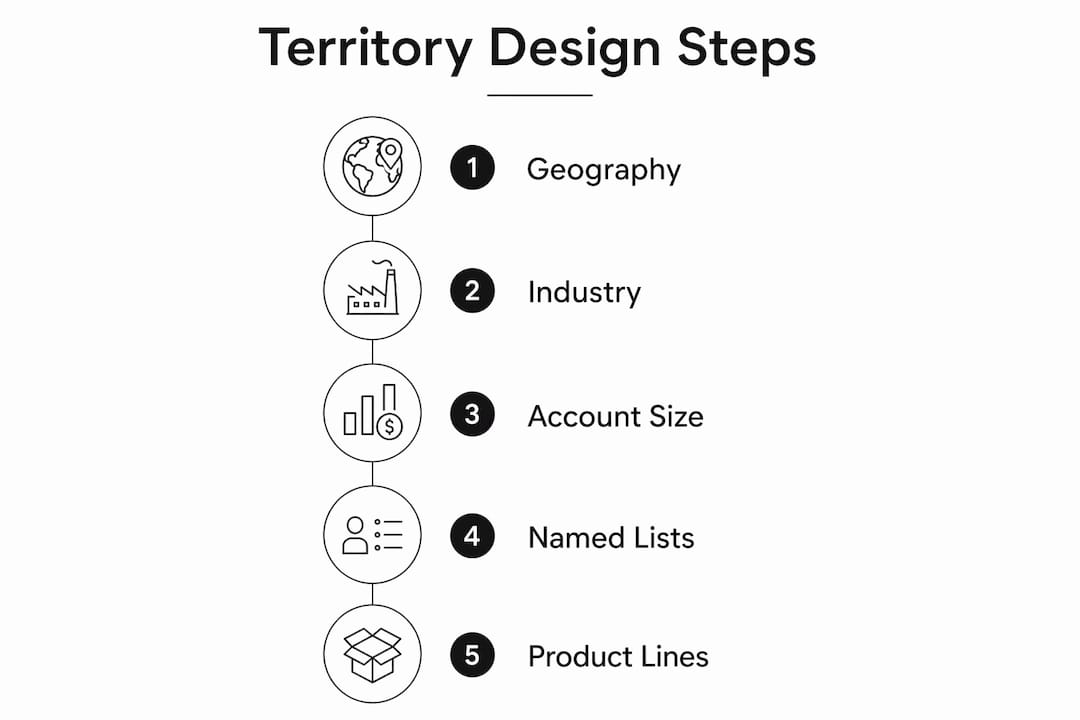
The five most common segmentation methods are geography, industry vertical, account size, named account lists, and product lines. Each has trade-offs.
| Design method | Best suited for | Key trade-off |
|---|---|---|
| Geography | Field sales, real estate, local services | Travel time and density vary widely |
| Industry vertical | B2B enterprise, specialized brokerages | Requires deep domain expertise per rep |
| Account size | Teams with tiered service models | Large accounts can dominate one rep’s time |
| Named account lists | Strategic or enterprise sales | Hard to scale; requires frequent list updates |
| Product line | Multi-product companies | Can create customer confusion with multiple reps |
One critical design principle: a territory with many small accounts is not equivalent to one with a few large accounts. Balance must be built on opportunity value, qualified account count, addressable spend, and pipeline potential. Raw account counts mislead. A rep with 200 small residential listings may carry less real opportunity than a rep with 15 luxury waterfront properties.
Good design also minimizes account overlap, accounts for travel time and time zones, and leaves room for growth as markets expand. A territory that is too tight today becomes a ceiling tomorrow.

Pro Tip: When designing territories for real estate, use actual transaction volume data by zip code or neighborhood, not just listing counts. Volume tells you where the real money moves.
What strategies can sales leaders use to manage and optimize territories?
The single biggest mistake in territory management is treating it as a one-time setup. Static territory assignments create internal conflict and missed opportunity. Markets shift. Reps leave. Ideal Customer Profiles evolve. A territory plan built in january can be obsolete by april.
Treat territory management as a living system. Here is a practical framework for ongoing optimization:
- Conduct a territory audit quarterly. Review rep performance, account coverage, and pipeline by segment. Flag territories where reps are consistently over or under their quota.
- Rebalance when headcount changes. Quarterly rebalancing is the industry standard for teams larger than 20 reps. Smaller teams should rebalance at minimum annually, and immediately after any departure or hire.
- Update your Ideal Customer Profile regularly. As your ICP shifts, some territories become more valuable and others less so. Realign before the gap shows up in your numbers.
- Monitor overlap and conflict signals. When two reps claim the same account, that is a data point. Track it. Patterns reveal design flaws faster than any spreadsheet review.
- Tie territory reviews to your sales planning cycle. Annual planning is the natural moment to redesign. Quarterly business reviews are the moment to adjust.
The best sales leaders treat territory reviews the same way a portfolio manager treats asset allocation. You set a strategy, but you rebalance as conditions change. Waiting for a crisis to trigger a redesign always costs more than proactive adjustment.
Pro Tip: Build a simple territory health scorecard: pipeline coverage ratio, win rate by segment, and rep capacity utilization. Review it monthly. You will spot problems three months before they hit your revenue.
How does territory management integrate with technology and CRM solutions?
Technology does not replace good territory strategy. It enforces it. Territory management software automates balanced account assignments, reduces conflicts, and gives sales leaders real-time visibility into coverage gaps. Without a system of record, even a well-designed territory plan degrades within weeks.
For real estate agents and brokers, CRM integration is where territory management becomes operational. The right CRM setup delivers:
- Automated assignment rules that route new leads to the correct agent based on geography, property type, or price tier, eliminating manual sorting and the conflicts that come with it.
- Real-time territory dashboards that show pipeline by neighborhood, account type, or product line, so leaders see imbalances before they become problems.
- CRM tagging and segmentation that categorizes clients within territories for targeted follow-up. CRM tags let agents filter their book of business by micro-segment and prioritize outreach with precision.
- AI-assisted prospecting that identifies high-probability targets within a defined territory, so agents spend time on the right doors. AI prospecting tools are now a standard part of the territory management stack for top-producing agents.
- Performance analytics by territory that reveal which segments are converting and which are stalling, giving leaders the data to rebalance with confidence rather than gut feel.
The advantages of CRM tools for sales leaders extend well beyond contact management. A properly configured CRM becomes the operating system for your entire territory structure. It enforces rules, surfaces data, and keeps every agent accountable to their defined market.
Key Takeaways
Effective territory management requires clear ownership, data-driven design, and regular rebalancing to prevent coverage gaps and internal conflict from eroding sales performance.
| Point | Details |
|---|---|
| Define territories by buying motion | Align territory dimensions to how customers buy, not just geography or tradition. |
| Balance on opportunity, not account count | Measure territory equity by addressable spend and pipeline potential, not raw numbers. |
| Rebalance at least quarterly | Teams over 20 reps should review and adjust territories every quarter to stay current. |
| Use CRM to enforce territory rules | Automated assignment and tagging prevent conflicts and keep coverage consistent. |
| Treat territory as a living system | Static assignments create gaps and conflict; ongoing adjustment protects revenue. |
What I have learned from watching territory plans succeed and fail
The most common failure I see is not bad design. It is abandonment. A sales leader spends two weeks building a thoughtful territory map, presents it in the kickoff meeting, and then never touches it again. Six months later, two reps are fighting over the same luxury listing, three zip codes have gone untouched, and the leader is confused about why pipeline is uneven.
Territory management only works when someone owns the process, not just the plan. That means a named person reviews the scorecard monthly, flags anomalies, and has the authority to make adjustments without waiting for annual planning. Without that accountability, even the best-designed territory structure drifts into chaos.
The second thing I have learned: technology is an amplifier, not a fix. I have seen teams buy expensive territory management software and still run into the same conflicts because the underlying rules were never clearly defined. The software enforces what you tell it to enforce. If your ICP is vague or your assignment logic is inconsistent, the tool will automate your confusion at scale.
The agents and leaders who get this right share one habit. They segment their leads with discipline, review their territory data regularly, and treat rebalancing as a normal part of operations rather than an admission of failure. That mindset shift, from territory as a fixed map to territory as a living system, is what separates the power brokers from the rest.
— Jason
Territory management tools built for real estate professionals
Knowing how to manage sales territories is one thing. Having the right tools to execute it daily is another.

Plo gives real estate agents, luxury brokers, and sales leaders the prospecting and CRM infrastructure to put territory strategy into practice. From automated lead assignment to neighborhood-level pipeline tracking, the platform is built for agents who want to control their market, not just participate in it. Explore the top prospecting tools Plo recommends for territory-focused agents, or get a full walkthrough of winning clients through prospecting in your defined market. Your territory is your business. Own it.
FAQ
What is the territory management definition in sales?
Territory management is the process of dividing a market into defined segments and assigning each segment to a specific sales rep or team. The goal is full market coverage, clear ownership, and balanced workloads across the sales organization.
Why is territory management important for real estate agents?
Territory management gives agents a defined market to master, preventing wasted effort across too many areas. Agents with clear territories build deeper local knowledge, stronger client relationships, and more consistent pipelines.
How often should sales territories be rebalanced?
Teams larger than 20 reps should rebalance territories at least quarterly to account for rep changes, ICP shifts, and market dynamics. Smaller teams should rebalance at minimum once per year.
What are the most common territory design methods?
The five main methods are geography, industry vertical, account size, named account lists, and product lines. The best method aligns with how your customers actually buy, not with what is easiest to administer internally.
How does CRM software support territory management?
CRM software automates lead assignment by territory rules, tracks pipeline by segment, and surfaces coverage gaps in real time. It enforces territory structure consistently so conflicts and missed accounts are caught before they cost revenue.