

Client nurturing is defined as the proactive, deliberate process of building ongoing relationships with existing clients to maximize their loyalty, spending, and referrals over time. Unlike a single transaction or a reactive support call, client nurturing is a sustained commitment to delivering value between deals. The industry term you will see in CRM literature is “client relationship management,” and client nurturing sits at its most intentional end. Retention boosts profits by 25% to 95% with just a 5% increase in retention rate. That number alone reframes where your energy belongs.
What is client nurturing and why does it matter financially?
Client nurturing is the practice of maintaining deliberate, value-driven contact with existing clients so they stay, spend more, and refer others. Most sales teams treat the signed contract as the finish line. The data says it is the starting line.
Acquiring a new client costs 5 to 7 times more than keeping an existing one. That cost gap makes retention the highest-return activity in your sales budget. The probability of closing a sale with an existing client runs 60% to 70%, compared to just 5% to 20% with a new prospect. Repeat clients also spend 67% more than first-time buyers. These are not marginal differences. They represent a fundamentally different business model.
The importance of client nurturing becomes obvious when you map these numbers to your pipeline. A broker who closes one new deal per month but loses two existing clients is running backward. Nurturing closes that gap by turning your client base into a compounding asset rather than a leaking bucket.
| Metric | Existing clients | New prospects |
|---|---|---|
| Sales close probability | 60%–70% | 5%–20% |
| Relative acquisition cost | 1x (baseline) | 5x–7x higher |
| Average spend vs. new buyers | 67% more | Baseline |
| Profit impact of 5% retention gain | +25% to +95% | N/A |
Pro Tip: Track your client churn rate monthly, not quarterly. A 30-day lag in spotting a drifting client is often the difference between a recovery conversation and a lost account.
How does client nurturing differ from account management?
Client nurturing and account management are complementary but not the same activity. Confusing them is one of the most common mistakes sales teams make, and it leaves serious revenue on the table.
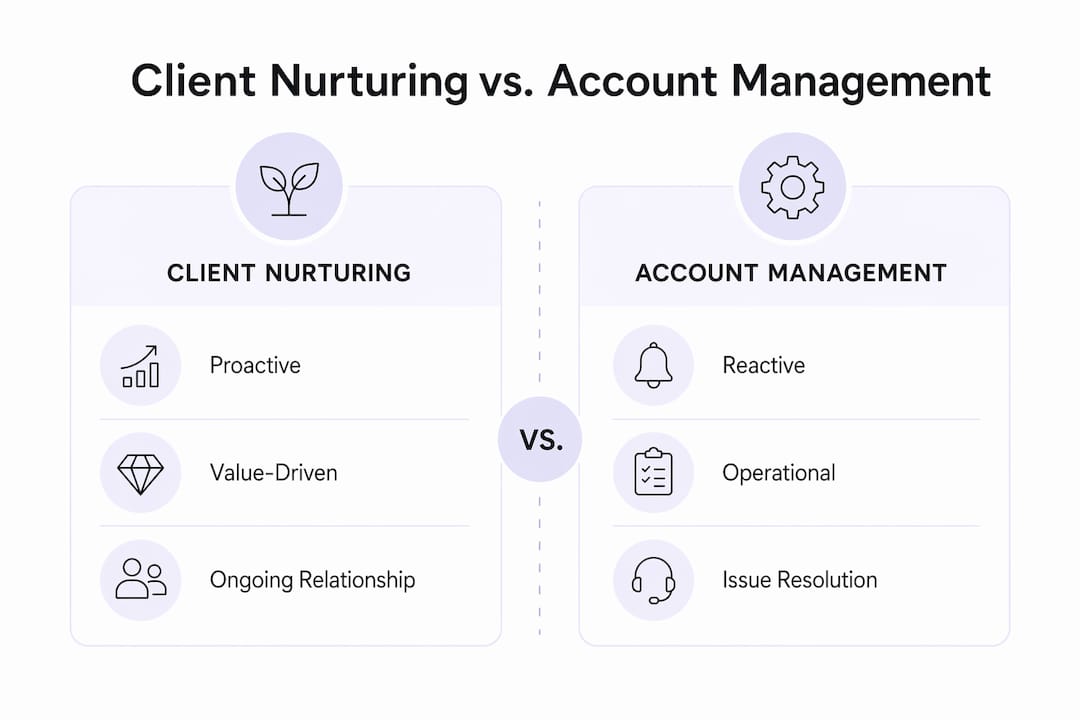
Account management is reactive and operational. It responds to service requests, resolves issues, and manages deliverables. Client nurturing is proactive and strategic. It creates touchpoints that have nothing to do with a current problem or active project. A quarterly business review, a market insight email, or a congratulatory note on a client’s company milestone are all nurturing moves. None of them are account management.
Lead nurturing, by contrast, focuses on prospects who have not yet bought. It moves a potential client through awareness and consideration toward a first purchase. Client nurturing focuses on existing clients and deepens a relationship that already exists. The goal shifts from conversion to expansion and retention.
| Activity | Focus | Nature | Primary goal |
|---|---|---|---|
| Account management | Active clients | Reactive, operational | Deliver on commitments |
| Lead nurturing | Prospects | Proactive, educational | Drive first purchase |
| Client nurturing | Existing clients | Proactive, strategic | Retain, expand, and generate referrals |
Pro Tip: Segment your client list by strategic value before deciding on contact frequency. A top-tier client warrants monthly personal outreach. A smaller account may need a quarterly check-in. Segmentation by client value prevents you from spreading your attention so thin that no one feels prioritized.
Core strategies for nurturing clients effectively
The best practices for nurturing clients share one trait: they are intentional. Random acts of communication do not build loyalty. A structured cadence does.

Personalized communication is the single biggest driver of client loyalty, with 76% of consumers citing it as a key factor. Personalization does not mean using a client’s first name in an email subject line. It means referencing their specific business goals, acknowledging their recent wins, and framing your value in terms of their outcomes. A luxury real estate broker who sends a market report filtered to a client’s target neighborhood demonstrates far more care than one who sends a generic newsletter.
Consistent communication cadence matters because clients have competing priorities and short memories for vendor value. Monthly summaries and quarterly reviews keep your name and your results visible between transactions. Without that cadence, even satisfied clients drift toward whoever contacts them next.
Here are the core tactics that produce results across industries:
- Personalized touchpoints: Reference the client’s specific goals, recent milestones, or industry news relevant to their business.
- Monthly value summaries: Send a brief recap of results, activity, or market insights tied directly to the client’s priorities.
- Quarterly business reviews: Schedule a structured conversation to assess progress, surface new needs, and demonstrate forward thinking.
- Proactive problem-solving: Flag issues before the client notices them. This builds trust faster than any marketing message.
- Feedback loops: Ask for input regularly and act on it visibly. Clients who see their feedback implemented become advocates.
- Referral programs: Simple, well-timed referral mechanisms that make introductions easy can multiply your client base organically through people who already trust you.
- Tiered engagement: Allocate your deepest attention to your highest-value accounts. Use automation for lower-tier clients to maintain presence without burning resources.
High-value account nurturing must be anticipatory. That means demonstrating an understanding of the client’s evolving business before they ask you to. A broker who reaches out with a relevant opportunity before a client even articulates the need has built a relationship that competitors cannot easily disrupt.
Pro Tip: Build a personalized sales pitch for each client tier. A one-size-fits-all message signals that you are not paying attention, and clients notice.
How do you measure client nurturing success?
Client nurturing success is measured through retention rate, expansion revenue, and client satisfaction scores. These three metrics tell you whether your relationships are growing, holding, or eroding.
Retention rate is the most direct signal. If your retention rate drops, your nurturing program has a gap. Expansion revenue, meaning upsells and cross-sells to existing clients, shows whether clients trust you enough to deepen the relationship. Client satisfaction scores, gathered through structured surveys or Net Promoter Score methods, reveal the emotional quality of the relationship before it shows up in revenue numbers.
Common challenges in sustaining client engagement include fading client memory, inconsistent follow-up, and competitive threats. The fix for fading memory is a structured follow-up schedule, not heroic effort. Consistent outreach ensures clients remember your value even when they are not actively buying. For competitive threats, the answer is visibility. A client who hears from you regularly is far less likely to take a competitor’s call seriously.
Service failures are inevitable. The way you handle them determines whether the relationship survives. Organizations with strong service recovery retain 78% of clients even after negative experiences. That figure means a well-handled mistake can actually strengthen a relationship.
Here is a practical recovery sequence:
- Acknowledge the issue directly and without deflection within 24 hours.
- Explain what went wrong in plain language, not corporate language.
- Present a concrete fix with a timeline.
- Follow up after the fix to confirm the client is satisfied.
- Document the failure and update your process to prevent recurrence.
Pro Tip: Use a client relationship management platform to log every client interaction. When a service failure occurs, your history of consistent care gives you credibility that a first-time vendor simply does not have.
Key Takeaways
Client nurturing is the highest-return activity in a sales professional’s toolkit because existing clients close at 60%–70%, spend 67% more, and cost a fraction of what new clients require to acquire.
| Point | Details |
|---|---|
| Define it clearly | Client nurturing is proactive relationship-building with existing clients, not reactive account management. |
| ROI is measurable | A 5% retention gain can boost profitability by 25% to 95%, making nurturing a financial priority. |
| Personalization drives loyalty | 76% of consumers cite personalized communication as a key loyalty factor. |
| Segmentation protects resources | Tier your clients by value and match contact frequency to strategic importance. |
| Recovery builds trust | Strong service recovery retains 78% of clients after negative experiences when handled with speed and transparency. |
Client relationships are living investments, not closed files
I have watched sales professionals spend enormous energy chasing new logos while their existing client base quietly shopped around. The math never made sense to me. You already have the trust. You already know the business. The relationship is the asset, and most people treat it like a closed file once the contract is signed.
What I have found, working with brokers and sales teams across luxury real estate and high-value markets, is that the professionals who build genuinely durable books of business do one thing differently. They treat every client relationship as something that needs tending, not just servicing. They send the market update nobody asked for. They remember the client’s expansion plans from six months ago and circle back. They make the client feel seen between transactions, not just during them.
The uncomfortable truth is that existing client marketing is chronically underleveraged. The obstacle is not knowledge. Every sales professional knows they should stay in touch. The obstacle is intention and consistency. Generic check-ins do not build loyalty. Specific, timely, relevant contact does. If your outreach could have been sent to any client on your list, it will not move the needle for any of them.
Emotional intelligence matters here more than most sales training acknowledges. Knowing when a client is under pressure, when they need reassurance rather than a pitch, and when to simply congratulate them without an agenda. These are the moments that compound into a relationship no competitor can easily replicate.
— Jason
How Plo helps you build a client nurturing system that holds
Real estate agents, yacht brokers, and luxury sales professionals face a specific challenge: their client cycles are long, their deals are high-stakes, and a single lapsed relationship can cost six figures in lost commission.

Plo is built for exactly this environment. The platform gives you the tools to maintain a consistent communication cadence, segment your clients by value, and surface the right touchpoint at the right moment. Whether you need to automate monthly market summaries or track every interaction with a top-tier account, Plo keeps your relationships visible and your pipeline moving. Explore top prospecting tools that pair with a strong nurturing system, or see how Plo supports your full sales pipeline from first contact to long-term retention.
FAQ
What is client nurturing in simple terms?
Client nurturing is the ongoing practice of building and maintaining relationships with existing clients through personalized, consistent communication. The goal is to keep clients loyal, increase their spending, and generate referrals.
How does client nurturing differ from lead nurturing?
Lead nurturing targets prospects who have not yet purchased, while client nurturing focuses on existing clients to deepen loyalty and drive repeat business. The strategies overlap but the audience and goals are distinct.
What are the most effective client nurturing tactics?
Personalized outreach, monthly value summaries, quarterly business reviews, and proactive problem-solving are the most effective tactics. Segmentation by client value ensures your best resources go to your highest-priority accounts.
How do you measure whether client nurturing is working?
Track retention rate, expansion revenue from upsells, and client satisfaction scores. A rising retention rate combined with growing expansion revenue confirms your nurturing program is producing results.
Can client nurturing recover a damaged relationship?
Yes. Organizations with strong service recovery retain 78% of clients after negative experiences. The key is speed, transparency, and a visible fix that demonstrates you take the relationship seriously.