

Lead nurturing, known in marketing operations as a structured prospect engagement process, is the systematic practice of delivering targeted, behavior-driven communications that move leads from first contact to signed contract. In real estate and luxury sales, mastering this process is the difference between a pipeline that converts and one that quietly leaks. Research shows it takes an average of eight touchpoints to secure a first sales meeting, yet 44% of salespeople stop after one attempt. That gap is where your competitors lose and where you win. This guide walks you through lead nurturing step by step, from foundational setup to campaign optimization, with every stage built for high-value transactions.
What are the essential prerequisites for effective lead nurturing?
Effective lead nurturing begins before you send a single message. The foundation is accurate segmentation, and skipping it is expensive. 73% of buyers actively avoid suppliers whose outreach feels irrelevant to their situation. In luxury real estate, where a single deal can represent years of relationship-building, irrelevant outreach does not just annoy prospects. It ends conversations permanently.
Data capture and tagging
Every lead entering your CRM needs four data points captured at intake: traffic source, first interaction type, role or buyer profile, and transaction size range. These fields drive every downstream decision. A yacht broker prospect who downloaded a marina investment report requires a completely different sequence than a residential buyer who clicked a Facebook ad for a beachfront listing. Without clean intake data, your automation fires the wrong message to the wrong person.
CRM capabilities you actually need
Not every CRM handles luxury or real estate workflows well. The platforms that support this process effectively share three traits: dual lead scoring (separate fields for fit and engagement), behavioral trigger automation, and sales handoff documentation. HubSpot covers all three and integrates with tools like Sendspark for personalized video. Salesforce handles enterprise-level segmentation. For agents who want something purpose-built, Plo’s platform at ex.plo.re is designed specifically for real estate and luxury broker workflows.
| Platform | Best For | Behavioral Triggers | Video Integration | Dual Scoring |
|---|---|---|---|---|
| HubSpot | Mid-size teams | Yes | Via Sendspark | Yes |
| Salesforce | Enterprise brokerages | Yes | Via third-party | Yes |
| Plo (ex.plo.re) | Real estate and luxury brokers | Yes | Built-in | Yes |
| Zoho CRM | Budget-conscious agents | Partial | Via third-party | Partial |
Pro Tip: Run a data audit before launching any nurture sequence. Duplicate contacts, missing source tags, and unscored leads are the most common reasons campaigns underperform in the first 30 days.
How to build a lead nurturing sequence step by step
The step by step lead nurturing process follows five defined stages. Each stage has a specific goal, a content type, and a trigger that moves the lead forward. Rushing through stages or skipping them entirely is the single most common failure point in real estate sales pipelines.
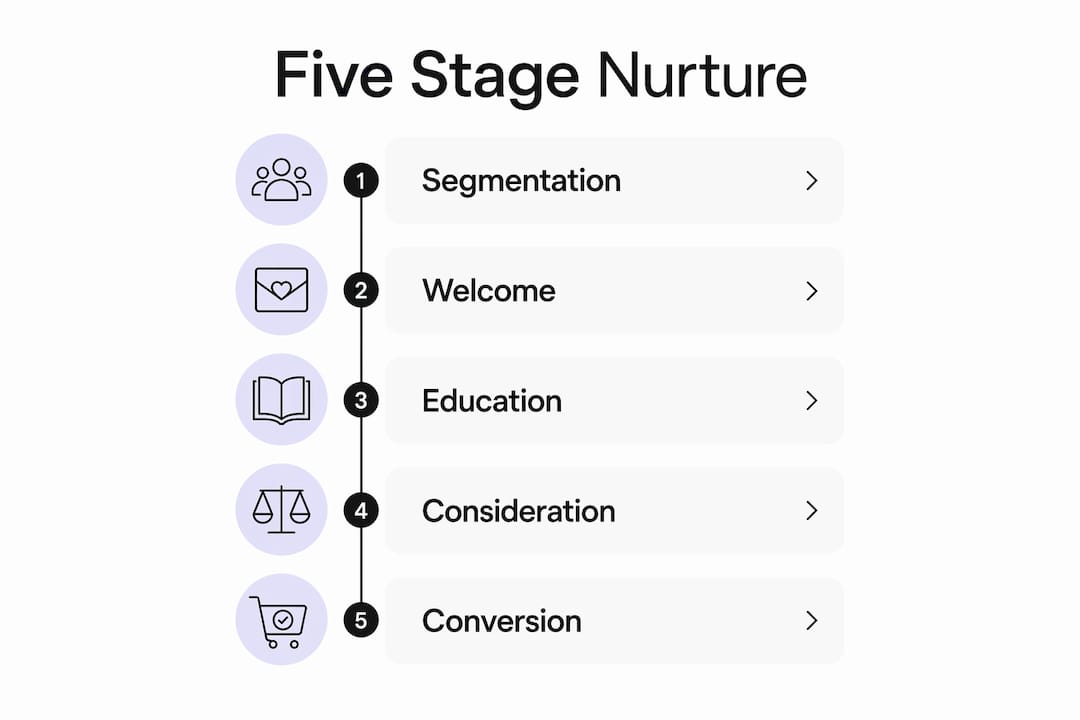
The five-stage nurture framework
Stage 1: Segmentation. Before any message goes out, assign each lead to a persona bucket. Residential buyer, commercial investor, luxury rental client, and yacht or aircraft buyer each require distinct content tracks. This is not optional. Tailoring messages to buying roles directly improves engagement and conversion rates.

Stage 2: Welcome sequence. The first 72 hours after a lead enters your pipeline carry the highest intent. Send 3 messages over the first 3 days. Message one is a personalized introduction. Message two delivers immediate value, such as a neighborhood market report or a curated listing preview. Message three is a soft call to action. Personalized welcome videos in this sequence increase engagement by 3x compared to text-only emails.
Stage 3: Education. Over weeks two through four, shift to content that builds authority. Case studies of similar transactions, ROI breakdowns for investment properties, and market trend reports all work well here. The goal is to position you as the expert before the prospect is ready to buy.
Stage 4: Consideration. At this stage, leads are evaluating options. Send comparison content, testimonials from past clients in similar situations, and property-specific data. This is where behavioral triggers become critical. Triggered sequences that fire when a lead revisits a listing page or re-opens an email outperform calendar-based follow-ups because they respond to actual intent signals.
Stage 5: Conversion and sales handoff. When a lead hits your engagement threshold, the sequence shifts to direct outreach. The sales rep receives a full behavioral summary: which pages the lead visited, which emails they opened, and what content they engaged with most. Referencing that specific recent action in the first outreach message lifts reply rates by 4x.
Timing and cadence
Front-load your sequence. Send 3–5 targeted messages in the first two weeks when intent is highest, then taper to weekly or biweekly contact to maintain awareness without burning out your prospect. Spacing out follow-ups over a longer timeline builds trust, which matters enormously in luxury sectors where decision cycles run 6–18 months.
Critical mistakes to avoid:
- Sending generic outreach with no reference to the lead’s source or behavior
- Stopping follow-up after one or two touches when the average deal requires eight
- Using the same sequence for every persona regardless of role or transaction type
- Triggering sales handoff too early before the lead reaches a meaningful engagement score
- Neglecting to document behavioral context for the sales rep at handoff
Pro Tip: When your sales rep’s first message references the lead’s last specific action, such as “I saw you revisited the Pacific Heights listing yesterday,” reply rates increase 4x over generic intros. Build this context into your handoff template.
How to personalize outreach for multiple buyer personas
Real estate and luxury transactions rarely involve a single decision-maker. A commercial property acquisition might involve a CFO evaluating financing, an operations manager assessing logistics, and an owner focused on brand positioning. Each person needs a different message, even though they are all part of the same deal.
Persona-based content mapping
Separate scoring for fit and engagement prevents your team from wasting time nurturing a lead who looks active but is fundamentally the wrong buyer. Fit score measures whether the prospect matches your ideal client profile. Engagement score measures how actively they are interacting with your content. A high-engagement, low-fit lead should not receive the same sales attention as a high-fit, moderate-engagement prospect.
| Persona | Primary Concern | Content Type | Best Channel |
|---|---|---|---|
| Investor/CFO | ROI, cap rate, financing terms | Market data, ROI reports | Email, LinkedIn |
| Owner/Principal | Brand, exclusivity, lifestyle | Visual listings, case studies | Email, Instagram |
| Operations Manager | Logistics, timelines, process | Checklists, process guides | Email, phone |
| First-time luxury buyer | Trust, education, reassurance | Video walkthroughs, FAQs | Email, text |
For real estate buyer personas, the most effective approach layers channels in sequence. Start with email to establish context. Follow with LinkedIn for professional credibility. Then move to phone once engagement signals confirm readiness. Jumping straight to phone without prior digital engagement is the fastest way to lose a luxury prospect’s trust.
What metrics and monitoring optimize lead nurturing campaigns?
Tracking the right numbers tells you where leads are dropping off and which sequences are actually working. Most agents track open rates and stop there. That is not enough.
The metrics that matter most in a real estate nurture campaign:
- Open rate: Baseline health check. Below 20% signals a subject line or list quality problem.
- Click-through rate: Measures content relevance. Low clicks on high opens means your content is not matching the promise of your subject line.
- Engagement score progression: Are leads moving up in score over time, or stalling at the same stage?
- Conversion to sales meeting: The ultimate measure of nurture effectiveness. Track this by sequence and persona.
- Time in stage: Leads sitting in the same stage for more than 30 days without movement need a re-engagement trigger, not more of the same content.
Detecting and addressing nurture fatigue
Nurture fatigue shows up as declining open rates over consecutive sends, increased unsubscribes, and zero click activity despite continued opens. When you see these signals, reduce frequency before you lose the lead entirely. Spacing out touches is not a sign of weak follow-up. It is a sign of respect for the buyer’s timeline, which luxury clients notice and appreciate.
For cold leads who have gone silent, re-engagement sequences that combine a direct video email with a fresh piece of high-value content revive 12–18% of cold prospects. That is a meaningful return on a segment most agents have already written off.
Pro Tip: Set a 45-day inactivity alert in your CRM. Any lead with zero engagement after 45 days automatically enters a re-engagement track with a personalized video and a new content offer. Do not let cold leads die quietly.
Key Takeaways
Effective lead nurturing in real estate and luxury sales requires a five-stage behavioral sequence, dual lead scoring, and documented handoff context to convert high-value prospects consistently.
| Point | Details |
|---|---|
| Eight touchpoints are the baseline | Most deals require eight contacts before a meeting; stopping early is the primary conversion killer. |
| Segment before you send | Irrelevant outreach drives 73% of buyers away; accurate persona tagging prevents this from the start. |
| Front-load the first two weeks | Send 3–5 messages early when intent is highest, then taper to avoid fatigue in long sales cycles. |
| Behavioral triggers beat calendars | Sequences triggered by real actions like page visits outperform scheduled sends at every stage. |
| Document context at handoff | Sales reps who reference specific lead actions in their first message see 4x higher reply rates. |
Why most nurture campaigns fail before they even start
I have reviewed hundreds of real estate and luxury broker pipelines, and the pattern is almost always the same. The campaign looks right on paper: a welcome email, a few follow-ups, maybe a listing update. But the results are flat because the sequence is built around the agent’s calendar, not the buyer’s behavior.
The uncomfortable truth is that most nurture campaigns are really just broadcast schedules dressed up as strategy. They send the same message to every lead on the same day regardless of what that lead actually did last week. A prospect who just revisited your $4.2 million listing for the third time in five days does not need your monthly newsletter. They need a direct, personalized message that acknowledges exactly what they are looking at.
The other failure I see constantly is the handoff. Marketing builds a solid sequence, scores the lead, and then passes a name and an email address to the sales rep with zero behavioral context. The rep calls cold, the prospect feels like a number, and the deal evaporates. Documenting every behavioral trigger in the CRM before handoff is not extra work. It is the work.
Luxury buyers and serious real estate investors have long decision cycles and high expectations. They will not tolerate generic outreach, and they will reward patience and relevance with loyalty. The agents who win in this market are the ones who treat nurturing as a long-term relationship investment, not a short-term conversion tactic.
— Jason
Take your nurturing further with Plo
If you are ready to move beyond manual follow-ups and build a pipeline that works while you focus on closing, Plo is built for exactly that. The platform combines prospecting, CRM, and multi-channel automation in one place, purpose-built for real estate agents, yacht brokers, and luxury sales professionals.
Plo’s tools handle segmentation, behavioral triggers, and sales handoff documentation so your team always has the context they need to convert. Explore top prospecting tools for real estate to see how the right stack changes your conversion numbers. If you want a complete view of how automation fits into your sales cycle, the real estate sales cycle guide is a strong next step. Your next client is already in your pipeline. The question is whether your nurture process is good enough to close them.
FAQ
What is lead nurturing in real estate?
Lead nurturing in real estate is the process of delivering targeted, timed communications to prospects across multiple touchpoints until they are ready to transact. It typically follows a five-stage sequence from segmentation through to sales handoff.
How many touchpoints does it take to get a meeting?
Research shows it takes an average of eight touchpoints to secure a first sales meeting, yet 44% of salespeople stop after just one contact.
What is the best cadence for a nurture sequence?
Front-load with 3–5 messages in the first two weeks when prospect intent is highest, then taper to weekly or biweekly contact to maintain presence without triggering fatigue.
How do behavioral triggers improve nurturing?
Behavioral triggers fire messages in response to real prospect actions like revisiting a listing or reopening an email. This approach outperforms calendar-based sends because it reaches leads at moments of genuine interest.
How do I re-engage cold leads?
A re-engagement sequence combining a personalized video email with a fresh, high-value content offer revives 12–18% of cold leads, making it one of the most cost-effective tactics in any nurture program.