

Sales enablement is defined as the process of equipping sales teams with the content, training, tools, and data they need to engage buyers effectively and close deals consistently. It is not a single tactic or a content library. It is a strategic alignment of marketing, sales, and operations around a shared goal: improving win rates, shortening sales cycles, and increasing sales velocity. For real estate professionals and business leaders who want measurable revenue growth, understanding this discipline is the first step toward building a team that performs at a higher level every quarter.
What is sales enablement and why does it matter?
Sales enablement is the practice of giving every sales rep the right resource at the right moment in the buyer’s journey. That means scripts, whitepapers, product sheets, email templates, and continuous coaching delivered in a way that builds confidence and consistency across the team. The goal is not to micromanage activity. It is to remove friction so reps spend more time selling and less time searching for materials or guessing at objections.
The importance of sales enablement becomes clear when you look at what happens without it. Reps onboard slowly, content lives in scattered folders, and managers coach inconsistently. The result is a wide performance gap between your top producers and everyone else. A well-built enablement program narrows that gap by giving every rep access to the same knowledge and tools your best performers already use instinctively.

Sales enablement also creates a feedback loop between marketing and sales. Marketing learns which content actually moves deals forward. Sales gets materials built around real buyer objections rather than brand messaging. That alignment alone changes the quality of every client conversation your team has.
What does sales enablement do to improve team effectiveness?
The core function of sales enablement is reducing the time it takes for a rep to become fully productive. Onboarding programs built on enablement principles use structured certifications, role-play scenarios, and coached practice rather than passive reading. Reps reach quota faster because they practice real conversations before they have them.
Beyond onboarding, enablement supports reps throughout the entire sales cycle:
- Content delivery: Reps receive relevant case studies, objection-handling guides, and proposal templates tied to specific deal stages.
- Ongoing coaching: Managers use call recordings and performance data to coach on specific behaviors, not just outcomes.
- Buyer interaction quality: Reps learn to ask better discovery questions and present solutions that match the buyer’s stated priorities.
- Objection handling: Structured playbooks give reps tested responses to the most common pushbacks, reducing lost deals from avoidable friction.
The result is a team that increases quota attainment and reduces ramp-up time, two metrics that directly affect revenue.
Pro Tip: Record your top performer’s best discovery call and use it as the benchmark for every new rep’s certification. Real examples outperform scripted training every time.
What are the four pillars of an effective sales enablement strategy?
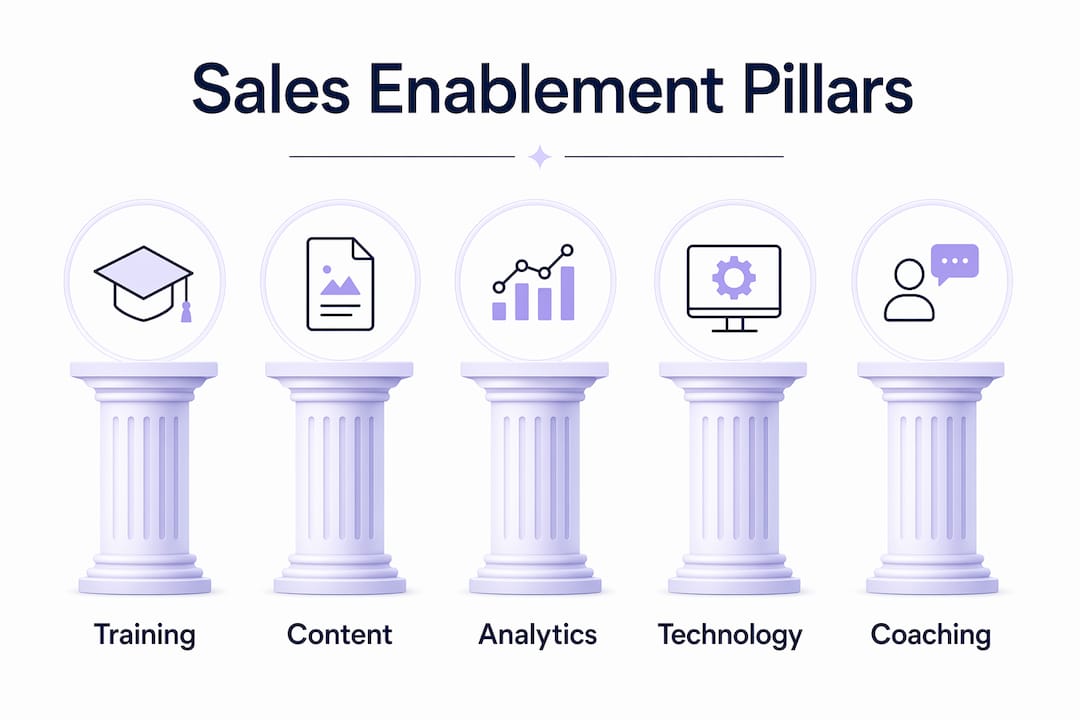
An effective enablement strategy rests on four pillars. Each one supports the others. Weakness in any single pillar limits the whole program.
- Training and coaching: Structured onboarding, ongoing skill development, and manager-led coaching sessions tied to real deal data. This is not a one-time event. It is a continuous cycle.
- Centralized content management: A single, organized repository where reps find approved materials by deal stage, buyer persona, or product line. Reps who cannot find content in under two minutes will stop looking and improvise.
- Data-driven analytics: Tracking which content gets used, which training modules correlate with higher win rates, and where deals stall in the pipeline. Analytics turn enablement from a cost center into a measurable growth function.
- Integrated technology: Tools embedded directly into the workflows reps already use, particularly CRM systems, so adoption happens naturally rather than requiring a behavior change.
| Pillar | Primary outcome |
|---|---|
| Training and coaching | Faster ramp-up, higher quota attainment |
| Centralized content | Less time searching, more consistent messaging |
| Data-driven analytics | Measurable link between enablement and revenue |
| Integrated technology | Higher adoption, continual learning culture |
Each pillar compounds the others. Strong content without analytics means you never know what works. Great analytics without integrated technology means reps ignore the insights. All four working together create a program that improves itself over time.
How to implement sales enablement efficiently
The most common reason enablement programs fail is poor cross-departmental alignment. Without a unified content taxonomy, reps waste time searching for materials, marketing creates assets nobody uses, and operations never connects training to pipeline outcomes. Alignment must come first.
A practical implementation follows this sequence:
- Audit existing content: Identify what exists, what is outdated, and what gaps exist by deal stage and buyer objection.
- Align on taxonomy: Marketing, sales, and operations agree on how content is labeled, organized, and updated. One naming system, one location.
- Embed into CRM: Training embedded in CRM workflows gets used. Separate learning management systems with low adoption rates do not. Put enablement where reps already work.
- Launch with a pilot cohort: Test the program with a small group of reps before rolling out company-wide. Collect feedback, fix gaps, then scale.
- Treat it as iterative: Enablement is not a project with a launch date and a close date. It is an ongoing function that updates as your market, buyers, and products change.
The biggest mistake leaders make is treating enablement as a one-time initiative. You build the content library, run the training, and declare success. Six months later, the content is stale, the training is forgotten, and the team is back to improvising. Sustainable enablement requires a dedicated owner and a regular review cycle.
Pro Tip: Assign a sales enablement specialist to own content relevance and coaching cadence. Without a named owner, the program drifts. A dedicated specialist with strong communication skills keeps the program alive and improving.
For real estate teams, CRM integration is particularly critical. Agents who access scripts, property data, and follow-up templates directly inside their CRM close more deals because they never break their workflow to search for resources.
How to measure and optimize sales enablement success
Sales velocity is the most meaningful benchmark for enablement success. It measures how quickly leads convert to closed deals and reflects the combined effect of win rate, deal size, and cycle length. Counting the number of training sessions completed or content pieces published tells you nothing about revenue impact.
The metrics that matter are:
| Metric | What it measures |
|---|---|
| Time to quota | How fast new reps reach full productivity |
| Win rate | Percentage of deals closed from opportunities created |
| Sales cycle length | Average days from first contact to closed deal |
| Content adoption | Which materials reps actually use in live deals |
| Sales velocity | Overall speed at which pipeline converts to revenue |
The distinction between vanity metrics and meaningful KPIs is critical. A high number of training completions means nothing if win rates stay flat. Reducing sales cycle length and increasing win rates are the outcomes that justify the investment in enablement.
Use analytics to connect specific enablement activities to business outcomes. If reps who complete a particular objection-handling module close 20% more deals, that module becomes mandatory. If a content asset has zero adoption, retire it or rebuild it. Let data drive every decision.
Pro Tip: Review your enablement metrics quarterly, not annually. Markets shift fast, especially in real estate. Quarterly reviews let you catch content gaps and coaching failures before they show up as missed revenue targets. Plo’s data analytics tools make this review cycle practical for agents and brokers.
What tools and technologies support modern sales enablement?
Sales enablement platforms centralize content, track engagement, and deliver training in one place. The best platforms integrate directly with CRM systems so reps access everything without switching applications. Key features to look for include:
- Content repositories: Organized by deal stage, buyer type, and product line with version control so reps always use current materials.
- Engagement analytics: Data on which content buyers actually open and spend time with, not just what reps send.
- Training delivery: Embedded modules, video coaching, and certification tracking tied to real performance data.
- CRM integration: Native connection to your existing sales workflow so adoption is automatic, not forced.
- Automation and AI assistance: Automated content recommendations based on deal stage and buyer behavior, reducing the cognitive load on reps.
The right technology does not replace good coaching or strong content. It makes both more accessible and more consistent. A rep in the field should be able to pull up the right case study, the right objection response, and the right follow-up template in under 30 seconds. If your current tools cannot deliver that, your enablement program has a technology gap. For real estate professionals, outreach tools that integrate with prospecting workflows are particularly valuable for maintaining consistency across a high-volume pipeline.
Key Takeaways
Sales enablement drives revenue growth by aligning training, content, analytics, and technology into one continuous process that shortens sales cycles and raises win rates across the entire team.
| Point | Details |
|---|---|
| Core definition | Sales enablement equips reps with content, training, tools, and data to close deals consistently. |
| Four pillars | Training, centralized content, analytics, and integrated technology all work together. |
| Implementation priority | Embed enablement inside CRM workflows to maximize adoption and continual learning. |
| Right metrics | Track sales velocity, win rate, and cycle length, not training completions or content volume. |
| Ongoing commitment | Treat enablement as a continuous function with a named owner, not a one-time project. |
Why most enablement programs stall before they deliver results
I have watched well-funded enablement programs collapse within a year, and the cause is almost always the same. Leadership treats it like a product launch. There is a kickoff, a content build, a training rollout, and then everyone moves on. Six months later, nobody can tell you whether win rates improved.
The programs that actually work share one trait: they are owned, not launched. Someone wakes up every Monday thinking about content relevance, coaching quality, and metric trends. That person is not a passive administrator. They are a performance driver who sits at the intersection of marketing, sales, and operations.
The second thing I have noticed is that teams obsess over content volume and ignore content quality. A library of 200 assets nobody uses is worse than 20 assets every rep knows by heart. Curation beats accumulation every time.
The third failure point is measuring the wrong things. If your quarterly enablement report leads with “training hours completed,” you are measuring effort, not impact. Sales velocity, win rate, and time to quota are the numbers that tell you whether your program is working. Everything else is noise.
My honest recommendation: start smaller than you think you need to. Build three or four genuinely excellent content assets, embed them in your CRM, coach on them weekly, and measure the outcome. Prove the model works at small scale, then expand. The teams that try to build everything at once end up with a bloated program that nobody trusts.
— Jason
Plo gives you the tools to put enablement into practice
Real estate agents and luxury brokers do not need a generic enablement platform. They need tools built for the way they actually work: high-touch relationships, local market knowledge, and a fast-moving pipeline where every conversation counts.

Plo brings together prospecting, CRM integration, and performance analytics in one place so your team spends less time searching for resources and more time in front of clients. Whether you are building your first enablement program or tightening an existing one, the right foundation starts with the right tools. Explore Plo’s top prospecting tools to see how real estate professionals are shortening their sales cycles and winning more listings today.
FAQ
What is the sales enablement definition?
Sales enablement is the process of providing sales teams with the content, training, tools, and data they need to engage buyers effectively and close deals consistently. It aligns marketing, sales, and operations around shared revenue goals.
What does sales enablement do for a sales team?
Sales enablement reduces ramp-up time, improves buyer interaction quality, and increases quota attainment by giving reps structured coaching, relevant content, and integrated technology at every stage of the sales cycle.
What are the most important sales enablement metrics?
Sales velocity, win rate, sales cycle length, and time to quota are the metrics that reflect real business impact. Content adoption shows which materials reps actually use in live deals.
How does a sales enablement specialist support the team?
A sales enablement specialist develops training content, manages the content repository, and coaches reps on best practices. Strong communication and presentation skills are the core requirements for the role.
How does sales enablement differ from sales training?
Sales training is a component of enablement, focused on skill development. Sales enablement is the broader system that includes training, content management, technology integration, and performance analytics working together continuously.