

A sales playbook is defined as the operating manual that translates your sales strategy into repeatable, step-by-step instructions every rep can follow on any deal. Think of it as the difference between handing a new hire a map versus handing them a GPS with turn-by-turn directions. The best playbooks cut new hire ramp time from 90 days down to 30. Without one, your top rep’s hard-won instincts stay locked in their head, and every new team member starts from scratch. If you’re a sales leader or business owner asking what is a sales playbook and whether you actually need one, the answer is yes, and the sooner you build it, the faster your team scales.
What key components make up an effective sales playbook?
A well-built sales playbook covers every stage of the selling cycle with specific, usable content. Not theory. Not inspiration. Actual instructions your reps can pull up mid-call.
The core sections every playbook needs include:
- Ideal Customer Profile (ICP): Who you sell to, including firmographics, pain points, and buying triggers
- Qualification criteria: The MEDDIC or BANT framework your team uses to score deal quality
- Discovery questions: A curated list of 10–15 questions that surface real buyer needs
- Demo flow: A stage-by-stage walkthrough tied to specific buyer outcomes
- Objection handling: Scripted responses to the top 5–7 objections your reps hear every week
- Pricing and packaging guidance: When to discount, what approvals are needed, and how to frame value
- Contract motion: Steps from verbal agreement to signed paper, including legal handoffs
Effective playbooks define what to know, show, do, and say at each stage, anchored to how buyers actually make decisions. That buyer-first structure is what separates a playbook that drives results from one that collects dust.
Length matters more than most leaders realize. Early-stage playbooks should stay between 10 and 20 pages. Longer documents get ignored after the first week. A 60-page PDF is not a playbook. It is a filing cabinet.

Pro Tip: Test your playbook’s usability by asking a rep to answer “What do I do next?” at three different points in a live deal. If they can’t find the answer in under 30 seconds, the playbook needs to be tighter.
How does a sales playbook differ from a sales process?
Confusing a sales process with a sales playbook is one of the most common mistakes sales leaders make. The two are not interchangeable, and treating them as the same weakens execution consistency across your team.
The sales process defines the stages a deal moves through and the criteria required to advance it. The playbook defines exactly how to execute at each of those stages. One is the skeleton. The other is the muscle.
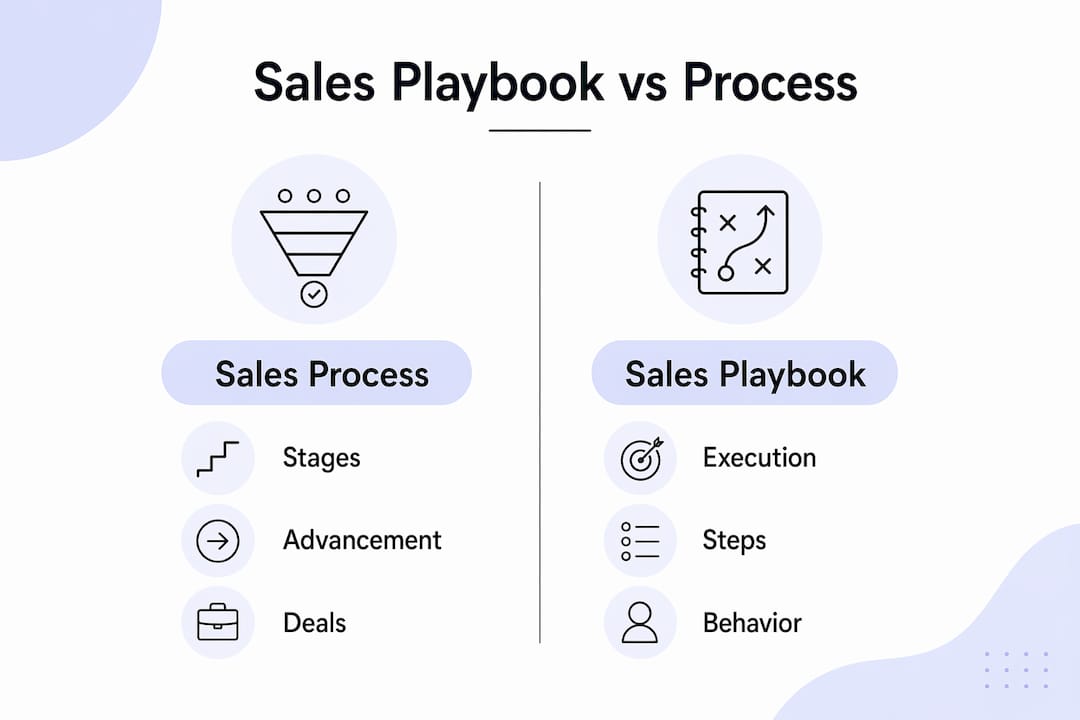
| Element | Sales process | Sales playbook |
|---|---|---|
| What it defines | Deal stages and advancement criteria | How to execute at each stage |
| Primary function | Structure and qualification | Tactics, scripts, and plays |
| Without it | Deals lack structure | Reps lack consistent execution |
| Analogy | The skeleton | The muscle |
| Update frequency | Quarterly or annually | Ongoing, based on deal data |
A team with a process but no playbook knows when to advance a deal. They just don’t know how to get there. A team with a playbook but no process has great tactics and zero structure to apply them in. You need both. The process sets the rules of the game. The playbook tells your reps how to win it.
How to build and maintain a sales playbook that stays relevant
Building a playbook too early is a common and costly mistake. Wait until you have closed 10–20 deals across two or three ICP variations before writing a single page. That deal volume gives you enough pattern recognition to base the playbook on what actually works, not what you hope will work.
Here is the process that produces a playbook built to last:
- Run post-deal analysis. Review your closed-won and closed-lost deals side by side. Identify the questions that surfaced real pain, the objections that killed deals, and the moments where buyers accelerated. These patterns become your playbook’s foundation.
- Document the winning motion. Write down exactly what your best rep does at each stage. Not a summary. The actual questions, the actual talk tracks, the actual next steps they propose.
- Test with real reps before launch. Hand a draft to two or three account executives and ask them to use it on live deals. Their friction points reveal gaps faster than any internal review.
- Integrate into onboarding. New hires should work through the playbook during their first two weeks, not as reading material but as a live exercise with role-plays and deal simulations.
- Schedule quarterly reviews. Markets shift. Buyer objections evolve. A playbook that was accurate in january may be outdated by april. Assign a specific owner to update it every quarter based on recent deal data.
Pro Tip: Before your quarterly review, pull your last 10 closed-lost deals and look for a pattern. If the same objection appears in more than three of them and your playbook doesn’t address it, that’s your first update.
Post-deal pattern recognition consistently outperforms theory-based content when it comes to real-world deal navigation. Reps trust content that mirrors what they actually encounter in the field.
What are the measurable benefits and common pitfalls of sales playbooks?
The benefits of a sales playbook are concrete and measurable. The most cited is onboarding speed. A well-executed playbook reduces ramp time from 90 days to 30. That is two months of productive selling recovered per new hire.
Beyond onboarding, the benefits include:
- Consistent deal advancement: Every rep follows the same qualification and discovery process, so pipeline data becomes reliable
- Faster coaching: Managers can identify exactly where a rep is deviating from the proven motion instead of diagnosing from scratch
- Scalable knowledge transfer: Founder-led sales knowledge converts into a repeatable framework that survives team growth and turnover
- Improved win rates: Reps who follow a buyer-aligned playbook close more deals because they advance opportunities the way buyers actually want to buy
The pitfalls are just as real. The most dangerous one is the absence of an enforcement mechanism.
“Playbooks without active enforcement mechanisms decay in effectiveness within 60 to 90 days.” Without manager-led pipeline reviews and deal-level coaching, a playbook becomes advisory rather than infrastructure.
The second pitfall is length. A 50-page playbook signals that the author wrote for completeness, not usability. Reps will not reference it under pressure. The third pitfall is treating the playbook as a one-time project. Static content becomes wrong content. Markets change, buyers change, and your playbook must change with them.
How can sales leaders practically implement a sales playbook?
Adoption is where most playbooks fail. Writing a great document is the easy part. Getting your team to use it every day is the real work.
Here is how to build adoption from day one:
- Embed it in onboarding. New reps should complete structured exercises from the playbook during their first two weeks. Role-plays, mock discovery calls, and objection drills tied directly to playbook content build muscle memory before they ever talk to a real buyer.
- Use it in pipeline reviews. Every weekly pipeline review should reference the playbook. When a deal stalls, the manager’s first question should be “Which play did you run?” That question alone changes rep behavior.
- Integrate with your CRM. Playbooks integrated with CRM platforms give reps instant access to the right talk track or objection response during multi-channel selling. Accessibility drives usage.
- Measure adoption, not just outcomes. Track whether reps are following the qualification criteria, running the correct discovery questions, and using the defined next-step language. Outcome data tells you if the playbook works. Adoption data tells you if reps are actually using it.
- Assign a playbook owner. Someone on the leadership team must own the playbook’s accuracy and relevance. Without a named owner, updates never happen and the document drifts out of date within a quarter.
Behavior change and accessibility are the two factors that determine whether a playbook becomes infrastructure or shelf-ware. Build for both from the start.
For real estate agents and luxury brokers, the playbook also needs to address closing deal specifics unique to high-value transactions, including how to handle multi-stakeholder decisions and long sales cycles.
Key Takeaways
A sales playbook is only as valuable as its enforcement mechanism. Without active use in pipeline reviews, onboarding, and coaching, even the best-written playbook decays within 60–90 days.
| Point | Details |
|---|---|
| Definition matters | A sales playbook translates strategy into step-by-step instructions, distinct from a sales process. |
| Build on real data | Wait for 10–20 closed deals before writing. Base content on post-deal pattern recognition, not theory. |
| Keep it concise | Early-stage playbooks should be 10–20 pages. Longer documents get ignored after the first week. |
| Enforce actively | Integrate the playbook into pipeline reviews and onboarding, or it decays within 60–90 days. |
| Assign ownership | Name a specific person to update the playbook quarterly based on recent deal data and market shifts. |
Why most sales playbooks fail before they even get used
I’ve seen this pattern more times than I can count. A sales leader spends six weeks building a genuinely good playbook. It covers the ICP, the objections, the discovery questions. It’s well-organized and clearly written. Then it gets shared in a Slack channel, everyone says “great work,” and within 30 days nobody is referencing it.
The failure is almost never the content. It’s the absence of a ritual that makes the playbook part of how the team operates. The managers who get this right do one thing differently: they make the playbook the language of every pipeline conversation. When a deal stalls, they don’t ask “what happened?” They ask “which play did you run, and where did it break down?” That question forces the rep to engage with the playbook as a tool, not a document.
The other thing I’ve learned is that playbooks built from real deal data earn rep trust in a way that theory-based playbooks never do. When a rep reads an objection response and thinks “that’s exactly what my last buyer said,” they use it. When they read something that sounds like it was written by someone who hasn’t been on a call in three years, they ignore it. The sales scripts that convert are always the ones pulled from real conversations.
Build from the field up. Enforce through ritual. Update on a schedule. That’s the whole formula.
— Jason
Plo helps you put your playbook into action
A sales playbook tells your team what to do. The right tools make sure they can do it at scale, on every deal, without dropping the ball between touchpoints.

Plo is built for real estate agents, luxury brokers, and yacht brokers who want to run a tighter sales operation. From prospecting tools that surface qualified leads to CRM workflows that keep every deal moving, Plo puts your playbook’s best practices into the daily rhythm of your team. You’ve done the work of defining how to sell. Plo makes sure that work shows up in every client interaction, not just the ones your top rep handles.
FAQ
What is a sales playbook in simple terms?
A sales playbook is an operating manual that gives your sales team specific instructions for every stage of a deal. It covers who to target, what to say, how to handle objections, and how to close.
How long should a sales playbook be?
Early-stage playbooks should be 10–20 pages. Documents longer than that are rarely used by reps after the first week, which defeats the purpose entirely.
How is a sales playbook different from a sales process?
The sales process defines deal stages and advancement criteria. The playbook defines how to execute at each stage. One provides structure; the other provides tactics.
When should you build your first sales playbook?
Build your playbook after closing 10–20 deals across two or three ICP variations. That deal volume gives you the pattern recognition needed to base the content on what actually works.
How do you stop a sales playbook from becoming outdated?
Assign a named owner and schedule quarterly reviews tied to recent deal data. Playbooks without an active enforcement mechanism and regular updates decay within 60–90 days.