

A closing deal checklist is a structured, step-by-step tool that guides sales professionals through every action required to finalize a business agreement without missing critical legal, operational, or relational steps. Think of it as the difference between winging a high-stakes presentation and walking in with a rehearsed plan. The best closers in real estate, B2B sales, and luxury brokerage don’t rely on memory or instinct alone. They use a repeatable framework, and a well-built checklist turns a signed agreement into a fully executed transfer by covering documents, money movement, and operational handoff in one disciplined sequence.
What key documents and approvals must be in a closing deal checklist?
The Asset Purchase Agreement, or APA, sits at the center of any business sale closing. But the APA alone does not close a deal. Third-party consents and payoff mechanics must be confirmed in advance, including landlord approvals, franchisor sign-offs, and key vendor or customer consents. Missing even one of these can delay funding by days or kill the deal entirely.
Beyond the APA, your checklist for closing deals must include ancillary agreements such as non-competes, employment agreements, and transition service agreements. Working-capital calculations need to be finalized and agreed upon before the closing date, not on it. Reps and warranties, indemnification clauses, and escrow instructions all require review and sign-off from both legal teams. Confirming good corporate standing and proper signing authority for each party is not a formality. It is a legal requirement that, when skipped, has voided closings at the last hour.

Pro Tip: Start assembling your essential closing documents at least three weeks before the target close date. Late document requests are the single most common cause of closing delays.
| Document | Responsible Party |
|---|---|
| Asset Purchase Agreement (APA) | Buyer and seller legal counsel |
| Third-party consents (landlord, franchisor) | Seller with broker support |
| Payoff and lien release letters | Seller’s lender and escrow agent |
| Working-capital schedule | CFO or financial advisor |
| Board or authority approvals | Corporate counsel for each entity |
How do you operationalize your sales closing process?
Effective sales closing depends on four things: recognizing timing, selecting the right technique, handling objections, and following through. Operationalizing this as a repeatable process increases closure rates and makes your pipeline predictable. The best sales professionals treat closing not as a single moment but as a series of confirmed micro-commitments.
Here is a numbered sequence that converts your closing strategy into a repeatable process:
- Confirm prospect readiness. Look for verbal buying signals, repeated questions about implementation, or requests for pricing specifics.
- Select your closing technique. Match the technique to the buyer. Use the assumptive close for confident, decisive buyers. Use the summary close for analytical buyers who need to see the full picture laid out.
- Run a pre-close test. Confirm authority, verify value clarity, and surface any remaining objections before asking for the signature.
- Handle final objections. Address concerns directly with evidence, case studies, or adjusted terms. Do not skip past them.
- Secure the commitment. Get a signed agreement, a deposit, or a dated next step. Verbal agreements are not closed deals.
- Hand off to customer success. Immediately schedule the intro call and transfer account knowledge before marking the deal closed-won.
CRM platforms like monday.com support this sequence by tracking each step, assigning owners, and triggering automated follow-up reminders. Without a system enforcing these steps, even experienced reps let deals drift. No universal closing line exists. Effective closing means selecting the right technique per prospect and timing, not recycling the same script on every call.
What are the critical steps for executing deal closure day?
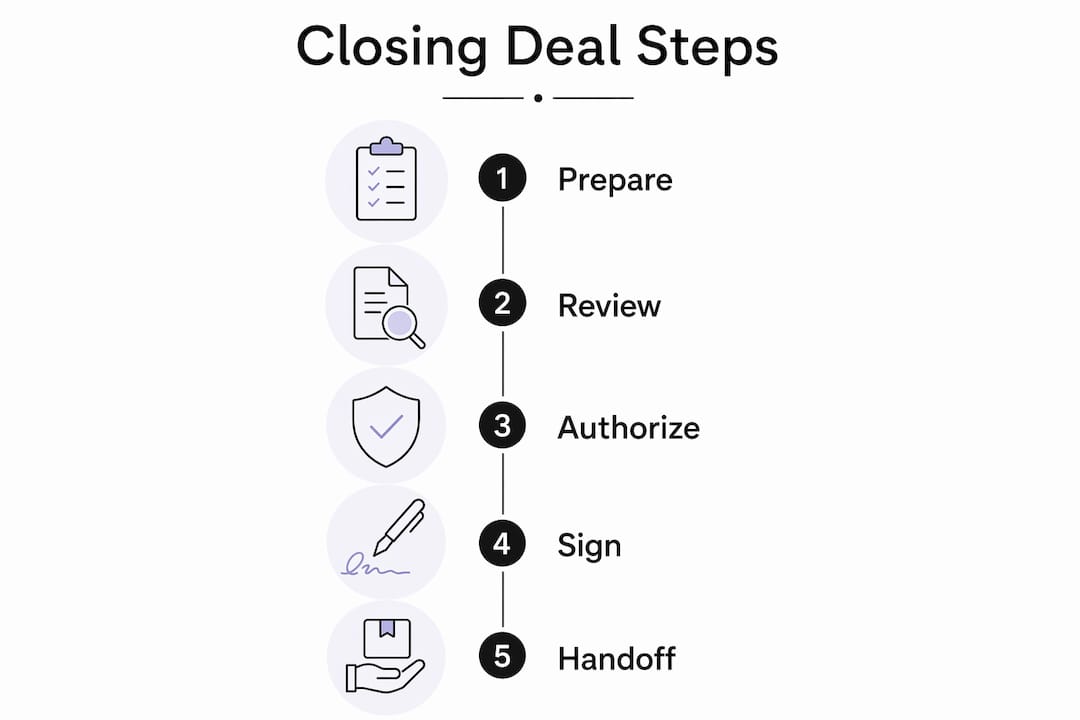
Closing day is not the time to discover that wiring instructions are unconfirmed or that a signature page is missing. A dry-run closing checklist the day before significantly reduces last-minute errors and increases confidence across your entire team. Script the day like a run-of-show: who signs what, in what order, and who confirms receipt of funds.
M&A transactions routinely track 50 to 200 individual deliverables in a document known as the closing bible. This means that even a mid-market deal can have dozens of moving parts that need status tracking, not just a mental note. Assign an owner and a deadline to every item. Unassigned deliverables are the ones that cause stalls.
Pro Tip: Build a post-close punch list before closing day. Identify which operational items, such as credential transfers and vendor notifications, will happen in the 72 hours after signing. This prevents the common “we’ll figure it out later” trap.
Key closing day checklist items:
- Confirm wiring instructions in writing with the escrow agent or closing attorney
- Verify all signature pages are prepared and distributed to the correct parties
- Confirm all third-party consents are received and on file
- Check that payoff letters are current and not expired
- Confirm access credentials, keys, and system logins are ready for transfer
- Send pre-drafted vendor and employee communications for release post-signing
- Assign one person to track fund receipt and confirm closing with all parties
How do you handle objections and authority challenges before closing?
Late-stage deal failures most often trace back to insufficient mapping of decision-makers and unresolved authority questions. A prospect who says “I need to run this by my partner” on closing day is a discovery failure, not a closing failure. The pre-close checklist exists to catch this before it costs you the deal.
Run a three-point pre-close test before every closing attempt. First, confirm who has final signing authority and whether they are present or reachable. Second, verify that the prospect can clearly articulate the value they expect from the agreement. Third, surface any objection that has not been fully resolved. If any of these conditions are not met, return to discovery rather than forcing a signature. A forced close that unravels costs far more time than a deliberate pause.
| Closing technique | Best used when |
|---|---|
| Assumptive close | Buyer has shown strong intent and few objections |
| Summary close | Analytical buyer needs full value recap before deciding |
| Urgency close | Genuine deadline or limited availability exists |
| Question close | Buyer is hesitant; you need to surface the real objection |
| Concession close | Deal is stalled on a specific term that can be adjusted |
High-quality early discovery is the foundation of closing success. Objections that surface at the close were almost always visible earlier in the sales cycle. The sales professionals who close consistently are the ones who surface and resolve those objections weeks before the signing date.
What does a strong post-deal handoff checklist look like?
The moment of true closed-won status is not the signature. It is the completion of a written handoff brief and a scheduled three-way intro call between the account executive, the customer success manager, and the client. Skipping this step is the fastest path to early churn, regardless of how clean the close was.
A structured handoff brief covers six areas: why the client bought, the people map on the client side, agreed success metrics, known landmines or sensitivities, commercial terms and renewal dates, and a defined first-90-days plan. This is not optional documentation. It is the mechanism that transfers institutional knowledge from sales to the team responsible for delivering on the promise.
Practical handoff checklist items every sales professional should enforce:
- Complete the written handoff brief before marking any deal closed-won
- Schedule the three-way intro call within 48 hours of signing
- Transfer all relevant notes, call recordings, and email threads to the CRM
- Confirm success metrics are documented and shared with the client
- Set a 30-day check-in on the calendar before the handoff call ends
- Flag any known risks or sensitivities for the customer success team in writing
- Assign a dated next step so the account does not go dark post-close
Visible, dated next steps on every deal reduce pipeline drift and keep the post-close momentum alive. The real estate sales cycle mirrors this dynamic closely. Agents who hand off poorly lose referrals. Agents who hand off well build a client base that sells for them.
Key takeaways
A closing deal checklist works because it converts a complex, multi-party process into a tracked sequence of owned deliverables, reducing errors, preventing stalls, and protecting the value of every deal you close.
| Point | Details |
|---|---|
| Documents must be assembled early | Start gathering essential closing documents at least three weeks before the target date. |
| Assign owners to every deliverable | Unassigned checklist items are the primary cause of deal stalls and closing delays. |
| Pre-close test before every attempt | Confirm authority, value clarity, and objection resolution before asking for the signature. |
| Handoff brief is non-negotiable | Mark deals closed-won only after the written handoff brief and intro call are complete. |
| Dry-run closing day in advance | Script signing logistics, wiring confirmation, and deliverable status the day before closing. |
Why I stopped treating closing as a moment and started treating it as a project
I have watched deals fall apart on closing day that had no business falling apart. The agreement was solid, the relationship was strong, and both parties wanted to sign. What killed them was process. A missing consent letter. A wiring instruction that nobody confirmed. A customer success team that had never heard the client’s name before the handoff call.
The shift that changed everything for me was treating closing as a project management exercise, not a sales performance. Every item gets an owner. Every item gets a deadline. Nothing is assumed to be “handled.” That discipline feels bureaucratic until the day it saves a seven-figure deal because someone checked the payoff letter expiration date 48 hours before funding.
The other thing I would tell any sales professional reading this: tailor your checklist to your deal type. A luxury real estate transaction has different closing mechanics than a B2B SaaS contract. The luxury sales checklist for a high-end property involves title work, escrow timelines, and real estate closing steps that simply do not apply to a software deal. Build your checklist from the ground up for your specific context, not from a generic template.
The professionals who close consistently are not the ones with the best pitch. They are the ones with the best process.
— Jason
How Plo helps you close more deals with less friction
Plo is built for the professionals who refuse to leave deals to chance. Whether you are a real estate agent managing multiple transactions or a luxury broker coordinating complex closings, Plo gives you the tools to track every deal closure step, assign ownership, and automate follow-ups so nothing slips.

From prospecting through to post-close handoff, Plo amplifies the work you are already doing. The platform integrates task tracking, CRM data, and team coordination into one place, so your closing process runs on discipline, not memory. Explore Plo’s top prospecting tools and see how the right technology turns your checklist into a competitive advantage.
FAQ
What is a closing deal checklist?
A closing deal checklist is a structured list of legal, financial, and operational steps required to finalize a business agreement. It covers documents, approvals, money movement, and post-close handoff to prevent errors and delays.
What documents are required to close a deal?
Core documents include the Asset Purchase Agreement, third-party consents, payoff and lien release letters, working-capital schedules, and board or authority approvals. Each document should have a named owner and a confirmed deadline.
How do you handle last-minute objections before closing?
Run a pre-close test to confirm signing authority, value clarity, and objection resolution before attempting to close. If any condition is unmet, return to discovery rather than forcing a signature that may unravel.
When is a deal officially closed-won?
A deal is closed-won when the written handoff brief is complete and a three-way intro call between the account executive, customer success manager, and client is scheduled. A signed contract alone does not constitute a complete close.
How many deliverables does a typical closing checklist include?
M&A transactions commonly track between 50 and 200 individual deliverables in a closing bible. Even smaller deals benefit from a status-tracked checklist with assigned owners rather than a static document.