

Local lead sourcing is defined as the process of identifying, attracting, and qualifying potential clients within a specific geographic area through targeted, multi-channel outreach. For real estate agents, yacht brokers, and small business sales professionals, this guide to local lead sourcing is the difference between a pipeline that trickles and one that flows. Platforms like Google Business Profile and LeadZap have made geographic targeting more precise than ever. The agents who win locally are not the ones spending the most on ads. They are the ones with the sharpest lists, the fastest follow-up, and the discipline to show up across every relevant channel.
What are the most effective local lead sourcing methods today?
Cold email outreach remains one of the highest-ROI methods for local prospecting. Personalized sequences generate 35–50% open rates with reply rates between 3% and 8%. Those numbers beat most paid channels at a fraction of the cost.
The cost difference is significant. B2B paid ads average $198 per lead, nearly five times the cost of a well-run cold email campaign. That gap matters when you are working a defined territory and need volume without burning your budget.
The most effective local lead generation tips combine multiple channels rather than relying on one:
- Cold email sequences with personalized subject lines tied to local triggers (a new listing, a neighborhood sale, a recent permit filing)
- LinkedIn outreach targeting decision-makers by geography, job title, and company size
- Direct mail for high-value segments where physical presence signals credibility
- Phone follow-up layered into email sequences to increase response rates
- Account-Based Marketing (ABM) for targeting specific firms or property owners with tailored messaging
Account-Based Marketing deserves special attention. ABM achieves a 15–25% meeting rate compared to just 1–3% for generic outreach. That is not a marginal improvement. It is a structural advantage for agents who specialize in a defined niche or neighborhood.
Specializing in 2–3 industries or property types builds the kind of credibility that makes your outreach land differently. Generic messaging gets deleted. Specific messaging gets replies.
Pro Tip: Use AI-native prospecting tools to build your initial list, then layer in manual research on your top 20 targets. The combination of scale and personalization is what separates average outreach from outreach that books meetings.

How do you build a qualified local lead list?
A qualified local lead list starts with a precise Ideal Customer Profile (ICP). Your ICP should define firmographic criteria like business size, property type, transaction history, and geographic radius, plus behavioral triggers like recent moves, permit activity, or listing expirations.
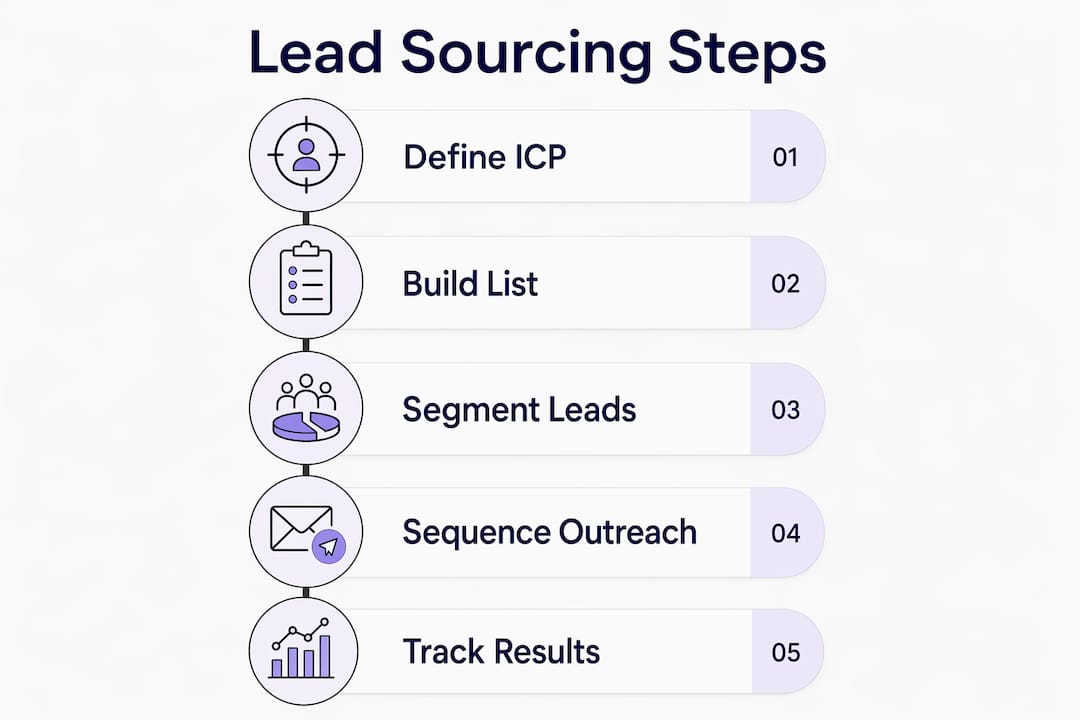
Once your ICP is defined, build your list around verified data points. A strong local lead list includes business name, verified email, direct phone number, website URL, Google ratings, and social media presence. Each data point serves a purpose: email for outreach, Google ratings for personalization hooks, social presence for LinkedIn targeting.
Here is a practical build sequence:
- Define your ICP with at least five firmographic criteria and two behavioral triggers
- Source raw data using tools like LeadZap, Google Maps scraping, or local business directories
- Verify contact data with email validation tools to reduce bounce rates
- Enrich profiles with Google ratings, LinkedIn URLs, and recent activity signals
- Score and segment leads into hot, warm, and cold tiers based on fit and intent
Segmenting leads into hot, warm, and cold categories focuses your sales energy where it converts fastest. Hot leads get immediate personal outreach. Warm leads enter a nurture sequence. Cold leads receive lower-touch automated touches until they signal intent.
| Lead Tier | Criteria | Recommended Action |
|---|---|---|
| Hot | Strong ICP fit, recent trigger event, verified contact | Personal call or email within 24 hours |
| Warm | Good ICP fit, no immediate trigger, engaged with content | Automated sequence with personal follow-up at touch 3 |
| Cold | Partial ICP fit, no trigger, unverified contact | Low-touch nurture sequence, re-evaluate quarterly |
Pro Tip: Never send a cold email to an unverified address. A high bounce rate damages your sender reputation and tanks deliverability for your entire domain. Verify every list before you launch.
Why does multi-channel outreach improve local conversion rates?
Single-channel outreach is the most common mistake in local prospecting. Email-only outreach misses 40–60% of potential conversations. The fix is not more emails. It is more channels.
Prospects contacted across three or more channels are three times more likely to convert than those reached through a single channel. That multiplier compounds when your sequencing is deliberate rather than random.
A proven local outreach sequence looks like this:
- Day 1: Personalized cold email referencing a local trigger (a recent sale, a neighborhood development)
- Day 3: LinkedIn connection request with a brief, relevant note
- Day 5: Follow-up email with a specific value offer or case study
- Day 8: Phone call during business hours with a clear, short voicemail
- Day 12: Final email with a direct ask and an easy opt-out
“Most deals require 5–8 touchpoints across email, phone, and LinkedIn to close. Skipping channels or reducing touches leaves substantial pipeline on the table.” — LeadZap Blog
Most leads close after 5–8 touchpoints, yet most salespeople abandon pursuit after one or two attempts. That gap is your competitive advantage. The agents who stay in the sequence win the deals that everyone else walked away from.
CRM attribution matters here. Every channel touch should be logged and attributed so you know which sequences produce the best results in your specific market. Without that data, you are optimizing blind. Tools like a well-configured CRM paired with call tracking software give you the feedback loop to tighten your sequence over time. You can explore multi-channel prospecting workflows built specifically for local client acquisition.
What pitfalls kill local lead sourcing results?
The most common failure in local lead sourcing is not a traffic problem. Local traffic is rarely the issue. The real problem is what happens after a lead arrives: slow routing, vague landing pages, and zero source tracking.
The pitfalls that consistently degrade results:
- No source attribution: If you cannot identify which channel produced a lead, you cannot scale what works or cut what does not
- Vague landing pages: A page that says “Contact us for more information” converts far worse than one that says “Get a free home valuation for your [City] property in 48 hours”
- Slow lead routing: Routing leads within 15 minutes during business hours dramatically improves conversion because local buyers choose the first credible responder
- No niche focus: Broad messaging dilutes your authority and reduces reply rates
- Over-qualifying early: Spending 20 minutes researching a cold lead before sending the first email kills volume and momentum
The fix for most of these is structural. Set up CRM source tracking before you launch any campaign. Build landing pages specific to each local market or property type. Create a routing rule that flags new leads for same-day contact. These are not complex changes. They are discipline decisions.
Pro Tip: Before you increase your ad spend or expand your outreach volume, audit your contact forms, call tracking setup, and CRM source fields. Wasting budget on untracked traffic is the fastest way to burn your pipeline budget with nothing to show for it.
How does local lead sourcing fit into a broader sales pipeline?
Local lead sourcing does not operate in isolation. It feeds a pipeline that needs both immediate wins and long-term inbound momentum. The proven sequence is outbound first, inbound second: run outbound campaigns to generate near-term pipeline while building inbound content over 12–18 months to reduce dependence on cold outreach.
The metric that matters most is not total web traffic. Tracking “booked pipeline by location” gives you a far more actionable read on what is working in each market. Pair that with CRM source attribution and you have a feedback loop that tells you exactly where to invest next.
| Channel | Speed to Pipeline | Cost Efficiency | Long-Term Scalability |
|---|---|---|---|
| Cold email outreach | Fast (days) | High | Moderate |
| Paid local ads | Fast (days) | Low ($198/lead avg.) | Low without optimization |
| Referral programs | Moderate (weeks) | Very high | High |
| Inbound content (SEO) | Slow (12–18 months) | High over time | Very high |
| ABM campaigns | Moderate (weeks) | High for niche targets | Moderate |
Referrals deserve more attention than most agents give them. A referred lead arrives with built-in trust, converts faster, and costs almost nothing to acquire. Building a formal referral program, even a simple one with a thank-you process and a follow-up system, turns your existing clients into your best local lead generation asset.
Paid ads have a role, but they should amplify a working system, not substitute for one. Before increasing ad spend, confirm your website clarity, contact forms, and call tracking are all connected to your CRM. Otherwise, you are paying for traffic that disappears without a trace.
Key takeaways
Effective local lead sourcing requires a qualified list, multi-channel sequencing, fast lead routing, and CRM tracking to convert geographic demand into consistent pipeline.
| Point | Details |
|---|---|
| Multi-channel outreach triples conversion | Prospects reached across three or more channels convert at three times the rate of single-channel contacts. |
| Segment leads into tiers | Hot, warm, and cold segmentation focuses your effort on the highest-value prospects first. |
| Speed of response wins deals | Routing leads within 15 minutes during business hours significantly improves local conversion rates. |
| Track pipeline by location | “Booked pipeline by location” is more useful than total traffic for measuring local sourcing performance. |
| Outbound first, inbound second | Launch outbound campaigns for near-term results while building inbound content for sustainable 12–18 month growth. |
What i have learned about local lead sourcing the hard way
I have watched agents spend thousands on Google Ads, generate dozens of leads, and close almost nothing. The problem was never the traffic. It was the 48-hour callback window, the generic landing page, and the zero-touch follow-up after the first email went unanswered.
The agents who consistently win locally share one habit: they treat their lead list like a living asset, not a one-time export. They update it, segment it, and work it across multiple channels with the patience to run 7 or 8 touches before writing off a prospect. Most of their competitors quit at touch two.
The other thing I have seen consistently underestimated is niche specialization. An agent who owns a specific neighborhood or property type in the minds of local buyers does not need to outspend the competition. They just need to show up with the right message to the right list at the right time. That is not a technology problem. It is a strategy problem.
My honest advice: before you add another tool or channel, get your CRM source tracking right. Know exactly which outreach produced which lead. That single discipline will tell you more about where to invest your next dollar than any marketing playbook ever will. The role of automation in your sales process is to amplify a system that already works, not to paper over one that does not.
— Jason
Build your local pipeline with the right tools
Plo is built for real estate agents, yacht brokers, and luxury sales professionals who want to stop guessing and start closing. The platform combines prospecting data, outreach sequencing, and CRM integration into one workflow so you spend less time building lists and more time booking meetings.
If you are ready to put the strategies in this article to work, Plo gives you the tools to do it at scale. From top prospecting tools compared side by side to a full client acquisition workflow designed for local markets, the resources are ready when you are. Take control of your local pipeline today.
FAQ
What is local lead sourcing in real estate?
Local lead sourcing is the process of identifying and qualifying potential clients within a defined geographic area using targeted outreach, data tools, and multi-channel contact strategies. It prioritizes lead quality and geographic relevance over raw volume.
How many touchpoints does it take to close a local lead?
Most deals require 5–8 touchpoints across email, phone, and LinkedIn before closing. Salespeople who stop after one or two attempts miss the majority of available deals.
What is the best channel for local lead generation?
No single channel outperforms a coordinated multi-channel approach. Cold email delivers the best cost efficiency, but combining it with LinkedIn and phone follow-up triples conversion likelihood compared to email alone.
How do i qualify local leads effectively?
Build a lead scoring framework based on your Ideal Customer Profile, then segment contacts into hot, warm, and cold tiers. Prioritize leads with verified contact data, recent trigger events, and strong ICP alignment for immediate outreach.
Why are my local leads not converting?
Conversion issues most often stem from slow lead routing, vague landing pages, and missing CRM source tracking rather than insufficient traffic volume. Fix your follow-up process and attribution before increasing spend.