

Most real estate agents believe reaching more people means winning more business. The logic seems sound. Cast a wider net, get more bites. But digital marketing drives 70% more local real estate conversions than broad, untargeted campaigns. That single number rewrites the strategy entirely. Local lead generation is not a limitation. It is your greatest competitive advantage. This guide breaks down what local lead generation actually means, why it outperforms generic approaches, which channels deliver results, and how to build lasting client relationships from the ground up.
Table of Contents
- Understanding local lead generation in real estate
- The business case: Why local leads outperform other sources
- Best channels and strategies for local lead generation
- Turning local leads into long-term client relationships
- Most agents underestimate the power of neighborhoods
- Take your local lead generation further
- Frequently asked questions
Key Takeaways
| Point | Details |
|---|---|
| Local leads convert faster | Clients from your immediate area are more likely to act quickly and choose you over a distant competitor. |
| Higher return on investment | Focusing on local lead generation delivers better results with less wasted time and marketing spend. |
| Digital tools boost results | Modern platforms make it easier than ever to attract and manage local leads efficiently. |
| Nurturing builds loyalty | Turning local leads into long-term clients creates a dependable pipeline of referrals and repeat business. |
Understanding local lead generation in real estate
Before you can master something, you need to define it clearly. Local lead generation in real estate is the intentional process of attracting potential buyers and sellers who are actively searching within a specific geographic area where you operate and hold expertise. It is not about reaching everyone. It is about reaching the right people.
“Local leads are clients actively seeking agents or properties in a defined area.” That specificity is what makes them so valuable.
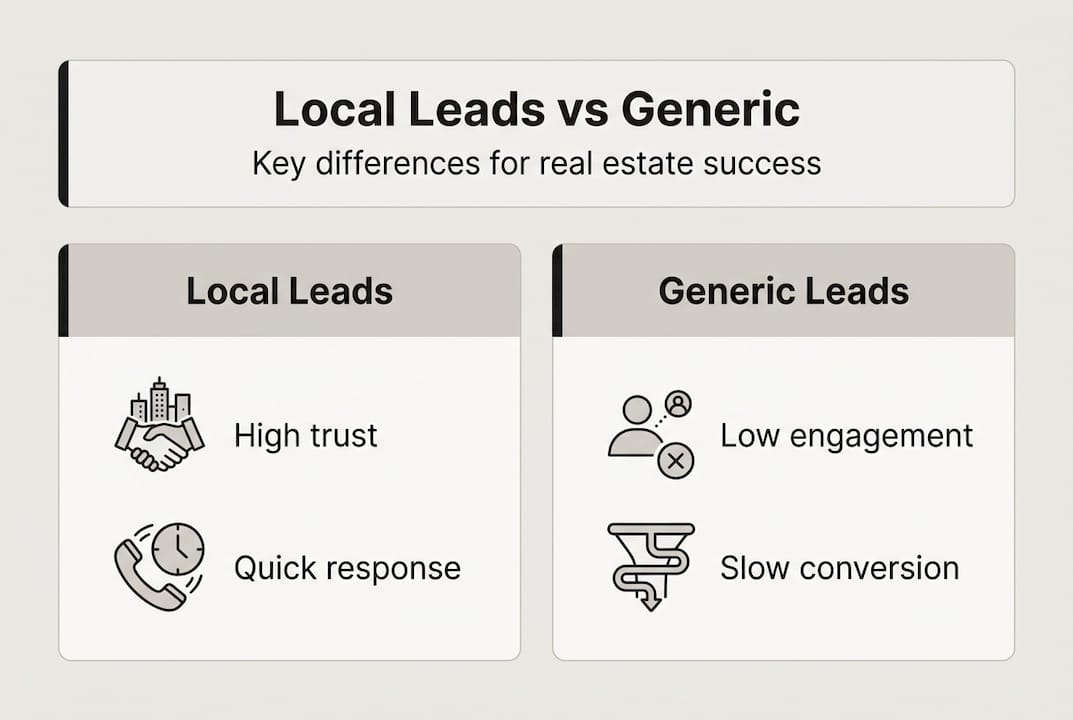
Generic online leads come from mass advertising platforms with broad targeting. These prospects may be browsing casually, comparing dozens of agents across multiple cities, or simply not ready to act. Local leads, by contrast, already know the neighborhood. They have a defined intent. They are further along in their decision-making process, which means your conversations start closer to the finish line.
Local reputation also compounds over time in a way that paid digital ads simply cannot. When you become the recognized expert in a specific market, referrals flow naturally. Past clients recommend you to their friends and family. Local businesses send clients your way. That network effect is nearly impossible to build when you are spreading your energy across too many markets at once.
Here is what sets local leads apart from other types of real estate leads:
- Higher purchase intent: They are searching for a specific area, not just browsing.
- Faster closing timelines: Less time spent qualifying and more time spent negotiating.
- Built-in trust: Local familiarity breeds credibility before you even make contact.
- Stronger referral potential: Satisfied local clients refer neighbors, colleagues, and friends.
- Lower competition: Fewer agents are competing for hyper-local attention compared to national portals.
For agents serious about attracting local real estate clients, the neighborhood becomes the business unit. Your goal is not just to close a deal. It is to own a market’s mindshare.
The business case: Why local leads outperform other sources
Let’s talk numbers and real outcomes. Local leads are not just strategically smart. They are measurably better for your bottom line.
| Lead Source | Average Conversion Rate | Average Time to Close | Trust Level |
|---|---|---|---|
| Local referrals | 12 to 18% | 30 to 45 days | Very high |
| Community events | 8 to 12% | 45 to 60 days | High |
| Local SEO leads | 6 to 10% | 45 to 75 days | Medium-high |
| Generic online portals | 1 to 3% | 90 to 180 days | Low |
The gap is stark. When you focus locally, you compete less and convert more. That is the formula every broker should be chasing.
Statistic spotlight: Digital marketing drives 70% more conversions for local real estate leads compared to broad national campaigns. That lift is not marginal. It is transformative.
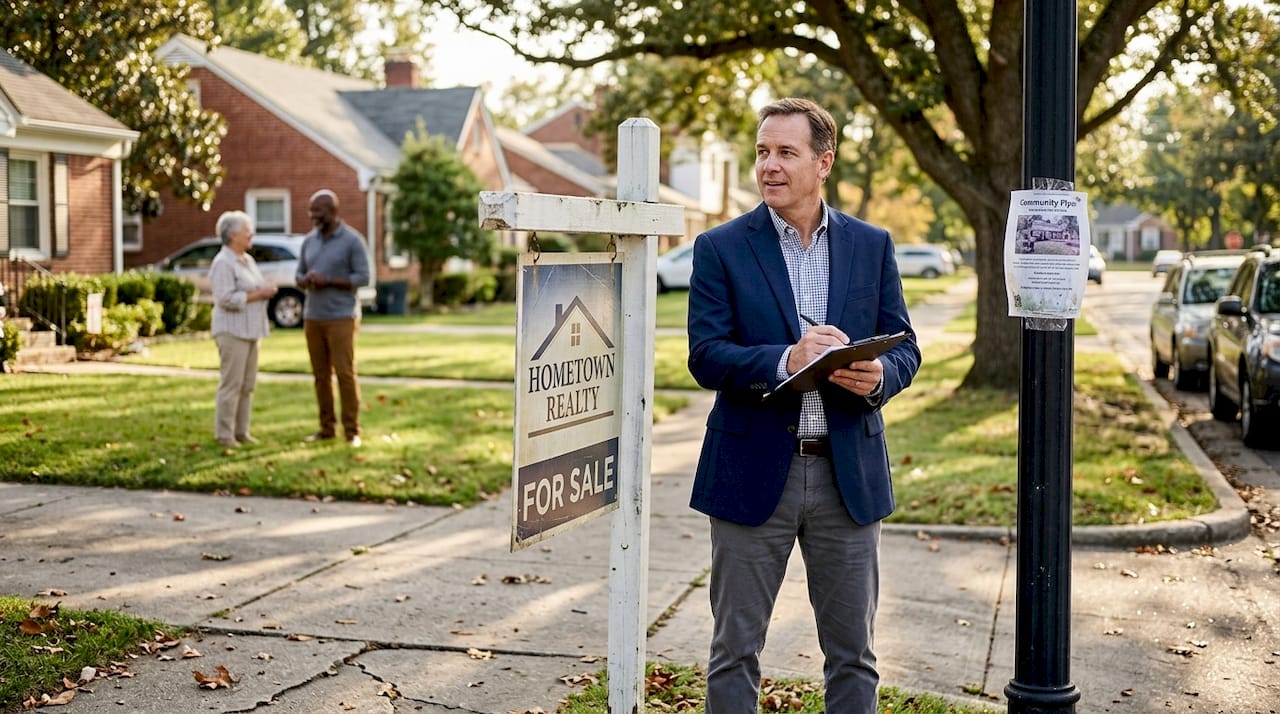
Why do local leads convert faster? Trust. When a prospect has seen your signs around the neighborhood, read your local market reports, or heard your name from a neighbor, they arrive pre-sold on your credibility. You skip the lengthy trust-building phase that drains time with cold leads.
There is also a resource efficiency argument. Broad campaigns burn budget on impressions that never convert. Local targeting concentrates spend where intent already exists. The top lead generation strategies for agents in 2026 consistently emphasize depth over breadth for exactly this reason.
Pro Tip: Track your lead sources inside your CRM so you can calculate the real cost per closed deal by channel. Most agents are shocked to discover how much cheaper local leads are per transaction compared to portal leads.
Digital tools have amplified what local agents can accomplish. Targeted social ads, geo-fenced campaigns, and local search optimization now let you punch far above your marketing weight class. Agents who combine community presence with smart digital strategy dominate their real estate lead sources in ways that were simply not possible five years ago.
Best channels and strategies for local lead generation
Knowing local leads outperform is one thing. Knowing how to generate them consistently is where strategy turns into income.
| Channel | Effort Level | Cost | Speed to Results |
|---|---|---|---|
| Community events | Medium | Low | Medium |
| Local social media groups | Low | Free | Fast |
| Google Business Profile | Medium | Low | Medium |
| Referral partnerships | Medium | Low | Slow but compounding |
| Local SEO content | High | Low to medium | Slow but lasting |
Here are the five most effective approaches, ranked by impact:
- Community events and sponsorships. Show up at neighborhood gatherings, sponsor a local sports team, or co-host a home-buying workshop. Face-to-face credibility builds faster than any algorithm can replicate.
- Referral networks and local partnerships. Partner with mortgage brokers, interior designers, and contractors. They have clients who need you. You have clients who need them.
- Local SEO and Google Business Profile. Local SEO for real estate is one of the highest-ROI investments you can make. When someone searches for an agent in your city, you need to appear at the top.
- Social media targeting and groups. Social media marketing strategies built around neighborhood Facebook groups, Instagram geo-tags, and local community boards consistently generate warm inquiries. Social media marketing and local SEO are now foundational tools for agents who want a steady pipeline.
- CRM-powered follow-up systems. Capturing a lead means nothing without a structured follow-up plan. A well-configured CRM turns cold contacts into warm conversations and warm conversations into signed contracts.
Pro Tip: Create a neighborhood-specific landing page on your website targeting a single zip code or community name. Use local keywords and real market data. A focused page like this can outrank major portals for hyper-local searches within months.
The agents generating the most local leads are not necessarily the ones with the biggest budgets. They are the most consistent. Showing up regularly, both online and in person, compounds your visibility in a way that one-time campaigns never will.
Turning local leads into long-term client relationships
Attracting a local lead is step one. The real leverage comes from what happens next. Most agents underinvest in the nurturing phase, and that is where long-term income is built or lost.
The fundamentals of effective local lead nurturing:
- Follow up within the first hour. Response speed signals professionalism and builds immediate trust.
- Personalize every touchpoint. Reference the specific neighborhood, property type, or concern they mentioned. Generic messages get ignored.
- Share local market insights regularly. Monthly reports, price trend updates, and neighborhood news position you as the area expert clients want to call first.
- Use CRM automation smartly. CRM systems play a central role in nurturing and converting leads at scale without losing the personal touch.
- Check in after closing. The deal closing is not the end of the relationship. It is the beginning of a referral pipeline.
The goal is to move every local lead through a clear journey: from stranger to prospect, from prospect to client, from client to advocate. Each stage requires intentional communication and genuine value delivery.
Automation makes this scalable. You can schedule a six-month check-in email, a yearly market update, or a neighborhood anniversary message. These touchpoints feel personal even when they are automated, because they are relevant to where the client actually lives and what they actually care about.
For a deeper look at systematic follow-up, explore nurturing real estate leads with proven frameworks designed for faster conversions in 2026. And if you are still building your CRM practice in real estate, starting with local leads is the most efficient path to mastering the system.
Pro Tip: Set a reminder in your CRM to reconnect with past local clients every six months. A simple, genuine check-in email or handwritten note generates more referrals per hour than almost any paid campaign.
Most agents underestimate the power of neighborhoods
Here is the uncomfortable truth most training programs skip: thinking bigger is not always thinking smarter. The instinct to expand your reach is understandable. More visibility should mean more opportunities. But agents who chase every market end up owning none of them.
The most successful agents we see are not regional powerhouses. They are neighborhood specialists. They know which streets flood during heavy rain, which schools are rezoning, and which local coffee shop hosts the best networking events. That depth of knowledge builds a referral engine that no paid campaign can replicate.
Focusing on hyper-local client attraction in two or three core neighborhoods creates a compounding effect. Your first year, you close a few deals. Your second year, those clients refer their neighbors. By year three, you are the agent everyone in that neighborhood calls first. The math of referrals is exponential, not linear. Most agents never experience it because they abandon the strategy too early, chasing the illusion of scale before they have built a foundation of local dominance.
Take your local lead generation further
You now have a clear picture of why local lead generation outperforms broad approaches and how to build a system that delivers results. The next step is applying these strategies with tools built specifically for real estate professionals.

At ex.plo.re, we give you the resources and technology to move faster and close smarter. Explore our real estate prospecting strategies to sharpen your outreach, apply effective local attraction methods to build your neighborhood authority, and follow our real estate lead generation guide for a step-by-step system proven to grow your pipeline. Your market is waiting. Let us help you own it.
Frequently asked questions
What is a local lead in real estate?
A local lead is a potential client who is actively seeking to buy or sell property in a specific geographic area where you operate. Unlike broad online leads, local leads seek specific agents in a defined area, making them far more actionable.
Which methods are most effective for generating local leads?
The most effective methods include community events, referral partnerships, local SEO, and social media targeting. Social media and local SEO are key tools for agents, and digital marketing delivers 70% more conversions when targeting local prospects.
How do I nurture local leads into clients?
Nurture local leads by personalizing follow-ups, sharing valuable local market insights, and using CRM tools to automate consistent communication. CRM systems are central to converting leads at scale without sacrificing the personal touch that local clients expect.
Why do local leads convert better than generic leads?
Local leads have higher purchase intent, trust local agents more, and face less competition from other brokers. Digital marketing lifts conversions 70% when focused locally, proving that precision consistently outperforms volume in real estate lead generation.