

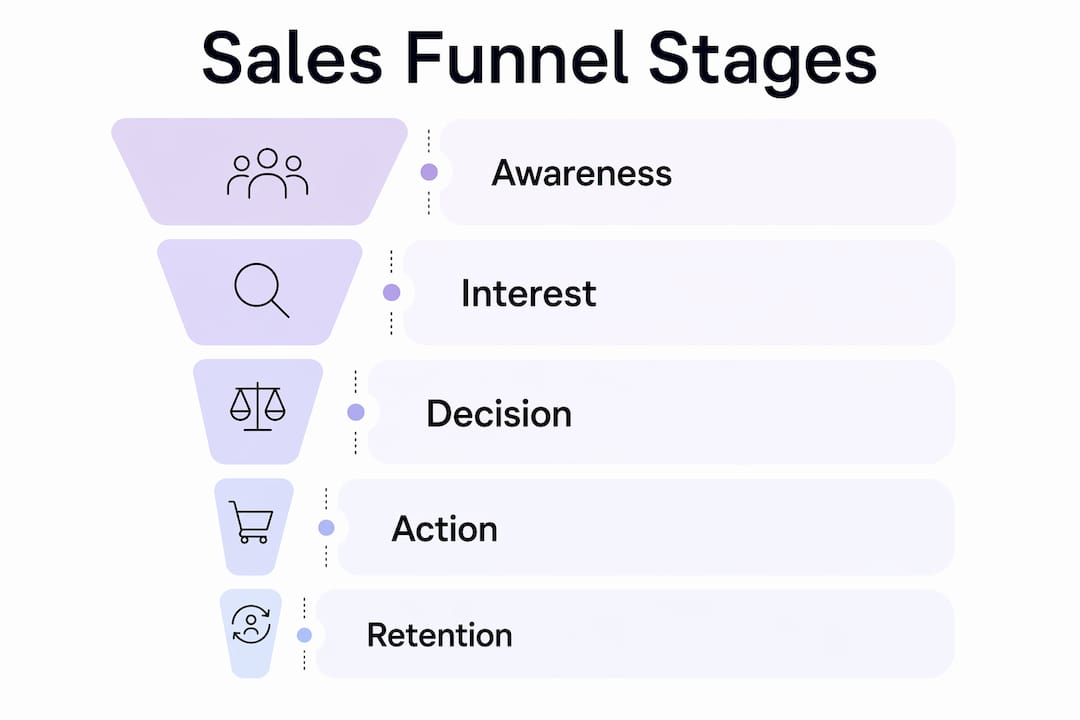
A sales funnel is defined as a visual and strategic roadmap of the customer journey, tracking every touchpoint from initial awareness to final purchase. Understanding sales funnels is the foundation of every repeatable, scalable sales process. The concept breaks the buyer’s path into structured stages, typically Awareness, Interest, Decision, and Action, following the AIDA model. IBM, HubSpot, and Outreach each operationalize this framework differently, but the core logic is identical: prospects enter wide at the top and narrow down to paying customers at the bottom. If you work in sales or marketing and you are not thinking in funnels, you are guessing.
What is a sales funnel and how does it work?
A sales funnel is the structured sequence of stages a prospect moves through before becoming a customer. Each stage narrows as leads decide whether to continue or seek alternatives, which is why the shape resembles a funnel. The model gives sales and marketing teams a shared language for describing where prospects are and what they need next.

The four core stages
The most widely used model follows four stages:
- Awareness: The prospect discovers your product or service. Marketing channels like SEO, paid ads, social media, and referrals drive this stage. The goal is relevance, not a sales pitch. Awareness messaging should focus on relevance to pre-qualify leads before they ever speak to a salesperson.
- Interest: The prospect engages with your content, signs up for a newsletter, or requests more information. This is where nurturing begins.
- Decision: The prospect evaluates your offer against competitors. Proposals, demos, case studies, and pricing conversations happen here.
- Action: The prospect commits. In B2C, this is a purchase. In B2B, the Action stage often includes procurement review, legal sign-off, and contract execution.
More detailed models add Qualification, Proposal, Negotiation, Closing, and Retention as distinct stages. Funnel narrowing happens because of lack of interest, budget constraints, or better alternatives. That drop-off is not a failure. It is the funnel doing its job by filtering out prospects who were never going to close.
TOFU, MOFU, BOFU
Sales teams also use shorthand to describe funnel position. Top of funnel (TOFU) covers awareness and early interest. Middle of funnel (MOFU) covers evaluation and qualification. Bottom of funnel (BOFU) covers decision, closing, and action. Each zone requires different content, messaging, and team involvement.
Pro Tip: Map every piece of content you produce to a funnel stage. If 80% of your content is TOFU awareness material but your pipeline stalls at MOFU, you have found your leak.
How does a sales funnel differ from a marketing funnel?
The sales funnel and the marketing funnel are related but not the same thing. Confusing them leads to misaligned teams, wrong metrics, and missed revenue targets.
| Dimension | Marketing Funnel | Sales Funnel |
|---|---|---|
| Primary focus | Brand awareness and lead generation | Converting prospects into customers |
| Key metrics | Impressions, clicks, leads generated | Pipeline value, close rate, deal velocity |
| Team ownership | Marketing team | Sales team |
| Stages covered | Awareness through initial interest | Qualification through closed deal |
| Success measure | Volume of qualified leads delivered | Revenue closed |
Marketing funnels focus on awareness and initial engagement, while sales funnels focus on conversion stages with increasing commitment and closing probability. Marketing feeds the top of the sales funnel. Sales takes over once a lead is qualified. The handoff point between the two is where most revenue leaks occur in organizations that do not define it clearly.
The practical implication is significant. A marketing team optimizing for click-through rates may flood the sales funnel with unqualified leads. A sales team ignoring top-of-funnel health will eventually run out of pipeline. Both funnels must be measured and managed together.
Pro Tip: Define your Marketing Qualified Lead (MQL) and Sales Qualified Lead (SQL) criteria in writing. This single document eliminates most of the friction between marketing and sales teams.
How do you build an effective sales funnel?
Building a sales funnel involves six core steps: define your goals, create lead offers, qualify leads, nurture prospects, close deals, and analyze results. Each step must map to a specific buyer behavior, not just an internal sales activity.
Step-by-step funnel construction
- Define the problem you solve. Your funnel starts with clarity on who you serve and what pain you address. Without this, your awareness messaging attracts the wrong prospects.
- Create a lead offer. Give prospects a reason to raise their hand. This could be a free consultation, a market report, a demo, or a content download. The offer must match the stage.
- Qualify your leads. Not every lead deserves equal attention. Use criteria like budget, authority, need, and timeline (BANT) to separate serious prospects from browsers.
- Nurture with intent. Send targeted content that moves prospects from Interest to Decision. Email sequences, retargeting ads, and one-on-one outreach all serve this function.
- Close with a clear process. Define what closing looks like at each stage. In real estate, closing includes offer submission, negotiation, and contract signing. Each sub-step should be tracked.
- Analyze and refine. Tracking lead movement and the reasons for progression or loss is the key to meaningful funnel optimization.
What to track at each stage
- Conversion rate from stage to stage
- Average time spent in each stage
- Reasons leads drop off (lost to competitor, budget, timing, no decision)
- Source of leads that close at the highest rate
Operationalizing your funnel with stage-based goals and tracking enables real optimization rather than only observing final outcomes. The difference between a team that grows predictably and one that lurches between feast and famine is almost always funnel discipline.
Pro Tip: Review your sales funnel metrics weekly, not monthly. Problems compound fast when you only look at pipeline health at the end of a quarter.
What real-world examples show about funnel performance?
The sales funnel concept proves its value most clearly when you look at how it changes behavior in practice. Teams that manage by funnel stage make better decisions than teams that manage by gut feel.
“A healthy funnel includes expected drop-offs due to practical reasons, not just lead volume.” — Xero on Funnel Drop-off
In B2B sales, a technology company might run LinkedIn campaigns (TOFU) to attract IT decision-makers, then offer a product demo (MOFU) to qualified leads, then enter a formal proposal and negotiation process (BOFU) before closing. Each stage has a defined owner, a defined action, and a defined metric. The funnel makes the invisible visible.
In real estate, the same logic applies directly. A luxury agent might attract leads through neighborhood market reports (Awareness), follow up with a personalized property match email (Interest), schedule a buyer consultation (Decision), and then guide the client through offer and contract (Action). The real estate sales cycle maps almost perfectly to the four-stage funnel model.
- Pipeline forecasting: When you know the conversion rate at each stage, you can predict revenue with accuracy. If 20% of Decision-stage prospects close and you have 10 in that stage, you can forecast two deals.
- Resource allocation: Funnel data tells you where to invest. If leads stall at Interest, you need better nurture content. If they stall at Decision, your proposal or pricing needs work.
- Retention as a funnel stage: Modern funnels extend beyond purchase to include retention and expansion stages. This matters because acquiring a new client costs far more than growing an existing one. Many sales teams overlook post-sale retention as part of the funnel, which directly impacts customer lifetime value.
Pro Tip: Build a lead qualification process into your funnel before leads reach your sales team. Pre-qualified leads close faster and waste less of your team’s time.
Key takeaways
A sales funnel is the single most important framework for converting prospects into clients at scale, and it only works when every stage is defined, tracked, and actively managed.
| Point | Details |
|---|---|
| Sales funnel definition | A structured roadmap tracking prospects from first awareness through to closed purchase. |
| Four core stages | Awareness, Interest, Decision, and Action form the foundation of every effective funnel. |
| Marketing vs. sales funnel | Marketing generates leads at the top; sales converts them at the bottom. Define the handoff clearly. |
| Build with tracking | Map buyer behaviors to each stage and measure conversion rates and drop-off reasons weekly. |
| Retention extends the funnel | Post-sale stages protect customer lifetime value and drive growth beyond the initial close. |
The funnel is not the finish line
I have worked with enough sales teams to know that most of them build a funnel once and then treat it like a fixed object. They define the stages, load in their CRM fields, and move on. That is exactly where the value gets left on the table.
The funnel is a diagnostic tool, not a decoration. Every time a deal stalls or a lead goes cold, the funnel should tell you why. If it cannot, your stage definitions are too vague or your tracking is too shallow. I have seen teams discover that 60% of their lost deals stalled at the proposal stage, not because the pricing was wrong, but because proposals were going to the wrong stakeholder. The funnel revealed the problem. No funnel, no visibility.
The other mistake I see constantly is treating the funnel as ending at the close. The most profitable clients I have ever seen managed are the ones who were nurtured past the transaction. Retention is not a customer service function. It is a revenue function, and it belongs inside your funnel model. If you are a real estate agent or luxury broker, your next listing often comes from your last closed buyer. That relationship lives in the bottom of your funnel, not outside it.
Build your funnel with the close in mind. Manage it with retention in mind. Optimize it with data in mind. That is the sequence that separates power brokers from average producers.
— Jason
How Plo helps you build a funnel that actually closes
Knowing the theory of a sales funnel is one thing. Running one that fills your pipeline with qualified local clients is another. Plo was built specifically for real estate agents, yacht brokers, and luxury brokers who need more than a whiteboard diagram.
Plo gives you the prospecting tools, CRM visibility, and automation to manage every funnel stage without dropping a lead. From first contact to closed deal, you get a clear view of where every prospect stands and what move to make next. Explore the top prospecting tools Plo recommends for funnel-stage management, or go deeper with proven funnel best practices built for brokers who want to close more in 2026.
FAQ
What is a sales funnel in simple terms?
A sales funnel is a step-by-step model that tracks how prospects move from first learning about your product to making a purchase. It narrows at each stage as leads drop off or advance toward a decision.
What are the main sales funnel stages?
The four core stages are Awareness, Interest, Decision, and Action. More detailed models add Qualification, Proposal, Negotiation, Closing, and Retention for complex sales cycles.
How does a sales funnel differ from a marketing funnel?
A marketing funnel focuses on generating awareness and delivering qualified leads. A sales funnel takes those leads and converts them into paying customers through structured follow-up and closing activities.
Why do leads drop off in a sales funnel?
Leads exit the funnel due to lack of interest, budget constraints, or better alternatives. This drop-off is normal and expected. A healthy funnel filters out poor-fit prospects so your team focuses on those most likely to close.
How do you optimize a sales funnel?
Track conversion rates and drop-off reasons at every stage, then address the weakest point first. Operationalizing your funnel with stage-based goals and detailed tracking is the foundation of meaningful improvement.