

Facing a phone call with an unfamiliar property owner can feel intimidating, even for seasoned agents. Cold calling remains a powerful way to build trust and expand your client base, despite the rise of digital marketing. By mastering targeted phone outreach and focusing on nuanced communication, you will connect with prospects who offer new opportunities and accelerate your growth as a real estate professional. Bold communication skills and market insight are key to making your cold calls stand out in today’s competitive market.
Table of Contents
- Cold Calling Defined For Real Estate Agents
- Key Types Of Real Estate Cold Calling
- How Cold Calling Works In Client Acquisition
- Legal Compliance And Do Not Call Rules
- Risks, Challenges, And Common Mistakes
- Proven Strategies To Boost Success Rates
Key Takeaways
| Point | Details |
|---|---|
| Cold Calling Essentials | Real estate cold calling is a proactive approach that requires agents to engage potential clients through direct phone conversations. |
| Target Group Strategies | Successful cold calling involves identifying and understanding specific target groups to tailor communication effectively. |
| Effective Communication | Developing personalized scripts and honing active listening skills are crucial for establishing rapport with prospects. |
| Compliance Awareness | Agents must be aware of legal regulations, including the National Do Not Call Registry, to avoid potential penalties. |
Cold Calling Defined for Real Estate Agents
Cold calling in real estate represents a strategic, direct approach to prospecting where agents initiate unsolicited contact with potential clients who haven’t previously expressed interest in their services. Cold calling techniques involve systematically reaching out to property owners, potential buyers, and sellers through targeted telephone conversations.
This proactive communication method allows real estate professionals to build their client base from scratch by identifying and engaging specific market segments. Agents typically focus their cold calling efforts on several key target groups:
- Neighborhoods with high potential turnover
- For Sale By Owner (FSBO) listings
- Expired listings
- Pre-foreclosure property owners
Despite the digital transformation of marketing strategies, voice-to-voice communication remains a powerful tool in establishing trust and creating personal connections. Cold calling provides real estate agents an opportunity to demonstrate their expertise, understand client needs, and establish immediate rapport that digital communication often lacks.
Successful cold calling requires a combination of research, communication skills, and strategic approach. Agents must prepare thoroughly by understanding the local market, researching potential leads, and developing a compelling narrative that resonates with prospects’ specific needs and motivations.
Pro tip: Practice your opening script and anticipate potential objections before making your first cold call to increase your confidence and conversion rates.
Key Types of Real Estate Cold Calling
Real estate professionals employ several strategic approaches to cold calling, each targeting unique market segments and potential client opportunities. Real estate marketing strategies reveal that successful agents diversify their prospecting techniques to maximize lead generation and conversion potential.
The primary types of real estate cold calling include:
- Neighborhood Prospecting: Systematically calling homeowners in specific geographic areas to identify potential sellers
- Expired Listing Calls: Reaching out to property owners whose listings have failed to sell
- For Sale By Owner (FSBO) Targeting: Contacting property owners attempting to sell their homes independently
- Pre-Foreclosure Outreach: Identifying and contacting homeowners facing potential foreclosure
- Probate Lead Calling: Connecting with property owners who have inherited real estate through estate proceedings
Each cold calling approach requires a nuanced strategy tailored to the specific segment’s unique circumstances and motivations. Agents must research thoroughly, understand local market dynamics, and develop empathetic communication techniques that address potential clients’ specific needs and pain points.
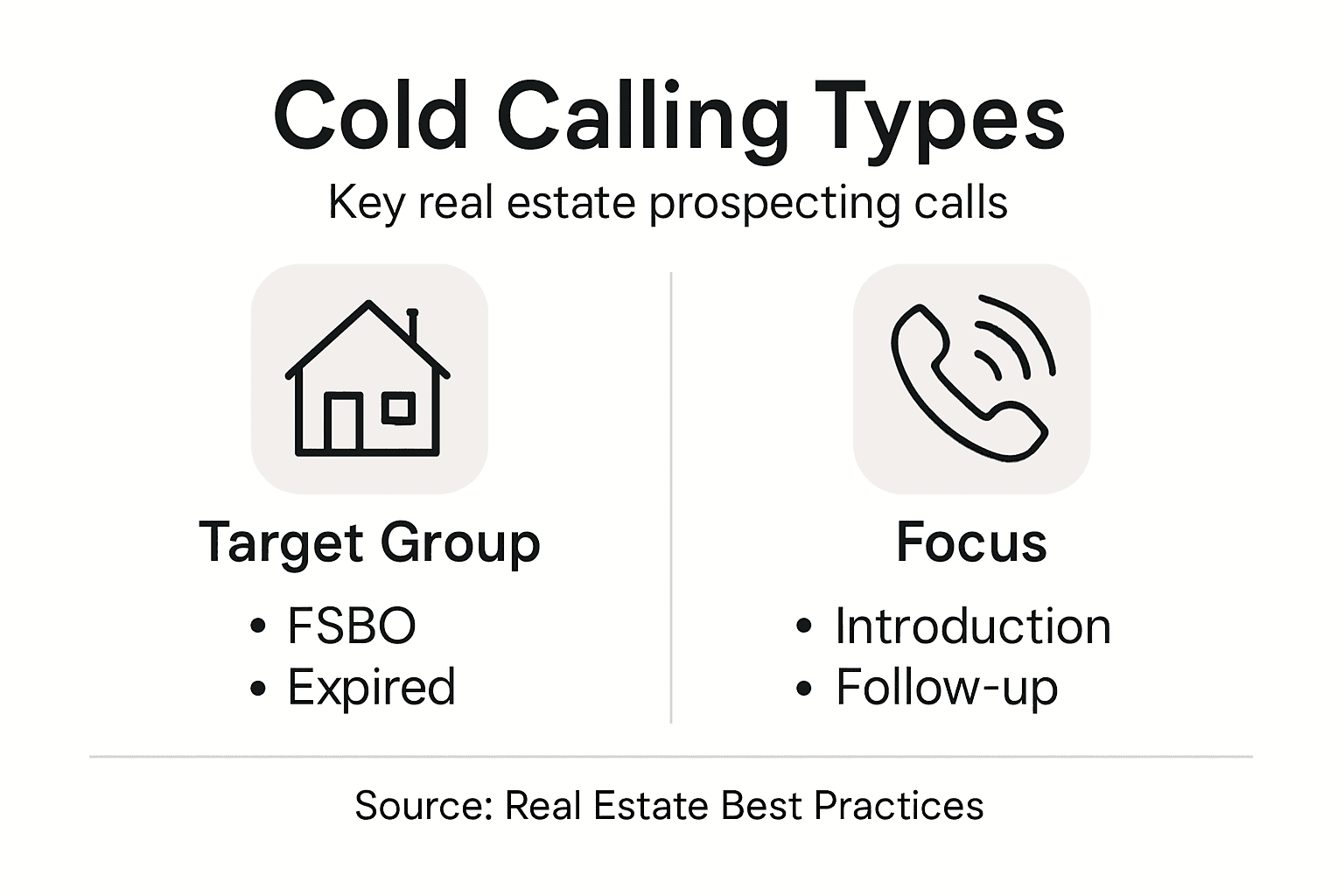
Here’s a quick comparison of cold calling target groups and the unique challenges agents face:
| Target Group | Common Challenges | Ideal Communication Strategy |
|---|---|---|
| Neighborhood Homeowners | Building initial trust | Hyper-local market insight |
| Expired Listings | Overcoming prior disappointment | Solution-focused empathy |
| FSBO Owners | Educating on agent value | Clear articulation of benefits |
| Pre-Foreclosure Owners | Sensitive financial situation | Compassionate, discreet approach |
| Probate Leads | Navigating emotional stress | Respectful, informative dialogue |
Successful cold calling goes beyond simple pitch delivery. It demands active listening, genuine relationship building, and the ability to provide value-driven solutions that demonstrate the agent’s expertise and commitment to client success.
Pro tip: Develop a customized script for each cold calling segment that addresses the specific challenges and opportunities unique to that target group.
How Cold Calling Works in Client Acquisition
Real estate call center strategies reveal the intricate process of transforming cold calls into potential client relationships. The client acquisition process through cold calling involves a strategic, multi-step approach designed to engage and convert prospects into committed clients.
The cold calling workflow typically includes several critical stages:
- Initial Contact: Establishing first communication with a potential client
- Needs Assessment: Identifying the prospect’s specific real estate requirements
- Information Gathering: Collecting key details about the client’s property goals
- Value Proposition Delivery: Explaining how the agent can solve the client’s unique challenges
- Relationship Building: Creating trust and rapport through genuine conversation
Trained real estate agents approach cold calling as a nuanced communication art, not just a sales pitch. They focus on active listening, understanding underlying client motivations, and providing tailored solutions that address specific market needs. Successful cold calling requires agents to quickly establish credibility, demonstrate market expertise, and create a comfortable dialogue that encourages further engagement.

The most effective cold calling strategies go beyond scripted interactions, emphasizing personalized communication that resonates with individual client circumstances. Agents must adapt their approach in real-time, responding to verbal and tonal cues that reveal the prospect’s genuine interests and potential reservations.
Pro tip: Record and review your cold calls regularly to identify communication patterns, refine your approach, and continuously improve your client acquisition techniques.
Legal Compliance and Do Not Call Rules
Federal Trade Commission regulations establish critical guidelines for real estate professionals engaging in cold calling practices. Navigating these legal requirements is essential to maintain professional standards and avoid potential financial penalties.
Key legal compliance requirements for real estate cold calling include:
- National Do Not Call Registry: Mandatory check before making telemarketing calls
- Established Business Relationship Exemptions: Specific time-based contact allowances
- Consumer Consent Rules: Obtaining and documenting proper communication permissions
- Identification Requirements: Mandatory self-identification during initial contact
- Opt-Out Request Protocols: Immediate processing of consumer communication preferences
Real estate agents must understand the nuanced regulations surrounding telemarketing communications. The National Do Not Call Registry imposes strict guidelines, including restrictions on calling numbers registered by consumers who wish to avoid unsolicited contact. Agents are permitted limited exceptions, such as maintaining contact with existing clients or recent transaction participants.
Comprehensive compliance requires real estate professionals to implement robust tracking systems that monitor Do Not Call Registry status, track consumer communication preferences, and ensure prompt honoring of opt-out requests. Violations can result in significant financial penalties and potential legal consequences that could damage professional reputation.
Review these legal compliance aspects for real estate cold calling:
| Compliance Requirement | What It Ensures | Agent Action Needed |
|---|---|---|
| Do Not Call Registry Check | Protects consumer privacy | Verify number before calling |
| Business Relationship Exemptions | Allows limited contact | Track client history |
| Consumer Consent Documentation | Prevents unwanted calls | Record explicit permissions |
| Self-Identification During Calls | Maintains transparency | State name and company early |
| Opt-Out Request Processing | Honors preferences | Remove from contact list |
Pro tip: Develop a comprehensive compliance tracking system that automatically updates and validates contact lists against the National Do Not Call Registry to minimize legal risks.
Risks, Challenges, and Common Mistakes
Real estate cold calling strategies reveal significant challenges that can derail prospecting efforts if not addressed strategically. Understanding these potential pitfalls is crucial for real estate professionals seeking to optimize their client acquisition approach.
Common mistakes in cold calling include:
- Lack of Preparation: Insufficient research about potential leads
- Scripted Conversations: Sounding robotic or impersonal
- Excessive Talking: Failing to practice active listening
- Insufficient Follow-up: Neglecting post-call communication strategies
- Rejection Sensitivity: Allowing initial negative responses to discourage future attempts
Successful real estate agents recognize that cold calling requires resilience and continuous skill refinement. The most significant risks involve potential damage to professional reputation, wasted time and resources, and missed opportunities for meaningful client connections. Agents must develop a mindset that views each call as a learning experience, regardless of the immediate outcome.
Professional cold calling demands emotional intelligence and adaptability. Real estate professionals must quickly read verbal and nonverbal cues, pivot conversation strategies in real-time, and maintain a genuine, empathetic approach that distinguishes them from generic telemarketing attempts.
Pro tip: Develop a robust self-reflection process after each cold calling session, documenting what worked, what didn’t, and specific strategies for improvement.
Proven Strategies to Boost Success Rates
Real estate professionals seeking to enhance their cold calling effectiveness must adopt a strategic, multi-dimensional approach that transforms traditional outreach methods. Sales funnel optimization plays a critical role in developing a systematic method for converting initial contacts into potential clients.
Key strategies for improving cold calling success include:
- Targeted Lead Research: Thoroughly investigating potential client backgrounds
- Personalized Communication: Crafting unique approaches for different client segments
- Time-Optimized Calling: Identifying peak communication windows
- Script Flexibility: Developing adaptable conversation frameworks
- Emotional Intelligence: Reading and responding to subtle communication cues
- Consistent Follow-up: Implementing strategic post-call engagement processes
Successful cold calling transcends simple phone interactions. Real estate agents must view each call as an opportunity to build genuine relationships, not just generate immediate transactions. This approach requires developing a deep understanding of prospect motivations, market dynamics, and personal communication strengths.
Professional cold calling demands continuous skill refinement and a growth mindset. Agents should regularly analyze call performance, seek feedback, and invest in communication training that enhances their ability to connect authentically with potential clients.
Pro tip: Record and systematically review your cold calls to identify communication patterns, refine your approach, and develop more effective engagement strategies.
Elevate Your Cold Calling Strategy and Win More Clients Today
Cold calling in real estate presents many challenges like building trust quickly and handling rejection. This article highlights key pain points such as the need for personalized communication, overcoming objections, and following up effectively with potential clients. If you want to transform your cold calling efforts into powerful client acquisition tools you need smart technology and expert support tailored to your unique real estate goals.
At ex.plo.re we understand the emotional demands and strategic nuances of cold calling. Our cutting-edge tools and dedicated team help you streamline your prospecting efforts by providing:
- Targeted lead research to connect with the right clients
- Flexible scripts that adapt to different market segments
- Compliance tracking so you never worry about federal rules
- Follow-up systems that keep prospects engaged and build lasting relationships
Turn cold calls into warm leads and become the power broker of your local market with ex.plo.re CRM.
Experience how real estate marketing strategies can be amplified with our platform while leveraging sales funnel optimization to boost your conversion rates.
Take control of your cold calling success now and let our expert technology and talented team maximize your impact.

Don’t let another promising prospect slip away. Visit ex.plo.re CRM to get started on powering up your cold calling game with solutions designed specifically for real estate agents ready to win.
Frequently Asked Questions
What is cold calling in real estate?
Cold calling in real estate is a method where agents proactively reach out to potential clients without prior contact. This includes making unsolicited calls to property owners, buyers, and sellers to generate leads and build a clientele.
What are the key types of cold calling strategies for real estate agents?
Key types of cold calling strategies include neighborhood prospecting, expired listing calls, For Sale By Owner (FSBO) targeting, pre-foreclosure outreach, and probate lead calling. Each strategy targets unique segments of the real estate market.
How does cold calling impact client acquisition?
Cold calling aids in client acquisition by initiating direct conversations with potential clients, allowing agents to assess their needs, build trust, and demonstrate how they can provide value, ultimately converting leads into clients.
What are common challenges faced when cold calling in real estate?
Common challenges include overcoming initial resistance from prospects, establishing trust quickly, handling objections effectively, and navigating potential legal compliance issues surrounding telemarketing.
Recommended
- Role of CRM in Real Estate Success Today
- 7 Essential Real Estate Networking Tips for More Clients
- Real Estate Sales Cycle Explained: Winning More Clients
- Why Prospecting Matters for Brokers’ Success
- Reliable Cleaning Services for Real Estate Showings
- 7 Key Ways Real Estate Notary Services Help Your Deals – My Mobile Notary
- Lead Generation for Manufactured Homes – Proven Digital Strategies – BoxBuild