About

What Is a Central Listing? A Broker’s 2026 Guide
Most brokers encounter the term “central listing” and assume they know what it means. They are usually half right. The phrase operates in two distinct contexts across the real estate industry, and confusing them can cost you marketing leverage, client trust, and control over your own data. Whether you broker luxury residential properties or high-value yachts, understanding what is a central listing in your specific context is the difference between a passive sales approach and one that generates serious results. This guide breaks both contexts down with precision.
Table of Contents
- Key takeaways
- What is a central listing, exactly?
- Benefits that make central listings worth the conversation
- Central listing vs other listing types
- How to implement central listings in your practice
- My honest take on where central listings are heading
- Tools that amplify your central listing strategy
- FAQ
Key takeaways
| Point | Details |
|---|---|
| Two distinct meanings | “Central listing” refers to an exclusive brokerage contract in yachting and a centralized data platform in residential real estate. |
| Exclusivity drives investment | A central agency agreement motivates brokers to spend on marketing because their commission is guaranteed regardless of who finds the buyer. |
| Platform adoption is accelerating | Residential brokerages are replacing multi-MLS manual entry with centralized repositories to control data and reduce errors. |
| Central beats open for results | Open listings consistently produce less dedicated marketing support and slower sales compared to exclusive central arrangements. |
| Technology is the force multiplier | Platforms like Cotality BLX give brokerages rules-based compliance, syndication control, and data sovereignty in 2026 and beyond. |
What is a central listing, exactly?
The definition of central listing splits cleanly depending on your sector. Get the distinction right, and everything else follows.
Central listing in yacht brokerage
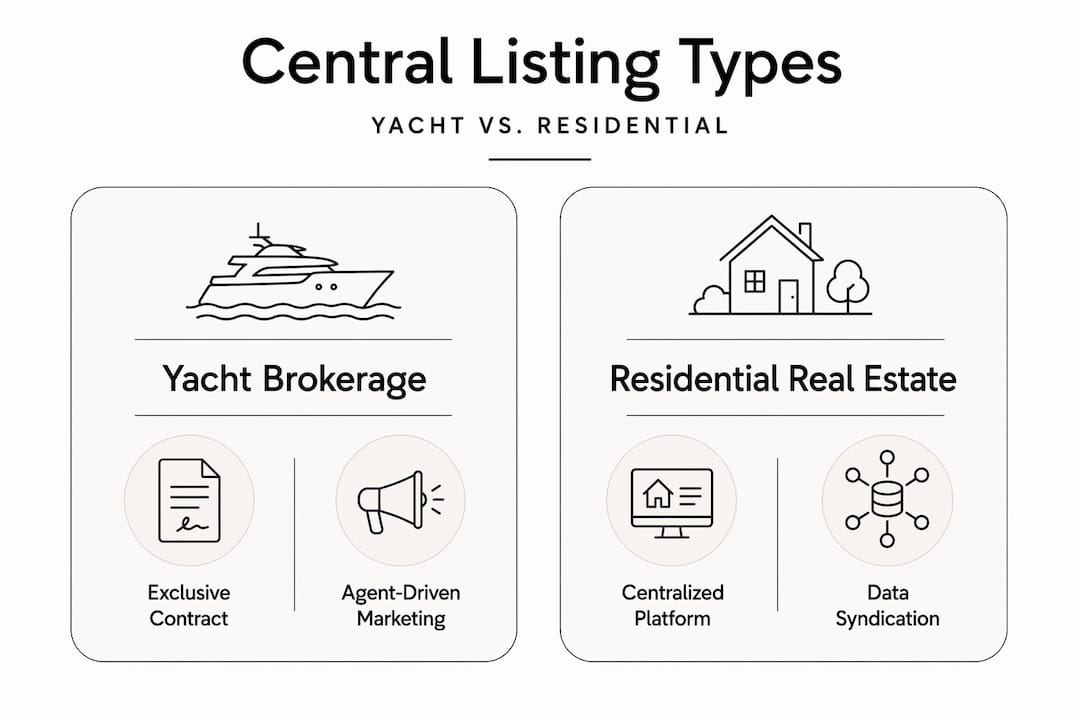
In yacht brokerage, a central listing is a formal, exclusive contract. Specifically, it is called a Central Agency Listing Agreement. It grants one broker full authority over the sale of the vessel, including sole responsibility for marketing, negotiation, and transaction management. That broker earns commission regardless of who ultimately brings the buyer. A co-broker can introduce a buyer and still get compensated, but the central agent controls the entire process.

This is not the same as an open listing, where the seller engages multiple brokers simultaneously and only the one who closes gets paid. Open listings lead to passive behavior. No broker invests in professional photography or targeted digital campaigns when another agent might close the deal tomorrow. The central agency model solves this by aligning incentives. The central broker’s commission is protected, so they invest fully.
Central listing in residential real estate
In residential real estate, the central listing overview looks different. Here, “central listing” increasingly refers to a centralized listing repository or platform. Think of it as a single point of data entry that distributes your listing across multiple MLSs, portals, and syndication channels automatically. Rather than manually entering the same property data into six different systems, you enter it once and the platform handles the rest.
HomeServices of America and Cotality launched Cotality BLX specifically for this purpose, replacing fragmented manual entry with a single, controlled data flow that maintains compliance across channels. The MLS still acts as a central database for cooperative compensation, but centralized listing platforms sit above that layer, giving brokerages direct control over how and where data is published.
| Feature | Yacht brokerage central listing | Residential centralized listing platform |
|---|---|---|
| Core concept | Exclusive agency contract | Single-entry data management system |
| Exclusivity | Yes, contractually guaranteed | Not inherently exclusive |
| Commission protection | Guaranteed to central agent | Not applicable |
| Primary benefit | Motivated, invested marketing | Data accuracy and syndication efficiency |
| Technology component | CRM and outreach tools | Platform integration with MLSs and portals |
| Who controls it | Assigned central broker | Brokerage or technology provider |
Pro Tip: If you broker both residential and yacht properties, use different language when explaining “central listing” to clients in each sector. Conflating the two creates confusion and undermines your credibility as a specialist.
Benefits that make central listings worth the conversation
The importance of central listing becomes most obvious when you look at what brokers on open or fragmented arrangements actually deliver versus what a central agent commits to.
A central agent in yacht brokerage invests in professional photography, video walkthroughs, CRM-driven outreach to qualified buyers, and targeted digital campaigns. That investment directly flows from guaranteed commission protection. Remove the guarantee and you remove the motivation. It is that simple.
On the residential side, the benefits of central listing platforms are operational as much as they are commercial. Centralized listing platforms improve data consistency and reduce agent workload by providing a single data-entry point that distributes listings across MLSs and portals simultaneously. That means fewer errors, less duplication, and more time for actual client work.
Key benefits your brokerage gains from adopting central listing services:
- Reduced manual entry. Enter listing data once and syndicate everywhere, cutting hours of repetitive work per transaction.
- Enhanced data integrity. Single-source data management eliminates version conflicts and outdated information showing up on third-party portals.
- Better client trust. Buyers and sellers receive consistent, accurate information regardless of which channel they use to find the listing.
- Compliance assurance. Platforms like Cotality BLX use rules-based validation to keep listings aligned with MLS standards automatically.
- Faster sales cycles. Unified communication and marketing under one responsible broker leads to stronger offers and faster closings.
- Greater brokerage control. You own your data flow and decide where listings appear, rather than depending on third-party portals to interpret your data correctly.
Pro Tip: Pair your central listing agreement with a CRM that tracks all buyer inquiries and outreach history. This documentation protects your commission claim and demonstrates to sellers that their property is being actively marketed, not just sitting in a database.
Central listing vs other listing types
Understanding the central listing vs local listing debate requires a clear map of all your options. Most brokers work with four main agreement types.
Exclusive Right to Sell is the most common arrangement. It grants the listing broker sole marketing authority and guaranteed commission regardless of who produces the buyer. This is the legally favored type in most U.S. regions and the closest residential equivalent to a yacht brokerage central agency agreement.
Exclusive Agency grants the broker exclusivity but allows the seller to sell independently without paying commission. It reduces broker confidence somewhat, though it still provides more protection than open arrangements.
Open Listing is the most problematic for broker investment. The seller can engage multiple brokers, and only the one who closes gets paid. MLS policies generally restrict or disallow open listings because they undermine cooperative compensation and produce inconsistent marketing effort. You rarely see strong marketing on open listings because no broker can justify the spend.
Central Agency Listing (as used in yacht brokerage) combines the exclusivity of an exclusive right to sell with active, commission-motivated management and co-brokerage cooperation.
| Listing type | Exclusivity | Commission protection | Marketing investment | MLS compatibility |
|---|---|---|---|---|
| Exclusive Right to Sell | High | Guaranteed | High | Standard requirement |
| Exclusive Agency | Medium | Conditional | Medium | Accepted |
| Open Listing | None | First-to-close only | Low | Often restricted |
| Central Agency | High | Fully guaranteed | Very high | Context-dependent |
Practical scenarios where central listing wins:
- You are listing a luxury yacht or high-value asset where marketing ROI depends on commitment.
- You manage a large residential portfolio and need data consistency across multiple MLS regions.
- Your client demands a single point of contact and expects coordinated, professional marketing.
- You are scaling a brokerage and need to reduce per-listing administrative time significantly.
How to implement central listings in your practice
Knowing the central listing process from contract to close puts you ahead of brokers who treat it as a vague concept. Here is how you actually use a central listing in practice.
- Draft a clear central agency or exclusive right-to-sell agreement. Include the listing duration (typically 6 to 12 months for yachts, 3 to 6 months for residential), commission structure, co-brokerage terms, and marketing obligations. Ambiguity here causes disputes later.
- Enter the listing into your centralized repository. If your brokerage uses a platform like Cotality BLX, input all property data once and confirm syndication settings. Verify which MLSs and portals receive the feed before going live.
- Build a property-specific marketing plan. Commission professional photography, create video content, and schedule digital campaigns across relevant channels. This is where your commission guarantee pays off because you can justify the spend.
- Set up a buyer inquiry tracking system. All inquiries, showings, and offers should route through you. Use a CRM to log every interaction and provide sellers with regular updates.
- Monitor data accuracy across all distribution channels. Check that listing details are consistent on every portal weekly. Errors on third-party sites erode buyer confidence faster than most brokers realize.
- Review and optimize regularly. Analyze which channels drive the most qualified inquiries and reallocate marketing spend accordingly. Centralized platforms make this data available in one place.
For brokerages building out their teams, train every agent on the platform workflow before assigning listings. Inconsistent data entry at the agent level defeats the purpose of centralization entirely. Also, stay current with MLS submission requirements, which vary by region and change more often than most brokers expect.
Pro Tip: Schedule a monthly audit of your active listings across all syndicated platforms. Errors compound over time. A price change that updates in your central repository but fails to push to a major portal can cost you a serious buyer.
My honest take on where central listings are heading
I have watched brokers dismiss central agency agreements as overly formal or unnecessarily restrictive. That view usually comes from agents who benefit from open listing chaos, not from sellers or serious buyers.
From what I have seen across residential and yacht brokerage, the brokers who consistently close faster and at stronger prices are the ones who control the listing narrative. That control comes from exclusivity. Open listings rarely produce the kind of committed, professional marketing that moves a $2M property. They produce inbox noise.
The residential data management side of this conversation is where I think the real transformation is happening right now. The move toward centralized repositories is not just a convenience play. It is about data sovereignty at the brokerage level. Firms that control their own listing data will have a structural advantage as the MLS landscape consolidates. Those that depend on fragmented manual entry will lose accuracy, speed, and eventually clients.
My recommendation is direct: stop treating central listings as a niche concept for yacht brokers. It is a framework for how committed, high-performing brokers operate across every asset class. The contract structure and the technology platform both point to the same principle. Own the listing, control the process, and invest like you mean it.
Understanding how data shapes brokerage performance gives you the full picture of why centralization is not optional in 2026. It is your competitive position.
— Jason
Tools that amplify your central listing strategy
Central listings create the structure. The right technology fills it with momentum.
Plo builds tools specifically for real estate agents, yacht brokers, and luxury brokers who are ready to work smarter. When you have a central listing in place, the next step is making sure your prospecting machine is just as organized as your listing process. The top prospecting tools for 2026 help you source leads, manage follow-up sequences, and keep buyer conversations active without letting anything fall through the cracks. Pair that with lead generation systems built for realtors and you have a full-cycle operation, from listing creation to closed deal. Plo’s technology and expert team exist to amplify the work you are already doing. Take control of your pipeline the same way central listings put you in control of your properties.
FAQ
What does central listing mean in real estate?
Central listing refers to either an exclusive agency contract granting one broker full sale responsibility, or a centralized data platform that manages listing distribution across MLSs and portals from a single point of entry. The meaning depends on the sector and context.
How is a central listing different from an open listing?
An open listing involves multiple brokers competing for commission, which reduces individual marketing investment. A central listing assigns responsibility to one broker whose commission is protected, motivating a higher level of dedicated marketing and client service.
What are the main benefits of a central listing for brokers?
The core benefits include guaranteed commission protection, stronger marketing investment, centralized data accuracy, reduced manual entry, and faster sales cycles. Brokers who use central listing services consistently achieve better outcomes than those relying on fragmented listing approaches.
What platforms support centralized listing management?
Platforms like Cotality BLX are designed to give brokerages a single data-entry point that syndicates to multiple MLSs and portals automatically. These tools reduce errors, maintain compliance, and give brokerages direct control over how their listing data is distributed.
When should a broker choose a central listing agreement?
Choose a central listing when marketing the property requires real investment, when your client expects a single point of contact, or when you are managing listings across multiple MLS regions and need data consistency. It is the right structure for any high-value asset where passive marketing is not acceptable.