About

Role of Data in Brokerages: Boosting Sales Impact
Luxury brokers face growing pressure to outpace competitors while meeting the personalized expectations of sophisticated clients. As property and yacht markets become more international and complex, the old intuition-only approach no longer provides the clarity needed for lasting success. By focusing on data as a strategic asset, brokers will uncover powerful methods to anticipate client needs, refine market analysis, and optimize every touchpoint for greater impact.
Table of Contents
- Defining Data’s Role in Modern Brokerages
- Key Data Types and Sources for Brokers
- Using Data to Identify High-Value Clients
- Transforming Data Into Actionable Client Insights
- Compliance, Risks, and Data Security in Brokerages
Key Takeaways
| Point | Details |
|---|---|
| Data as a Strategic Asset | Modern brokerages utilize data for market intelligence, client profiling, risk assessment, and performance tracking to enhance decision-making. |
| Diverse Data Sources | Brokers should integrate various data types, including financial reports and geospatial information, to develop comprehensive market insights. |
| High-Value Client Identification | Advanced analytics facilitate the precise identification of high-value clients by evaluating behavioral patterns and financial capacities. |
| Compliance and Security | Brokerages must adopt dynamic compliance and risk management strategies, leveraging technology to protect sensitive client data and navigate regulatory requirements. |
Defining Data’s Role in Modern Brokerages
Data has transformed from a simple record-keeping tool to a strategic asset that drives decision-making in modern brokerages. The emergence of advanced analytics has revolutionized how luxury real estate and yacht brokers understand market dynamics, client preferences, and competitive landscapes.
At its core, data in brokerages now serves multiple critical functions:
- Market Intelligence: Providing real-time insights into pricing trends
- Client Profiling: Creating comprehensive understanding of buyer behaviors
- Risk Assessment: Evaluating potential investment opportunities
- Performance Tracking: Measuring sales effectiveness and agent productivity
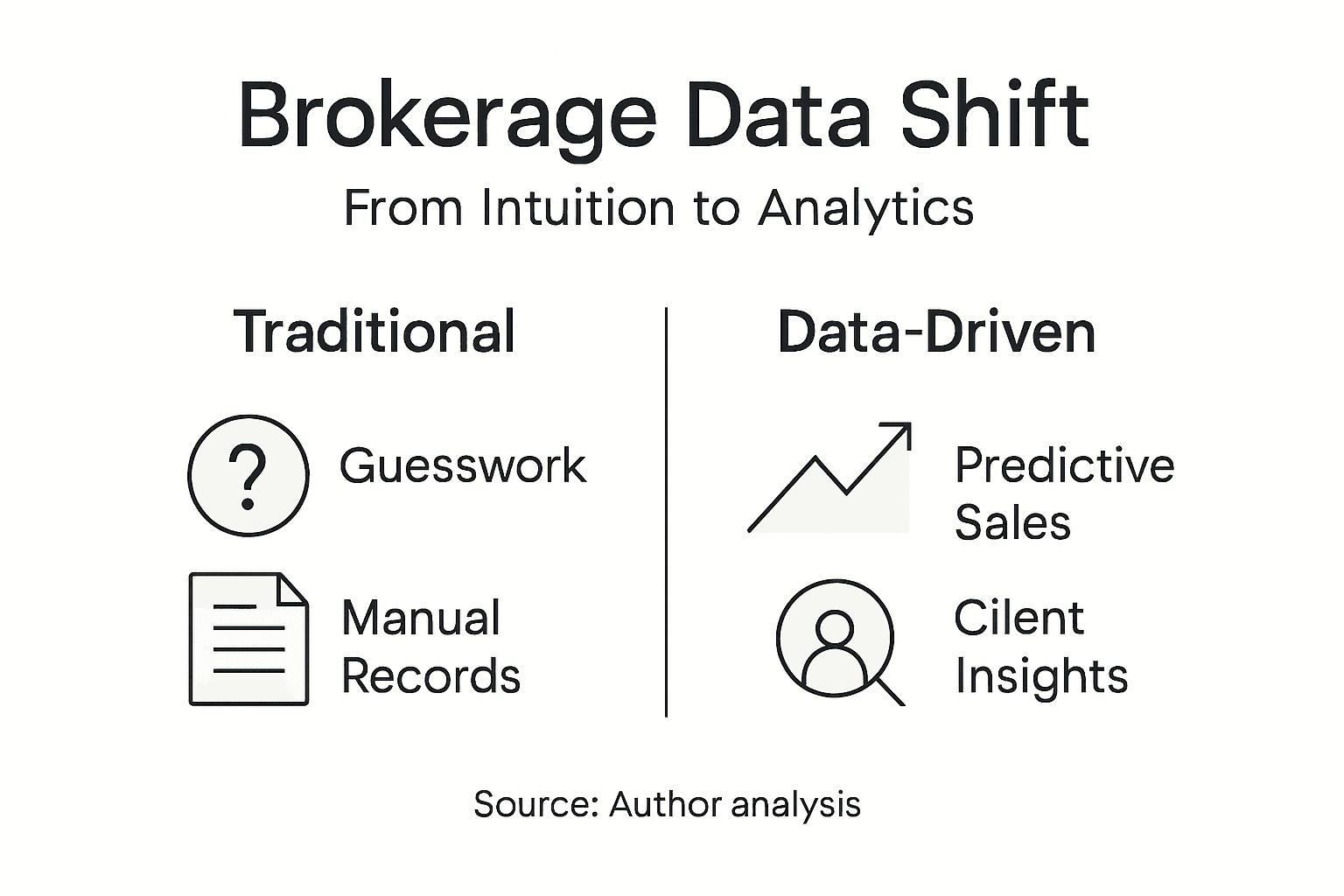
Advanced data analytics enables brokers to move beyond traditional intuition-based approaches, offering a more scientific method of understanding complex market ecosystems. By leveraging high-dimensional datasets, brokers can now predict market movements with unprecedented accuracy.
The transformation goes beyond mere number-crunching. Modern data strategies integrate multiple information streams – from client interaction histories to macroeconomic indicators – creating a holistic view of potential opportunities. This approach allows brokers to personalize their engagement, target specific client segments, and develop more strategic marketing approaches.
Pro tip: Invest in robust data management systems that can integrate multiple information sources and provide actionable, real-time insights.
Here is a summary table illustrating the evolving role of data in modern brokerages:
| Strategic Function | Traditional Approach | Modern Data-Driven Approach |
|---|---|---|
| Market Analysis | Intuition-based estimates | Real-time, predictive analytics |
| Client Engagement | General marketing | Personalized, segmented outreach |
| Risk Management | Manual review | Automated, algorithmic detection |
| Team Performance | Basic reporting | Dynamic, multi-metric measurement |
Key Data Types and Sources for Brokers
Brokers today must navigate a complex landscape of data types that provide critical insights into market dynamics, client behaviors, and investment opportunities. Understanding these diverse data sources is essential for developing comprehensive strategic approaches in luxury real estate and yacht brokerage environments.
The primary data categories for modern brokers include:
- Financial Datasets: Corporate financial reports, market performance metrics
- Customer Interaction Data: Transaction histories, communication logs, preference tracking
- Geospatial Information: Property location details, neighborhood economic indicators
- Market Trend Analytics: Pricing movements, inventory fluctuations, seasonal patterns
Complex data mapping strategies reveal the intricate relationships between different information streams. Brokers can leverage structured and unstructured datasets from multiple sources, including proprietary financial databases, government reports, and specialized market intelligence platforms.
These data sources can be categorized into three critical classifications:
- Primary Data: Direct client interactions and firsthand transaction records
- Secondary Data: Pre-existing financial reports and published market research
- Tertiary Data: Compiled research and aggregated market summaries
By integrating these diverse data streams, brokers can develop more nuanced understanding of market dynamics, predict client needs with greater accuracy, and create targeted marketing strategies that respond to real-time market conditions.
Pro tip: Develop a systematic approach to data collection that prioritizes quality over quantity, focusing on reliable and verifiable information sources.
The table below compares primary data source classifications brokers use, highlighting benefits and best use cases:
| Data Type | Main Source | Primary Benefit | Best Use Case |
|---|---|---|---|
| Primary Data | Direct client interactions | Custom insights | Client relationship building |
| Secondary Data | Published reports | Market context | Competitive benchmarking |
| Tertiary Data | Aggregated summaries | Broad overviews | Trend identification |
Using Data to Identify High-Value Clients
Identifying high-value clients has transformed from an art of intuition to a precise science powered by advanced data analytics. Modern brokers now leverage sophisticated techniques to segment and prioritize clients with the greatest potential for long-term engagement and revenue generation.
Key strategies for identifying high-value clients include:
- Behavioral Scoring: Tracking interaction frequency and engagement quality
- Financial Capacity Analysis: Evaluating transaction history and investment patterns
- Predictive Modeling: Using machine learning to forecast client lifetime value
- Network Influence Assessment: Measuring potential referral and network expansion capabilities
Predictive modeling techniques enable brokers to move beyond traditional demographic segmentation, creating more nuanced client profiles that reveal true revenue potential. By analyzing complex behavioral patterns, brokers can develop targeted strategies that align precisely with each client’s unique characteristics and aspirations.
The data-driven approach to client identification typically involves multiple sophisticated steps:
- Comprehensive Data Collection: Aggregating interaction records, financial indicators, and behavioral metrics
- Advanced Analytics Processing: Applying machine learning algorithms to identify patterns
- Dynamic Client Scoring: Creating comprehensive value assessment models
- Continuous Refinement: Regularly updating client profiles based on new interactions
Successful brokers understand that high-value client identification is not a one-time event but a continuous, dynamic process of understanding and anticipating client needs through intelligent data analysis.
Pro tip: Invest in robust data analytics platforms that can integrate multiple data sources and provide real-time insights into client potential.
Transforming Data Into Actionable Client Insights
The art of converting raw data into strategic business intelligence represents a pivotal capability for modern brokerages seeking competitive advantage. Transforming vast information streams into meaningful, actionable insights requires sophisticated analytical approaches that go far beyond traditional reporting methods.
Key components of effective data transformation include:
- Data Contextualization: Interpreting information within broader market dynamics
- Predictive Pattern Recognition: Identifying underlying client behavior trends
- Segmentation Strategies: Creating nuanced client profiles based on multidimensional metrics
- Strategic Recommendations: Generating targeted action plans from analytical findings
Organizational data integration strategies demonstrate that successful brokerages move beyond mere data collection toward creating contextual, qualitative insights that drive measurable business impact. By developing sophisticated analytical frameworks, brokers can translate complex data signals into clear, strategic recommendations.
The transformation process typically involves several critical stages:
- Data Aggregation: Collecting information from multiple sources
- Advanced Analytics: Applying machine learning and statistical modeling
- Insight Generation: Extracting meaningful patterns and relationships
- Strategic Recommendation: Developing targeted action plans
Successful data transformation requires brokers to view information not as static records but as dynamic, interconnected narratives that reveal deep insights about client behaviors, market trends, and potential opportunities.

Pro tip: Invest in cross-functional training that enables your team to interpret data analytically and translate insights into practical business strategies.
Compliance, Risks, and Data Security in Brokerages
Data security and regulatory compliance have become increasingly complex challenges for modern brokerages, requiring sophisticated strategies that balance operational efficiency with rigorous protection of sensitive client information. The digital transformation of financial services has exponentially increased both the potential risks and the technological capabilities for managing those risks.
Key compliance and security considerations include:
- Regulatory Framework Management: Navigating complex, evolving legal requirements
- Data Privacy Protection: Implementing robust cybersecurity measures
- Risk Mitigation Strategies: Developing proactive threat detection systems
- Client Information Confidentiality: Ensuring secure data handling protocols
RegTech solutions employing advanced technologies are revolutionizing how brokerages approach compliance and risk management. By leveraging artificial intelligence, machine learning, and blockchain technologies, brokers can create more adaptive and intelligent security frameworks that respond dynamically to emerging regulatory challenges.
The compliance landscape demands a multi-layered approach to risk management:
- Continuous Regulatory Monitoring: Tracking changes in global compliance requirements
- Advanced Cybersecurity Implementation: Deploying state-of-the-art protection mechanisms
- Comprehensive Data Governance: Establishing clear protocols for data handling
- Regular Security Audits: Conducting systematic vulnerability assessments
Successful brokerages recognize that compliance is not a static checkbox but a dynamic, ongoing process of adaptation, learning, and continuous improvement in an increasingly complex digital ecosystem.
Pro tip: Invest in integrated compliance platforms that provide real-time regulatory updates and automated risk assessment capabilities.
Unlock the Power of Data to Supercharge Your Brokerage Sales
The article highlights how leveraging advanced data analytics, client profiling, and predictive modeling is essential for modern brokers striving to identify high-value clients and transform insights into actionable strategies. If you struggle with managing multiple data streams, personalizing client outreach, or turning complex market patterns into clear sales opportunities you are not alone. These challenges can hold back your growth and dampen your impact.
At ex.plo.re we understand the urgency of streamlining the sales cycle while harnessing data intelligence to elevate your brokerage. Our platform integrates robust client data management with expert tools designed to simplify prospecting, improve personalized engagement, and boost productivity for luxury real estate and yacht brokers alike. Let us help you turn your data into your greatest sales asset.
Take control of your client relationships today by exploring how our technology and expert support empower brokers to anticipate market trends, personalize pitches, and amplify results. Visit ex.plo.re CRM Solutions now to start turning data complexity into your competitive advantage.
Frequently Asked Questions
How has data changed the decision-making process in brokerages?
Data has shifted from a record-keeping tool to a strategic asset in brokerages, enhancing decision-making through advanced analytics, market intelligence, and performance tracking.
What types of data are essential for modern real estate and yacht brokers?
Essential data types for brokers include financial datasets, customer interaction data, geospatial information, and market trend analytics to understand client behavior and market dynamics better.
How can brokers identify high-value clients using data?
Brokers can identify high-value clients by tracking behavioral scores, evaluating financial capacity, employing predictive modeling, and assessing network influence, allowing for targeted engagement strategies.
What are some best practices for data security and compliance in brokerages?
Best practices include continuous regulatory monitoring, implementing advanced cybersecurity measures, establishing comprehensive data governance, and conducting regular security audits to protect sensitive client information.