
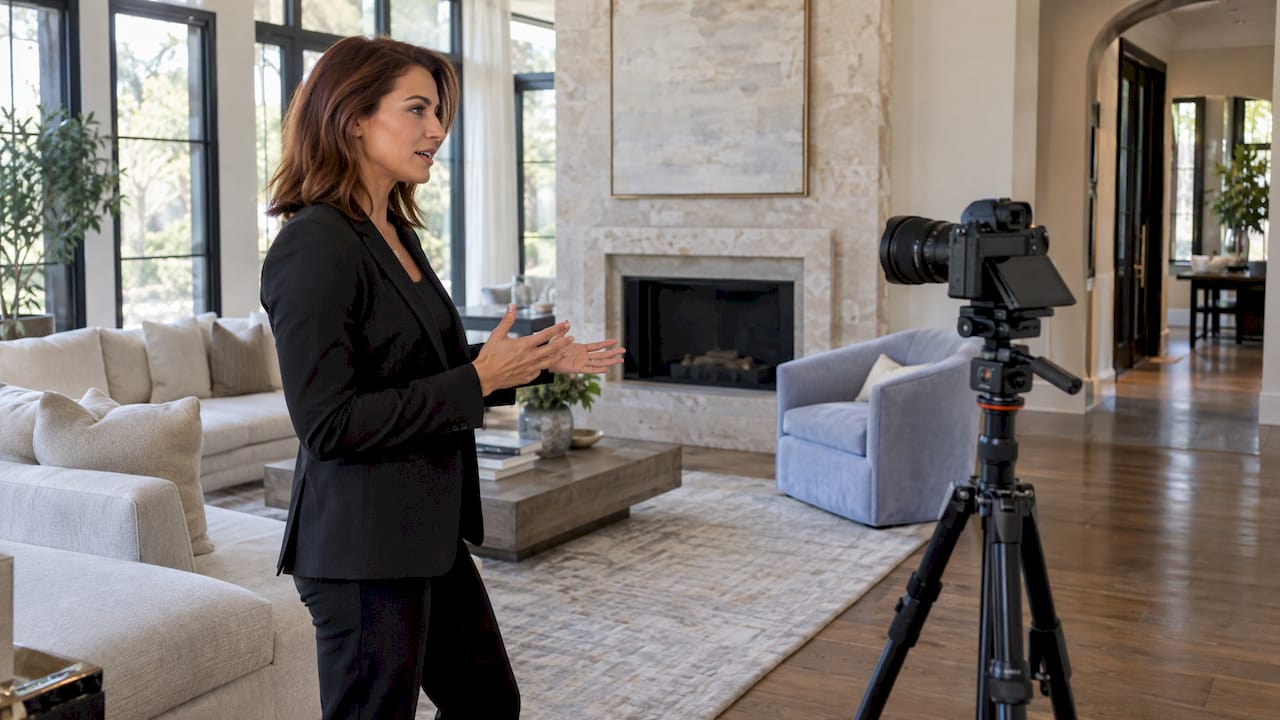
The agents winning on YouTube are not the ones with the best cameras. They are the ones who answer the questions their local buyers and sellers are already typing, week after week, and make it easy to call them afterward. Content gets people to your channel. A system turns those viewers into conversations. That is the whole game, and this guide covers both halves: what to film, how to keep a schedule you can actually hold, and how to catch the inquiries that follow.
TL;DR
- Overview: YouTube rewards agents who teach their own market. Neighborhood guides, honest home tours and plain-English market updates beat generic listing promos.
- Home tours had the highest median views in a 2026 analysis of US real estate videos, at 3,010, against 531 for listing and sale videos.
- One video a week, batch-recorded, beats bursts of effort followed by silence.
- Views are not the goal. Several agents report that practical, local videos with modest views produced more business than their viral ones.
- Put your contact information early, link a lead magnet in the description, and have a system ready to follow up.
Table of Contents
- Why YouTube fits the way agents win business
- What to film: video ideas that attract real prospects
- Luxury and yacht-adjacent storytelling
- Build a filming rhythm you can keep
- Turn views into local inquiries
- Measure what matters
- From viewer to client: the follow-up is where deals are won
- Our point of view
- Put a system behind your channel
- FAQ
- Sources
Why YouTube fits the way agents win business
A buyer relocating to your market does not want a slogan. They want to know what the commute feels like, what the HOA fees add up to and whether the neighborhood is quiet on a Tuesday night. YouTube is built for exactly that kind of search, and a video keeps answering it long after you posted it.
That is the difference from a feed post. A Reel or a story has a short shelf life. A video titled around a real local question can bring you inquiries for months. Florida Realtors profiled South Florida agent Larry Mastropieri, who credits his YouTube channel for tripling his sales from about 100 houses in 2024 to 300 in 2025. His team publishes videos on seven topics weekly, from new-construction updates to investor insights and community profiles. That is one agent’s result, not a promise, but it shows the ceiling when the habit sticks.
His most useful point is about expectations. Most of his videos reach 50 to 200 viewers, and those are people who want to transact. For a local business, that is a very healthy audience.
What to film: video ideas that attract real prospects
Start with questions, not with your listings. Here are the formats that keep surfacing among agents who report steady inbound leads.
Neighborhood and relocation videos
Seattle agent Sun told Real Estate News that her strongest inbound drivers are neighborhood recommendations, buyer and seller strategy breakdowns and market-truth videos that address decision anxiety. Another Keller Williams agent, Maslowski, got her first lead six weeks after shifting to relocation-based content, and estimates most agents need about three months of weekly posting before the first one arrives. Plan on a quarter, not a weekend.
She also uses negative-framed titles such as “Why I Would Never Live in North Georgia” to earn clicks, then turns the negatives into trade-offs. Poor public transit, for example, becomes the price of suburban space. The framing gets the click. The honesty earns the trust.

Money and cost-of-living breakdowns
Carol Cavallaro, a Villages, Florida agent profiled by Florida Realtors, found that her most-viewed video, “Living Single in The Villages,” with hundreds of thousands of views, generated far less business than her practical “Money Map” videos on taxes, bonds, CDD fees, amenity fees and insurance. Her takeaway, in the magazine’s October 2026 piece: the video with the most viewers does not always produce the most buyers.
She also advises agents to break everything down. Most agents try to cram too much into one short video. One question, one clear answer.
Home tours with a reason to watch
In the Thunderbit report of US real estate videos, home tours made up about 7.0% of videos but had the highest median views at 3,010. Agent advice followed at 1,203, luxury content at 1,123 and market updates at 911. Listing and sale videos sat at a median of 531. The lesson: the property has to be the main character, with a reason to watch beyond “it’s for sale.”
| Format | Median views (2026 US analysis) | Best used for |
|---|---|---|
| Home tours | 3,010 | Buyers comparing areas and price points |
| Agent advice | 1,203 | Building trust before a first call |
| Luxury content | 1,123 | High-end buyers and sellers |
| Market updates | 911 | Sellers and investors watching timing |
| Listing and sale videos | 531 | Supporting a specific active listing |
Source for all figures: Thunderbit’s YouTube viewership research. Medians describe typical videos, so treat them as a direction, not a target.
Honest tours build confidence
Cavallaro reports that two couples each bought homes priced above $500,000 in a single week without meeting her or seeing the properties in person. She had toured the homes on camera and pointed out concerns, like ceiling leaks, instead of just opening the door. Her description of the stance: be neutral and be honest.
Candor travels well across home content. Homeowners who read guides like living through a renovation respond to the same thing: someone who says plainly what the process is really like. A buyer watching a tour wants that same plain talk, and it is what makes the call at the end feel safe.
Luxury and yacht-adjacent storytelling
If you sell at the top of the market, your viewer is not shopping on price alone. They are evaluating who you are. Two approaches stand out.
Cinematic short films. SERHANT. Studios produced five short films in its “Through The Lens Of” series, each styled after a famous director. According to the Shorty Awards entry, the campaign drew 329,000 impressions, marketed $65.65M of New York City properties and contributed to $31M going under contract. You do not need a studio. You do need a point of view and a consistent look.
Long-form walk-throughs with commentary. The Thunderbit research summarizes advice for luxury agents: put the price and neighborhood in the title, give one short video per listing a title built on the address, and answer local relocation questions. Longer tours of 20 to 30 minutes with broker commentary on value, plus area-based playlists and chapters, serve serious buyers who want detail.
The same logic applies to yacht and other high-ticket brokers. The buyer wants to see the asset, hear an expert explain why it is priced where it is and sense that you are the person who will handle the details.
Build a filming rhythm you can keep
Most channels fail from inconsistency, not from bad video. A few working routines from agents who report results:
- Keep an idea library. Sun’s Seattle team draws weekly from an online library of over 100 ideas born from client conversations, search trends and market shifts. Every question a client asks you is a title.
- Plan in batches. Keller Williams agents quoted by Real Estate News plan four to six videos at a time. Maslowski batch-records twice a month and hands editing to a professional. Sun spends about four hours a week filming and posts one educational or market video plus one property video weekly.
- Start at one a week. Aaron Cuha, on a REVB podcast episode in October 2026, suggests starting with one video a week until you have five in the can. He says the algorithm takes 10 to 15 consistent videos to trust a channel.
- Never leave a gap. Cuha would rather you post a 3-minute video than skip a week, even if it limits that video’s reach. He also says a dormant channel can be revived simply by posting consistently again.
- Keep the bar sensible. Karin Carr’s view, also reported by Real Estate News: one video a week of four to ten minutes is plenty, because good enough is good enough.
The agents in these stories use AI for research, outlines and thumbnails, with one team estimating about 80% of that prep. Mastropieri adds a caution worth following: do not hand the editing to AI entirely, because it will not carry your personality or your individual expertise. Viewers hire a person.
Turn views into local inquiries
A video that does not invite a next step is just entertainment. A few moves that agents in these reports used:
- Put your contact information at the start. Cavallaro moved hers to the beginning of her videos and reports four calls in two days.
- Match a lead magnet to the video. Reel-e.ai, quoted by Real Estate News, recommends pairing each video with a relevant download in the description and pinned comment, along with a calendar link. A cost guide under a cost video. A relocation checklist under a relocation tour.
- Repurpose. Mastropieri posts on multiple channels and turns transcripts into website articles, so one recording feeds several surfaces.
- Aim at leads, not virality. Remember the 50 to 200 viewers who want to transact.
One podcast update from a Texas-area agent reported that 37 long-form videos generated 67 inbound leads. That is a self-reported figure from a single agent, so read it as an illustration of what steady long-form output can do, not as an average.
Measure what matters
You do not need a dashboard full of vanity numbers. YouTube Analytics lives in YouTube Studio, and one explainer on its metrics boils the useful ones down to impressions, click-through rate, average view duration and retention, traffic sources and subscribers gained. Click-through rate tells you whether the title and thumbnail earn the click. Average view duration tells you whether the video keeps its promise.
Then add the one metric YouTube cannot give you: inquiries. For each video, log how many calls, form fills and downloads followed. After ten videos you will see which topics pay. Cavallaro’s experience says it may not be your most-watched one.
From viewer to client: the follow-up is where deals are won
Here is the part most agents skip. A viewer who downloads your relocation guide at 11 p.m. is warm for about a day. If the first reply comes three days later, the moment is gone. The video did its job, and the follow-up wasted it.
That is why we build around the whole cycle, not just the content. Our Marketing suite is priced at $445 per month and sits alongside the CRM, email marketing and social media campaign tools we offer, so the person who found you on YouTube lands in a system instead of a notes app. Automated emails keep that new contact hearing from you while you are out showing homes.
Our point of view
We talk to agents who have a great video, a few hundred views and no idea who watched it. The content was never the problem. The gap is what happens after someone raises a hand.
Our view is simple. Video is the front door, and your pipeline is the house. An agent who films every week but follows up by memory will lose people to the agent who films less and responds the same hour. That is why we put sales automation, CRM, email marketing, listing management and social media campaign tools in one place, and why we back them with expert-led onboarding.
If you want more local clients, do not chase the viral spike. Teach your market, make it easy to reach you and let your system carry the follow-up. That is how you control the narrative in your own area.
Jason
Put a system behind your channel
If your videos are already earning attention, the next lift is capturing it. Our Marketing suite is $445 per month. If you want a person on the work, the Lead-gen expert service is $1,000 per month and the Marketing manager service is $1,000 per month. For teams that want guaranteed lead volume, the Leads Guaranteed plan is $5,899 per month, and the Performance Partner plan starts from $6,000 per month. See everything on our pricing page, or read how brokerage marketing automation works for real estate, yacht and luxury sales teams.

Bring your next five video ideas and we will help you build the pipeline that catches the people who watch them.
FAQ
How often should a real estate agent post on YouTube?
One video a week is a solid standard. Cuha suggests building a buffer of five finished videos, then staying consistent, since he says the algorithm takes 10 to 15 videos to trust a channel. Carr’s view is that four to ten minutes weekly is plenty.
How long before YouTube brings leads?
It varies. Maslowski got her first lead six weeks after switching to relocation content and thinks most agents need about three months of weekly posting. Plan for a full quarter before judging.
Do I need high-end equipment or editing?
No. The agents quoted here emphasize useful local information and a genuine personality over production polish. Many batch-record twice a month and delegate editing, which keeps the weekly schedule realistic.
What should I put in the description of each video?
Your contact details and a lead magnet that matches the video, such as a cost guide or relocation checklist, plus a calendar link. Repeat it in a pinned comment so viewers see it whether or not they open the description.
Sources
- How KW agents turn YouTube into a predictable lead source, Real Estate News
- The Formula Behind Successful YouTube Channels, Florida Realtors
- How to make YouTube your always-on lead generator, Florida Realtors
- Research Report: YouTube Viewership for US Real Estate, Thunderbit
- Through The Lens Of, Shorty Awards
- Episode 121: Aaron Cuha, REVB podcast
- YouTube Analytics Explained