
Yes, TikTok ads can generate buyer, seller, and referral leads when you run a focused Lead Generation or In-Feed test and follow up fast. Launch one Lead Gen campaign built around a 15 to 30 second native walkthrough with an Instant Form attached, and give it two weeks. Watch two numbers only: cost per lead and how many of those leads actually book an appointment.
TL;DR:
- Running focused TikTok lead generation campaigns with a simple native walkthrough and instant form can effectively generate buyer, seller, and referral leads within two weeks.
- The best ad format for real estate is in-feed ads with an instant form, while other formats like website conversions or TopView are less suitable for small teams.
- Compliance requires flagging housing-specific ads, avoiding biased language or imagery, and carefully tracking rejection reasons to prevent account issues.
- Authentic, phone-shot videos, especially neighborhood tours and quick market updates, outperform highly produced promos, with hooks landing in the first two seconds being crucial.
- Effective targeting involves a 15-30 mile radius, 2-3 interest overlays, behavioral signals, and CRM lookalikes, with adjustments based on real-time data rather than assumptions.
Table of Contents
- Can You Advertise Real Estate on TikTok? The Quick-Start Checklist
- Which TikTok Ad Format Should Real Estate Agents Use?
- What Are the Housing Compliance Rules for TikTok Real Estate Ads?
- What Creative Actually Works for Real Estate TikTok Ads?
- How Should Agents Target Real Estate TikTok Ads?
- What Should Go on a TikTok Real Estate Instant Form?
- What Do TikTok Real Estate Ads Cost, and What Should You Track?
- How Do You Test and Scale a TikTok Real Estate Campaign?
- How Plo Helps Agents Execute a TikTok Ad Strategy
- An Editorial Take on Where TikTok Ads Actually Fit
- Ready for a Managed TikTok Ad Strategy for Real Estate?
- Sources
- FAQ
Can You Advertise Real Estate on TikTok? The Quick-Start Checklist
You can, and the fastest way to find out if it works for your market is to launch one clean test rather than five scattered ones. Here’s the sequence that gets a real estate TikTok strategy live within a week without wasting budget on guesswork:
- Pick your objective and flag Housing category. If the ad touches a specific listing or property, TikTok requires the Housing special ad category. Select it before you build anything else.
- Define your geography and one interest overlay. A metro area or city radius, paired with a single interest layer like home improvement, is enough to start.
- Shoot one native walkthrough or neighborhood video. Fifteen to thirty seconds, phone camera, no polish required.
- Build an Instant Form. Name, phone, email, and one qualifying question.
- Wire the form into your CRM with a same-day follow-up workflow already switched on.
- Set a $50 to $100 daily budget and give the campaign a full two to four week learning window before judging it.
Skip any one of these steps and you’re not really testing TikTok ads for realtors. You’re testing whether luck shows up.
Which TikTok Ad Format Should Real Estate Agents Use?
Format choice depends entirely on what you’re trying to accomplish, and most agents pick the wrong one because they chase whatever looks flashiest in the ad manager.
- In-Feed Ads with an Instant Form are the default for lead capture. They keep the entire buyer or seller journey inside the app, which TikTok’s own ad guidance for real estate businesses treats as the most practical objective for agents without a dedicated landing page team.
- Website conversions make sense only if you already have a working landing page with a pixel installed. Without that infrastructure, this objective wastes spend.
- Spark Ads let you put budget behind a post that’s already performing organically, which amplifies proof rather than guessing at a fresh script.
- Promote is the low-effort button for boosting a single video without building a full campaign structure. It’s a fine training-wheels move for your first week.
- TopView and Brand Takeover belong to national brands with six-figure awareness budgets, not solo agents or small teams. Skip them entirely.
Most agents should live in In-Feed and Spark Ads. Everything else is a distraction from the two formats that actually generate pipeline.
What Are the Housing Compliance Rules for TikTok Real Estate Ads?
Any ad tied to a specific property, price, or listing falls under TikTok’s Housing special ad category, and that classification restricts certain demographic targeting to comply with fair housing standards. Age, gender, and zip-code exclusion targeting are off the table once you flag an ad as housing-related, though city and metro-level geography along with interest-based overlays remain fully available, according to TikAdSuite’s 2026 growth guide.
Run through this before you submit anything:
- Confirm Housing category is selected for any listing-specific creative.
- Remove any language implying preference for or exclusion of a protected class.
- Avoid imagery that could be read as steering buyers toward or away from a neighborhood based on who lives there.
- Keep screenshots of every submitted ad and its approval status in case you need to dispute a rejection later.
If TikTok rejects an ad, don’t just resubmit the same creative and hope. Read the rejection reason carefully, adjust the specific flagged element, and reapply. Repeated rejections without changes can trigger a review of your entire ad account, not just the one campaign.
Pro Tip: Keep a simple spreadsheet logging every ad’s compliance category, submission date, and outcome. When you’re running multiple campaigns across listings, that record becomes the fastest way to spot a pattern before it becomes an account-level problem.
What Creative Actually Works for Real Estate TikTok Ads?
Overproduced real estate promos with drone shots and cinematic music routinely underperform against a phone-shot walkthrough filmed the same afternoon a listing goes live. TikAdTools’ 2026 strategy breakdown confirms what most agents learn the hard way: native, authentic footage outperforms polish because it matches what people already expect from their feed.
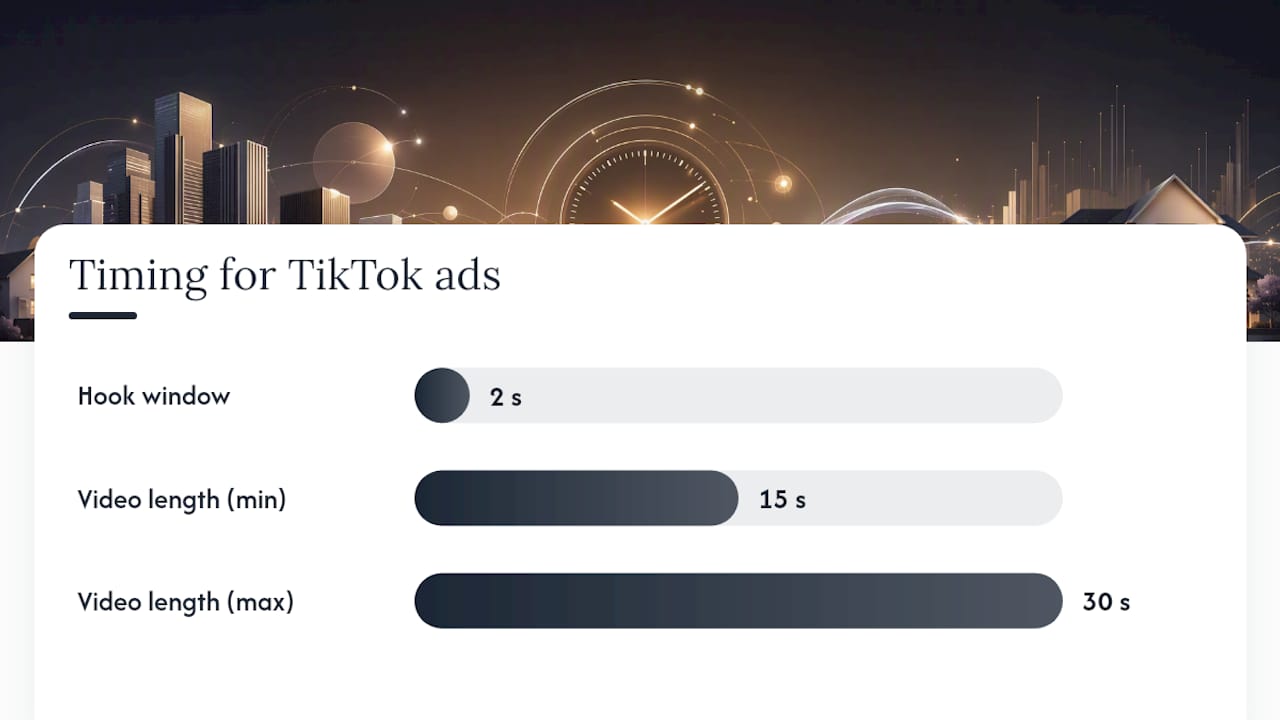
Your hook has to land in the first two seconds, either visually (the front door opening, a surprising room) or verbally (“this listing has a secret room”). Everything after that hook needs captions carrying the key details, since a meaningful share of viewers watch with sound off.
Build your content around four repeatable pillars:
- Neighborhood tours that sell the area, not just the address.
- Short market updates that position you as the local expert, not just a listing agent.
- Client milestone clips like handing over keys or a sold sign going up.
- “Why this house” hooks that lead with the one detail that makes a property worth stopping to watch.
Keep videos between 15 and 30 seconds, test two or three headline variations per creative, and refresh your content library every 7 to 14 days. Marketers who let a hook run past two weeks watch performance decay as the same audience sees it repeatedly.
Pro Tip: Film in small batches throughout the week rather than trying to produce one polished video a month. A rougher clip filmed the day a client gets their keys almost always beats a scripted version filmed three weeks later.
How Should Agents Target Real Estate TikTok Ads?
Special Ad Category restrictions eliminate some of the precision agents are used to from other platforms, so the targeting recipe that works is simpler than most expect.
- Start with a 15 to 30 mile radius around your target market.
- Layer in two or three interests: real estate, mortgage, or home improvement.
- Add behavioral signals where TikTok makes them available, particularly recent video watch history tied to home content.
- Upload your CRM contact list to build a lookalike audience, staying within TikTok’s data handling rules for housing ads.
- Widen geography and interest layers only after your two to four week learning window closes and you have enough data to judge performance.
One insight worth acting on directly: GetHookd’s review of recent campaigns found that Opendoor’s broader-target tests outperformed narrowly segmented audiences under Housing category limits. The algorithm, given good native creative, often finds better buyers than a hand-picked audience does. Don’t over-engineer your targeting in week one. Let the creative do the work and adjust from real data, not assumptions.
What Should Go on a TikTok Real Estate Instant Form?
Every field you add to an Instant Form costs you completions, so the winning formula is short: name, phone, email, and exactly one qualifying question. That fourth field should ask about timeline (“When are you looking to move?”) or budget range, since either answer lets you triage the lead before you ever pick up the phone.
Longer forms feel thorough but usually just suppress volume without improving lead quality enough to justify it. Here’s the sequence that turns a form fill into a booked appointment:
- Trigger an automated email and SMS within minutes of form submission, confirming receipt and setting expectations for a call.
- Call within 24 hours, ideally same-day. Follow-up speed is consistently the single biggest variable separating agents who convert leads from agents who don’t, according to TikAdSuite’s research.
- Score the lead inside your CRM based on the qualifying answer, so hot leads surface above browsers.
- Route qualified leads to a nurture sequence if they’re not ready to talk yet, rather than letting them go cold.
Wiring your CRM to fire the moment a form submits, rather than checking leads manually once a day, is the difference between a lead-generation system and a leaky bucket.
What Do TikTok Real Estate Ads Cost, and What Should You Track?
Standard residential campaigns typically run $15 to $60 per lead, with luxury segments often landing higher depending on market and how many fields your form asks for. That range only tells half the story, though. A $60 lead that books an appointment 40% of the time beats a $20 lead that converts at 5%, so judge CPL alongside your conversion rate, never in isolation.
| Metric | What it measures | Why it matters |
|---|---|---|
| Cost per lead (CPL) | Spend divided by form completions | Entry-level efficiency signal |
| Lead-to-appointment rate | Leads that book a call or showing | Quality check on CPL |
| Appointment-to-listing/sale rate | Appointments that convert to business | True revenue predictor |
| Cost-per-client | Total spend divided by closed clients | The number that actually matters |
Start with $50 to $100 a day, and once a campaign clears its learning window with a workable cost-per-client, scale budget in 20 to 30% increments rather than doubling overnight. TikAdTools’ platform comparison notes TikTok often beats Facebook on CPL for residential segments, though Facebook still holds an edge on retargeting infrastructure, so the two channels work best coordinated rather than pitted against each other.
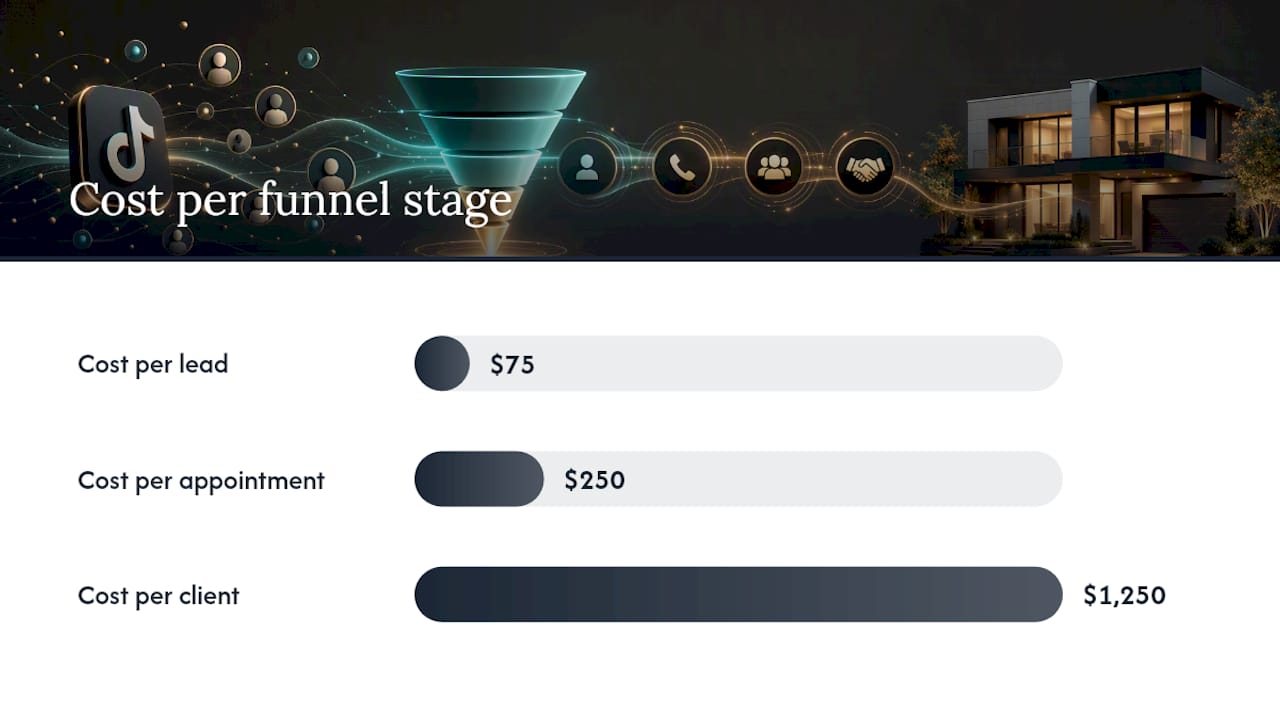
Run the math on a simple example: $75 CPL, a 30% lead-to-appointment rate, and a 20% appointment-to-client rate puts your cost-per-client at roughly $1,250. That’s the number to compare against your average commission before deciding whether to scale.
How Do You Test and Scale a TikTok Real Estate Campaign?
Run two to four creative variants at once, and test hooks separately from offers so you know exactly which element moved the number. Give each test a full two to four week learning window before drawing conclusions. TikTok’s algorithm needs that runway to optimize delivery, and pulling the plug at day three tells you nothing reliable.
- Refresh creative every 7 to 14 days and retire hooks that stall out.
- Double down on winners with Spark Ads rather than rebuilding a new campaign from scratch.
- Use Promote to rapidly amplify a top organic post while your paid campaign is still in its learning phase.
- Scale budget gradually and watch appointment rates, not just CPL, as the signal that a campaign is ready to grow.
Novelty keeps the algorithm responsive. A hook that crushed it in week one will fade by week three if you never refresh it.
How Plo Helps Agents Execute a TikTok Ad Strategy
Running this playbook solo takes real hours: scripting, filming, form-building, CRM wiring, and daily monitoring, all on top of showings and closings. A platform and team can handle the parts that eat an agent’s week, from AI-assisted ad creation to managed campaign execution and CRM automation that fires follow-up the moment a lead submits a form.
That speed matters more than most agents realize. Faster automated follow-up directly raises appointment rates, since the agents who call first tend to be the agents who close. Certain playbooks, including the Instagram ads framework for booking showings and broader lead generation strategies for 2026, give you a coordinated approach across platforms rather than a single-channel bet.
If you’re deciding whether to build this in-house or bring in a managed partner, that decision itself deserves more than a guess.
An Editorial Take on Where TikTok Ads Actually Fit
TikTok ads work best for agents selling in competitive local markets with a property type that photographs or films with personality, think starter homes, renovated flips, or lifestyle-heavy listings, rather than commercial or highly generic inventory. If your market is thin on inventory and thick on competition, video differentiation matters more than it does in a slow market where any listing gets attention.
The biggest pitfall isn’t creative quality. It’s slow follow-up killing a lead that cost real money to generate, or skipping the Housing category checkbox and getting an account flagged. A distant second pitfall is overproducing creative when a phone-shot walkthrough would have performed better and cost nothing to make.
Give a focused test 30 to 45 days before judging it. Anything shorter measures noise, not signal.
— Jason
Ready for a Managed TikTok Ad Strategy for Real Estate?
There are practical all-in-one AI-powered platforms combining ad creation, managed campaigns, CRM automation, and lead guarantees, so you don’t have to stitch together multiple tools and hope the follow-up happens in time.
The Leads Guaranteed plan runs $5,899 per month and pairs guaranteed lead volume with the automation infrastructure to actually convert it, while the Marketing suite at $445 per month covers agents who want the tools without the full managed service. If you’d rather have a dedicated expert build and run campaigns for you, the Lead-gen expert service runs $1,000 per month. Every plan connects to the same CRM backbone that turns a TikTok Instant Form submission into a same-day phone call instead of a lead going cold in an inbox somewhere. Book a demo and see exactly how a managed campaign would look for your market before you commit a single ad dollar.
Sources
- TikTok Ads for Real Estate Businesses: A 2026 Growth Guide – TikAdSuite
- TikTok Ads for Real Estate: 2026 Strategies That Actually Work – TikAdTools
- The Scroll-To-Sold TikTok Strategy To Yield 10 Closings In 120 Days | Inman Real Estate News
- 3 Top TikTok Real Estate Ads Examples to Try in 2026 – GetHookd
FAQ
Can you advertise real estate on TikTok?
Yes. TikTok allows real estate advertising as long as listing-specific ads are flagged under the Housing special ad category, which restricts certain demographic targeting to keep campaigns compliant with fair housing standards.
What is the 3-3-3 rule in real estate?
The 3-3-3 rule is a home-buying budgeting guideline (roughly 3% down, a payment under 3 times gross income, and a mortgage under 3 times income), not a TikTok advertising framework. It’s unrelated to ad strategy, so agents should not confuse it with campaign structure or testing timelines.
Are TikTok real estate agents legit?
Agents genuinely close deals and generate referrals through TikTok. Practitioner reporting, including a documented case of 10 closings in 120 days built on authentic storytelling, shows the platform produces real pipeline, not just vanity views.
How to make $1,000 a month from TikTok?
For agents, the realistic path isn’t TikTok creator payouts. It’s using ads and organic content to generate leads that convert into commission income, which is why pairing a $50 to $100 daily test budget with fast follow-up matters more than chasing platform monetization programs. Managed options like Plo’s Lead-gen expert service exist specifically to turn that ad spend into booked appointments.