

Virtual tours are interactive 360-degree digital experiences that let buyers explore a property, yacht, or retail space remotely without stepping foot inside. The case for why use virtual tours is now backed by hard numbers: businesses integrating 360-degree tours report 16%–67% increases in conversion rates and bookings, alongside a 40% drop in unnecessary physical viewings. That is not a marginal gain. It is a structural shift in how buyers make decisions. For real estate agents, luxury brokers, and property owners, virtual tours have moved from a novelty to a core sales tool that filters, qualifies, and closes clients faster.
Why use virtual tours to boost engagement and sales?
Virtual tours convert passive browsers into active participants. That shift matters because passive consumption to interactive exploration increases engagement in ways static photography simply cannot replicate. A buyer scrolling through listing photos is skimming. A buyer navigating a 360-degree tour is making decisions.
The data confirms this. Websites featuring interactive virtual tours see 5–10 times longer on-site duration and up to 10 times more overall engagement compared to sites with only static images. Longer time on site signals genuine buyer intent. It also tells Google’s algorithm that your content is worth ranking.
Buyers who engage with a virtual tour arrive at the conversation already informed. They have walked the floor plan, checked the light in the master bedroom, and assessed the kitchen layout. That pre-qualification shortens your sales call and raises the quality of every lead you speak to.
- Longer sessions: Buyers spend significantly more time on listings with virtual tours, signaling stronger purchase intent.
- Higher lead quality: Prospects who contact you after a tour have already self-selected. They are serious.
- Reduced objections: Buyers who have explored a space remotely raise fewer basic questions during live presentations.
- Better trust signals: Transparency builds confidence. Showing everything, including the flaws, positions you as an honest broker.
Pro Tip: Optimize your virtual tour for mobile before launch. The majority of property searches begin on a smartphone, and a tour that loads slowly or navigates poorly on mobile will lose buyers before they even start exploring.
What commercial benefits do virtual tours offer property owners?
The commercial case for virtual tours is measurable and immediate. Buyers who engage with a tour are up to 67% more likely to complete a booking or purchase. The reason is straightforward: uncertainty kills deals, and virtual tours eliminate uncertainty before the conversation begins.

The 40% reduction in unnecessary physical viewings is equally significant. Every wasted showing costs you time, travel, and energy. When buyers have already toured a property digitally, the ones who book an in-person visit are genuinely interested. Your calendar fills with qualified appointments instead of tire-kickers.
The benefits extend well beyond residential real estate. Hospitality brands use virtual tours to drive direct bookings by letting guests preview rooms, lobbies, and amenities before committing. Retail and commercial property owners use them to attract tenants by showcasing floor plans and build-out potential. Yacht brokers use them to qualify international buyers who cannot fly in for a first look.
Virtual tours also function as 24/7 lead filters, moving prospects further along the decision cycle without any effort from your team. A buyer in a different time zone can tour your listing at midnight and arrive in your inbox ready to make an offer. That is a sales asset that works while you sleep.
- Hospitality: Hotels and resorts report higher direct booking rates when virtual tours replace or supplement static room galleries.
- Commercial real estate: Tenants can assess fit and layout before requesting a physical walkthrough, reducing wasted broker time.
- Luxury sales: International buyers for yachts, estates, and high-end properties rely on virtual tours to justify long-distance travel.
- Retail: Brands use virtual tours of flagship stores to build brand credibility and drive foot traffic.
Pro Tip: Treat your virtual tour as a modular asset. Scenes, hotspots, and content layers can be updated without reshooting, so you can refresh pricing, availability, or featured amenities without rebuilding the entire experience.
How to integrate virtual tours into your marketing strategy
A virtual tour sitting on a listing page and doing nothing else is a missed opportunity. The real advantage comes when you embed it as a functional tool across your entire sales and communication plan. Treating virtual tours as strategic tools, rather than isolated gimmicks, is what separates agents who see ROI from those who write them off as expensive extras.
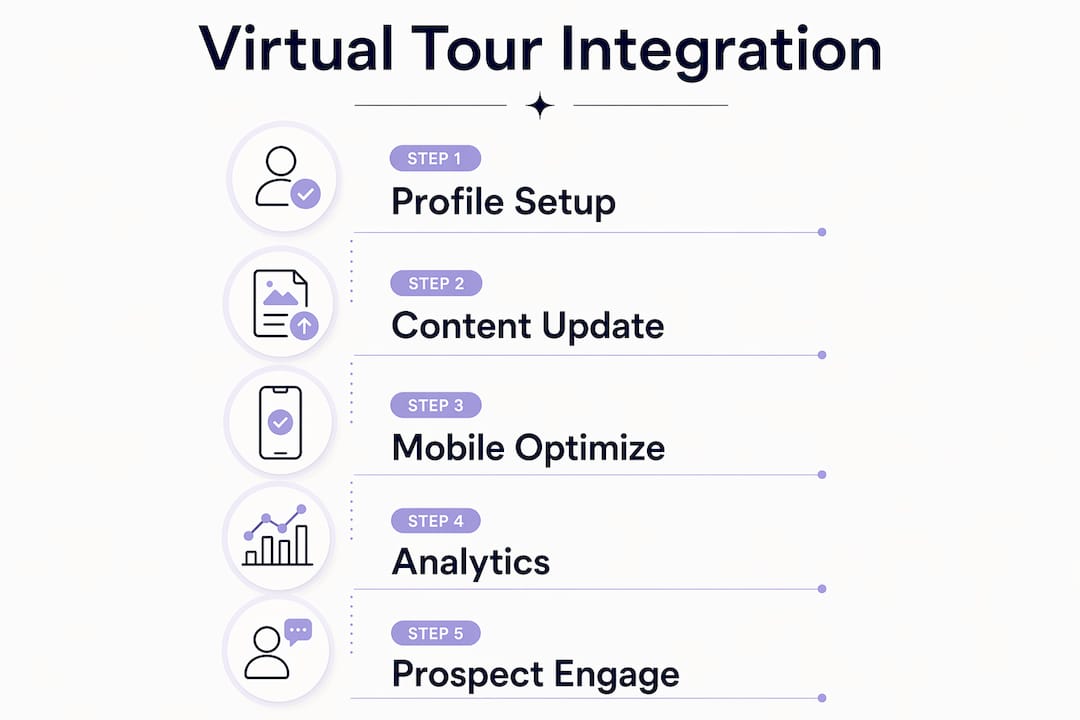
Start with your Google Business Profile. Google Business Profiles featuring virtual tours gain significantly more views and clicks, which directly improves local SEO rankings. For agents competing in dense urban markets, that visibility advantage compounds over time. Pair your tour with a well-optimized profile and you capture buyers at the exact moment they are searching locally.
For remote and B2B sales, virtual tours replace the first in-person visit entirely. A corporate relocation buyer evaluating six cities does not need to fly to each one. Send them a curated tour and follow up with a live video walkthrough. You control the narrative and the pace of the conversation. Read more about hosting tours that convert to structure that process effectively.
| Feature | Virtual tours | Traditional video |
|---|---|---|
| Buyer control | Full: buyers navigate at their own pace | None: linear playback only |
| Update flexibility | Modular: scenes updated without reshooting | Full reshoot required for changes |
| Lead qualification | High: self-selecting, engaged prospects | Low: passive viewers with no interaction |
| SEO benefit | Strong: improves dwell time and Google profile visibility | Minimal: limited engagement signals |
| Sales cycle impact | Accelerates: buyers arrive pre-qualified | Neutral: buyers still need in-person visits |
The table above makes the distinction clear. Traditional video is a broadcast. A virtual tour is a conversation. The impact of digital marketing on real estate success depends on choosing tools that create dialogue, not monologue.
What are the practical steps for implementing virtual tours?
Getting a virtual tour live is straightforward. Getting one that actually converts requires deliberate choices at every step.
Start with technology fundamentals. Mobile optimization is non-negotiable. Balancing visual fidelity with usability features like hotspots, mini-maps, and intuitive navigation is what separates a tour that converts from one that frustrates. A stunning tour that takes 12 seconds to load on a phone will lose buyers before they see the first room.
These are the features every effective virtual tour needs:
- Intuitive navigation: Buyers should move through the space naturally, without reading instructions.
- Hotspots: Clickable information points that surface pricing, specs, features, or contact forms at the right moment.
- Content layers: Embedded video clips, floor plans, or documents that deepen buyer understanding without leaving the tour.
- AR and AI integration: Augmented reality overlays for furniture placement and AI concierge chatbots that answer buyer questions in real time.
- Analytics dashboard: Granular data on which rooms buyers spend the most time in, where they drop off, and which hotspots they click.
Budgeting for a virtual tour is a one-time investment with ongoing returns. Because tours are modular, you update content rather than rebuild. That makes the cost-per-lead drop significantly over a listing’s lifecycle.
Pro Tip: Connect your virtual tour analytics to your CRM. Knowing which buyers spent 8 minutes in the master suite and clicked the pricing hotspot twice tells you exactly who to call first and what to lead with.
Key Takeaways
Virtual tours are the most effective tool for qualifying buyers, reducing wasted showings, and closing deals faster across real estate, hospitality, and luxury sales.
| Point | Details |
|---|---|
| Conversion rate lift | Businesses report 16%–67% higher bookings after adding virtual tours to listings. |
| Engagement multiplier | Sites with virtual tours see up to 10x more engagement than those with static images only. |
| Lead qualification | Tours act as 24/7 filters, delivering pre-qualified buyers who are ready to act. |
| SEO advantage | Google Business Profiles with virtual tours earn more views and clicks, improving local rankings. |
| Modular asset value | Scenes and hotspots update without reshooting, keeping tours relevant at low ongoing cost. |
The real reason virtual tours change the game
I have watched agents spend thousands on photography, staging, and print advertising, then wonder why their listings sit. The answer, almost every time, is that they are giving buyers information without giving them experience. A photo tells a buyer what a room looks like. A virtual tour tells them how it feels to stand in it.
What I find most underused is the lead qualification function. Agents treat virtual tours as a marketing expense. The smarter frame is to treat them as a sales filter. Every buyer who contacts you after completing a tour has already decided the space is worth their time. That changes the entire dynamic of the first conversation. You are not selling. You are confirming.
The modular nature of virtual tours also changes how I think about content investment. A well-built tour is not a one-listing asset. The technology, the workflow, and the brand presentation carry forward. Agents who build this capability once and refine it over time develop a compounding advantage over those who treat each listing as a fresh start.
The future of this technology points toward AI concierge integration and real-time personalization. Buyers will soon navigate tours that surface information based on their browsing behavior and ask questions answered instantly by an embedded AI. Agents who are already comfortable with the format will adapt quickly. Those who waited will be catching up.
— Jason
How Plo amplifies your virtual tour results
Virtual tours generate the engagement. Plo converts that engagement into closed deals. Plo’s prospecting and sales tools are built for real estate agents, luxury brokers, and yacht brokers who want to move faster from first contact to signed contract. When your virtual tour delivers a pre-qualified lead, Plo’s workflow picks up immediately, tracking that prospect, surfacing the right follow-up, and keeping your pipeline moving. Explore Plo’s top prospecting tools to see how the full system works together. You can also review the client acquisition workflow built specifically for agents competing in local markets.
FAQ
What is a virtual tour in real estate?
A virtual tour is an interactive 360-degree digital experience that lets buyers explore a property remotely. It replaces or supplements the first in-person showing by giving buyers full control over how they navigate the space.
How much do virtual tours increase conversions?
Businesses integrating virtual tours report conversion rate increases of 16%–67% and a 40% reduction in unnecessary physical viewings. Buyers who complete a tour are up to 67% more likely to book or purchase.
Do virtual tours help with SEO?
Google Business Profiles featuring virtual tours earn significantly more views and clicks than those without. That increased engagement improves local search rankings and drives more organic traffic to your listings.
How often should I update a virtual tour?
Because virtual tours are modular, you can update individual scenes, hotspots, and content layers without reshooting the entire experience. Update pricing, availability, or featured details whenever they change.
Are virtual tours worth it for small brokerages?
Virtual tours deliver the same lead qualification and conversion advantages regardless of brokerage size. The modular update model keeps ongoing costs low, making the return on investment strong even for independent agents and small teams.