

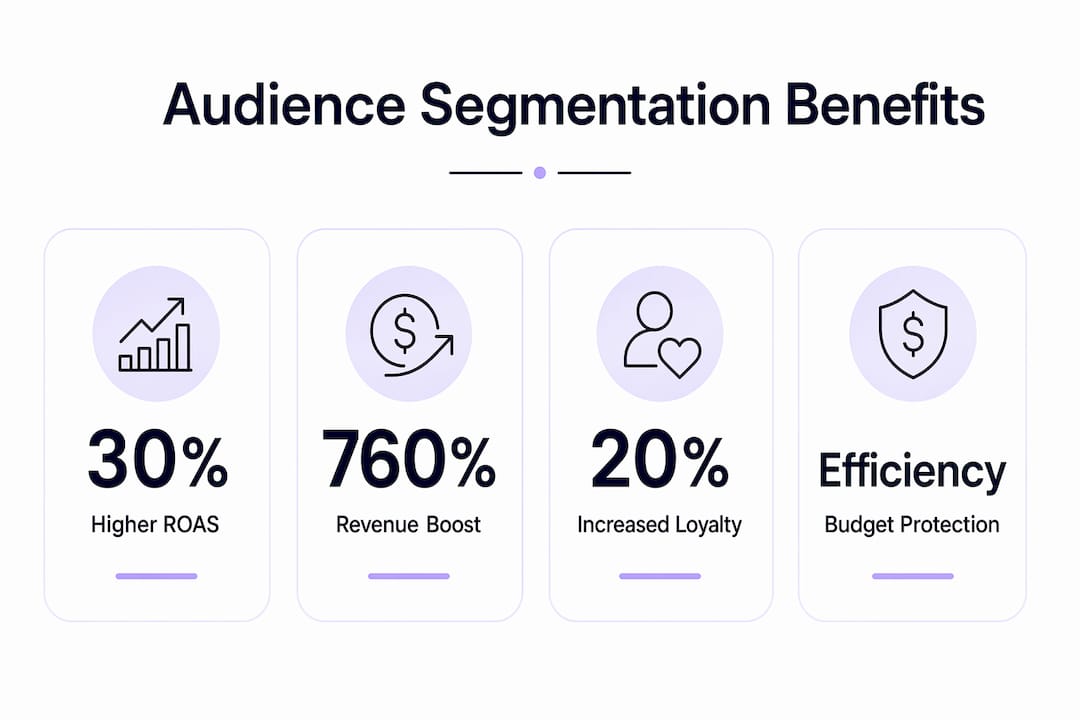
Audience segmentation is the practice of dividing your market into distinct groups based on shared characteristics to deliver more targeted communication and improve business outcomes. For real estate agents, luxury brokers, and marketing professionals, this is not a nice-to-have. It is the difference between a campaign that converts and one that burns budget. Segmented campaigns can boost revenue by up to 760% compared to generic outreach. That number reflects what happens when the right message reaches the right person at the right moment, rather than a broadcast sent to everyone and resonating with no one.
Why segment your audience in the first place?
The core answer is relevance. A message tailored to a specific group of buyers outperforms a generic pitch every time. Audience segmentation, also called market segmentation in formal marketing literature, gives you the framework to build that relevance at scale. When you know who you are talking to, you can write better copy, choose better channels, and spend your budget where it actually produces results.
For luxury brokers and real estate professionals, the stakes are especially high. Your buyers are not a monolith. A first-time buyer in a suburban market has completely different motivations than a high-net-worth investor looking for waterfront property. Treating them the same way in your outreach is not just inefficient. It signals that you do not understand them, and that kills trust before the conversation starts.

Segmentation shifts marketing from broad broadcasting to loyal conversations, protecting your budget and building higher-quality brand interactions. That shift is the entire point.
What are the key benefits of audience segmentation?
The benefits of audience segmentation go well beyond better open rates. They compound across every stage of the sales cycle.
- Higher conversion rates. Segment-specific messaging speaks directly to a buyer’s situation. That specificity drives action. Segmented campaigns show a 25–60% uplift in customer retention and engagement over generic efforts.
- Reduced wasted spend. When you know which segments respond to which offers, you stop paying to reach people who will never convert. Every dollar works harder.
- Better creative decisions. Segmentation tells you what to say and how to say it. A luxury waterfront buyer responds to lifestyle imagery and exclusivity language. A first-time buyer needs reassurance and process clarity. One creative does not serve both.
- Stronger retention and lifetime value. Clients who feel understood stay longer and refer more. Segmentation respects consumer attention by limiting exposure to low-intent viewers, which improves the quality of every interaction.
- Clearer campaign measurement. When you run segment-specific campaigns, you can measure what works for each group and iterate with precision.
“Segmentation is not just a data exercise. It is a planning tool that shapes budget allocation, creative direction, and channel selection. Without that operational follow-through, the analysis is worthless.”
Segmented campaigns achieve 20–30% higher return on ad spend when paired with segment-specific creatives and measurable KPIs. That figure assumes you are actually acting on your segments, not just labeling them in a spreadsheet.
How does effective audience segmentation work in practice?
Segmentation works when it is built around groups you can actually reach and serve profitably. There are four primary types every marketer should know.
- Demographic segmentation. Age, income, location, family status. This is the starting point for most real estate campaigns. Knowing that your highest-value buyers are 45-to-65-year-old professionals in a specific zip code shapes everything from your ad targeting to your listing presentation.
- Behavioral segmentation. What people do, not just who they are. Past purchase behavior, website activity, email engagement, and CRM interaction history all signal intent. A lead who has opened your last four emails and visited your listings page three times this week is behaving very differently from someone who signed up six months ago and went cold.
- Psychographic segmentation. Values, lifestyle, and motivation. This is where luxury marketing lives. Understanding that a buyer prioritizes privacy, legacy, and status over square footage changes your entire pitch.
- Value-based segmentation. Grouping clients by their actual or projected revenue contribution. High-LTV buyers form the highest-priority seed for your outreach strategy. Effective segmentation requires operational viability, meaning segments must be actionable, accessible, and profitable before you invest in them.
The operational viability test is where most marketers fail. A segment is only useful if you can reach it affordably and convert it profitably. Evaluate every segment against customer acquisition cost (CAC), customer lifetime value (CLV), and channel reachability before committing budget. Segments that fail this test get cut, regardless of how interesting the data looks.
Pro Tip: Start your segmentation of real estate leads with CRM data you already have. Sort contacts by engagement level and transaction history before building any new targeting layers. Simple, clean segments outperform complex ones every time.
What are the challenges and misconceptions about audience segmentation?
The biggest misconception is that segmentation is a dashboard exercise. Marketers build elaborate audience maps, present them in a strategy deck, and then run the same generic campaign they were already running. Failure to operationalize segmentation causes wasted resources and ineffective messaging. The analysis only has value when it changes what you actually do.
Here are the most common pitfalls:
- Treating segmentation as purely analytical. If your segments do not change your creative, your channel mix, or your budget allocation, they are not working. Segmentation must connect to execution.
- Over-complexity. Marketers sometimes build 12-segment models that no team can manage. Segments drift, data goes stale, and the whole system collapses under its own weight.
- Ignoring privacy changes. Post-iOS14 privacy changes reduced the effectiveness of traditional ad-level segmentation. Manual interest stacks on paid social are far less reliable than they were before 2021. This is not a temporary problem. It is the new baseline.
- Relying on third-party data alone. First-party CRM data is now the primary lever for effective segmentation. Agents and brokers who have built clean contact databases are ahead of those who relied entirely on platform targeting.
- Data drift. Segments built on last year’s behavior may not reflect this year’s buyer. Regular audits keep your groups accurate and your campaigns relevant.
Audience segmentation in 2026 prioritizes first-party data and creative expression over manual targeting settings. That shift demands a different skill set: less platform dependency, more CRM discipline, and stronger creative thinking.
How to apply audience segmentation strategies for maximum impact
Getting segmentation right requires a clear sequence. Here is how to build a system that actually produces results.
- Start with a single goal. Do not try to segment for every campaign objective at once. Pick one: re-engagement, new buyer acquisition, or referral activation. Build your first segments around that goal.
- Use first-party data as your foundation. Pull from your CRM, email platform, and website analytics. Starting with 2–3 simple segments focused on high-impact goals outperforms complex, multi-variable models that risk data drift and mismanagement.
- Build segment-specific creatives. A single creative served to all segments is a red flag. Each group needs messaging that speaks to its specific situation, objection, or aspiration. Tailoring content to distinct buyer segments is what separates a power broker’s outreach from a generic agent’s newsletter.
- Select channels based on segment behavior. High-net-worth buyers may respond to direct mail and private events. First-time buyers engage heavily on social and email. Let the segment’s behavior dictate the channel, not your personal preference.
- Set measurable KPIs for each segment. Conversion rate, cost per lead, and engagement rate should be tracked separately per segment. This tells you which groups are profitable and which need refinement.
- Iterate on a fixed schedule. Review segment performance monthly. Kill underperforming segments early. Double down on winners. Ongoing monitoring and testing allow timely investment in winning segments and refinement of underperforming ones.
| Segment type | Primary data source | Best channel | Key metric |
|---|---|---|---|
| High-LTV past clients | CRM transaction history | Direct outreach, email | Referral rate |
| Active browsers | Website behavior data | Retargeting, email | Lead conversion rate |
| Cold leads (6+ months) | Email engagement history | Re-engagement email | Re-activation rate |
| First-time buyers | Form submissions, demographics | Social, nurture email | Cost per qualified lead |
Pro Tip: An email marketing workflow built around CRM segments, not broadcast lists, consistently outperforms generic drip campaigns. Segment by last interaction date and property interest before you write a single subject line.
Segmentation only works when it changes what you do
I have watched marketing teams spend weeks building audience maps that never touched a single campaign. The segments lived in a presentation. The campaigns ran as usual. The results were predictably flat.
The real failure is not bad data. It is the gap between analysis and execution. Segmentation must connect to three things: what you say (creative), where you say it (channel), and how much you spend saying it (budget). If your segments do not influence all three, you are doing data analysis, not marketing.
The agents and brokers I have seen win with segmentation all started small. Two or three groups, one clear goal, one channel. They proved the model worked before adding complexity. Simple, minimal segmentation focused on a critical goal consistently yields better results than elaborate multi-variable frameworks. Start there. Grow from proof, not ambition.
The other thing worth saying plainly: your CRM is your most valuable segmentation asset right now. Post-iOS14, platform targeting is less reliable than it was. The agents who invested in clean, well-tagged contact databases are running circles around those who depended on third-party audiences. If your CRM is a mess, fixing it is your highest-priority segmentation task.
— Jason
How Plo helps you put segmentation to work
Knowing why to segment is one thing. Having the tools to act on it is another.
Plo is built for real estate agents, luxury brokers, and yacht brokers who need to move from insight to action without losing momentum. The platform integrates CRM data directly into your prospecting workflow, so your segments are not just labels in a spreadsheet. They drive outreach, follow-up, and creative decisions in real time. If you are ready to build a prospecting system around your best segments, the top prospecting tools for real estate guide is the right place to start. You can also explore the full client acquisition workflow Plo has built for local market domination.
Key takeaways
Audience segmentation produces measurable results only when it connects analysis to creative, channel, and budget decisions.
| Point | Details |
|---|---|
| Segmentation drives revenue | Segmented campaigns can boost revenue by up to 760% compared to generic outreach. |
| Operational viability is non-negotiable | Evaluate every segment by CAC, CLV, and channel reachability before investing budget. |
| First-party data leads in 2026 | Post-iOS14 changes make CRM data your most reliable segmentation foundation. |
| Start simple, then scale | Two to three segments focused on one goal outperform complex multi-variable models. |
| Creative must match the segment | Segment-specific messaging and offers drive 20–30% higher return on ad spend. |
FAQ
Why segment your audience instead of targeting broadly?
Broad targeting wastes budget on low-intent viewers and dilutes your message. Segmented campaigns deliver relevant communication to specific groups, which drives higher conversion rates and stronger client relationships.
What are the main types of audience segmentation?
The four primary types are demographic, behavioral, psychographic, and value-based segmentation. Each uses different data to group buyers by shared characteristics, motivations, or revenue potential.
How many segments should I start with?
Start with two to three segments focused on a single high-impact goal. Simple segments outperform complex models because they are easier to manage, measure, and act on without data drift.
How has iOS14 changed audience segmentation strategies?
Post-iOS14 privacy changes reduced the reliability of platform-level interest targeting. Segmentation now relies on first-party CRM data and creative variation as the primary tools for reaching the right buyers.
How do I know if my segments are working?
Track conversion rate, cost per lead, and engagement rate separately for each segment. Ongoing monitoring and testing tell you which segments are profitable and which need to be refined or retired.