

Market segmentation is the practice of dividing a broad audience into smaller groups that share measurable characteristics, so your marketing speaks directly to the people most likely to buy. This is why market segmentation works: it replaces guesswork with precision. According to 2025 SurveyMonkey data, 62% of workers report that data-driven insights improve their business decisions, and segmentation is the mechanism that makes those insights possible. Brands like Nike, Salesforce, and Sotheby’s International Realty do not market to “everyone.” They identify distinct groups, craft targeted messages, and convert at rates that broad-scale campaigns cannot match. Segmentation is not a tactic. It is the foundation of every marketing decision that actually moves revenue.
Why market segmentation works: the core principles
Segmentation shifts your marketing from broadcasting to targeting. Instead of spending budget on audiences who will never convert, you concentrate resources on groups with the highest probability of responding. Segmentation improves ROI by increasing conversion rates, reducing customer acquisition costs, and focusing spend on likely converters. That means every dollar works harder because it reaches someone who already fits the profile of your best customer.
The mechanics behind this are straightforward:
- Relevance increases conversion. When a message matches a customer’s specific need, the probability of action rises sharply. A luxury real estate agent targeting high-net-worth relocators converts at a higher rate than one sending generic listings to an unfiltered list.
- Focused spend lowers acquisition cost. Narrowing your audience reduces wasted impressions and unqualified clicks. You pay to reach fewer people, but the right ones.
- Sharper measurement accelerates learning. Segment-specific campaigns produce segment-specific data. You learn what works for each group and iterate faster than a one-size-fits-all approach allows.
- Personalization becomes repeatable. Structured segmentation enables scalable personalization that improves engagement and loyalty across campaigns, not just one-off moments.
Pro Tip: Before you build a single campaign, define your top two or three segments by name. Give each one a persona with a job title, a primary motivation, and one specific objection. Campaigns built around named personas consistently outperform those built around demographic ranges alone.
What are the main types of market segmentation?
The four primary models are demographic, geographic, psychographic, and behavioral segmentation. Each captures a different dimension of your audience, and each has a ceiling when used alone.

| Segmentation model | What it captures | Primary use case |
|---|---|---|
| Demographic | Age, income, occupation, family status | Broad audience filtering and media planning |
| Geographic | Location, region, climate, urban vs. rural | Local targeting and market entry decisions |
| Psychographic | Values, lifestyle, motivations, personality | Messaging tone and brand positioning |
| Behavioral | Purchase history, usage frequency, loyalty stage | Offer timing and retention campaigns |
Demographic data tells you who someone is. Behavioral data tells you what they do. Psychographic segmentation reveals the motivations behind buying decisions that demographics alone cannot explain. Two buyers with identical income levels and zip codes may purchase for entirely different reasons. One buys a luxury condo for status. The other buys for privacy. The same ad will not convert both.
This is where layering becomes the real advantage. Combining segmentation models converts generic groups into precise marketing targets with commercial value. A real estate team targeting “affluent buyers aged 40 to 55 in coastal markets who have browsed listings three or more times in the past 30 days” is working with a layered segment. That segment is actionable. A segment defined only as “high-income adults” is not.
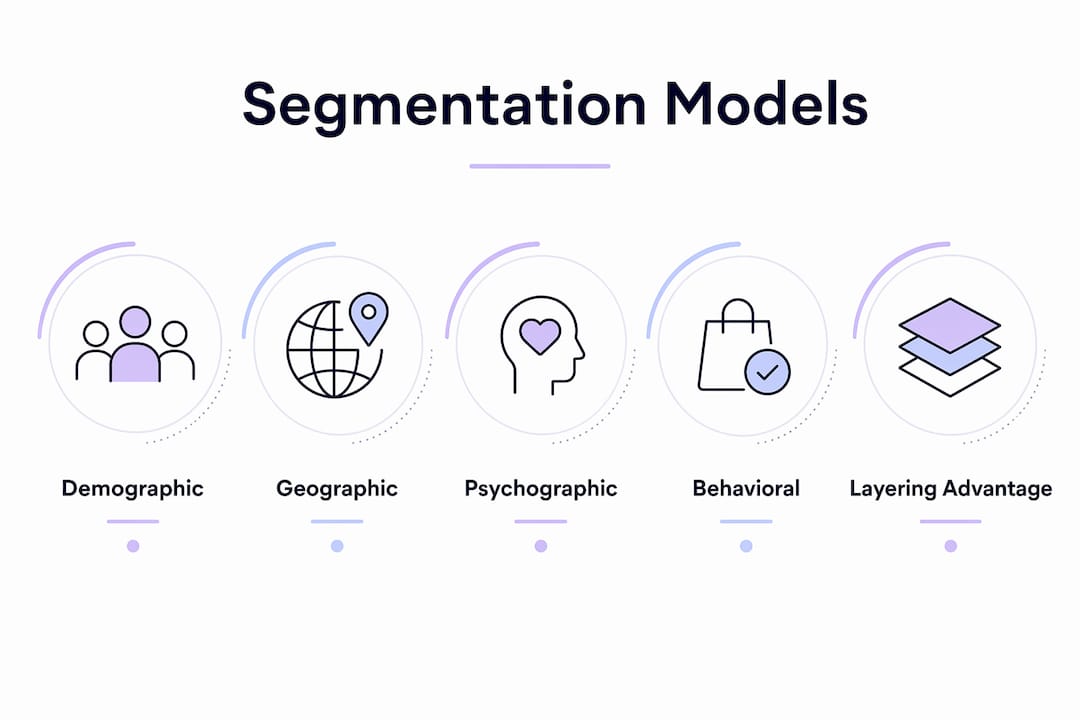
Pro Tip: Start with two layers: demographic plus behavioral. Add psychographic data once you have enough campaign history to validate motivations. Layering too many models before you have clean data produces noise, not insight.
How does segmentation drive decisions beyond marketing?
Segmentation’s most underrated benefit is internal alignment. Segmentation provides a shared language for marketing, sales, product, and customer success teams, aligning strategy across every function that touches the customer. When your sales team, your listing agents, and your content team all operate from the same defined segments, they stop pulling in different directions.
The strategic advantages extend well beyond campaign performance:
- Uncovering white spots. Strategic segmentation identifies untapped opportunities, competitor weaknesses, and profitable niche spaces that broad market analysis misses entirely. A luxury broker who segments by buyer motivation rather than price range often discovers an underserved relocation segment that competitors have ignored.
- Avoiding price wars. When you focus on a segment that values expertise and exclusivity over price, you compete on dimensions where you win. Competing on price alone is a race to the bottom that segmentation helps you exit.
- Evidence-based resource allocation. Segmentation data tells you which groups generate the highest lifetime value, so you can direct budget, headcount, and attention accordingly rather than spreading resources evenly across unequal opportunities.
- Niche leadership. Owning a well-defined segment builds a reputation that compounds. Sotheby’s International Realty does not try to serve every buyer. It owns a specific segment and commands premium positioning because of that focus.
The shift segmentation creates is from intuition to evidence. Teams stop debating who the customer is and start acting on a shared, data-backed definition.
How do you make sure segmentation actually delivers results?
Execution is where most segmentation efforts fail. Without structured analytical frameworks, segmentation lacks commercial impact regardless of how well the models are defined. The following steps separate segmentation that drives revenue from segmentation that lives in a slide deck.
- Clean your data first. Poor data quality undermines segmentation results before the first analysis runs. Duplicate records, missing fields, and outdated contact information produce segments that do not reflect reality. Audit your CRM before you segment it.
- Validate segments against four criteria. Each segment must be measurable (you can quantify it), substantial (large enough to justify dedicated spend), distinct (meaningfully different from other segments), and actionable (you can reach it with a specific tactic). Segments that fail any of these criteria will not produce results.
- Assign ownership. Every segment needs a person responsible for its performance. Without ownership, segments get defined and then ignored when campaign pressure hits.
- Build segment-specific KPIs. Measuring all segments against the same conversion metric obscures performance differences. A retention-focused segment and an acquisition-focused segment require different success metrics.
- Update segments regularly. Markets and consumer behavior evolve continuously, and segmentation that was accurate 18 months ago may no longer reflect your audience. Schedule a quarterly review to test whether your segments still hold.
The most common pitfall is building segments that are either too broad to act on or too narrow to scale. A segment of “all buyers” is useless. A segment of “left-handed buyers in one zip code” is too small to justify dedicated resources. The sweet spot is a group large enough to sustain a campaign and specific enough to receive a message that feels personal.
Pro Tip: Run a simple A/B test before committing full budget to a new segment. Send two versions of a message to a small sample from the segment and measure open rate, click rate, and conversion. If the segment responds differently from your baseline audience, it is real and worth investing in.
Key takeaways
Market segmentation works because it replaces broad, inefficient outreach with targeted, evidence-based marketing that aligns resources to the highest-value opportunities.
| Point | Details |
|---|---|
| Precision over volume | Segmentation focuses spend on high-probability converters, reducing wasted budget and lowering acquisition costs. |
| Layered models outperform single models | Combining demographic, behavioral, and psychographic data produces segments that are commercially actionable. |
| Internal alignment is a hidden benefit | Shared segment definitions align sales, marketing, and product teams around the same customer reality. |
| Data quality determines outcome | Clean, validated data is the prerequisite for any segmentation that produces real results. |
| Segmentation must stay dynamic | Quarterly reviews keep segments accurate as markets and buyer behavior shift over time. |
Segmentation is not a project. It is a practice.
I have watched marketing teams spend weeks building beautiful segmentation frameworks and then never update them. Six months later, they are running campaigns against segments that no longer exist in the form they were defined. The market moved. The data did not.
The misconception I see most often is that segmentation is a one-time strategic exercise. You do it, you present it, you move on. That is exactly backwards. The importance of market segmentation comes from treating it as a living system, not a deliverable. The teams that get the most from segmentation are the ones who review it quarterly, challenge their assumptions, and retire segments that stop performing.
There is also a tendency to over-engineer the models before the data is ready. I have seen teams layer five segmentation variables on a CRM with 40% data completeness and then wonder why the campaigns underperform. The discipline of starting with two clean variables and expanding from there is harder than it sounds, but it produces results that complex models on dirty data never will.
The other thing worth saying directly: segmentation is not just a marketing tool. The real estate agents and luxury brokers who use it most effectively have made it the operating system for their entire client acquisition process. They know which segment is most likely to list in the next 90 days. They know which segment responds to email versus direct outreach. They know which segment requires three touchpoints before a conversation and which one converts on the first call. That level of precision does not come from intuition. It comes from treating segmentation as a continuous practice, not a quarterly report.
— Jason
Put segmentation to work in your real estate prospecting
Knowing why segmentation works is one thing. Applying it to your prospecting pipeline is where the real gains happen. Plo gives real estate agents, luxury brokers, and yacht brokers the tools to identify, target, and convert the client segments most likely to close. From targeted prospecting guides to a curated list of the best prospecting tools for 2026, Plo puts the mechanics of segmentation directly into your daily workflow. Stop marketing to everyone. Start owning the segments that matter most to your business.
FAQ
Why does market segmentation improve conversion rates?
Segmentation aligns your message with the specific needs of a defined group, which increases relevance and reduces friction in the buying decision. Focused targeting means you spend budget on audiences already predisposed to respond.
What is the difference between demographic and psychographic segmentation?
Demographic segmentation categorizes buyers by measurable traits like age and income, while psychographic segmentation captures motivations, values, and lifestyle factors. Two buyers with identical demographics may purchase for entirely different reasons, which is why psychographics add critical depth.
How often should you update your market segments?
Segments should be reviewed at least quarterly. Consumer behavior and market conditions shift continuously, and outdated segments produce campaigns that miss their audience entirely.
Can small businesses benefit from market segmentation?
Segmentation is especially powerful for smaller operations because it concentrates limited resources on the highest-value opportunities rather than spreading budget across an unfiltered audience. Even a two-variable segmentation model produces measurably better results than no segmentation at all.
What makes a market segment actionable?
A segment is actionable when it is measurable, substantial enough to justify dedicated spend, clearly distinct from other segments, and reachable through a specific marketing tactic. Segments that fail any of these four criteria will not translate into campaign results.