

Most real estate agents treat onboarding as a checkbox exercise. Collect the paperwork, send a welcome email, and move on to the next showing. But that mindset costs you deals. In luxury markets especially, the moment a client signs with you is not the finish line. It is the starting gun. How you bring that client into your world in the first 48 to 72 hours shapes every interaction that follows, including whether they refer their network to you or quietly move on after closing. This article breaks down exactly why optimizing your onboarding process is one of the most powerful moves you can make for your business right now.
Table of Contents
- What is client onboarding and why it matters in real estate
- Top benefits of optimizing client onboarding for agents and brokers
- How technology transforms onboarding in luxury real estate
- Common onboarding pitfalls (and how to avoid them)
- Our take: The hidden ROI of world-class client onboarding
- Ready to elevate your onboarding? Explore proven real estate tools
- Frequently asked questions
Key Takeaways
| Point | Details |
|---|---|
| Onboarding is key to loyalty | An optimized onboarding process is crucial for building long-term trust with clients. |
| Technology boosts efficiency | Automation and CRM tools reduce errors, speed up onboarding, and make agents more effective. |
| Avoid common pitfalls | Standardizing and personalizing onboarding prevents confusion and delays. |
| Treat onboarding as an asset | World-class onboarding drives both client satisfaction and revenue growth. |
What is client onboarding and why it matters in real estate
Client onboarding is the structured process of welcoming a new client into your business, collecting the information you need, setting clear expectations, and establishing trust from day one. In real estate, it goes far beyond a signed buyer or seller agreement. It is a deliberate sequence of steps that transforms a prospect into a confident, engaged client who feels in control of their journey.
For luxury brokers, this definition carries even more weight. High-net-worth clients are accustomed to white-glove experiences in every corner of their lives. From private banking to bespoke travel, they expect precision. When your onboarding feels cobbled together or reactive, you signal that the rest of the transaction will feel the same way. That first impression matters more than most agents realize, and client reports and case studies consistently show the measurable impact a polished onboarding process has on client trust and deal outcomes.
A well-designed onboarding process typically includes the following key steps:
- Initial welcome communication sent within hours of signing, not days
- Needs assessment to capture the client’s goals, timeline, and non-negotiables
- Document collection for identity verification, financial qualification, and legal agreements
- Expectation setting around timelines, communication frequency, and next steps
- Introduction to your team or tools, whether that is a showing coordinator, a CRM portal, or a dedicated assistant
- A personalized property brief or market overview that shows you have already done your homework
“The first 72 hours of a client relationship reveal everything about how an agent operates. Make those hours count, and clients will trust you with every decision that follows.”
For a deeper look at structuring this flow, our client onboarding guide covers a proven step-by-step framework used by top luxury brokers. The key insight is that onboarding is not administrative overhead. It is your first real opportunity to demonstrate competence, care, and professionalism at scale.
When you treat onboarding as a strategic touchpoint rather than a formality, everything shifts. Clients feel seen. They ask fewer repeated questions. They trust your judgment faster. And that trust accelerates every phase of the transaction that follows.

Top benefits of optimizing client onboarding for agents and brokers
Optimizing your onboarding process is not just about looking polished. It produces measurable business results that compound over time. Here is what agents and brokers consistently report when they level up their onboarding:
- Higher referral rates. Clients who feel genuinely welcomed and organized from the start are far more likely to refer friends and family. Referrals from happy clients cost you nothing and convert at a dramatically higher rate than cold leads.
- Faster deal closures. When documents are collected upfront, expectations are set early, and communication channels are established immediately, transactions move faster. Fewer back-and-forth delays mean fewer opportunities for deals to fall apart.
- Reduced errors and miscommunication. A structured onboarding process catches missing information before it becomes a crisis. Standardized document checklists and automated reminders prevent the kind of last-minute scramble that erodes client confidence.
- Stronger client retention and repeat business. Clients who had a smooth, professional onboarding experience feel loyal to the agent who delivered it. They come back when they are ready to buy or sell again.
- Increased agent productivity and morale. When your onboarding is systematized, you spend less time chasing down information and more time on high-value activities like showing properties and negotiating offers.
Pro Tip: Build a 72-hour onboarding checklist that your team follows for every new client without exception. Consistency is what separates a scalable business from one that depends entirely on your personal availability.
The numbers back this up. Client reports and case studies reveal that agents who formalize their onboarding processes see meaningful improvements in both client satisfaction scores and transaction velocity. And when you examine a real-world onboarding success story, the pattern is clear. United Yacht Sales, for example, saved 45 days per transaction cycle after overhauling their onboarding with the right tools and processes. That is 45 days returned to your team, your clients, and your bottom line.
Think of each onboarding interaction as a micro-investment. Done well, it multiplies returns across the lifetime of that client relationship. Done poorly, it creates friction that you spend the rest of the transaction fighting against.
How technology transforms onboarding in luxury real estate
The gap between agents who use technology strategically and those who rely on manual processes has never been wider. CRM platforms, automated workflows, and digital document management are not optional extras anymore. For luxury brokers operating at volume, they are the infrastructure that makes exceptional client experiences repeatable.
A CRM (Customer Relationship Management) platform centralizes all client data in one place. Contact details, communication history, document status, timeline preferences, and even personal notes about a client’s taste in properties are instantly accessible. This means any member of your team can pick up a client conversation without the client needing to repeat themselves. That seamlessness is exactly what luxury clients expect.
Automation takes it further. When a client signs your agreement, an automated sequence can immediately trigger a welcome email, a document request, a calendar invitation for the first check-in call, and an internal task assigned to your team. No manual steps. No dropped balls. The sales automation benefits are especially pronounced in onboarding, where timing and consistency are everything.
Here is a direct comparison of how traditional onboarding stacks up against an automated approach:
| Activity | Traditional onboarding | Automated onboarding |
|---|---|---|
| Welcome communication | 1 to 3 days (manual) | Immediate (triggered) |
| Document collection | Email back-and-forth | Digital portal, automated reminders |
| Follow-up scheduling | Manually calendared | Auto-scheduled at set intervals |
| Data entry | Manual, error-prone | Auto-populated from intake form |
| Error rate | High (missing documents common) | Low (checklist enforced by system) |
| Agent time spent | 3 to 5 hours per client | Under 1 hour per client |
The time savings alone justify the investment. But the quality improvement is equally important. Luxury clients perceive technology-powered onboarding as a signal of operational maturity. When they log into a branded client portal and see their documents organized, their timeline mapped out, and their agent’s contact details easily accessible, they feel confident they made the right choice.
The best onboarding automation tools available to agents in 2026 are purpose-built for this kind of workflow, and they integrate directly with your existing communication and listing systems. Real estate automation is no longer a future-state concept. It is a present-day competitive advantage that top brokers are already using to pull ahead.
Pro Tip: When evaluating CRM tools, prioritize platforms that allow you to customize onboarding workflows by client type. A luxury buyer onboarding sequence should look and feel very different from a standard residential buyer experience.
Common onboarding pitfalls (and how to avoid them)
Even agents who understand the value of onboarding often make avoidable mistakes that undermine the experience. Here are the most common pitfalls and exactly how to sidestep them:
- No standardized process. When every onboarding looks different, some clients get excellent service and others get confusion. Standardize your process so quality does not depend on how busy you are that week.
- Failure to personalize for luxury clients. High-net-worth buyers notice generic communication immediately. Use what you know about the client’s preferences, lifestyle, and goals to personalize every touchpoint from the welcome message to the first property brief.
- Slow initial response. If a client signs with you and hears nothing for 24 hours, doubt creeps in. Speed signals professionalism. Automate your initial response so it happens instantly, even when you are in a showing.
- Missing or incomplete documents. Gaps in documentation cause transaction delays that clients blame on you, fairly or not. Use a standardized checklist and automated follow-ups to ensure every document is collected before it becomes critical.
- Overpromising on timelines. Setting unrealistic expectations during onboarding creates disappointment later. Be precise and honest about what clients can expect at each stage.
The resource Before Your Call offers actionable guidance on exactly what information to gather before your first serious client interaction, so you walk in prepared rather than reactive.
Here is a quick-reference table for avoiding the most damaging onboarding mistakes:
| Pitfall | Impact | Solution |
|---|---|---|
| No standardized process | Inconsistent client experience | Build a repeatable onboarding checklist |
| Generic communication | Luxury clients disengage | Personalize by client profile and property type |
| Delayed initial contact | Erodes trust immediately | Automate welcome message within minutes |
| Missing documents | Delays closing, damages credibility | Use digital checklists with automated reminders |
| Vague timeline expectations | Client frustration mid-transaction | Set written milestones at onboarding |
When you optimize listings alongside your onboarding process, you create a unified client experience that starts from the moment they discover your listing and continues through closing and beyond. It is a complete ecosystem. And when you review onboarding case studies from top-performing brokerages, the agents who avoided these pitfalls consistently outperformed their peers on every metric that matters.
The biggest mistake of all? Thinking these pitfalls only affect new agents. Experienced brokers with full pipelines are often the most prone to onboarding shortcuts, precisely because they are busy. Busy is not the same as effective.
Our take: The hidden ROI of world-class client onboarding
Here is the perspective most sales coaches skip over. Onboarding is not a support function. It is a revenue driver. And when you start measuring it that way, your entire approach to the first 72 hours of a client relationship changes.
Think about the lifetime value of a single luxury client. A buyer who purchases one property with you, returns for a second purchase two years later, refers two colleagues in between, and occasionally sells a property is worth hundreds of thousands of dollars in gross commission over a decade. Every one of those future transactions is either enabled or eroded by how that client felt during their first onboarding experience with you.
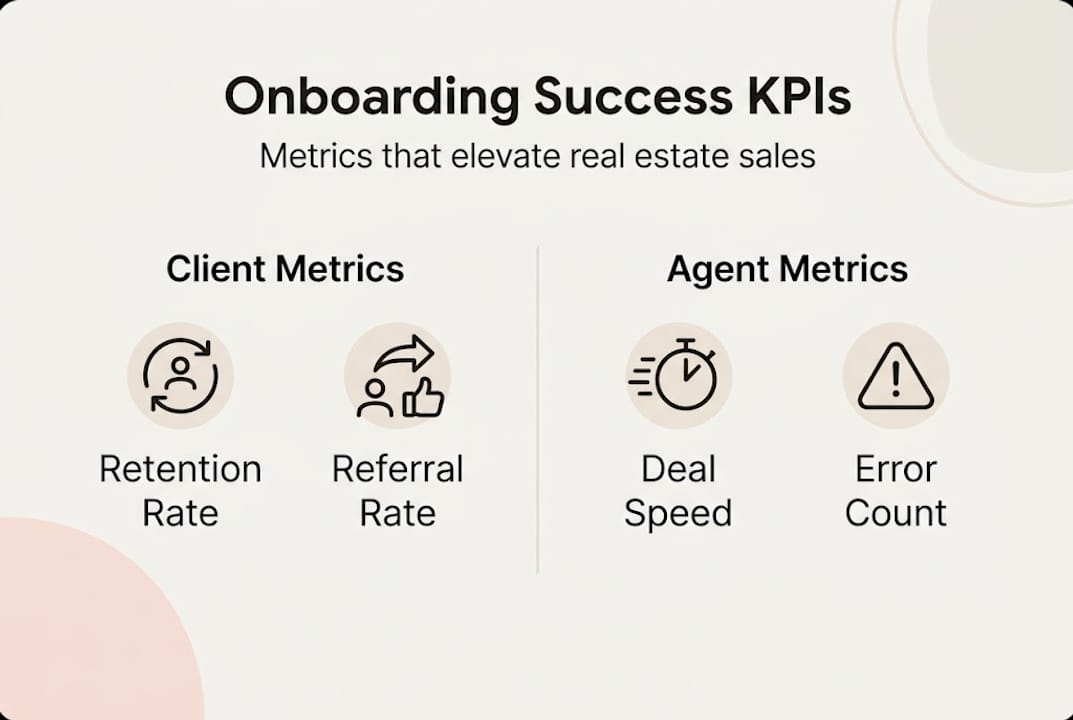
Advanced teams measure onboarding success with concrete business KPIs, including referral conversion rate, time-to-first-offer, and client satisfaction scores at the 30-day mark. They treat onboarding not as the beginning of admin but as the beginning of a marketing relationship. When you explore real-world ROI insights, the agents with the highest lifetime client value are almost always the ones with the most intentional onboarding systems.
The uncomfortable truth is that most agents spend more energy on lead generation than on converting the leads they already have into loyal, long-term clients. A polished onboarding process is the bridge between those two realities.
Ready to elevate your onboarding? Explore proven real estate tools
The value of world-class onboarding is clear. Now it is time to build the infrastructure that makes it possible. Modern agents and luxury brokers are not figuring this out manually. They are using purpose-built tools that handle the complexity so they can stay focused on relationships.
At ex.plo.re, we have built a suite of solutions specifically designed for agents who want to work at the highest level. From top prospecting tools that fill your pipeline with qualified leads to real estate automation workflows that make your onboarding seamless and scalable, we give you the edge that top producers already have. Ready to see what a streamlined system looks like for your business? Get started with CRM and let our team help you build an onboarding process that converts clients into advocates.
Frequently asked questions
What is the most common mistake in real estate client onboarding?
Failing to standardize the process leads to confusion, missed steps, and lost trust. Consistent onboarding systems are what separate top producers from reactive agents.
How does automation improve client onboarding for real estate?
Automation ensures key steps are not missed, speeds up communication, and gives agents more time for high-value client service. The role of automation in reducing manual follow-up alone justifies the investment.
What are the measurable signs that onboarding needs improvement?
Slow deal closings, repeated questions from clients, and frequent document errors are the clearest signals that your onboarding process needs a structured overhaul.
Is onboarding as important for luxury real estate clients?
Absolutely. Luxury buyers expect seamless, white-glove experiences that begin with onboarding, and client satisfaction data shows that first impressions directly influence referral behavior.
Can better onboarding really boost client retention?
A positive onboarding experience sets the foundation for trust and long-term loyalty. Clients who feel organized and supported from day one are significantly more likely to return and refer, as retention research consistently confirms.