

Pricing a property based on gut feel is one of the most costly mistakes an agent can make. Clients walk in expecting confidence backed by evidence, not estimates pulled from a Zestimate or a hunch. The good news? Comparative market analysis (CMA) is the evidence-driven framework that separates top producers from average agents. This guide breaks down exactly what a CMA is, how to execute one with precision, and how to turn that pricing expertise into a client attraction engine that works every single time you walk into a listing appointment.
Table of Contents
- What is a comparative market analysis?
- Step-by-step: How to conduct a CMA
- CMA vs. appraisal: Key differences agents should know
- How to leverage CMA for client attraction and sales strategy
- Our take: What most agents miss about comparative market analysis
- Level up your CMA workflow with powerful tools
- Frequently asked questions
Key Takeaways
| Point | Details |
|---|---|
| CMA builds pricing confidence | A comparative market analysis gives agents a data-backed foundation for accurate pricing. |
| Step-by-step process | Conducting a CMA involves selecting comps, adjusting for differences, and recommending a price range. |
| Different from appraisals | CMAs are informal, agent-driven estimates, while appraisals are legal, lender-required reports. |
| Boost sales and client trust | Presenting strong CMAs helps win listings and enhance your authority in the market. |
| Blend tech and expertise | Successful agents combine smart tools with local knowledge for truly effective CMAs. |
What is a comparative market analysis?
A CMA is your foundation for credible pricing conversations. It takes the guesswork out of the equation and replaces it with real market data. In simple terms, a CMA estimates a property’s current market value by comparing it to recently sold, active, expired, and pending similar properties, then adjusting for key differences between each property and the subject home.
This is not a casual exercise. Done right, it’s a structured analytical process that positions you as the expert your clients need. Agents who consistently produce accurate CMAs close more listings and experience fewer price reductions. Understanding 2026 real estate trends gives your CMA work even sharper context, because local market shifts directly affect which comps matter and how you weight them.
“A comparative market analysis is a real-estate pricing report that estimates a property’s current market value by comparing the subject property to recently sold similar properties, then adjusting for differences.” — Chase Mortgage Education
Here’s what a solid CMA covers:
- Recently sold comps: Properties closed within the last 90 to 180 days in the same neighborhood or submarket
- Active listings: Current competition your client’s property will face on the market
- Expired listings: Properties that failed to sell, revealing pricing ceilings buyers rejected
- Pending listings: Properties under contract that indicate where the market is moving right now
- Condition and feature adjustments: Square footage, lot size, bedroom count, upgrades, and location premiums or discounts
The credibility you build with a well-constructed CMA carries through every conversation. For commercial property evaluations, the same principle applies: data-backed analysis always wins over informal estimates. Clients who receive a thorough CMA feel informed and confident, which dramatically increases your close rate on listing appointments.

Using the right marketing software for real estate can also streamline how you present your CMA findings, turning a spreadsheet of data into a visually compelling report clients actually understand and remember.
Step-by-step: How to conduct a CMA
Now that you understand what a CMA is, let’s break down how to actually perform one, from start to finish.
Selecting comparable sales and reconciling adjusted comp prices into a recommended listing price range is the core of every reliable CMA. Here’s the process in sequence:
- Define your search radius. Start with a half-mile to one-mile radius from the subject property. In rural or low-density markets, expand to two to three miles. Tighten the radius for urban or high-density neighborhoods where micro-location factors heavily influence value.
- Set your time frame. Pull closed sales from the last 90 days as your primary source. If there aren’t enough comps, extend to 180 days while noting that older data may reflect different market conditions.
- Filter for property similarity. Match on property type, bedroom and bathroom count, living area within 15 to 20 percent, and similar lot size. A 1,200-square-foot condo is not a valid comp for a 2,400-square-foot single-family home.
- Make dollar adjustments. Assign value to differences between each comp and the subject property. For example, if the subject has a pool and a comp doesn’t, add a market-supported dollar amount to the comp’s sale price. Common adjustment categories include square footage, garage space, condition, view, and lot size.
- Reconcile your adjusted values. After adjusting each comp, calculate the adjusted price per square foot and the adjusted total value. Look for the range where most comps cluster. That range is your recommended listing price band.
- Contextualize with active and expired data. Active listings show you where your competition is priced. Expired listings reveal prices the market refused. These anchor the upper limit of your recommendation.
- Present your findings clearly. Build a one to two-page summary that shows the client how you arrived at your number. Visuals and clear reasoning increase trust faster than a raw number ever will.
This connects directly to optimizing real estate listings, because accurate pricing from the start keeps listings from sitting and losing momentum.
Adjustment reference table
| Feature difference | Typical dollar adjustment range |
|---|---|
| Additional bedroom | $5,000 to $15,000 |
| Additional bathroom | $5,000 to $12,000 |
| Garage (per space) | $8,000 to $20,000 |
| Pool (in-ground) | $10,000 to $30,000 |
| Updated kitchen | $5,000 to $25,000 |
| Lot size (per 1,000 sq ft) | $2,000 to $10,000 |
| View premium | $5,000 to $50,000+ |
Note: Ranges vary significantly by market. Always calibrate to local data.
Pro Tip: Cross-reference your MLS data with county records to catch unreported updates or incorrect square footage on comps. One bad data point can skew your entire analysis. For valuing commercial real estate, the same rigor around data accuracy applies at an even higher stakes level.
Strong CMA skills also fuel your lead generation strategies. Sellers who receive a thorough, professional pricing analysis are far more likely to sign a listing agreement on the spot. Your ability to generate real estate leads scales when your CMA presentation becomes a signature part of your sales process.
CMA vs. appraisal: Key differences agents should know
Once you’ve mastered CMA, it’s crucial to understand how it differs from a formal appraisal, so you can advise clients with confidence.
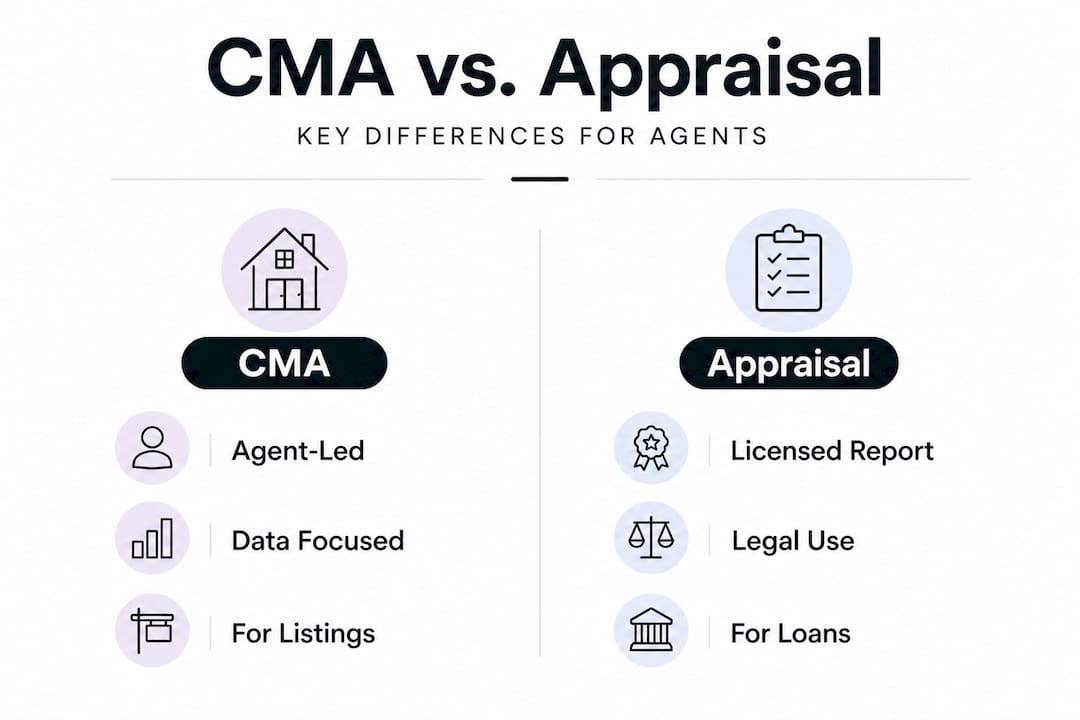
A CMA estimates property value using comparable sales, while an appraisal is a licensed appraiser’s official report used for mortgage or legal transactions. Confusing the two can lead clients to make costly mistakes, and it can undermine your credibility when a lender’s appraisal comes in below your list price.
CMA vs. appraisal comparison
| Factor | CMA | Appraisal |
|---|---|---|
| Who performs it | Licensed real estate agent | Licensed or certified appraiser |
| Purpose | Pricing strategy for listing or offer | Required by lenders, courts, or estate proceedings |
| Cost to client | Free (typically) | $300 to $600+ |
| Regulatory oversight | None (informal) | Heavily regulated by federal and state law |
| Time to complete | 1 to 3 hours | 2 to 10 business days |
| Legally binding | No | Yes (for mortgage purposes) |
| Data depth | MLS comps plus agent insight | Comps plus physical inspection plus detailed report |
Key distinctions every agent should communicate clearly to clients:
- CMAs serve pricing strategy. Use them at listing consultations and when advising buyers on offer price. They’re your professional recommendation, not a legal document.
- Appraisals serve financial and legal needs. Lenders require them before approving a mortgage. Courts use them in divorce, estate, or eminent domain cases.
- Both use local sales data, but an appraisal includes a physical property inspection and must follow Uniform Standards of Professional Appraisal Practice (USPAP) guidelines.
- A low appraisal can kill a deal. If your CMA-based list price exceeds what a licensed appraiser finds supportable, you may face a price renegotiation after the buyer’s lender orders an appraisal.
Understanding the types of real estate appraisals helps you set client expectations accurately, particularly when sellers push for pricing that exceeds what the data supports. You should also guide your sellers on home appraisal mistakes so they know how to prepare for the lender’s process after going under contract.
Pro Tip: When your CMA and the appraisal come back close in value, it’s a powerful signal of your market expertise. Document these wins. Testimonials that reference your pricing accuracy are among the strongest social proof you can share with future prospects.
How to leverage CMA for client attraction and sales strategy
Armed with CMA clarity, you’re ready to turn pricing precision into a powerful marketing tool. Here’s how.
Reconciling adjusted comp prices into a recommended listing price range based on local market evidence increases client trust dramatically. Trust is the currency of real estate, and your CMA is how you earn it in the first appointment.
Here’s how top agents weaponize their CMA work:
- Lead with your data story. Don’t walk into a listing appointment and announce a price. Walk in with a printed or digital CMA report, walk the seller through the comps, and let the data lead them to your recommended price range. This approach dramatically reduces price objections.
- Use expired listings as persuasion tools. Show sellers what happened to similar homes that were overpriced. Expired comps are your most powerful argument for realistic pricing.
- Segment your CMA by scenario. Present a “list at market value” scenario, a “price for speed” scenario, and a “test the ceiling” scenario. Giving sellers choice increases buy-in and demonstrates your strategic thinking.
- Pair your CMA with a marketing plan. Pricing and marketing are inseparable. An accurate price gets buyers through the door. A strong marketing plan keeps the momentum going. Connect your CMA directly to your listing strategy.
- Use it as a lead magnet. Offer free CMAs to prospects in your farm area. This builds goodwill, keeps you top of mind, and opens the door to listing conversations months before a homeowner is ready to sell.
The role of market reports for agents extends this strategy further. Monthly or quarterly market reports that reference your CMA methodology position you as the authority in your local market, not just another agent with a license.
Pro Tip: Integrate AI in real estate sales to speed up your comp analysis and generate insight-rich market summaries. AI tools won’t replace your judgment, but they will save you hours every week and sharpen the precision of your recommendations. The agents winning right now are those who combine data intelligence with genuine local expertise.
Our take: What most agents miss about comparative market analysis
Let’s step back and consider where most agents stumble, and how you can set yourself apart.
The single biggest mistake we see? Agents who treat CMA as an automated output rather than a professional judgment exercise. They pull three comps from their MLS software, click a button, and hand the seller a number. That approach fails in unpredictable markets and erodes trust the moment the home sits unsold.
Here’s the uncomfortable truth: software doesn’t know that the house across the street has a noise issue from the nearby highway. It doesn’t know that one of your comps sold to a buyer who paid above market because they were relocating on a tight deadline. It doesn’t know that a new development nearby is shifting desirability for a specific block. You know those things. That local intelligence is what clients are actually paying for.
The agents who consistently win listings are not always the most tech-savvy. They are the ones who combine data with story. They use the CMA framework as a canvas and then paint in the context that numbers alone can’t capture. That’s a skill you develop over time, through market immersion, buyer and seller conversations, and genuine curiosity about your local real estate ecosystem.
There’s also a missed opportunity around the emotional delivery of CMA findings. Most agents present the data. Exceptional agents explain what the data means for this specific seller’s goals. If a seller needs to net a certain amount to purchase their next home, your CMA should connect directly to that outcome. Pricing strategy becomes personal when you tie it to the client’s real-world situation.
The marketing strategy for luxury agents requires this exact balance. In the luxury segment especially, buyers and sellers are sophisticated. They can smell a templated CMA from a mile away. Customization, depth, and narrative are what close luxury listings.
Balance your technology with earned expertise. Use tools to process data faster. Use your judgment to interpret it better. That combination is where your true competitive edge lives.
Level up your CMA workflow with powerful tools
Ready to transform your CMA process into a sales magnet? Here are resources you can use right now.
Mastering CMA methodology is your competitive advantage, but the best agents don’t stop there. Integrating purpose-built technology into your workflow means you can spend less time building reports and more time in front of clients.

At ex.plo.re, we give you the tools to turn every CMA into a client acquisition opportunity. From real estate prospecting tools that help you identify motivated sellers in your farm area to lead generation tools that automate your follow-up pipeline, we help you execute at every stage of the client journey. Our CRM solutions for agents tie it all together so your insights, contacts, and marketing activity live in one powerful platform. Book a demo today and see how our technology amplifies the expert work you’re already doing.
Frequently asked questions
What are the main components of a comparative market analysis?
A CMA includes selecting comparable property sales, making adjustments for differences in features and condition, and recommending a price range based on local market evidence. Active and expired listings are also factored in to provide full market context.
How does a CMA affect the success of a real estate listing?
An accurate, well-presented CMA reduces time on market and minimizes price reductions by ensuring the property is priced to attract serious buyers from day one. Reconciling adjusted comp prices into a clear recommendation increases client confidence and speeds up the decision to list.
Can a CMA replace an official appraisal?
No. A CMA is an informal pricing tool used for listing consultations and offer strategy, while an appraisal is a licensed professional’s legally binding report required by lenders and courts for mortgage approvals and legal proceedings.
What pitfalls should agents avoid when conducting a CMA?
Avoid using comps older than six months in active markets, skipping feature adjustments, and relying entirely on automated tools without applying local knowledge to validate the data.
How can technology enhance CMA accuracy and client experience?
CRM platforms and AI-powered analysis tools help agents gather cleaner data, apply consistent adjustments, and generate visually polished reports that communicate value clearly to clients, shortening the path from presentation to signed agreement.
Recommended
- Master Real Estate Marketing Strategy 2025 for Luxury Agents
- Best 6 Luxury Broker Marketing Tools – Expert Comparison 2025
- 7 Lead Generation Tools for Realtors – Expert Comparison 2026
- Top 6 Local Marketing Tools for Agents in 2026
- Market value when buying a property on the French Riviera
- Maximize Your NJ Home Sale with a Pre-Listing Appraisal | NJREAG