

Most agents are sitting on a goldmine of online leads and losing them to the first competitor who picks up the phone. 78% of leads choose the agent who responds first, yet the average response time across the industry runs well over an hour. Digital prospecting is the art and science of finding, engaging, and converting potential clients through online channels before your competition even wakes up. This article breaks down exactly how to build a digital prospecting system that drives consistent local client acquisition, sharpens your follow-up game, and puts the right technology in your corner.
Table of Contents
- Defining digital prospecting for real estate
- Key digital prospecting channels for agents
- Optimizing speed-to-lead and follow-up for higher conversions
- Leveraging technology: Tools and CRM systems for digital prospecting
- Our take: What most agents get wrong about digital prospecting
- Ready to transform digital prospecting into real results?
- Frequently asked questions
Key Takeaways
| Point | Details |
|---|---|
| Speed-to-lead matters | Responding to leads within minutes can dramatically boost your conversion rates. |
| Multi-channel approach | Combining several online prospecting channels gets the best results. |
| Follow-up converts | Most real estate deals happen only after regular, systematic follow-up. |
| CRM systems amplify results | Using automation and CRM tools helps you nurture, track, and close more clients efficiently. |
Defining digital prospecting for real estate
Traditional prospecting meant door-knocking, cold calls, and farming neighborhoods with paper mailers. Digital prospecting replaces or supercharges all of that with online tools, automated outreach, and data-driven targeting. The shift is not just cosmetic. It fundamentally changes how you identify prospects, how fast you can reach them, and how many you can work simultaneously.
At its core, digital prospecting for real estate agents involves three main activities:
- Online engagement: Building visibility through social media, search engines, and local listing platforms so prospects find you organically.
- Lead capture: Converting website visitors and social followers into identifiable contacts using forms, landing pages, and lead magnets.
- Automated follow-up: Using CRM systems (Customer Relationship Management software) and email or text sequences to stay in front of leads without manual effort every single time.
The mobile revolution accelerated everything. Buyers and sellers now research agents, browse listings, and even sign documents from their phones. If your prospecting system is not built for where people actually spend their time, you are already behind.
Here is the competitive reality worth internalizing:
Agents who commit to daily digital prospecting close three times more deals than those who rely on traditional methods alone.
That is not a marginal improvement. That is a complete transformation of your business trajectory.
The biggest advantages digital prospecting gives you over traditional methods are scalability and precision. A cold-call campaign might let you reach 50 people in a day. A well-structured Facebook lead ad can put your offer in front of 5,000 targeted local homeowners overnight. More importantly, digital targeting lets you narrow by zip code, income bracket, homeownership status, and purchase intent. You are not just casting a wide net. You are fishing in the right pond with the right bait.

For agents looking to sharpen their approach, exploring dedicated real estate prospecting tools and studying the best prospecting methods currently working in your market is the most direct path to faster growth.
Key digital prospecting channels for agents
Knowing that digital prospecting works is one thing. Knowing which channels deserve your time and budget is another. Not all digital channels are created equal, and the data tells a clear story.
SEO leads convert at 14.6%, while Facebook leads convert at 1 to 2% and standard website form leads sit between 0.5 and 1%. Referrals remain the conversion king at around 50%, but they are not fully scalable on their own. The smart play is to use all of these channels together.
| Channel | Avg. Conversion Rate | Cost Level | Best Use Case |
|---|---|---|---|
| Referrals | ~50% | Low | Trust-based, warm leads |
| SEO / Organic Search | 14.6% | Medium (time) | Long-term local authority |
| Facebook / Social Ads | 1–2% | Medium | Volume and brand awareness |
| Website Forms | 0.5–1% | Low | Passive lead capture |
| Paid Search (PPC) | 2–5% | High | High-intent buyer/seller leads |
Here is how each channel serves a different purpose in your pipeline:
- Referrals are your highest-quality leads. Build a systematic ask into every closing and client check-in.
- SEO builds long-term authority. Consistent local content and Google Business Profile optimization put you at the top when prospects search for agents in your area.
- Social media fuels awareness and trust at scale. Regular video tours, market updates, and testimonials keep you top of mind.
- Paid ads accelerate volume when you need fast pipeline growth. They work best paired with a strong follow-up system.
- Website forms are passive but powerful. Every page of your site should have a clear, low-friction call to action.
The mistake most agents make is treating these channels as either/or options. Your strongest lead generation strategies stack multiple channels so that prospects see you in multiple places before they ever reach out. You can also explore how other top performers generate real estate leads and compare the mix against your current real estate lead sources to identify gaps.
Optimizing speed-to-lead and follow-up for higher conversions
You can have the best channels in place and still lose deals. The culprit is almost always response speed and follow-up consistency. This is where most agents leave the most money on the table.
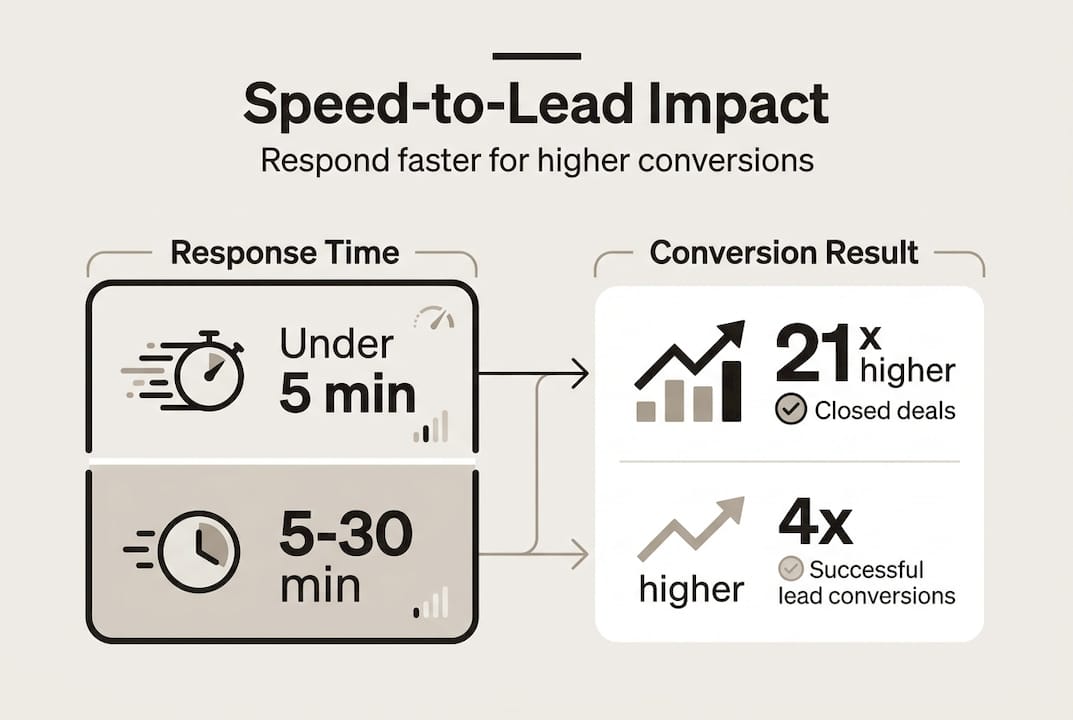
The numbers are unambiguous: responding within 5 minutes increases your qualification rate by 21 times compared to responding in 30 minutes or more. Wait an hour and the lead has likely already called someone else.
| Response Time | Qualification Likelihood |
|---|---|
| Under 5 minutes | 21x higher |
| 5 to 30 minutes | 4x higher |
| 30 to 60 minutes | Average |
| Over 1 hour | Significantly lower |
Once you have made contact, persistence matters just as much as speed. 80% of leads convert only after five or more follow-up touches. Most agents stop at one or two and move on. That means agents who stick with a structured nurture sequence are quietly winning the clients everyone else abandoned.
Here is a practical process to tighten your speed-to-lead system:
- Set up instant lead notifications. Make sure new leads hit your phone via SMS and email the moment they come in.
- Use an auto-responder for initial contact. A personalized text or email that fires immediately keeps the prospect engaged while you prepare to call.
- Call within five minutes. This is non-negotiable if you want to maximize your qualification rate.
- Load every lead into a CRM with a follow-up sequence. Do not rely on memory or a spreadsheet.
- Schedule at least six follow-up touches across different channels including phone, email, and text over the first 30 days.
Pro Tip: Pair your fastest follow-up with your best content. A lead who gets a quick response AND a personalized market report immediately sees you as the expert, not just the first person to call.
To build this kind of system effectively, study how to nurture leads for faster sales and model your follow-up workflow around what is proven to convert at each stage.
Leveraging technology: Tools and CRM systems for digital prospecting
Speed and persistence only scale when you have the right technology behind them. Trying to manage digital prospecting manually is like trying to fill a swimming pool with a garden hose. You need systems that work while you focus on relationships and closing.
A CRM, or Customer Relationship Management system, is the engine of your prospecting operation. It stores every lead, tracks every interaction, and triggers automated follow-up sequences so no one falls through the cracks. Using CRM for follow-up and relationship management can triple your prospecting impact, not by working harder but by making every touchpoint count.
Here are the core technology components every agent needs:
- Automated email and text sequences: Pre-built message series that go out on a schedule based on lead behavior or time elapsed since contact.
- Lead routing: Automatically assigns new leads to the right follow-up track based on source or intent signals.
- Pipeline visibility: A clear dashboard showing every lead’s status, last contact date, and next scheduled action.
- Integrations: Your CRM should connect with your website, social media lead forms, and paid ad platforms so leads flow in without manual data entry.
- Activity reminders: Automated prompts that tell you exactly who to call today and why.
Real estate-specific CRM platforms go beyond generic tools. They include features like MLS integration, listing alerts sent automatically to prospects, and property match notifications that keep your leads engaged long before they are ready to sign.
Pro Tip: Do not over-customize your CRM before you use it. Start with the default workflows, run real leads through them for 30 days, and then adjust based on what you actually observe.
The most common pitfall is buying a powerful tool and using it like a glorified address book. If you are not running automated sequences and tracking every touchpoint inside your CRM in real estate practice, you are leaving its biggest value completely untouched.
Our take: What most agents get wrong about digital prospecting
Here is the uncomfortable truth we see repeatedly. Agents invest in more lead sources instead of fixing a broken follow-up system. They buy another portal subscription when the real problem is that leads from their existing channels go cold after one unanswered call.
Digital prospecting success is 20% platform and 80% process. The agent with a disciplined real follow-up workflow and a basic CRM will consistently outperform the agent with every premium tool but no system holding it together.
The other mistake is confusing activity with productivity. Posting on social media daily without a lead capture mechanism attached is brand maintenance, not prospecting. Every digital action you take should have a clear next step for the prospect. Where do they go? What do they do? What do you do next?
Control the narrative by building a prospecting process that is repeatable, measurable, and relentlessly consistent. Stop chasing the next shiny platform. Master the fundamentals of speed, follow-up, and relationship-building, and you will outperform 90% of agents in your market.
Ready to transform digital prospecting into real results?
You now have a clear picture of what digital prospecting requires: the right channels, rapid response, persistent follow-up, and technology that scales your effort. The next move is putting these pieces into action.
At ex.plo.re, we built our platform specifically to help agents like you boost client acquisition with tools that work the way you actually work. From the industry’s best digital prospecting tools to a CRM designed for real estate pipelines, everything you need is in one place. Ready to amplify your impact and close more deals locally? Explore our CRM solutions and see what a fully optimized prospecting system feels like from day one.
Frequently asked questions
What is digital prospecting in real estate?
Digital prospecting uses online tools and strategies to find, engage, and convert potential clients for real estate sales. It includes online engagement and lead capture through channels like SEO, social media, and automated follow-up systems.
Which digital prospecting channel delivers the highest conversion rate?
Referrals yield 50% conversion and are the highest-converting source, but SEO leads deliver a 14.6% conversion rate with far greater scalability for consistent pipeline growth.
How quickly should I respond to new digital leads?
Responding within five minutes is the standard you should aim for. Response within 5 min increases your qualification odds by 21 times compared to slower response windows.
Why is follow-up critical in digital prospecting?
Most leads are not ready to act immediately. 80% of leads convert only after five or more follow-up touches, which means stopping early almost guarantees losing clients who were genuinely interested.
What technology can automate my digital prospecting?
CRM systems automate follow-up and relationship management through scheduled email and text sequences, lead routing, and pipeline tracking, so no lead goes cold without a deliberate decision to pause outreach.
Recommended
- How to Attract Local Real Estate Clients Effectively
- Social Media Marketing for Agents: Boost Local Leads Fast
- How to Generate Real Estate Leads for High-Value Clients
- 6 Smart Real Estate Lead Sources List for Agents
- Netthybel.no | Bestill Digital Visning og Virtuell Visning av Bolig – 3D Visning med Matterport
- Top tips for finding reliable tenants in 2026 – Rental Income Insurance