

Overview — Market segmentation directly increases revenue and operational efficiency by concentrating resources on the customer groups most likely to convert, retain, and grow. Done right, it is one of the highest-leverage moves a marketing leader can make.
- Higher conversion rates and lower customer acquisition cost (CAC) when campaigns target high-propensity segments instead of broad audiences
- Improved customer lifetime value (CLTV) through personalized messaging that builds loyalty and repeat purchase behavior
- Better product-market fit because segment insights feed roadmaps, pricing, and positioning decisions
Segmentation is not a one-time analysis. Treat it as an ongoing strategic capability and it compounds. Treat it as a spreadsheet exercise and it stales out within a quarter.
Key Takeaways
Market segmentation delivers its strongest returns when treated as an ongoing operational capability, not a one-time strategic exercise.
| Point | Details |
|---|---|
| Conversion and CAC impact | Targeting high-propensity segments reduces CAC and lifts conversion rates versus broad campaigns. |
| Prioritize with the 5Qs | Score segments on identifiability, size, reach, responsiveness, and actionability before committing budget. |
| Measure with holdouts | Always run a control group to isolate segment lift from broader market trends. |
| Govern segments actively | Assign an owner and a quarterly review date to every active segment to prevent data drift. |
| Treat it as a capability | Iterative, governed segmentation compounds over time; static, one-off lists do not. |
Table of Contents
- What is market segmentation, and why does it matter?
- How do the advantages of market segmentation accelerate growth?
- How segmentation builds competitive advantage and better product fit
- How segmentation reduces waste and raises customer lifetime value
- How do you evaluate and prioritize segments worth investing in?
- What metrics actually prove that segmentation is working?
- What are the biggest risks of segmentation, and how do you avoid them?
- Applying segmentation to local real estate prospecting
- The part most teams skip — and why it costs them
- Sources
What is market segmentation, and why does it matter?
Market segmentation divides an addressable market into distinct groups that share meaningful attributes — demographic, behavioral, psychographic, geographic, or needs-based — so teams can design targeted offers and measurable campaigns instead of mass tactics. Coursera’s overview of segmentation frames the shift plainly: personalized experiences built on segment data consistently outperform one-size-fits-all campaigns on engagement and retention.
The standard operating framework is S-T-P: Segment the market, Target the most attractive groups, and Position your offer to resonate with each. Layered on top is the segment-evaluation checklist, often called the 5Qs:
- Identifiable — can you describe and measure the segment clearly?
- Substantial — is it large enough to generate profitable returns?
- Reachable — do you have channels to access it?
- Responsive — will it react differently to a tailored offer than to a generic one?
- Actionable/Stable — can your team execute against it, and will it hold its shape long enough to justify investment?
Investopedia’s market segmentation entry adds that accurate targeting typically reduces acquisition costs while raising conversion rates, which is the financial case in one sentence. For a deeper primer tailored to marketing professionals, Plo’s segmentation guide covers the frameworks in a practical B2B context.
How do the advantages of market segmentation accelerate growth?
Segmentation increases conversion and shortens sales cycles because every touchpoint speaks to a specific need rather than a statistical average. When you stop trying to appeal to everyone, your message lands harder with the people who actually matter.
The direct growth benefits:
- Higher conversion rate — relevant messaging converts at a higher rate than generic campaigns across email, paid search, and social
- Faster trial-to-paid conversion — segment-specific onboarding flows remove friction for the exact use case the prospect cares about
- Higher average order value — when you understand a segment’s willingness to pay, you price and package accordingly
- Cross-sell and upsell potential — behavioral segments reveal natural upgrade paths that a blended audience obscures
Investopedia confirms that targeting high-propensity segments reduces CAC while lifting conversion, which translates directly into incremental revenue per dollar of marketing spend. Adobe’s enterprise segmentation analysis frames this as a capability advantage: teams that align data, content, and delivery to defined segments improve both campaign velocity and ROI at scale.
To model the revenue impact, track conversion rate by segment against a holdout group that receives your standard campaign. Even a modest lift in conversion rate on a high-volume segment produces meaningful incremental revenue without increasing media spend.
Pro Tip: Before scaling a new segment, run a two-week holdout test. If the lift is statistically meaningful, you have a defensible business case for full activation.
How segmentation builds competitive advantage and better product fit
Segmentation uncovers underserved needs that competitors have overlooked — and that is where defensible differentiation lives. When you know exactly which problem a segment is trying to solve, you can build a product feature, a pricing tier, or a service wrapper that fits so precisely that switching feels costly.

The product-development connection is direct. Segment insights feed roadmaps by revealing which features matter most to the highest-value groups, which pricing structures match their willingness to pay, and which packaging reduces friction at the point of decision. Adobe’s segmentation research notes that linking segmentation to product decisions reduces development risk because feature choices are tied to a defined customer profile rather than internal assumptions.
Consider a luxury brokerage that segments its buyer database by transaction motivation: relocation buyers, investment buyers, and lifestyle buyers. Each group has a different decision timeline, a different set of objections, and a different definition of value. A relocation buyer wants speed and certainty. An investment buyer wants yield data and comparable sales. A lifestyle buyer wants neighborhood narrative and aspirational imagery. One product, three positioning strategies, three conversion paths, and a competitive moat against generalist brokers who send the same listing email to all three. For a practical look at how this plays out in luxury markets, Plo’s luxury marketing strategy guide walks through segment-led positioning in detail.
Psychographic and needs-based segmentation tend to be more predictive than pure demographics here. Knowing that a segment is motivated by status versus security versus convenience shapes messaging at a level that age and income brackets simply cannot.
Pro Tip: Use needs-based segmentation to anchor your positioning, then layer demographics on top for channel targeting. The needs define the message; the demographics define where you place it.
How segmentation reduces waste and raises customer lifetime value
Segmentation reduces wasted impressions and enables personalization at a scale that manual targeting cannot match. OpenStax’s Principles of Marketing puts the context in sharp relief: the average person sees thousands of advertising messages each day. Without precise targeting, your message is one of thousands competing for a moment of attention from people who may have no use for it.
The operational benefits stack up quickly:
- Lower CAC — spend concentrates on segments with demonstrated purchase intent
- Fewer irrelevant impressions — media budgets stop subsidizing audiences that will never convert
- Faster campaign setup — modular creative templates built around segment profiles cut production time on each new campaign
- Improved retention — segment-specific lifecycle messaging keeps high-value customers engaged beyond the first transaction
- Higher CLTV — retention and repeat purchase rates compound over time when messaging stays relevant to the segment’s evolving needs
From a governance standpoint, well-defined segments also simplify data management. When segments are documented and governed centrally, teams stop building one-off audience lists for every campaign, which reduces both compliance risk and the time analysts spend on ad-hoc exports.
Here is a practical sequence for operationalizing segment-level efficiency:
- Define segment profiles in your CRM with clear attribute rules (behavioral triggers, not just demographics)
- Build modular creative assets mapped to each segment’s core message
- Set up automated workflows that trigger the right content at the right lifecycle stage
- Sync CRM segments to your ad platforms daily to keep targeting current
- Review segment performance monthly and retire or refine segments that no longer pull their weight
Coursera’s segmentation overview reinforces this: organizations that move from mass campaigns to segment-driven personalization see measurable gains in both engagement and retention, which is the CLTV argument made concrete.
How do you evaluate and prioritize segments worth investing in?
Use a simple scoring model that ranks segments by commercial potential and actionability before committing budget. The Wharton faculty framework recommends a structured audit process — the 5Qs — to keep segment selection disciplined and aligned with changing customer needs.
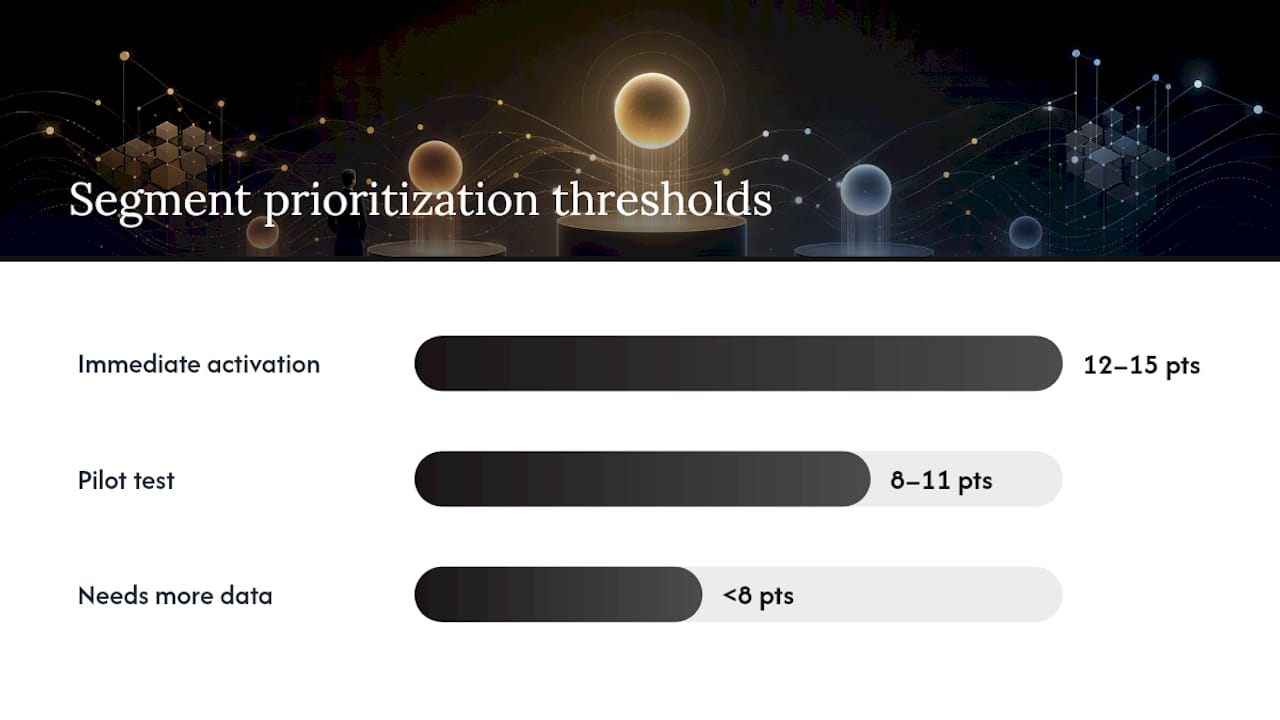
Score each candidate segment on these five dimensions (1–3 scale, 3 = strongest):
| Dimension | Scoring Guidance |
|---|---|
| Identifiable | Can you describe and measure it with existing data? |
| Substantial | Does the segment revenue potential justify dedicated spend? |
| Reachable | Do you have channels to reach it efficiently? |
| Responsive | Will it react differently to a tailored offer? |
| Actionable/Stable | Can your team execute, and will the segment hold its shape? |
Segments scoring 12 or above are strong candidates for immediate activation. Segments scoring 8–11 may be worth a pilot. Below 8, the segment likely needs more data or a different framing before it earns budget.
The prioritization process in four steps:
- Validate the data — confirm segment attributes are measurable in your CRM and ad platforms before building campaigns around them
- Run a pilot — test the top-scoring segment with a small budget and a holdout group before full activation
- Check resource fit — confirm your team has the creative, channel access, and analytics capacity to execute properly
- Set a go/no-go threshold — define the minimum conversion lift or CAC improvement that justifies scaling
Matomo’s segmentation examples show how practitioners operationalize exactly this kind of testing to validate lift before scaling spend.
Pro Tip: Guard against over-segmentation. A segment needs to be large enough to cover the cost of the tailored campaign and still generate a return. If a segment cannot justify its own creative and media budget, merge it with the closest adjacent group or deprioritize it until you have more volume.
What metrics actually prove that segmentation is working?
Track both acquisition and retention metrics at the segment level. Conversion rate, CAC, CLTV, retention rate, and incremental revenue per segment are the five numbers that tell the full story.
Core metrics and how to compute them:
- Conversion rate by segment — conversions divided by total segment touches; compare against your pre-segmentation baseline or a holdout group
- CAC by segment and channel — total spend on a segment divided by new customers acquired; lower CAC in targeted segments vs. broad campaigns validates the efficiency gain
- CLTV by cohort — average revenue per customer over their lifetime, tracked by segment entry cohort to show whether tailored onboarding improves long-run value
- Retention rate — percentage of segment customers active at 90, 180, and 365 days; segment-specific lifecycle messaging should move this number
- Incremental revenue per segment — revenue from the treated group minus revenue from the holdout, net of campaign cost
Run tests for a minimum of two full purchase cycles before drawing conclusions. Small samples produce noisy results; commit to the minimum viable test window before acting on the data.
When presenting to a CFO or board, lead with incremental margin and payback period on marketing spend. Conversion rate lifts are interesting to marketers; margin and payback are what finance needs to approve the next budget cycle.
OpenStax’s marketing principles text provides the broader context: in an environment where a single person encounters up to 10,000 ad messages daily, the margin between a targeted campaign and a generic one is not a rounding error — it is the difference between a campaign that pays back and one that does not.
What are the biggest risks of segmentation, and how do you avoid them?
Segmentation fails when it is not actionable, too granular to execute against, or left to go stale. Those three failure modes account for the majority of segmentation projects that never produce measurable results.
Common pitfalls and their fixes:
- Over-segmentation — too many small segments fragment your budget and creative capacity. Fix: set a minimum viable segment size tied to your channel economics before you build the campaign.
- Outdated segments — customer behavior shifts; a segment defined two years ago may no longer reflect reality. Fix: schedule a quarterly segment audit using the 5Qs scoring model.
- Poor data quality — segments built on incomplete or inconsistent CRM data produce misdirected campaigns. Fix: run a data hygiene pass before segment definition, not after.
- Lack of governance — without a documented owner and review cadence, segments drift and multiply. Fix: assign a segment owner and a review date to every active segment.
- Measurement mistakes — comparing segment performance without a holdout group conflates market trends with campaign effects. Fix: always run a control group, even a small one.
The Wharton audit framework exists precisely because segments need periodic review to stay aligned with evolving customer needs. Build that review into your operating calendar, not just your launch plan.
One additional risk worth naming: data privacy. Behavioral and psychographic segmentation relies on customer data, and how you collect, store, and use that data must comply with applicable privacy regulations. Integrate compliance checks into your segment governance process from the start.
Pro Tip: Treat your segment library the way you treat your product roadmap — with a backlog, an owner, and a regular review. Segments that are not actively maintained are a liability, not an asset.
Applying segmentation to local real estate prospecting
Prioritizing one high-propensity segment in a local real estate market can materially improve lead-to-client conversion. Here is a practical step-by-step example that illustrates how the strategy plays out in the field.
Step 1: Identify the segment. Pull your CRM data and look for a cluster of leads that share a behavioral pattern — say, homeowners in a specific zip code who have engaged with your content more than three times in the past 90 days but have not yet requested a consultation.
Step 2: Score and prioritize. Apply the 5Qs. This group is identifiable (CRM-tagged), substantial (enough volume to justify a dedicated campaign), reachable (email and retargeting), responsive (demonstrated engagement), and actionable (your team has the capacity to run a tailored sequence).
Step 3: Design tailored outreach. Build a three-touch email sequence that speaks directly to the segment’s likely motivation — in this case, homeowners who are curious but not yet ready. Lead with a local market report, follow with a comparable sales analysis for their street, and close with a low-friction consultation offer. Plo’s email workflow guide for realtors covers exactly this kind of sequence in detail.
Step 4: Activate via CRM and ads. Sync the segment to your ad platform and run a retargeting campaign alongside the email sequence. Keep the creative consistent across both channels. For international buyer segments, attracting international property clients offers a useful parallel framework for segmenting by buyer origin and motivation.
After 30 days, compare consultation request rates between the treated group and the holdout. That delta is your segment lift.
Key inputs Plo’s platform supports in this workflow:
- Lead scoring and CRM tagging to define and maintain the segment
- Automated email and ad workflows triggered by behavioral signals
- Local ad activation with AI-generated creative tailored to the segment
- Reporting dashboards that surface conversion lift at the segment level
Pro Tip: Set up a daily CRM-to-ad-platform sync. Manual exports create data lag that lets your segment go stale between campaign refreshes — and in a fast-moving local market, a week-old audience list is a meaningful accuracy problem.
The part most teams skip — and why it costs them
Most segmentation projects I have watched fail share one trait: the team nailed the strategy and then handed it to a campaign manager with no governance structure and no measurement plan. The segments were real. The insights were solid. But without a holdout group, nobody could prove the lift. Without a quarterly review, the segments were 18 months stale by the time anyone noticed.
The fix is not more sophisticated modeling. It is operational discipline. Pick one segment this week — your highest-scoring group by the 5Qs — and run a two-week holdout test. You do not need a perfect data infrastructure to start. You need a defined group, a tailored message, a control group, and a conversion metric. That is it. The results will tell you more than any planning document.
Segmentation’s real advantage is not the insight. It is what you do with it consistently, over time, with a process that keeps it honest.
Sources
- 5.1 Market Segmentation and Consumer Markets – Principles of Marketing | OpenStax
- Market Segmentation (Wharton faculty paper)
- Market segment – Investopedia
- Market segmentation: Strategy, types, and benefits for CMOs and CIOs
- Market Segmentation: Types, Process, and Benefits | Coursera
- 7 Benefits Segmentation Examples + How to Get Started – Matomo