
Overview: A buyer persona is a research-based, composite profile of your ideal customer — built from real interviews, CRM data, and behavioral signals — that gives your marketing and sales teams a shared, human picture of who they’re actually trying to reach. According to the Digital Marketing Institute, personas help teams personalize messaging, prioritize product decisions, and focus acquisition spend on the buyers most likely to convert. They’re used by marketing managers to sharpen campaign targeting, by sales teams to tailor their pitch, and by product leaders to sequence features. Think of “Luxury Listing Lisa” — a 44-year-old independent real estate broker in South Florida who closes $8M+ annually, relies on referrals, and loses sleep over inconsistent lead flow. That one-liner already changes how you write an email subject line.
Key Takeaways
Buyer personas built from real interviews and CRM data consistently outperform assumption-based profiles because they capture the decision triggers, fears, and exact language that drive buyer behavior.
| Point | Details |
|---|---|
| Start with real interviews | Conduct at least 5 interviews per persona segment before publishing any profile. |
| Include a verbatim quote | Every persona needs one direct buyer quote to make creative briefs and sales scripts specific. |
| Map psychology, not just demographics | Capture fears, decision criteria, and motivations — these drive messaging more than age or income. |
| Wire personas into your CRM | Store persona-matched fields and use them for lead scoring and segmentation from day one. |
| Update on a regular cadence | Run quarterly signal reviews and full re-interviews annually to keep profiles accurate. |
Table of Contents
- Why buyer personas matter for your marketing and sales results
- What should a buyer persona actually include?
- How to build a buyer persona from real research
- Two ready-to-use persona examples and a template
- How to apply personas across marketing and sales channels
- Common persona mistakes and how to fix them
- How and when to update your personas
- Moving beyond demographics: the psychological insights that drive decisions
- The persona insight that changed how I think about marketing
- Ready to put your personas to work?
- Sources
Why buyer personas matter for your marketing and sales results
Most marketing teams waste budget talking to the wrong people in the wrong way. Personas fix that by anchoring every campaign decision to a real human profile rather than a spreadsheet segment.
The concrete benefits stack up fast:
- Sharper targeting: Persona-aligned ad audiences reduce wasted impressions by focusing spend on buyers who match proven behavioral and psychographic signals.
- Lower customer acquisition cost: When your message speaks directly to a buyer’s stated priorities, conversion rates improve and you spend less to close the same revenue.
- Stronger sales-marketing alignment: A shared persona gives both teams the same vocabulary for describing the ideal buyer, which cuts the “these leads aren’t qualified” friction.
- Better product decisions: Knowing that your persona’s top frustration is slow onboarding, not pricing, tells your product team exactly where to invest next.
Forbes notes that evolved personas capture struggles, motivations, beliefs, and aspirations — the elements that make messaging resonate at a deeper level than demographics alone ever could.
Consider a yacht brokerage that had been running broad digital ads targeting “high-net-worth individuals aged 35–65.” After building two research-led personas from client interviews, they discovered their best buyers weren’t motivated by status — they were motivated by family legacy and the desire to create shared experiences. Shifting ad copy from “own the finest vessel” to “create memories that last generations” produced a measurable lift in qualified inquiry volume without increasing ad spend.
What should a buyer persona actually include?
A persona is only as useful as the decisions it drives. Generic demographic snapshots collect dust; decision-driving profiles get pulled into every creative brief and sales call. TechTarget defines a buyer persona as a composite representation of a customer type that digests demographic and behavioral signals into an actionable profile guiding marketing, sales, and product choices.
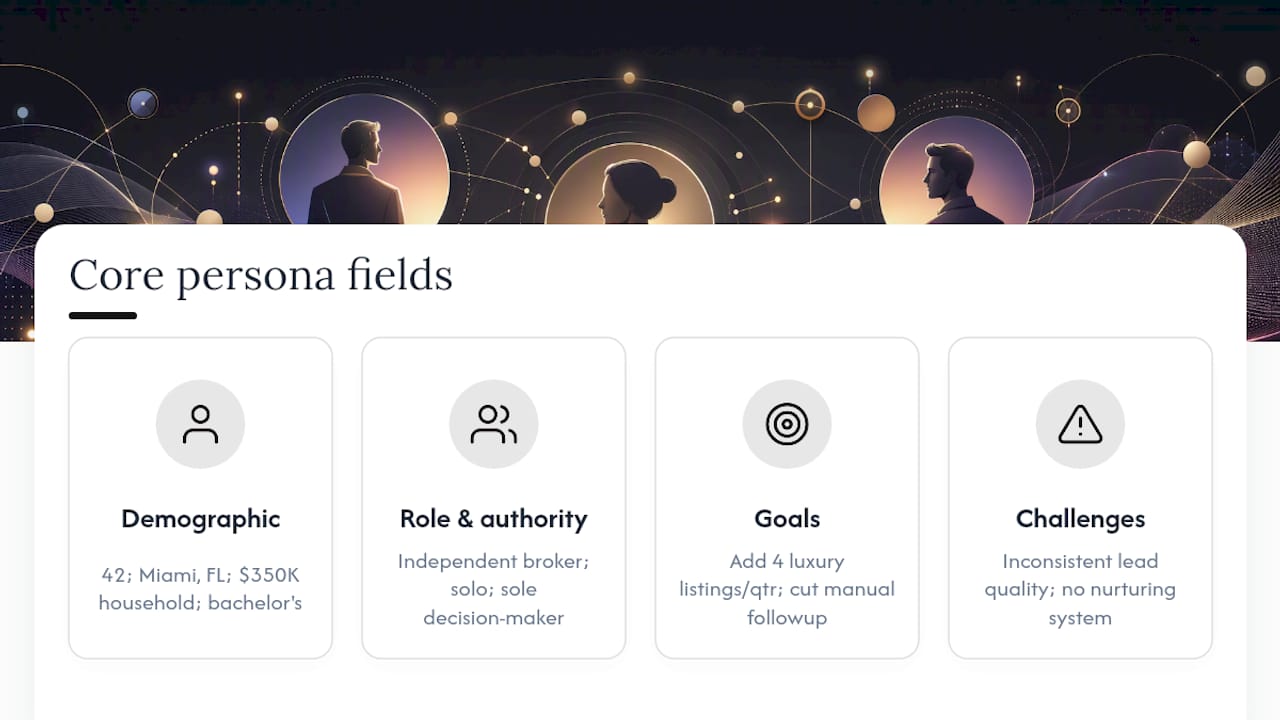
Here are the fields that belong in every persona document, each with an example value:
Demographic snapshot: Age, location, household income, education. Example: 42, Miami, FL, $350K household income, bachelor’s degree in business.
Professional role and decision authority: Title, company size, buying power. Example: Independent broker, solo practice, sole decision-maker on all tech and marketing spend.
Goals and priorities: What they’re trying to achieve in the next 12 months. Example: Add 4 luxury listings per quarter, reduce time spent on manual follow-up.
Key challenges: The friction points that slow them down. Example: Inconsistent lead quality, no system for nurturing cold prospects.
Buying triggers: What prompts them to start evaluating a solution. Example: Just lost a listing to a competitor who had a stronger digital presence.
Research sources: Where they go to learn and compare options. Example: LinkedIn, industry podcasts, peer referrals from broker associations.
Objections: What makes them hesitate or stall. Example: “I’ve tried CRMs before and they’re too complicated to maintain.”
Preferred channels: How they want to be reached. Example: Email for detailed content, text for quick follow-ups, Instagram for brand awareness.
Verbatim customer quote: One direct line from an actual interview. This is the field most teams skip, and it’s the one that matters most in a creative brief.
That quote, pulled from a real broker interview, tells a copywriter more than a 20-row demographic table. SurveyMonkey recommends including verbatim customer quotes in every persona because real language is what makes profiles strategic rather than decorative. Adobe for Business reinforces this with template-style guidance showing how these fields combine into a profile teams can actually act on.
How to build a buyer persona from real research
The most common persona failure isn’t a bad template — it’s skipping the research entirely and filling the fields with internal assumptions. HubSpot’s buyer persona research guide recommends combining interviews with recent buyers, CRM interaction data, and surveys, then updating personas as market conditions shift. Here’s a repeatable six-step workflow:
-
Align on objectives and scope. Before recruiting a single interviewee, agree with your stakeholders on which persona you’re building (new buyer, repeat buyer, churned customer), what decisions it will inform, and how you’ll distribute it. A persona built for a sales enablement deck needs different depth than one built for ad targeting.
-
Recruit interviewees strategically. Aim for 5–8 interviews per persona segment. Pull recent buyers from your CRM, ask your customer success team for names, and check NPS responses for engaged respondents willing to talk. For B2B personas, LinkedIn Sales Navigator lets you filter by title, company size, and industry to find prospects who match your target profile and are open to a 20-minute call.
-
Mine quantitative signals first. Before the interviews, pull CRM interaction data (email open rates by segment, deal stage drop-off points), website analytics events (pages visited before conversion, content downloaded), support ticket themes, and paid campaign performance by audience. These signals tell you where to probe in the qualitative phase.
-
Conduct qualitative interviews. Keep interviews conversational, 20–30 minutes. Sample questions:
- “Walk me through the last time you decided to invest in a new tool or service for your business. What triggered that search?” (buying trigger)
- “What would have to be true for you to feel completely confident moving forward?” (decision criteria)
- “What almost stopped you from buying?” (objection mapping)
- “What does success look like six months from now?” (JTBD-style goal framing)
-
Synthesize patterns across interviews. Look for phrases that recur across three or more conversations — those are your persona’s real language. Convert recurring phrases into 1–2 testable hypotheses. For example: “Message X (‘stop losing leads you already have’) will reduce the objection that the product is too complex.” Add these hypotheses to a testing backlog tied to the persona.
-
Build and publish the deliverable. Format the persona as a one-page summary with a fictional name, a stock photo, and all core fields filled. Shopify advises presenting personas with a quick summary, name, and photo so teams can recall and reference them easily — but every field must be grounded in real data, not aspirational guesswork.
Pro Tip: For fast interview recruiting, add a single open-ended question to your post-purchase email sequence: “Would you be willing to share 20 minutes with us to help us understand what made you decide to buy?” Buyers who respond within 48 hours are your most engaged advocates — and the most honest interviewees you’ll find.
CRM interaction data and analytics events are particularly powerful for identifying behavioral patterns before you ever pick up the phone.
Two ready-to-use persona examples and a template
B2B persona: “Broker Ben”
- Role: Independent luxury real estate broker, 12 years in market
- Location: Scottsdale, AZ
- Goals: Close 6 luxury listings per quarter, build a recognizable personal brand
- Challenges: Spends 3+ hours per day on manual follow-up; no consistent lead nurture system
- Buying trigger: Lost two listings in one quarter to a competitor with a stronger online presence
- Research sources: Broker association events, LinkedIn, referrals from past clients
- Objection: “I don’t have time to learn a new platform”
- Preferred channel: Email for detailed content; text for quick touchpoints
- Quote: “I know I need to be more consistent, but every system I’ve tried just adds more work.”
B2C persona: “First-Time Buyer Fiona”
- Profile: a marketing manager in her early thirties from a dual income household
- Location: Austin, TX
- Goals: Buy a home in a good school district within 6 months
- Challenges: Overwhelmed by conflicting online information; unsure how to evaluate neighborhoods
- Buying trigger: Lease renewal coming up; tired of renting
- Research sources: Zillow, Instagram, friends who recently bought
- Objection: “What if I buy and the market drops?”
- Preferred channel: Instagram for discovery; email for detailed guidance
- Quote: “I just want someone to tell me what I actually need to know, not try to sell me something.”
For practical buyer guidance that complements persona research, OwnInAZ’s buyer tips offer a useful real-world perspective on what first-time buyers actually worry about.
One-page persona template (copy and populate)
- Persona name (fictional, memorable)
- Stock photo (choose one that matches the demographic)
- One-sentence narrative summary
- Demographic snapshot (age, location, income, education)
- Role and decision authority
- Top 2 goals
- Top 2 challenges
- Primary buying trigger
- Research sources (3 max)
- Top objection
- Preferred communication channel
- One verbatim quote
Export this as a PDF or Google Slides one-pager. Keep it to a single page — if it runs longer, it won’t get used. Share it in your team’s shared drive with a clear file name (“Persona_BrokerBen_2026”) and pin it in your project management tool so it surfaces during campaign planning.
How to apply personas across marketing and sales channels
A persona sitting in a shared drive folder is just a document. The value comes from operationalizing it — wiring persona insights into the channels where your team makes daily decisions.
Content planning: Map each persona’s top challenge to a content format and topic. Broker Ben’s challenge (inconsistent follow-up) maps to a practical email sequence guide. Fiona’s challenge (information overload) maps to a neighborhood comparison checklist.
Ad audience segmentation: Use persona behavioral signals (job title, content consumed, platform behavior) to build lookalike and interest-based audiences. Persona-aligned creative outperforms generic creative because the copy speaks to a specific trigger, not a demographic bracket.
Email flows: Segment your list by persona and write subject lines that reference the persona’s stated pain. “Still losing leads to manual follow-up?” converts better for Broker Ben than any generic subject line.
Sales enablement: Give your sales team the persona’s top objection and a proven response. When a rep knows that Broker Ben’s hesitation is “too complicated to learn,” they lead with a 5-minute onboarding demo rather than a feature list.
CRM lead scoring: Store persona-matched fields (role, company size, trigger event) in your CRM and assign scoring weights. Leads that match your primary persona’s profile score higher and route to faster follow-up. Segmenting leads by persona attributes in your CRM is one of the highest-leverage moves you can make after building your first profile.
| Persona | Key message | Primary CTA |
|---|---|---|
| Independent luxury broker | “Stop losing listings to agents with stronger digital presence” | Book a strategy call |
| First-time residential buyer | “Get clear on what you actually need before you start touring” | Download the neighborhood checklist |
| Sales team leader | “Give your reps a system, not just a script” | Start a free trial |
Common persona mistakes and how to fix them
| Mistake | Why it fails | Fix |
|---|---|---|
| Relying on demographics only | Age and income don’t explain why someone buys or stalls | Add decision criteria, fears, and buying triggers from real interviews |
| Skipping interviews entirely | Internal assumptions produce wishful personas, not accurate ones | Conduct at least 5 interviews per persona segment before publishing |
| Building a static document | Markets shift; an outdated persona may be wrong over time | Schedule quarterly signal reviews and annual full re-interviews |
| Overfitting to the ideal customer | Personas become aspirational rather than descriptive | Base every field on observed behavior, not the customer you wish you had |
BuyerPersona.com argues that personas must move beyond demographic stereotypes to reveal the buyer’s decision journey, including the fears and obstacles that actually prevent a purchase. That’s the gap most teams never close.
Quick validation checklist: Before you publish a persona, confirm it passes these four tests:
- Does it include at least one verbatim quote from a real interview?
- Does every field reflect observed behavior, not internal assumption?
- Can a new team member read it and immediately know how to write an email subject line for this buyer?
- Does it include at least one objection and a suggested response?
If any answer is no, the persona isn’t ready to drive decisions.
How and when to update your personas
Personas go stale faster than most teams expect. A market shift, a new competitor, or a product pivot can make last year’s profile actively misleading.
- Quarterly signal review: Pull fresh CRM interaction data, review support ticket themes, and scan NPS comments for language shifts. If new phrases are appearing consistently, flag them for the next full update.
- Annual full re-interview: Run 3–5 new interviews per persona every 12 months. Markets change, buyer priorities shift, and the triggers that drove decisions two years ago may no longer apply.
- Trigger-based updates: Don’t wait for the calendar. A major product change, a campaign that underperforms against expectations, or a sudden shift in lead quality are all signals to revisit the persona immediately.
For low-cost revalidation between full cycles, run a targeted micro-survey (3–5 questions) to your most recent buyers. A/B test two subject lines that each reflect a different persona hypothesis — the winning line tells you which message is resonating right now. Combining qualitative interviews with quantitative signals from your CRM and analytics is the most reliable way to keep personas accurate over time.
Governance matters. Assign one owner per persona (usually a marketing manager or strategist) who is responsible for updates and distribution. Store the current version in a single, shared location and archive old versions with a date stamp. When a persona updates, send a one-paragraph summary to sales, product, and content teams so everyone is working from the same picture.
Moving beyond demographics: the psychological insights that drive decisions
Demographics tell you who your buyer is. Psychology tells you why they buy. The gap between those two things is where most personas fail and where the real competitive advantage lives.
BuyerPersona.com’s framework emphasizes mapping the buyer’s decision journey — the specific fears, evaluation criteria, and obstacles that shape every purchase decision. Forbes reinforces this by arguing that evolved personas capture motivations, beliefs, and aspirations to inform deeper messaging strategies.
In practice, this means asking interview questions that surface psychology, not just behavior:
- “When you imagine this going wrong, what does that look like?” (surfaces fears)
- “What would you tell a colleague who was on the fence about this decision?” (reveals decision criteria in the buyer’s own language)
- “What were you hoping this would fix that nothing else had?” (JTBD-style motivation probe)
Once you have those answers, map recurring phrases to testable hypotheses. If three interviewees independently say some version of “I just don’t want to look foolish in front of my clients,” that’s a hypothesis: messaging that emphasizes confidence and credibility will outperform messaging that emphasizes features. Run that as an A/B test in your next email campaign.
Dovetail’s guidance on building buyer personas recommends treating personas as living research projects, with at least one verbatim pain-point quote per profile that marketing teams can pull directly into creative briefs. When a copywriter can read a real buyer’s words rather than a paraphrased summary, the resulting copy sounds like it was written for a person — because it was.
Pro Tip: Keep a “quote bank” alongside each persona: a running list of 5–10 verbatim lines from interviews, tagged by theme (fear, goal, objection, aspiration). When a campaign brief lands on your desk, pull from the quote bank before you write a single headline. The buyer’s own words are almost always more persuasive than anything you’d invent.
Sales teams benefit from this same depth. Understanding the psychological triggers behind an objection is what separates a rep who handles it gracefully from one who just pushes harder. Uncovering those triggers is a skill that compounds over time when it’s built into your persona process from the start.
The persona insight that changed how I think about marketing
Here’s something I’ve seen play out more times than I can count: a team spends two weeks building beautiful persona documents, presents them in a kickoff meeting, and then watches them collect digital dust while campaigns go back to targeting “35–55, homeowners, interested in real estate.” The problem isn’t the personas. It’s that nobody made them impossible to ignore.
The teams that actually use their personas do one thing differently: they put the verbatim quote on the wall. Literally. Or in the header of every campaign brief. Or as the first slide in every creative review. When the buyer’s own words are in the room, it’s much harder to default to generic messaging.
My honest advice: don’t build more than two personas to start. Two well-researched, quote-rich profiles will do more for your marketing than six shallow ones. Get those two right, run one A/B test driven by a quoted insight, and let the results make the case for investing in the next round of research. Personas earn their place by winning tests, not by existing in a folder.
If you want to see how this plays out in a real sales context, the buyer persona guide for real estate walks through exactly how agents and brokers apply this process to client outreach.
Ready to put your personas to work?
Building a persona is step one. The real leverage comes from wiring those insights into your prospecting workflow, CRM, and campaign messaging. Plo gives real estate agents, luxury brokers, and sales teams the tools to do exactly that — from AI-powered ad creation to CRM automation that stores and scores leads against your persona profiles.
Explore prospecting tools built for real estate professionals and see how persona-driven targeting changes your acquisition numbers. Or start with the real estate prospecting guide to map your current workflow against your best personas.
Sources
- How to Do Buyer Persona Research — HubSpot
- How to Create a Buyer Persona — SurveyMonkey
- What Are Buyer Personas? — TechTarget
- Buyer Personas 101: How To Really Know Your Audience — Forbes
- The Beginner’s Guide to Defining Buyer Personas — Digital Marketing Institute
- What is a buyer persona? — Adobe for Business