

Client experience is defined as the cumulative perception a client forms across every interaction with your business, from the first sales conversation through renewal and beyond. It is the industry term most often abbreviated as CXe, and it sits at the center of how professional services firms win, keep, and grow their best relationships. Treatment and outcome weigh equally in client loyalty decisions, with 49% of clients who receive exceptional treatment returning versus 39% who focus on outcome alone. That gap is not a coincidence. It is the business case for making client experience a deliberate system, not a side effect of good work.
What is client experience, and how is it defined?
Client experience (CXe) is relationship-centered and account-level, spanning every stage from sales and onboarding through delivery, billing, and renewal. It is not a single touchpoint or a satisfaction survey. It is the full arc of how a client feels about doing business with you over time.

The definition matters because it sets the scope of what you are responsible for managing. If you think client experience is just about being friendly on calls, you will miss the structural problems that quietly erode trust: slow responses, unclear billing, vague project updates, and handoffs that feel like the client is starting over with a stranger.
A useful way to anchor the definition is this: client experience is everything your client notices, feels, and remembers about working with you. That includes the quality of your work, yes. It also includes how quickly you respond, how clearly you communicate, and whether the client ever feels anxious about what is happening with their account.
How does client experience differ from customer experience and user experience?
These three terms get used interchangeably, and that confusion costs firms real money. Each concept has a distinct scope and a different strategic owner.
CXe focuses on account-level relationships, while customer experience (CX) covers the entire brand journey across all buyer types, and user experience (UX) focuses on how people interact with a specific product or interface. Here is how they compare:
| Concept | Scope | Focus | Typical Owner |
|---|---|---|---|
| Client experience (CXe) | Account-level, ongoing | Relationship quality across service lifecycle | Account manager, client success |
| Customer experience (CX) | Brand-wide, all buyers | Full journey from awareness to advocacy | Marketing, CX team |
| User experience (UX) | Product or interface | Usability, task completion, interface design | Product, design team |
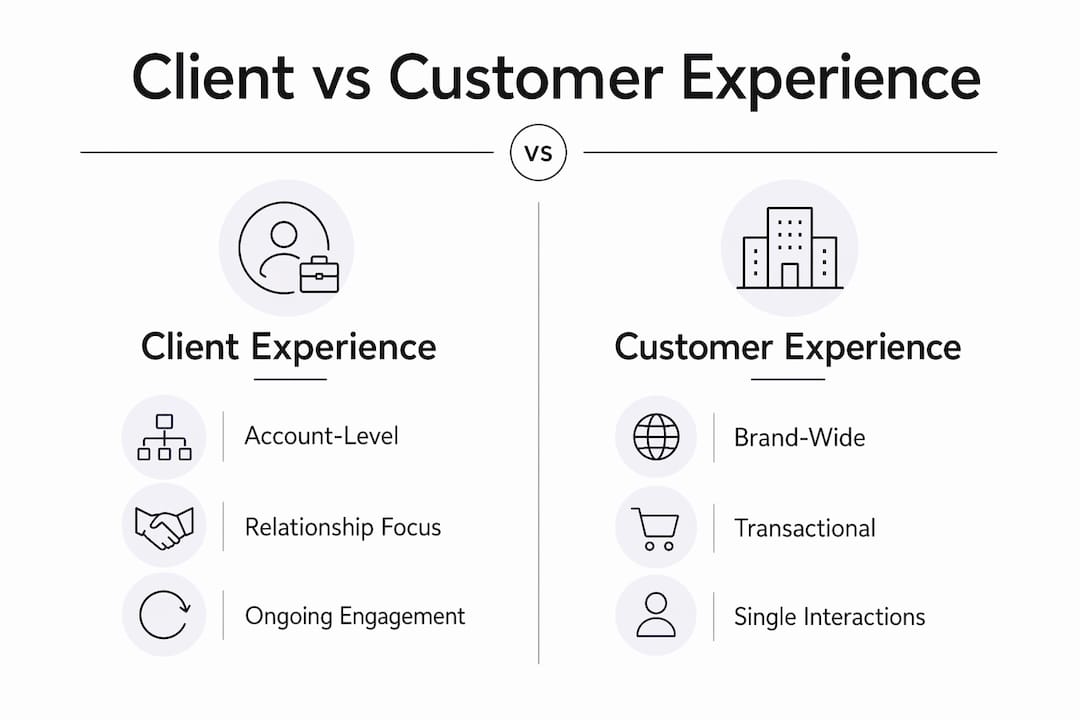
The practical implication is significant. A firm can have a beautiful website (strong UX), a well-known brand (strong CX), and still lose clients at renewal because the delivery phase felt chaotic and impersonal (weak CXe). Each layer requires its own attention.
For business professionals managing high-value accounts, CXe is the most direct lever. You control the relationship. You set the communication cadence. You decide whether clients feel informed or ignored. Improving CXe does not require a brand overhaul. It requires deliberate process design at the account level.
Why is client experience a critical business differentiator today?
Technical skill is the baseline. Every firm your clients consider claims to be good at what they do. The differentiator is how working with you feels compared to the alternative.
“Firms often suffer from an ‘Outcome Illusion,’ mistaking winning solely for client satisfaction when experience is more controllable and consistent. Experience is the more dependable driver of client feelings than outcomes.”
2026 Legal CX Report®
This insight applies far beyond law firms. Real estate agents, yacht brokers, financial advisors, and consultants all face the same dynamic. Technical brilliance alone no longer differentiates; clients remember the feelings during delivery more than the specific tasks completed.
The business case for prioritizing CXe is concrete:
- Retention: Clients who rate their experience as exceptional are more likely to return and less likely to shop competitors at renewal.
- Referrals: Only 5% of new clients come from advertising, while 47% come from referrals. Referrals are a direct output of strong CXe.
- Margin: Superior experiences correlate with stronger margins and higher cross-sell realization, because clients who trust you buy more from you.
- Pricing power: Firms known for exceptional client experience compete on value, not price.
Internal culture also shapes CXe quality. When your team understands that the client’s perception of competence is built through responsiveness and clarity, not just deliverables, they communicate differently. They send the update before the client asks. They flag a delay before it becomes a surprise. That shift in behavior is what builds trust and lowers perceived risk for the client.
How to improve client experience across the service lifecycle
Improving CXe is not about adding more touchpoints. More calls without structure create friction, not confidence. The goal is deliberate design at each stage of the client lifecycle.
Here is a practical framework organized by service stage:
- Sales: Set expectations explicitly. Tell the client what the onboarding process looks like, who their main contact will be, and when they will hear from you next. Ambiguity at this stage plants seeds of anxiety.
- Onboarding: Use a structured welcome process. A written onboarding checklist shared with the client signals professionalism and reduces the “what happens now?” feeling that erodes early trust. Optimizing client onboarding directly lifts sales outcomes.
- Delivery: Visible, structured progress reports shift the relationship from reactive to proactive. Clients who can see what is happening do not need to chase you for updates. That shift alone changes how competent you appear.
- Billing: Clarity here is non-negotiable. Surprise invoices or confusing line items destroy trust that took months to build. Send billing summaries before the invoice arrives.
- Renewal: Treat renewal as a relationship milestone, not an administrative task. A brief review of what was accomplished and what comes next reinforces the value you delivered and makes the decision to continue feel obvious.
Clients use responsiveness and clarity as proxies for technical expertise. This means your communication style is not just courtesy. It is a signal of competence. Slow replies and vague updates tell clients their account is not a priority, regardless of the quality of your actual work.
Pro Tip: Measure client satisfaction at each lifecycle stage, not just at the end of an engagement. A Net Promoter Score (NPS) survey sent after onboarding gives you early warning signals before a client reaches renewal with unresolved frustrations.
The biggest pitfall to avoid is treating CXe as a collection of individual gestures. A thank-you note after closing is nice. A system that delivers consistent communication, clear billing, and proactive updates across every account is what actually drives client retention and growth.
What is the measurable impact of client experience on growth?
The numbers make the case clearly. Experience is the more dependable driver of client loyalty than outcomes, and the downstream effects show up in revenue, referrals, and reduced acquisition costs.
| CXe Outcome | Impact |
|---|---|
| Exceptional treatment | 49% client return rate |
| Outcome-only focus | 39% client return rate |
| Referral-driven new clients | 47% of new business |
| Advertising-driven new clients | 5% of new business |
| Strong CXe correlation | Higher margins, cross-sell realization, retention |
The referral statistic is the one most business professionals underestimate. If 47% of your new clients come from referrals, then your existing client relationships are your primary growth channel. Every dollar you invest in improving CXe is a dollar invested in your most productive acquisition engine.
Consistent communication and structured processes correlate strongly with profitable client relationships. Firms that build CXe infrastructure into all service phases transform their client lifecycle into a retention and growth engine, rather than a series of disconnected transactions.
The implication for decision-makers is direct: CXe is not a soft metric. It is a revenue driver. Firms that treat it as infrastructure, not afterthought, grow faster and spend less acquiring new clients.
Key Takeaways
Client experience is the most controllable driver of loyalty, referrals, and margin growth in professional services, and firms that engineer it as a system outperform those that rely on outcomes alone.
| Point | Details |
|---|---|
| CXe definition | Client experience is the cumulative perception formed across every stage of the service relationship. |
| CXe vs. CX vs. UX | CXe is account-level; CX is brand-wide; UX is product-focused. Each requires separate strategy. |
| Referrals over advertising | 47% of new clients come from referrals, making CXe your highest-return acquisition channel. |
| Experience beats outcome | Clients who rate treatment as exceptional return at 49%, versus 39% focused on outcome alone. |
| Engineer, don’t improvise | Build CXe into sales, onboarding, delivery, billing, and renewal as structured infrastructure. |
The uncomfortable truth about client experience most firms ignore
I have watched talented professionals lose clients they should have kept for years. The work was excellent. The results were real. But the client left anyway, and when you asked why, the answer was always some version of “we just didn’t feel like a priority.”
That is the Outcome Illusion in action. Firms pour energy into the deliverable and assume the relationship will take care of itself. It does not. Clients are not evaluating your technical skill in a vacuum. They are evaluating how it feels to be your client, and that feeling is shaped by dozens of small signals: how fast you reply, how clearly you explain a delay, whether your invoice matches what they expected.
What I have found is that the firms growing fastest are not necessarily the most technically gifted. They are the ones who treat client experience as visible infrastructure. They have a documented onboarding process. They send proactive updates. They review the relationship at renewal instead of just sending a contract. These are not complicated moves. They are deliberate ones.
The shift in mindset is from “we do great work” to “we are great to work with.” Both matter. But only one of them is fully within your control at every stage of the engagement. Build the system. Your clients will notice, and they will tell other people.
— Jason
How Plo helps you build a client experience that wins
Real estate agents and luxury brokers who want to grow know that winning the listing is only the beginning. The experience you deliver from first contact through closing is what generates the referrals that fill your pipeline next quarter.
Plo gives you the tools to make that experience consistent and professional at every stage. From prospecting tools that help you find and qualify the right clients, to CRM workflows that keep communication structured and visible, Plo amplifies the work you are already doing. You can also sharpen how you present yourself with a sales pitch improvement guide built for 2026 market conditions. The result is a client relationship that feels effortless to them and runs like a system for you.
FAQ
What is the definition of client experience?
Client experience (CXe) is the overall perception a client forms from every interaction with a business across the full service lifecycle, including sales, onboarding, delivery, billing, and renewal.
How does client experience differ from customer experience?
Client experience is account-level and relationship-focused, while customer experience covers the entire brand journey across all buyer types. CXe is the more specific and relationship-intensive of the two.
Why does client experience matter more than the outcome?
Research from the 2026 Legal CX Report® shows that clients who rate their treatment as exceptional return at a 49% rate, compared to 39% for those focused on outcome alone. How clients feel during the process is a more reliable loyalty driver than results.
What are the key factors influencing client experience?
Responsiveness, communication clarity, billing transparency, and proactive updates are the primary factors. Clients use these signals as proxies for technical competence, meaning your process quality shapes your perceived expertise.
How do you measure client experience effectively?
Net Promoter Score (NPS) surveys sent at key lifecycle stages, such as after onboarding and at mid-engagement, give you early data on client sentiment before issues reach renewal. Tracking response times and communication frequency adds operational depth to the measurement.