

Market segmentation is defined as the process of dividing a broad market into smaller subgroups of consumers who share common characteristics, enabling businesses to target each group with precision rather than broadcasting generic messages to everyone. The industry term is “market segmentation,” and understanding it is the difference between campaigns that convert and campaigns that drain budget. Treating all customers the same is the single biggest marketing mistake a business can make. The four foundational segmentation types are demographic, geographic, psychographic, and behavioral, and each one answers a different question about your customer. Platforms like Kadence International have built entire research methodologies around these categories because the data consistently shows that relevance beats volume every time.
What are the main types of market segmentation?
Market segmentation analysis starts by choosing the right lens through which to view your audience. Each segmentation type reveals something different, and knowing which one to lead with shapes every downstream decision you make.
Demographic segmentation answers the question: who is the customer? Age, income, gender, education level, and family status fall here. A luxury real estate firm targeting buyers aged 45 to 65 with household incomes above $500,000 is using demographic segmentation. It is the most widely used type because the data is relatively easy to collect and the segments are clearly defined.

Geographic segmentation answers: where does the customer live or operate? This goes beyond country or city. Neighborhood-level targeting, climate zones, and urban versus suburban distinctions all qualify. A real estate agent farming a specific ZIP code is executing geographic segmentation with precision.
Psychographic segmentation answers: what does the customer value? Lifestyle, personality, social status, and attitudes drive this category. Two buyers with identical demographics can have completely different motivations. One wants a home as a status symbol; another wants the same property for its proximity to nature trails. Psychographic data separates them.
Behavioral segmentation answers: how does the customer act? Purchase history, brand loyalty, usage frequency, and buying-stage data all belong here. This is where demographic and behavioral data diverge most sharply. Demographics tell you who someone is. Behavior tells you what they actually do.
In B2B settings, a fifth type applies: firmographic segmentation, which categorizes businesses by industry, company size, revenue, and organizational structure. A SaaS company selling to enterprise clients versus small businesses uses firmographic data to separate those two audiences entirely.
| Segmentation type | Core question | Best use case |
|---|---|---|
| Demographic | Who is the customer? | Consumer goods, real estate, financial services |
| Geographic | Where is the customer? | Local services, retail, regional campaigns |
| Psychographic | What does the customer value? | Luxury brands, lifestyle products, premium services |
| Behavioral | How does the customer act? | E-commerce, SaaS, subscription businesses |
| Firmographic | What kind of business is it? | B2B sales, enterprise software, professional services |
What are the measurable benefits of market segmentation?
The financial case for segmentation is not theoretical. Segmented email campaigns generate up to 760% more revenue than non-segmented ones. That figure reflects what happens when relevance replaces volume: open rates climb 14.31% higher and click-through rates jump 100.95% compared to generic sends. The implication is direct. Every unsegmented campaign you run is leaving a measurable amount of revenue on the table.
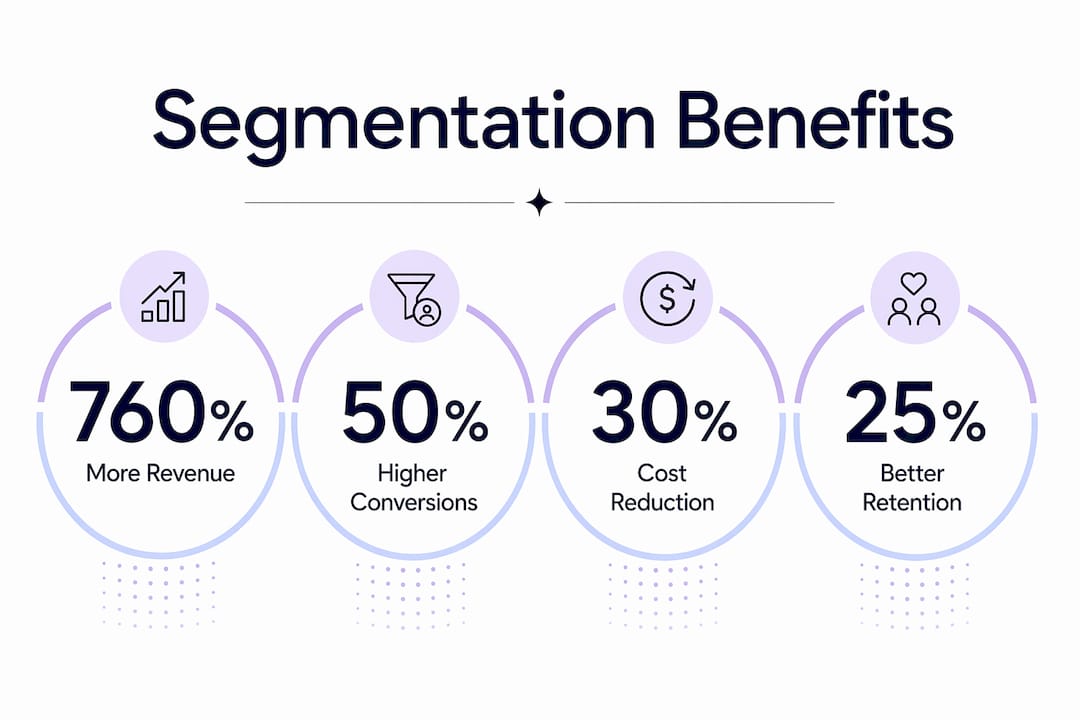
Conversion rates tell the same story. Segmentation increases conversions by up to 50%, turning campaigns from budget burdens into growth engines. For a marketing team running paid acquisition, that kind of lift does not require more spend. It requires smarter targeting.
Cost efficiency is the benefit that often surprises people. Effective segmentation reduces marketing costs by up to 30% because you stop paying to reach people who were never going to buy. Every dollar spent on an irrelevant audience is a dollar that could have gone toward a segment with real purchase intent.
Customer retention compounds the gains. Segmentation-driven personalization improves customer lifetime value by up to 25%. Customers who feel understood stay longer, spend more, and refer others. That is not a soft benefit. It is a measurable multiplier on every acquisition dollar you spend.
Pro Tip: Track segmented campaign performance separately in your analytics platform. Comparing revenue per segment over time reveals which groups are growing, which are plateauing, and where to reallocate budget before the next campaign cycle.
How to implement market segmentation effectively
Market segmentation follows a structured process, and skipping steps is where most implementations fail. Here is the sequence that produces usable, durable segments.
-
Define your objectives. Before touching any data, decide what you need segmentation to accomplish. Are you trying to improve email conversion rates? Reduce churn? Identify a new product opportunity? The objective shapes which segmentation variables matter most.
-
Gather your data. Pull from CRM records, website analytics, purchase history, survey responses, and third-party demographic data. Tools like Google Analytics 4, HubSpot, and Salesforce each surface different data layers. Use more than one source.
-
Identify your segmentation variables. Choose the variables most relevant to your objective. A campaign targeting first-time homebuyers calls for demographic and behavioral variables. A campaign targeting repeat luxury buyers calls for psychographic and behavioral ones.
-
Build your segments. Group customers based on shared variable combinations. Each segment should be measurably distinct from the others. If two segments behave identically in response to your campaigns, they are not actually separate segments.
-
Develop tailored strategies. Create messaging, offers, and channels specific to each segment. A segment of high-income buyers aged 50 and above responds differently to Instagram ads than a segment of first-time buyers aged 28 to 35. Treat them accordingly.
-
Validate and monitor. Test your segments against real campaign data. Segment size, profitability, reachability, and strategic fit are the four criteria that determine whether a segment is worth pursuing. A segment that is large but unreachable through your current channels is not a priority.
The most common mistake at this stage is creating too many segments. Twelve micro-segments with overlapping characteristics produce confusion, not precision. Start with three to five well-defined groups and refine from there.
Pro Tip: Revisit your segments every six months. Customer behavior shifts, especially in markets like real estate where economic conditions change buying timelines. Segments that were accurate in Q1 may be outdated by Q3.
How does combining segmentation models improve targeting?
Single-model segmentation gives you a partial picture. Demographic data alone tells you who the customer is but not why they buy or when they are ready to act. Layering behavioral data on top of demographic profiles changes the targeting entirely.
Consider a real estate campaign targeting buyers in Miami. Geographic segmentation narrows the audience to a specific metro area. Demographic segmentation filters by income and age. Psychographic segmentation identifies buyers motivated by lifestyle and status rather than investment returns. Behavioral segmentation isolates those who have visited property listing pages more than three times in the past 30 days. The result is not a broad audience of “Miami homebuyers.” It is a precise group of high-income, lifestyle-motivated buyers who are actively in the consideration phase right now.
Most effective segmentation analyses combine demographic, psychographic, behavioral, and geographic data for nuanced targeting. The brands that execute this well, including major real estate platforms and luxury consumer brands, build audience profiles that feel almost predictive. That is not magic. It is the output of layered data applied consistently.
| Approach | Data used | Targeting precision | Campaign outcome |
|---|---|---|---|
| Single model (demographic only) | Age, income, gender | Low to moderate | Broad reach, lower conversion |
| Dual model (demographic + behavioral) | Demographics + purchase behavior | Moderate to high | Improved conversion, reduced waste |
| Multi-model (4+ variables) | All segmentation types combined | High | Maximum conversion, lowest cost per acquisition |
The strategic fit criterion matters here. Not every high-value segment is reachable through your current channels or budget. Prioritize segments where your message can actually reach the right person at the right time. A segment that scores well on size and profitability but requires channels you do not operate in is a future opportunity, not a current one.
Pro Tip: Integrate your segmentation data directly into your CRM and marketing automation platform. When segment tags live inside HubSpot, Salesforce, or a real estate-specific CRM, every touchpoint, from email to follow-up call, reflects the right message for that buyer’s profile automatically.
Key takeaways
Market segmentation works because it replaces generic outreach with precise, data-backed targeting that increases revenue, reduces cost, and builds lasting customer relationships.
| Point | Details |
|---|---|
| Segmentation types serve different purposes | Demographic, geographic, psychographic, behavioral, and firmographic each answer a distinct question about your customer. |
| Revenue impact is measurable | Segmented campaigns generate up to 760% more revenue and improve conversion rates by up to 50%. |
| Cost savings compound over time | Effective segmentation reduces marketing costs by up to 30% by eliminating spend on irrelevant audiences. |
| Layered models outperform single-type approaches | Combining four or more segmentation variables produces the highest targeting precision and lowest cost per acquisition. |
| Segments require ongoing maintenance | Revisit and validate segments every six months to keep them aligned with current customer behavior. |
Why segmentation is no longer optional
I have watched segmentation evolve from a quarterly planning exercise into the backbone of every serious marketing operation. When I started working with marketing teams, segmentation was something you did before a big campaign launch and then filed away. Now, the teams winning market share treat it as a living system, one that feeds their CRM, informs their ad targeting, and shapes their product roadmap simultaneously.
The uncomfortable truth is that most businesses still segment by demographics alone, and then wonder why their campaigns underperform. Segmentation is a fundamental business strategy that affects product development, pricing, and client experience, not just the marketing department. When you only know who your customer is but not why they buy or when they are ready, you are guessing at the most expensive part of the process.
The emerging shift I find genuinely exciting is AI-driven predictive segmentation. Platforms are now building models that identify which segment a new lead belongs to before that person has completed a purchase. For real estate professionals, this means knowing whether an inquiry is from a serious buyer in the consideration phase or a casual browser, before you spend an hour on a follow-up call. That kind of intelligence does not replace human judgment. It sharpens it.
My practical advice: start simpler than you think you need to. Three well-defined segments with clear behavioral triggers will outperform ten loosely defined ones every time. Build the discipline of segmentation into your weekly workflow, not just your campaign planning calendar. The digital marketing trends shaping 2025 and 2026 all point in the same direction. Relevance wins. Volume loses.
— Jason
How Plo helps real estate pros put segmentation to work
Knowing your segments is one thing. Acting on them at scale is where most agents fall short. Plo is built specifically for real estate agents, yacht brokers, and luxury brokers who need to move from insight to outreach without losing momentum.

When you understand which buyers are motivated by lifestyle, which are investment-focused, and which are first-timers, your prospecting changes completely. Plo’s tools help you build those profiles, organize your pipeline by segment, and execute targeted outreach that matches the right message to the right client. Start with winning clients through prospecting and see how segmentation turns cold leads into closed deals. You can also explore how CRM in real estate keeps your segmented pipeline organized and moving.
FAQ
What is market segmentation in simple terms?
Market segmentation is the practice of dividing a broad market into smaller groups of people who share common traits, so you can target each group with messages that actually match their needs and motivations.
What are the four main types of market segmentation?
The four core types are demographic (who the customer is), geographic (where they are), psychographic (what they value), and behavioral (how they act). B2B marketers add a fifth type, firmographic, which categorizes businesses by size, industry, and structure.
How much can segmentation improve campaign performance?
Segmented campaigns achieve up to 760% more revenue and 50% higher conversion rates compared to non-segmented approaches. Marketing costs also drop by up to 30% when spend is focused on relevant audiences.
How many segments should a business start with?
Start with three to five clearly defined segments. Too many segments create overlap and execution complexity. Validate each segment against the four criteria of size, profitability, reachability, and strategic fit before building campaigns around it.
How does segmentation apply to real estate marketing?
Real estate agents use geographic segmentation to farm specific neighborhoods, demographic segmentation to target buyers by income and life stage, and behavioral segmentation to prioritize leads who are actively searching. Combining these layers produces buyer personas that make every outreach more precise and every conversation more relevant.