

Relying on the same tired playbook — waiting on referrals, posting once a week, and hoping the MLS delivers — is a recipe for unpredictable income and missed opportunities. The real estate market in 2026 demands that you take control of your pipeline with precision, creativity, and the right technology. This article gives you a practical, no-fluff framework for generating and converting more high-quality leads. You’ll get proven tactics, tool comparisons, measurement strategies, and a conversion system that actually works at scale.
Table of Contents
- What you need to generate leads in real estate today
- Step-by-step: Innovative ways to attract and capture leads
- Maximize return: Measuring lead quality and cost-effectiveness
- Nurturing and converting leads: From inquiry to client
- Rethinking real estate lead generation: What actually works in 2026
- Take your lead generation further with expert tools
- Frequently asked questions
Key Takeaways
| Point | Details |
|---|---|
| Multi-channel approach | Diversifying lead sources ensures stability and better conversion rates. |
| Track key metrics | Monitor CPL and closing rates to optimize spend and focus on the highest-ROI tactics. |
| Adopt new tools | Use AI, single-property sites, and value-driven content to boost your pipeline. |
| Persistent nurturing wins | Consistent follow-up for 10+ weeks greatly improves your chances of closing leads. |
| Value trumps volume | Delivering unique, actionable value attracts and converts the best clients. |
What you need to generate leads in real estate today
The foundation of modern lead generation starts with a mindset shift. Passive prospecting, where you wait for the phone to ring, no longer cuts it. Today’s top agents operate with a proactive, system-driven approach that blends digital channels, automation, and authentic local engagement.
Before you execute any tactic, make sure you have these essentials in place:
- A CRM with automation to manage contacts, track interactions, and trigger follow-up sequences without manual effort
- Targeted landing pages for specific neighborhoods, buyer or seller personas, and property types
- AI-powered research tools to identify likely movers before they even list or search
- Social media presence on platforms where your local audience is active, especially Facebook, Instagram, and LinkedIn
- Single-property websites that position you as the expert and bypass crowded portals
The old vs. new reality of lead sourcing looks dramatically different when you put it side by side:
| Lead Source | Cost Range | Lead Quality | Control | Scalability |
|---|---|---|---|---|
| MLS / Open Houses | Low | Medium | Low | Low |
| Real estate portals | High ($100–350 CPL) | Medium | Low | Medium |
| Social media (organic) | Low to Medium | High | High | High |
| AI-powered predictive leads | Medium | Very High | High | High |
| Cold calling / direct mail | Medium | Low to Medium | High | Medium |
One of the most important shifts you can make is embracing real estate lead sources that give you control over quality and cost. Social media is especially powerful here. Social media generates seller leads at twice the rate of the MLS, according to the National Association of Realtors. That’s not a minor advantage. That’s a competitive edge you should be building right now.
Pro Tip: Don’t try to dominate every channel at once. Pick two social media platforms where your ideal clients spend time, then systemize your presence before expanding.
The agents winning in 2026 are not necessarily spending more money. They’re spending smarter, tracking every dollar, and using tools that multiply their effort rather than replace their relationships.
Step-by-step: Innovative ways to attract and capture leads
Armed with the right foundation, it’s time to execute. These methods are proven, scalable, and designed to generate leads with clear intent signals rather than cold, anonymous inquiries.

1. Build single-property websites
Instead of driving traffic to a portal where your listing competes with a dozen others, create a standalone website for each listing. These sites capture visitor information directly, giving you warm leads who have already expressed interest in a specific property or neighborhood.
2. Use AI-powered predictive analytics
Modern AI tools analyze behavioral data, financial signals, and life events to predict who is likely to sell within the next 3 to 12 months. This means you can reach out before competitors even know a homeowner is considering a move. Next-gen lead capture tools like AI predictive seller leads and dynamic market reports give you a significant first-mover advantage.
3. Create dynamic market reports as lead magnets
Offer neighborhood-specific market reports that auto-update with fresh data. Prospects enter their contact information to receive the report, and you gain a highly qualified lead who is already thinking about the market. This approach delivers real value while generating opt-ins that indicate serious intent.
4. Run social polls and hand-raiser campaigns
A “hand-raiser” is when a prospect actively signals interest, such as clicking “I’m thinking about selling in the next 6 months.” Run simple polls or quizzes on your social platforms and follow up immediately with anyone who engages. These social media tactics for local leads generate surprisingly strong conversion rates because the prospect has already self-identified.
5. Host educational webinars or video series
A 20-minute “First-time seller masterclass” or a “State of the [City] market” live stream positions you as the authority and collects registrant information. These leads are far warmer than someone who clicked an ad cold.
Here’s how these methods compare when you look at the full economics:
| Tool / Method | Est. Cost Per Lead (CPL) | Typical Conversion Rate | Best For |
|---|---|---|---|
| AI predictive leads | $30–$80 | 5–10% | Seller outreach |
| Social media organic | $5–$25 | 4–8% | Buyer and seller leads |
| Single-property websites | $10–$40 | 6–12% | Buyer leads, listing leads |
| Dynamic market reports | $15–$50 | 5–9% | Seller leads |
| Portal advertising | $100–$350 | 2–4% | Broad buyer leads |
The numbers speak clearly. To attract local real estate clients more efficiently, you need methods that deliver intent-rich leads at a fraction of portal costs. The innovation isn’t in spending more. It’s in building systems that generate better signals.
Pro Tip: Combine a single-property website with a retargeting ad campaign. Anyone who visits the site but doesn’t opt in can be re-engaged through Facebook or Google ads at a very low additional cost.
Maximize return: Measuring lead quality and cost-effectiveness
Launching new tactics without measuring results is like driving without a dashboard. After you start generating leads through innovative channels, tracking the right metrics separates agents who scale from those who spin their wheels.
The three metrics that matter most:
- Cost per lead (CPL): What you spend to acquire a single lead across each channel
- Lead-to-appointment conversion rate: How many leads result in an actual consultation
- Cost per closed deal: The true cost of acquiring a client from each source
Here’s a realistic comparison of major lead sources using real market data:
| Source | Avg. CPL | Conversion Rate | Est. Cost Per Close |
|---|---|---|---|
| Zillow Premier Agent | $100–$350 | 2–4% | $2,400–$5,000 |
| Social media campaigns | $15–$50 | 4–8% | $400–$1,200 |
| AI predictive tools | $30–$80 | 5–10% | $500–$1,500 |
| Referral programs | $20–$60 | 15–25% | $200–$500 |
| Direct mail | $50–$120 | 1–3% | $2,000–$5,000 |
Zillow Premier Agent CPL ranges from $100 to $350 with 2 to 4% conversion rates, often resulting in $2,400 to $5,000 per closed deal. That’s a significant investment with shared, competitive leads. When you compare that to AI or social campaigns, the difference in ROI is impossible to ignore.
Experts consistently recommend that you track CPL vs. conversion, not just acquisition cost, and that you nurture leads across sequences of 10 or more weeks while diversifying sources to reduce dependency on shared portal leads.
Review your top lead strategies for 2026 at least quarterly. Markets shift fast. A channel that works brilliantly in Q1 may need adjustment by Q3. Your data tells you when to double down and when to pivot.
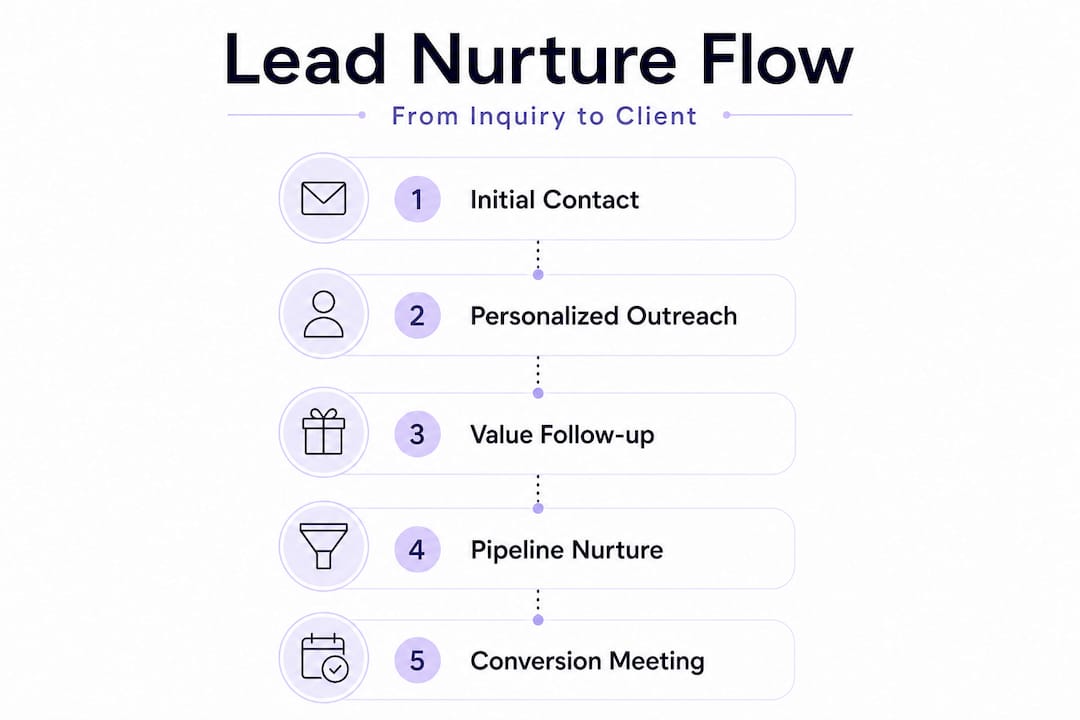
Nurturing and converting leads: From inquiry to client
Measurement alone doesn’t close deals. What converts leads into clients is a consistent, valuable, and timely nurturing process. Most agents give up far too early, which is exactly why agents who persist with structured follow-up win disproportionately.
Follow these steps to build a conversion-focused nurturing system:
- Respond within 5 minutes of a new lead inquiry. Response speed is the single biggest predictor of conversion. Studies show that response rates drop by over 80% after the first hour.
- Personalize the first touchpoint by referencing exactly what the lead inquired about. Generic responses kill trust instantly.
- Deliver immediate value in the first email or message. Send a market report, a neighborhood guide, or a personalized home value estimate.
- Qualify with curiosity, not a script. Ask open-ended questions to understand their timeline, motivation, and situation. Listen more than you talk.
- Set up a 10-week drip sequence with a mix of market updates, relevant listings, success stories, and check-in messages. Make every touchpoint feel useful, not just automated.
- Shift channels at week 4. If email isn’t generating engagement, switch to a phone call or a personalized video message. Pattern interrupts re-engage cold leads.
- Ask for the appointment directly by week 2 or 3. Don’t wait until the lead “feels ready.” Guide them forward with confidence and clarity.
The numbers are clear: Agents who maintain contact for 10 or more weeks see dramatically higher conversion rates than those who give up after one or two touchpoints. Consistency and genuine value delivery are the real conversion tools.
The most common mistakes agents make in nurturing are sending generic, irrelevant content, failing to follow up after a lead goes quiet, and treating every lead the same regardless of their timeline or motivation. Your lead nurturing best practices should be tailored, systematic, and built around delivering real insight rather than just checking a follow-up box.
Pro Tip: Record a 60-second personalized video for every new lead within the first 24 hours. Use their name, reference their inquiry, and add a clear next step. Video messages generate response rates 3 to 5 times higher than text-only emails.
The agents who master nurturing treat their pipeline like a long-term asset, not a short-term transaction list. Every lead you capture today could close 6 months from now. Build your sequences for that reality.
Rethinking real estate lead generation: What actually works in 2026
Here’s an uncomfortable truth most lead generation articles won’t tell you: technology doesn’t generate business. Relationships do. Technology amplifies them.
We see agents spend thousands on AI tools, portal subscriptions, and CRM platforms, then wonder why their pipeline is still dry. The tool is not the strategy. Too many agents are hunting for the silver bullet, the one app or the one platform that will automatically fill their calendar. That doesn’t exist. What exists is a system built on genuine value, timely follow-up, and relentless local presence.
The agents who dominate their markets in 2026 are doing something counterintuitive. They’re using less technology, but using it more deeply. They’ve chosen two or three tools that integrate seamlessly, and they’ve mastered those tools completely rather than subscribing to ten platforms and using none of them well.
There’s also a trap in “set and forget” automation. Automated sequences are powerful, but they’re not a substitute for human engagement. When a prospect responds to an automated email, a real agent needs to be on the other end of that conversation. The agents who confuse automation with relationship-building lose deals to agents who simply show up.
Our perspective, grounded in working with agents across every market type, is that the real edge in generating high-value real estate leads comes from combining proactive outreach with authentic, localized content. Be the agent who publishes real neighborhood insights, hosts genuine community events, and uses AI to prioritize who to call first rather than to replace the call entirely.
Innovation and value delivery are not optional extras in 2026. They are the price of entry. The agents who build sustainable pipelines are those who commit to both, consistently, even when it’s uncomfortable.
Take your lead generation further with expert tools
You now have the strategy. The next step is aligning it with the right technology to execute at scale without burning out or burning budget.
At ex.plo.re, we’ve built our platform to amplify exactly the kind of proactive, value-driven prospecting this article describes. From top real estate prospecting tools that surface high-intent leads before they hit the open market, to a detailed lead generation tools comparison that helps you spend wisely, to AI prospecting tools designed specifically for agents who want predictive precision, we provide the cutting-edge stack that turns strategy into results. Let our talented team and technology amplify the work you’re already doing. Book a quick demo and see how fast your pipeline can grow.
Frequently asked questions
What is the most cost-effective lead source for real estate agents?
Social media is consistently the strongest ROI channel, with social media generating seller leads twice as effectively as the MLS according to NAR, at a fraction of portal costs.
How long should I nurture a real estate lead before giving up?
Successful agents maintain contact for at least 10 weeks, as nurture sequences of 10-plus weeks consistently produce higher conversion rates and stronger client relationships than short follow-up windows.
What’s the average conversion cost from Zillow Premier Agent leads?
Zillow Premier Agent costs typically run $2,400 to $5,000 per closed transaction at a 2 to 4% conversion rate, making it one of the most expensive sources when you measure true cost per close.
How can I quickly improve my real estate lead conversion?
Respond within 5 minutes of inquiry, personalize every touchpoint, and deliver immediate value in your first message. Then track CPL vs. conversion consistently to identify which sources and sequences are actually driving closed deals.